Jerry Seinfeld, the Broader Autism Phenotype and a Major Fail by some Parent Activists

15 Nov

Entertainer Jerry Seinfeld recently stated in an interview that “I think, on a very drawn out scale, I think I’m on the spectrum”.  And from this was spawned a small faux controversy which, if anything, exposes the problems we face as a community due to a lack of understanding and unity from my own fellow autism parents.

If you wonder what I mean by that, parents of kids with the more obvious challenges presented by autism (children like mine, for example) are sometimes wont to get very defensive should autism stories be framed around anything other than the challenges faced by us as parents and by our kids.

It’s not a position I take and, in fact, it is a position that causes our communities a great deal of harm.

Let’s take a look first at what Mr. Seinfeld had to say. He was being interviewed not about autism but about his web series. His autism statements come at about 3:30 in the interview. I can’t seem to get the interview to embed in this webpage so here’s the link:

http://player.theplatform.com/p/2E2eJC/nbcNewsOffsite?guid=nn_bwi_seinfeld_141106

When asked why he believes this way, he states:

You’re never paying attention to the right things.  Basic social engagement is really a struggle.  I’m very literal.  When People talk to me, and they use expressions, sometimes I don’t know what they are saying.

this last statement comes after a cut, perhaps some conversation, perhaps just dead time, we get:

But, I don’t see it as dysfunctional. I see think of it as an alternate mindset.

For anyone who has followed the online parent discussion, it isn’t surprising that these statements would cause a backlash. What was surprising was that this story got legs, as they say.

The Chicago Sun Times has Jerry Seinfeld’s ‘celebrity autism’ doesn’t help, by autism parent Marie Myung-Ok.

The Washington Post has For some parents of autistic children, Jerry Seinfeld’s self-diagnosis was ‘a slap in the face’.  This article starts by quoting a writer from the Age of Autism blog (Kim Stagliano), and also quotes the Sun Times article above.  Buried in the middle is some reason by John Robison.

What’s the “controversy”? Ms. Myung-Ok notes that in addition to Jerry Seinfeld’s recent statement, we have Temple Grandin as an example of an autistic adult. Then there are historical figures who some have speculated are autistic (Einstein, Mozart and Newton). Leading to a “fear”:

What I fear is that these public faces of autism will allow society, and more important, policymakers, mentally off the hook. You can have autism and get a Ph.D.! It helps you write jokes! Your charming quirks and aggravating behaviors are now explainable.

Here’s the thing. One can have autism and get a Ph.D.. And I that’s not speculation on my part. In 20 years since I received my Ph.D. (and the years getting my Ph.D.), I’ve met a few. Let’s take Ms. Myung-Ok’s example: Temple Grandin. There’s someone who has overcome some very significant challenges to get to where she is today. Do we discount those challenges, both the ones she faced growing up and the ones she faces now, because she has a Ph.D.? Does the DSM say anywhere, “Except for people who go to college”? No.

What about Ms. Stagliano, quoted in the Washington Post? What sent her into a “rage spiral”?

Some might label her reaction a “rage spiral,” but Stagliano, whose three teenage girls have autism, is not about to apologize. Like many parents of autistic children, Stagliano — the managing editor of the Age of Autism, which covers autism news — said she’s grown tired of people, particularly those in the public spotlight, making autistic symptoms sound fashionable

Here’s a point of fact that both Ms. Stagliano and Ms. Myung-Ok need to accept: one can be autistic and successful. And that in no way diminishes the challenges faced by autistics–both those few who achieve success and the many who do not.

Here’s how you keep stories of autistic adults from becoming one-dimensional stories of successful autistic people: You don’t try to shout down the discussion; you call for a more in-depth discussion.

Let’s take Mr. Seinfeld’s recent interview as an example. Recall that it wasn’t about autism. It was about his web series Comedians in Cars Getting Coffee. So there wasn’t a lot of space for an in-depth discussion of why he came to the conclusions he did or what he really means by his statements. Note that he didn’t say he’s autistic, he said, “I think, on a very drawn out scale, I think I’m on the spectrum”. That sounds to me more like broader autism phenotype (autistic traits but not enough to warrant an autism diagnosis). Wouldn’t it be great if instead of going into a “rage spiral” we got more information on what Mr. Seinfeld feels puts him somewhere on a “very drawn out” part of the spectrum? Much more, given his success, wouldn’t it be great if we could find out what he did to make those traits not dysfunctional for him? Perhaps we could learn a thing or two to help others in our community. Probably not my kid or Ms. Myung-Ok’s kid or Ms. Stagliano’s kids. You know what, some of the coping skills of other student’s in my kid’s school don’t help him either, even though they have very significant challenges. But, even if these coping skills don’t help our kids, all of autism is our community. Not just the parts that Ms. Stagliano and Ms. Myong-Ok want.

Once one got Mr. Seinfeld into this hypothetical in-depth interview, wouldn’t it be helpful if Mr. Seinfeld could talk about the disabling aspects of autism? To talk about the entire spectrum? Wouldn’t that help us all?

Consider how John Elder Robison spoke as quoted in the Washington Post:

“You have mothers of kids that have severe disability who can’t take care of themselves,” said Robison, who is autistic. “When Seinfeld becomes the visible face of autism, they feel like their kids are rendered invisible and unimportant. That said, just because he is seemingly financially successful, we don’t know if his private life is a living hell or a dream world. Robin Williams was another famous successful comedian that everyone loved and who supposedly had it all, and yet, he’s dead.”

The Washington Post article concludes with:

In an article she penned for Salon, Marie Myung-Ok Lee, a writer and parent of a child with severe autism, offers an altogether different solution:

“What I am proposing,” she writes, “is separating the high-functioning end of the spectrum — perhaps calling it something else — so that we can focus on the urgent and looming issue at hand.”

Actually, let’s take a look at the full paragraph on the Chicago Sun Times website

Being a parent of a child with severe autism in no way diminishes my respect and admiration for Jerry Seinfeld and others striving for autism acceptance. What I am proposing is separating the high-functioning end of the spectrum — perhaps calling it something else — so that we can focus on the urgent and looming issue at hand.

There are many things wrong in that short paragraph.

First–it is the most disabled in our community (both disabled adults and children) who need autism acceptance, and it should be those of us who care for them who should be calling for this. We need our children, our siblings to have the respect and dignity afforded to all people. We need this to protect them from abuse and so that society will provide the supports we are calling for.

Second, there are many “urgent and looming” issues. Not one. The needs of those with the most obvious challenges are diverse. But the needs of those in the “high functioning end of the spectrum” are great and real. Or, once again, “urgent and looming”. John Elder Robison put it much better than I at a recent IACC meeting. Earlier in that meeting we heard about the medical issues which are more prevalent in the autistic adult population, including a much higher rate of attempted suicide.

I’d say to the person who just suggested how much worse her own child was, the sad truth is my end of the spectrum where most autistic people kill themselves. I have lived with enough complications myself that I know the pain of this is very real everywhere on the spectrum and think frankly all of us are equally deserving of respect and recognition that our problems as autistic people are legetimate and real and all we should pull together to help, not fighting.

Lastly, let’s consider this question of whether to split the spectrum. It goes against decades of understanding of what autism is–a spectrum. This was demonstrated in the way that Asperger syndrome was acknowledged as a part of the autism spectrum.

Here’s one way to look at this: Just as I wouldn’t consider a general severely handicapped classroom appropriate for my kid (even though those kids have extraordinary needs), the supports (even if they are self-generated supports) needed by someone like, say, John Elder Robison are different from the supports I need (and, face it, we all need supports of some sort). It’s autism, not intellectual ability that is the defining factor. And we need to learn from each other and support each other.

As to the question of separating the autism spectrum, let’s consider the historical perception of autism. I suspect Ms. Myung-Ok is not aware that in, say, the 1950’s many kids whom she refers to as “severely autistic” would not be given the diagnosis at all.

A paper from 1981 discusses the question of how autism and intellectual disability (mental retardation) was handled in the decades after Kanner’s first description of autism.  In Infantile autism reviewed: a decade of research, the authors note that “For over two decades afterwards, diagnosticians generally believed that the presence of mental retardation ruled out the diagnosis of autism in the Kannerian sense, even if the child met all the behavioral criteria.”

DeMyer paragraph

For those who have been saying that autism is “defined by and diagnosed by behaviors” (an argument I’ve seen a lot in online parent discussions of how Mr. Seinfeld is not autistic). That’s not really accurate. Autism papers often have discussions of individuals where they need an expert opinion to make the final diagnosis. In other words, even though the individual may have scored on some test in the autism range, there’s more to the diagnosis than just a checklist.

Also, consider two examples. Let’s say I wake up one day and decide to mimic the behaviors of autism. Even if I can pull this off 24/7, I am not autistic. Now consider a related example: the individual who can mask his or her behaviors. Consider the DSM 5:

C. Symptoms must be present in the early developmental period (but may not become fully manifest until social demands exceed limited capacities, or may be masked by learned strategies in later life).

Just because someone doesn’t show obvious behaviors of autism doesn’t mean someone is not autistic.

Readers here will likely recognize that I don’t spend much time in speculating on whether historical or public figures are/were autistic. I’ll break that for the moment with Mr. Seinfeld. Do I think he’s autistic? Not given the scant information available to us. Much more importantly, did he said he’s autistic? As I noted above, it sounds like he’s saying he’s broader autism phenotype. And, perhaps if we let him expand on his thoughts rather than shouting him down we as a community could benefit.


By Matt Carey

Final Reminder: 2014 IACC Call for Nominations Closes Friday, November 14, 2014!

13 Nov

The email below was just sent by the Office of Autism Research Coordination to remind the communities that the Interagency Autism Coordinating Committee is being reformed–nominations are still open but only until tomorrow.

In other words: if you want to be considered, or if you want to nominate someone else for consideration, now is the time to get those nominations in.

From OARC:

Final Reminder: 2014 IACC Call for Nominations Closes Friday, November 14, 2014!

Only one more day to send in submissions!

The Office of the Secretary of Health and Human Services (HHS) is seeking nominations of individuals to serve as non-federal public members on the Interagency Autism Coordinating Committee, a federal advisory committee established in accordance with the Combating Autism Act of 2006 (Public Law 109-416, PDF – 49 KB) and reauthorized by the Autism Collaboration, Accountability, Research, Education and Support Act of 2014 (Public Law 113-157, PDF – 211 KB).  The Committee, composed of federal officials and public stakeholders, provides recommendations and advice to the Secretary of HHS regarding issues related to autism spectrum disorder (ASD), including ASD research and services activities.

The Office of the Secretary of HHS has directed the Office of Autism Research Coordination to assist the Department in conducting an open and transparent nomination process. Nominations of new public members are encouraged, and current members may also be re-nominated to continue to serve. Self-nominations and nominations of other individuals are both permitted. Final selections and appointments of public members will be made by the Secretary. The period of service will be from the time of appointment through September 30, 2019.

The call for nominations opened on October 1, 2014 and will close at the end of the day (11:59 p.m.) on November 14, 2014. Please ensure e-mails or standard mail/Fedex are sent and date and time stamped by the given deadline.

Please click on the links below for information about the committee, and the requirements and instructions for submitting a nomination.

Comment on: Diagnosis of autism, abortion and the ethics of childcare in Yoruba culture

9 Nov

I have an email alert from PubMed for autism. I’ve seen a few very problematic papers go by over the years, but this one really bothers me. The study is from Nigeria, home of much of the Yoruba people. I have not seen the full paper, but from the brief abstract it appears that the Yoruba people have developed moral principles that create an accepting environment for autistic children. They believe in “equality of humans at birth” and “solidarity”. The author of the study appears to take the position that “despite these justifications” there is a need for a “contextual rethinking” which would allow for aborting fetuses deemed to be at high risk for autism.

Note that there is not existing test to determine that a fetus is at high risk for developing autism. And even if there were, really? We need contextual rethinking to allow for abortion of autistics? And this is in a medical journal?

Acceptance, equality and solidarity should not preclude diagnosis and support for autistics, but I wonder if the author is going beyond that in his/her call for these Yoruba principles from prohibiting treatment.

Here is the abstract:

Indian J Med Ethics. 2014 Oct-Dec;11(4):245-8.

Diagnosis of autism, abortion and the ethics of childcare in Yoruba culture.

Fayemi AK.

Author information

Abstract

This paper examines the ethics of childcare in Yoruba culture in the contexts of autism and abortion. The traditional Yoruba moral principles of ibikojuibi (equality of humans at birth) and ajowapo (solidarity) have been theoretically developed to establish the personhood of autistic children and provide a justification for not aborting foetuses with autism. Despite these justifications, this paper argues that there is a need for contextual rethinking, which would allow for: (i) prenatal genetic testing, as well as abortion of foetuses with a high risk of the autism mutation, and (ii) early clinical diagnosis and treatment of autistic children in contemporary Yoruba society.


By Matt Carey

London McCabe

8 Nov

London McCabe was a six year old kid.  He was a kindergartner whose principal described him as loving to sing and happy.  He liked hats.

I wish when news outlets would report on murders, they would start with who was killed.  The good points of the person.  What we as a people lost.

I bring that up because, as you likely suspect, London McCabe was killed.  Earlier this week, London McCabe was killed when his mother threw him from a bridge, from which he dropped about 133 feet to the frigid waters of a river below.  That’s about a three second fall.  Three seconds is short, I grant you, but long enough to feel abject terror.

If news articles focused on the victim, perhaps that sort of fact would come forward.  Perhaps we would be put in the place of sympathizing with the victim.

When you think of secondary victims, they would be the family and friends who knew and loved London.   People who had no way to avoid thinking about how he died.  I know I can’t avoid it. I can’t avoid thinking of my own kid terrified and falling.

I wish news articles wouldn’t immediately jump on the disability (or disabilities) of the victim, like the first article I saw.  For London McCabe was autistic.  Nonverbal.

Facts about motive are very scarce right now.  There are indications that the mother suffered from some mental illness.  As a community we’ve seen that argument play out all too often as a “blame the victim” approach: it’s hard to raise an autistic child and the parent buckled under the pressure.  We’ve seen this approach used cynically.  That doesn’t preclude actual mental illness in this case.  We ask for equality in the treatment of those who kill in our community.  Equality means not throwing our friends in the mental illness community under the bus.  The disability of the victim is not an excuse.  It is not a mitigating factor.  Real mental illness is.  Let’s see what the facts are in this case.

London McCabe’s family is not ready to discuss the details, but has released this message at a prayer vigil:

We are deeply touched by the community outpouring of love and support for our family…The best way you can honor him and not let his death be in vein is to purpose in your hearts to respond in kindness, love and respect toward all those people in your lives especially those with special challenges…Don’t allow hatred, anger, bitterness, or revenge to fill your heart

By Matt Carey

Andrew Wakefield: paid $316k to administer $80k in grants by the Strategic Autism Inititiative

7 Nov

When Andrew Wakefield left Thoughtful House (which has since changed it’s name and removed all mention of him from their website), he announced a new effort: the Strategic Autism Initiative. He was going to manage research into the causes of autism. That was in 2010. Now he bills himself as a video director of the Autism Media Channel. Makes one wonder how well that Strategic Autism Initiative thing worked out.

Well, we can’t tell for sure as tax forms are only available through 2012. But the trends tell us that perhaps, just perhaps, the Strategic Autism Initiative lost steam in their fundraising.  Donations are way down.  And a lot of money has gone into salaries and very little into actual programs.

Strategic Autism Initiative 2010 tax form
Strategic Autism Initiative 2011 tax form
Strategic Autism Initiative 2012 tax form

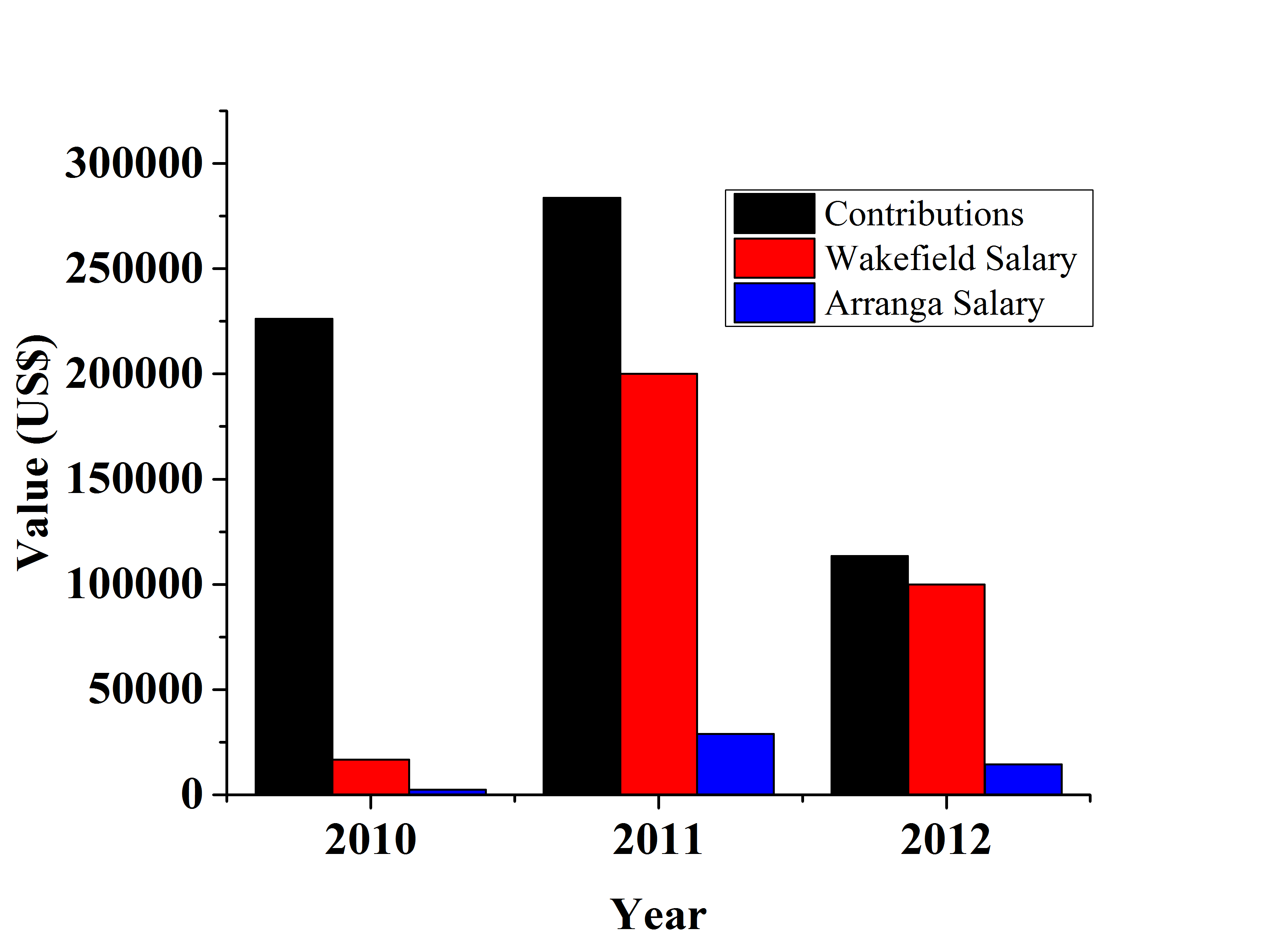
Let’s do a little summarizing. Let’s look at trends for the money they take in (contributions) and the money that they’ve put out in salaries. The Strategic Autism Initiative pays Andrew Wakefield and Terry Arranga.

SAI contributions and salaries

OK, you gotta hand it to Andrew Wakefield–he pulled in $623k in 3 years, basically on his name and reputation. And, he took $316k of that money, about 50%. In total, salaries accounted for 58% of what the SAI took in. The first year of the SAI (2010) was a short year, hence the low salary. Mr. Wakefield’s salary appears to be based on $270,000/year full time. Officially he was working 30hours/week in 2010 and 2011. 15 hours/week in 2012.

Notice that the contributions were way down in 2012. Still a sizable $113k, but down from the previous years.

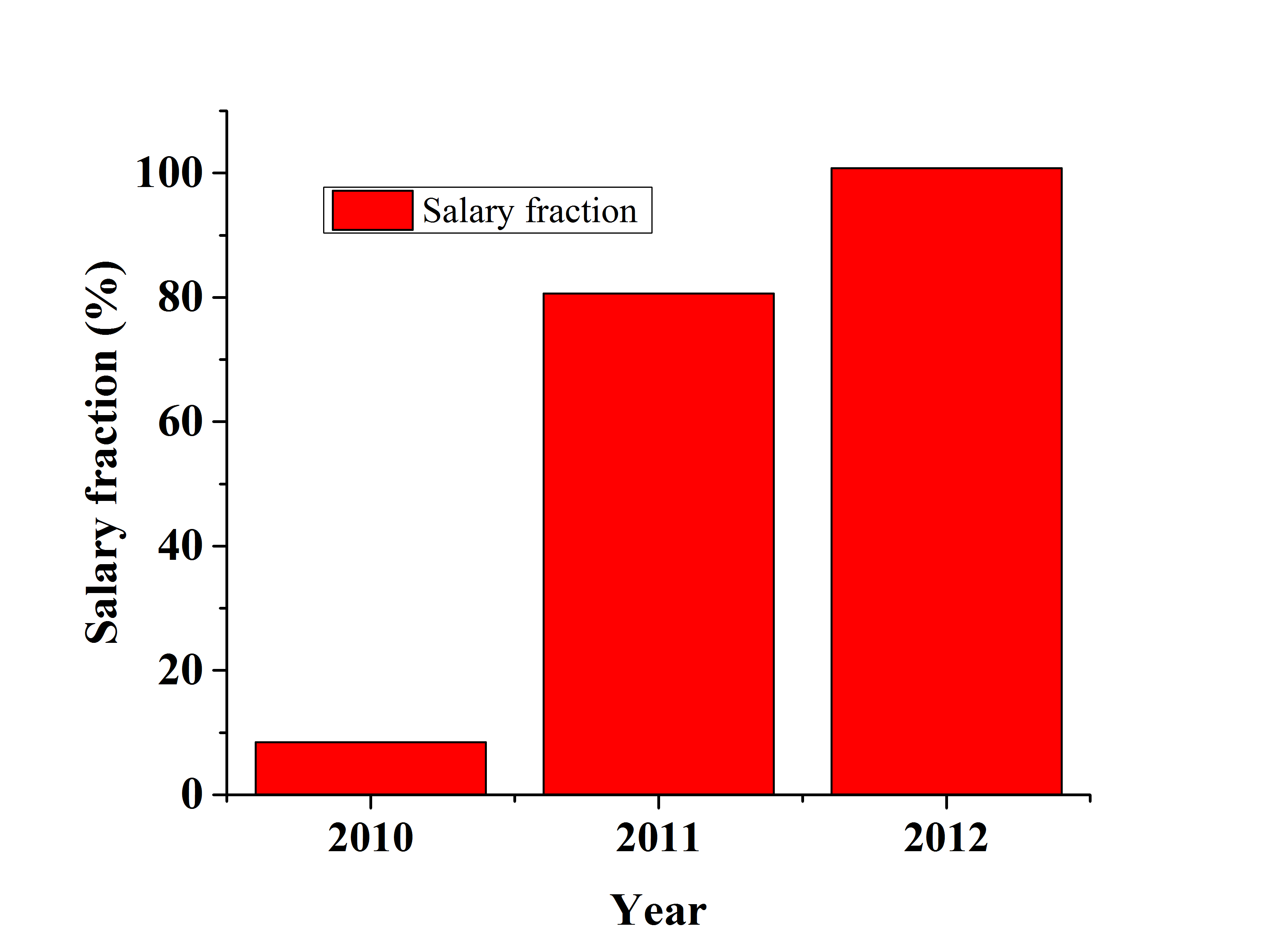
How does the salary outlay compare to the intake over the years? Well, it was relatively low the first year (the short year) and climbed to 80% in 2011 and 100% in 2012.

Salary Fraction

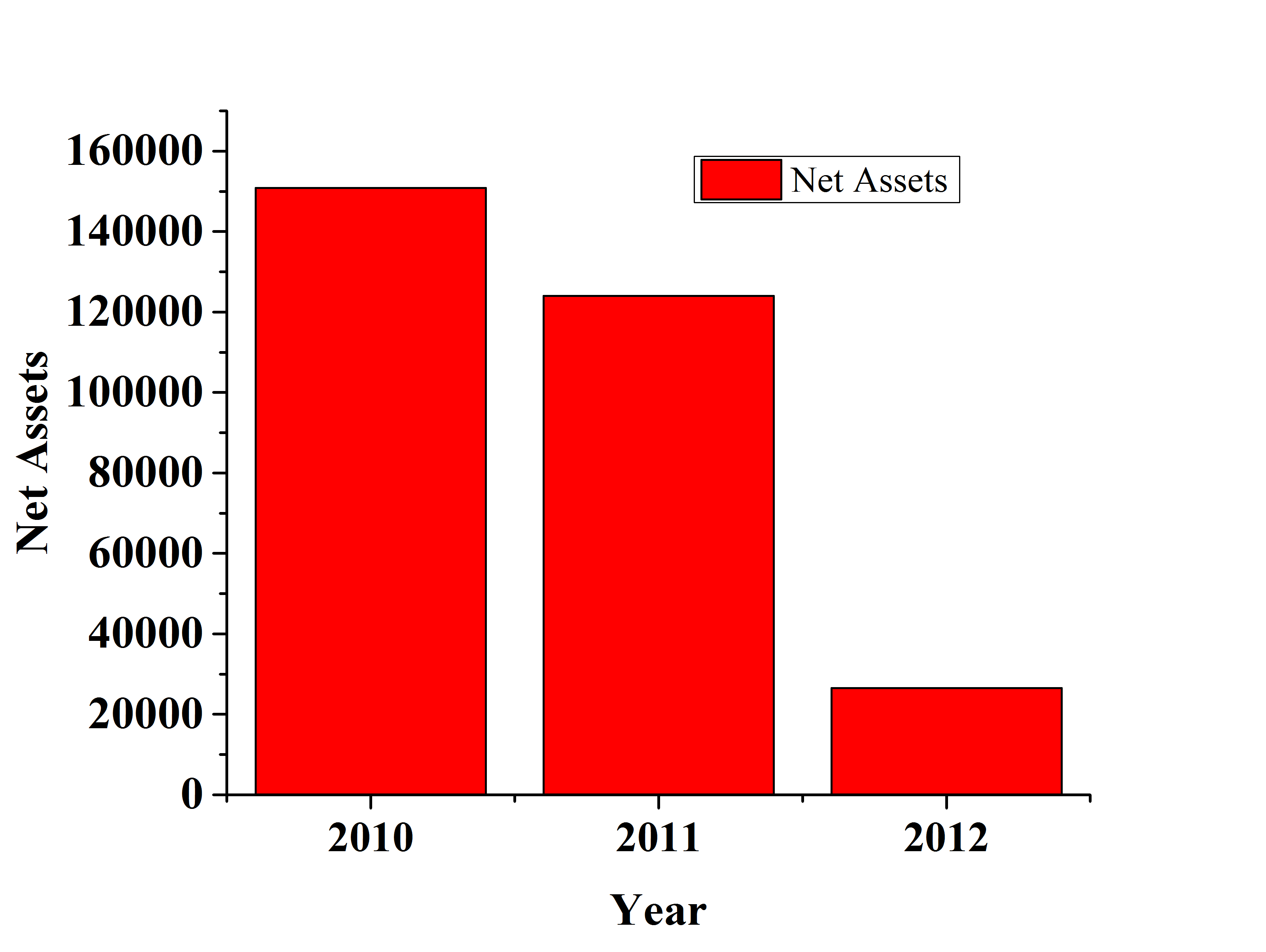
Not what one would call sustainable. Well, I guess if all one does is put money into salaries, that’s sustainable. Not exactly what a charity is supposed to be, though. Which begs the question, how much money did they have on hand at the end of each year?

Assets

Yep, pay out most of your money in salary and watch your assets go down. Also gives a partial explanation for why Mr. Wakefield is only listed as working 15 hours a week in 2012–there wasn’t the money to pay him more. The SAI would be about $70k in debt had they paid him for 30 hours/week.

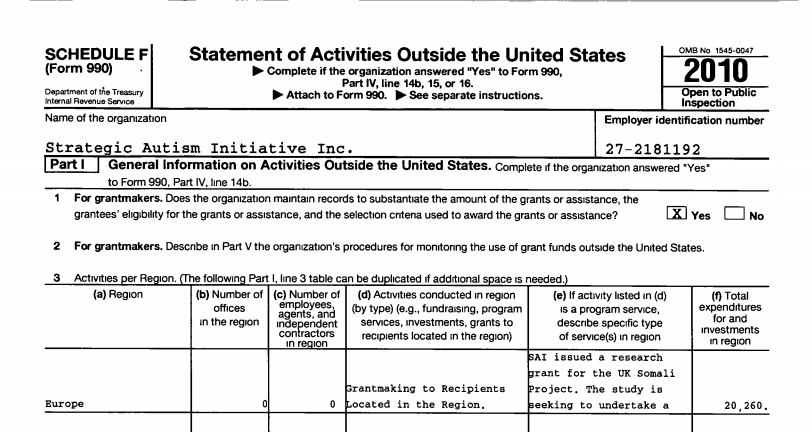
In 2010, they paid out $20,260 in a grant to perform a UK Somali study.

SAI 2010 grants

In 2011 they paid out a $25k grant to Generation Rescue for a “vax/unvax study”

SAI 2011 grants

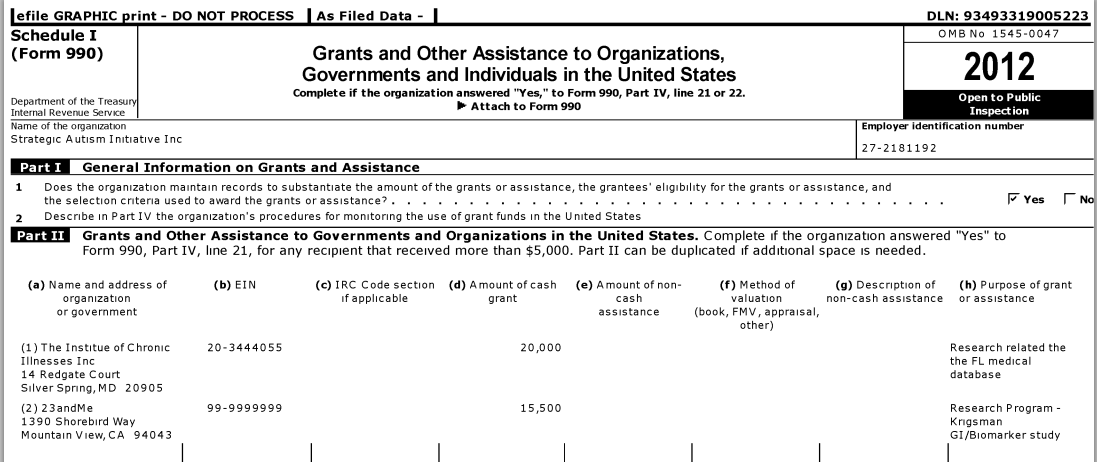
In 2012 they paid out $35k in grants. One to Mr. Wakefield’s former Thoughtful House colleague Arthur Krigsman and another to the Geiers for a study using the Florida medical database.

SAI 2012 grants

So, let’s consider this. In three years, Mr. Wakefield managed to give out 4 grants. Total of about $80k in grants. And for that effort he was paid $316k. What’s the supposed goal of the Strategic Autism Initiative?

SAI mission

“…to promote research in areas of autism and neurological disorders…”

Right. Promote research. About 13% of their budget went to promoting research. And that’s before we even consider the quality of that research.

Some bright people believe Andrew Wakefield. Some wealthy people believe Andrew Wakefield. Why, I don’t know. But even those who believe in what he says may someday question whether getting $0.13 on the dollar to the cause is worth keeping Andrew Wakefield employed.


By Matt Carey

Gigi Jordan found guilty of manslaughter in killing of her son Jude

6 Nov

Jude Jordan was an autistic boy. He was murdered by his mother. I use the term “murdered” in the colloquial sense of “a person deliberately took his life”. Legally it wasn’t murder. Legally it was manslaughter as the mother, the murderer, argued extreme emotional disturbance. Her story was convoluted, but she argued that she believed her son was being sexually abused by multiple people, including his biological father. She also argued that she believed that her ex husband intended to kill her and that would lead to the biological father becoming Jude’s caregiver. Having read documents she’s put online (she has some on a new website(http://www.gigijordantruth.com/) and more were on a now defunct website). I find her arguments seriously difficult to believe.

Jude’s mother is estimated to be worth about $50M. She had the money to hire a team of high powered attorneys to argue her case. And she will pay them more to appeal her case. But apparently she didn’t feel that she could use that $50M to hire attorneys to insure that someone she trusted could take care of Jude in case she died.

If you search for Gigi Jordan on Google, you can find her website right away. Because someone has bought advertising space for it. She apparently put that up as part of her media blitz that coincided with the jury going into deliberations.

But back to the important part of the story. Jude Jordan is dead. And the person who killed him may serve as little as 5 years in prison for the crime.

As happens whenever a news story about a parent killing his/her autistic child is put online, the comments include “walk in the parent’s shoes before you judge”.

Here’s the thing: I am a parent of an autistic child. A child with a very high level of challenges. I can’t say I’ve walked in Gigi Jordan’s shoes. I don’t have $50M like she did (how much is left after paying attorneys is unknown). I don’t know that I can set up a trust to care for my kid long after I’m gone. I can’t quit work to spend my years caring for my kid, as I would like. Gigi Jordan could do all of that.

As long as we are talking about walking in other people’s shoes: Gigi Jordan will never be able to walk in my shoes again. I love my time with my kid. And I want to protect my kid from caregivers in the future who think that one can murder a disabled kid and get a light sentence. And she’s part of the problem. When she gets a light sentence, it diminishes every disabled person’s chances of living a life free from the threat of caregiver abuse and/or murder.


By Matt Carey

IACC Co-occurring conditions workshop: Lewin Group presentation on co-occurring conditions in autistic children in the U.S.

4 Nov

Anjali Jain of the Lewin group presented on data they have collected from medical records about the prevalence of co-occurring conditions found in autistic children in the U.S.. This presentation was made to the Interagency Autism Coordinating Committee in Sept. 2014. (the original video is here, and the Lewin Group talk started at about timestamp 17:50.  The original has closed captioning).

Some of the most common co-occurring conditions are anxiety and depression. In fact, mental health conditions are found in about 70% of autistics. Similarly, neurological conditions and neurodevelopmental disorders are found in about 70% of autistics. By comparison, GI+nutritional disorders (which include areas like allergies), which get a great deal of attention, are found in about 20% of the autistic population. While large, this is much less common than the 70% rates found for mental health and neurodevelopmental disorders.

Another interesting finding was that autistic children are seen more often for treatment of infectious diseases. If the risk for serious problems from infectious diseases is higher in autistic children, this makes the decision of many autism parents to stop vaccinating their children even more problematic.

The full video (with closed captioning) can be found here:

http://videocast.nih.gov/launch.asp?18636


By Matt Carey

Presentations made to the Interagency Autism Coordinating Committee (IACC)

4 Nov

The U.S. Interagency Autism Coordinating Committee (IACC) holds regular meetings. Each IACC meeting typically has presentations by experts in various fields of autism research and services. Video of the meetings is made available by the NIH. For example the IACC workshop on under recognized and co-occurring conditions in ASD is there. It can be somewhat inaccessible in that the entire meeting is 7 hours long (and so is the video) while each talk was typically 10 minutes. In other meetings the talks have been longer, but it seems to me that some may find it valuable to have access to the individual talks. With that in mind, I have been pulling some of the meeting videos and cutting the talks out and posting to YouTube. I will post these talks as I get time.

The first set will be the epidemiology talks presented at the recent Workshop. One by the Anjali Jain of the Lewin Group, one by Lisa Croen of Kaiser Permanente, one by Isaac Kohane of Harvard University, and one by Daniel Coury of The Ohio State University.

By Matt Carey

Emily Willingham: winner of the 2014 John Maddox Prize for Standing up for Science

28 Oct

Emily Willingham is one of the best writers on the science and social aspects of autism. She also writes on other topics and is an accomplished researcher. Her journalism can be found at her site, EmilyWillinghamPhD.com, The Thinking Person’s Guide to Autism (the Site and the Book), DoubleXScience, Forbes, and elsewhere.

With all that in mind, it’s great to see that she’s been recognized for her work. SenseAboutScience.org has announced that she will share the 2014 John Maddox Prize for Standing up for Science:

Dr Emily Willingham and Dr David Robert Grimes are the two winners of the 2014 John Maddox Prize for Standing up for Science.

The announcement notes:

The judges awarded the prize to freelance journalist Dr Emily Willingham and early career scientist Dr David Robert Grimes for courage in promoting science and evidence on a matter of public interest, despite facing difficulty and hostility in doing so. The winners equally embody the spirit of the prize and, at this relatively early stage in their lives, have yet to receive recognition for their work bringing science and evidence to the public. Both Emily Willingham and David Grimes reflect Sir John Maddox’s passion for investigative journalism and for social engagement by young scientists.

On Emily Willingham in specific:

Emily Willingham, a US writer, has brought discussion about evidence, from school shootings to home birth, to large audiences through her writing. She has continued to reach across conflict and disputes about evidence to the people trying to make sense of them. She is facing a lawsuit for an article about the purported link between vaccines and autism.

The Prize is a joint initiative of the science journal Nature, the Kohn Foundation, and the charity Sense About Science. The late Sir John Maddox, FRS, was editor of Nature for 22 years and a founding trustee of Sense About Science.

And a statement by Michael Fitzpatrick, doctor, autism parent, writer and contributer to Left Brain/Right Brain:

Dr Michael Fitzpatrick, author MMR and Autism: What Parents Need to Know and trustee of Sense About Science, responded to the news about Emily Willingham: “She has provided a particularly valuable service in confronting specious theories attributing autism to diverse environmental agents, from milk and vaccines to endocrine disrupters and maternal antibodies. She has also exposed quack treatments for autism and challenged ill-informed reports suggesting a diagnosis of Asperger’s syndrome as an explanation of the behaviour of serial killers (pointing out that people with autism are much more likely to be victims than perpetrators of violent crime). As co-editor of the excellent Thinking Person’s Guide to Autism, she has helped to equip parents and people with autism with a critical approach to the evaluation of claims made by researchers and therapists alike.”

The full article is at SenseAboutScience.org.

by Matt Carey

Nick Walker on Neurodiversity: Some Basic Terms & Definitions

25 Oct

Nick Walker starts his introduction with “I’m an Autistic educator, author, speaker, transdisciplinary scholar, activist, parent, and martial arts master.” His writing is excellent and I’d highly recommend adding Neurocosmopolatinism to your list of blogs to track, if it isn’t there already.

A recent article by Mr. Walker covers the topic of neurodiversity clearly and accurately. It’s a great resource: Neurodiversity: Some Basic Terms & Definitions.

It is one of those articles I’d like to copy in it’s entirety. But instead I’ll send you to: Neurodiversity: Some Basic Terms & Definitions.


By Matt Carey