Tag Archives: Autism

David Geier now works for HHS. He’s supposedly going to do autism/vaccine studies

27 Mar

I’ve been waiting for an announcement like this since Robert Kennedy was named Secretary of HHS. Someone from his community, someone known for pushing out bad and very biased studies, would be named to do vaccine/autism research. I’ll admit, my money was on someone else. But, in general, this announcement does not surprise me.

I first saw this in a link someone sent to me from the Washington Post: Vaccine skeptic hired to head federal study of immunizations and autism. The story is by Lena H. Sun and Fenit Nirappil. I will admit, I have cancelled my Washington Post subscription, but Lena Sun is one of the authors I will miss supporting.

David Geier is part of the father/son team that brought us the “Lupron Protocol“. You can read up on the details here and elsewhere, but I will just say flat out the opinions I’ve made clear many times: it was junk science of the worst sort and, even more, it was abusive to disabled children. In addition to that, the Geiers have a long and story career of junk science and bad medicine. It takes a lot to lose your medical license. Mark Geier (David’s father) did.

Unless he has gone back to school, David Geier holds a B.A.. He’s never held a real research position that I am aware of. He doesn’t have the background to be an assistant to the people who have done studies he apparently will be re-investigating, much less lead a project on his own. And, I think the record shows clearly, he is clearly and terribly biased.

Given news of this sort, I’d expect Science Based Medicine to have an article out quickly. Steven Novella did just that in David Geier Hired to Study Vaccines and Autism. It’s a good read and I don’t want to duplicate too much of what he says. But here’s one key paragraph:

Tapping David Geier tells us everything we need to know – this is a hit job. In my opinion, Geier has zero credibility in the scientific community due to his long history of crankery in this area. He is not qualified as is evidenced by a long history of shoddy science and discredited conclusions.

David Gorski at Respectful Insolence has also chimed in, with great detail and his own flair in David Geier: A blast from the antivax past hired to “prove” vaccines cause autism. Worth reading to get more details on the history of the Geier team.

So allow me to add a few secondary observations on what is happening. Per the Washington Post:

The information that the CDC has turned over to NIH includes the underlying data from four studies on vaccines and autism published in the 2000s, three current officials said. None of the papers found any link.

Step back and think about what this means. My opinion: the goal is not just to show that vaccines cause autism, but to discredit the previous studies and, with that, the CDC researchers who did that work. And, in general, public health researchers in general.

My next point has to do with Mr. Geier’s position at HHS. He’s listed as a senior data analyst* with the organization listed as HHS/OS/ASFR. AFSR is the Office of the Assistant Secretary for Financial Resources. A strange place to place an epidemiologist type person, isn’t it? Take a look at the org chart below. This is not a place for someone doing research like this. Not only that, but if my (admittedly limited) ability to read Mr. Geier’s entry in the HHS phone book is accurate, he appears to report directly to the Assistant Secretary or the Principal Deputy Assistant Secretary. Why? Why isn’t he in some team of, oh, I dunno, epidemiologists, reporting to someone who, call me silly, can check his work?

Also, this begs the question: is Mr. Geier going to be influencing grants? I.e., is he just shoehorned into this position or is he going to help the people who work on grants and such? This next is a stretch, but what if he’s going to help get grants to other credulous “researchers”? I suspect projects are supposed to be approved through a different office, and this is more for managing finances. But, who knows in this topsy-turvy world.

One could imagine a world where Mr. Geier was invited in to work with people with the expertise to do these studies. You know, make sure there are no shenanigans and all. That would give Mr. Kennedy a chance to get an answer he doesn’t want to see. That would take guts. Frankly, if I’ve learned anything over the past 20 years it’s this: Robert Kennedy has no guts. He can’t face the fact that he’s not only wasted decades of his life, but that he’s caused harm. Harm to disabled children and their families. No, I don’t think Mr. Kennedy has that sort of courage. And with this decision, he’s proving me correct.


by Matt Carey

So, Mr. Kennedy does cancel some speaking engagements

13 Mar

I recently wrote about how Robert Kennedy Jr. is gutless (I’m an autism parent. No way I will vote for Robert Kennedy Jr.. He’s gutless).  Over the past few decades, Mr. Kennedy has spoken at many events where fake, even abusive, therapies are promoted to autism parents for use on their disabled children. As a keynote speaker, Mr. Kennedy could have either refused to attend or used his platform to distance himself from these charlatans. To my knowledge, he never has.

So I was a little surprised to read that Mr. Kennedy had pulled out of recent convention (Not Even RFK Jr. Wanted to Come to This Vegas Convention of Anti-Vaxxers and ‘Free Speech’ Brands). The Rolling Stone article states:

The result was more anemic than cohesive, however, in part because scheduled keynote speaker Robert F. Kennedy Jr. had pulled out following a February article from Mother Jones. The piece noted that another RePlatform speaker, Lonnie Passoff, president of financial services providers Green.Money and GabPay, the latter being the payment system of the far-right social media network Gab, had endorsed antisemitic comments on a prominent conspiracist’s streaming show. 

Good for you, Mr. Kennedy. Good for you. A speaker at the convention had endorsed antisemitic comments so you decided to not show up.

But this begs the question, why were you willing to speak when charlatans are preying on the families of disabled children? The example I gave in my previous piece was that of chemical castration. For those who didn’t read the piece, I’m not making this up or exaggerating.

Let me bring up another example. Bleach enemas. Charlatans sold (and still sell) chlorine dioxide (a bleach) as enemas and drinks to cure autism. Parents would give their kids bleach enemas, the kids would pass the lining of their intestines and people would say, “look, we got rid of the parasites that cause autism!” No, I’m not making this one up either. I wrote about it many times.

The main proponent of this “therapy” in the autism communities was/is a woman named Kerri Riviera. One of the times she spoke was at a parent convention called AutismOne in 2013. The keynote speaker that year was Robert Kennedy.

Mr. Kennedy could have refused to speak. He could have spoken at the time that he disapproves of these therapies. He could have spoken out since then, demonstrating regret for lending his name and credibility to charlatans such as these.

To my knowledge, he never has.

That would have taken courage. And the ability to discern junk science. These are traits I have not seen Mr. Kennedy show often.

__

By Matt Carey

I’m an autism parent. No way I will vote for Robert Kennedy Jr.. He’s gutless.

26 Feb

As an example, I will discuss one particularly egregious “therapy” that was used on autistic children, the so-called “Lupron protocol”. Mr. Kennedy was in a perfect spot to stop or limit this therapy, but he never did. It would have taken courage, and, in my opinion, Mr. Kennedy is gutless.

Robert Kennedy (RFK Jr.) is running for president. He failed to gain the Democratic Party nomination and is now running as a third-party candidate. Since the beginning of his campaign, he’s faced criticism for being anti vaccine and anti-science. As someone who has watched Mr. Kennedy for nearly two decades I will agree: he is, indeed, anti-vaccine and anti-science. But that’s not why I am strongly against the idea of him being president. I oppose his bid for one reason:

He’s gutless.

Let me explain.

Long before Mr. Kennedy reached national prominence with his myriad of bad ideas during the COVID-19 pandemic, he was well known in the anti-vaccine autism-parent community. He was probably most famous for pushing the failed idea that mercury in vaccines caused an autism epidemic (an idea he still won’t abandon). And this is where many discussions focus on how his actions are anti-science and anti-vaccine. But to me, I hurt for the harms Mr. Kennedy’s advocacy has caused autistic people and the autism communities. One can say, “his anti-vaccine views have caused harm to public health”. One would be right. But, the anti-vaccine movement has long used autism and autistic people as the hammer with which they attack vaccines. And, to quote Sancho Panza in Man of La Mancha, “Whether the rock hits the pitcher or the pitcher hits the rock, it’s generally bad for the pitcher”. Being the weapon of choice for attacking vaccines has caused increased stigma and allowed charlatans to sell fake “cures” for autism which range from useless to abusive.

As an example, I will discuss one particularly egregious “therapy” that was used on autistic children, the so-called “Lupron protocol”. Mr. Kennedy was in a perfect spot to stop or limit this therapy, but he never did. It would have taken courage, and, in my opinion, Mr. Kennedy is gutless.

For decades there have been regular autism-parent conventions focused primarily on two things: promoting the idea that vaccines cause autism and promoting fake “cures” for autism as a vaccine injury. And Mr. Kennedy has been prominent at these conventions, serving as a keynote speaker.

Mr. Kennedy speaks primarily on the idea that vaccines cause autism (they don’t). He’s well respected as someone who has been involved for decades in this arena. His name gives some credence to the others at these conventions, including those who push abusive therapies.

I have never heard of Mr. Kennedy speaking out against the fake, even abusive, “therapies” pushed at these parent conventions. Why? In my opinion:

He’s gutless.

Allow me to focus on one of the most egregious fake therapies pushed as part of the vaccines-cause-autism movement. There are more. Many more. But let’s just discuss chemical castration.

If you are thinking, no way that happened, Matt. You must be exaggerating. I’m not.

Doctors were prescribing Lupron in order to reduce the testosterone in autistic children. That’s chemical castration in my lay opinion. Dr. David Gorski, an oncologist, wrote a series of articles about this “treatment” as “why not just castrate them“.

Surely they had a good reasoning for taking such drastic measures, you must be thinking. No, they didn’t. In fact, the “science” behind the therapy is horrifically bad. It would be funny if it wasn’t actually used on children.

How was the “Lupron protocol” justified? First, let’s start with the idea that autism is caused by mercury. It isn’t, but this is the idea that Mr. Kennedy pushed so hard 20 years ago. Mercury intoxication is commonly treated by chelation, which is a way to remove mercury from the body. For years medical practitioners pushed chelation on autism parents (again, often at these autism parent conventions that Mr. Kennedy is known to speak at). Only chelation didn’t work. It didn’t work because autism isn’t mercury intoxication. But to people like the Geiers, the problem was that chelation wasn’t working, the problem was they needed a better way to chelate. They came up with the idea that testosterone was binding to mercury and keeping chelators from working. So, they postulated, remove the testosterone and one can remove the mercury and the kid will stop being autistic. Which brings us to chemical castration: remove or reduce testosterone in the body. Which brings us back to Lupron.

Seriously, it happened. And a father-son team named Geier led the charge.

In order to prescribe the Lupron, the Geier’s needed a diagnosis. Insurance companies aren’t going to allow people to prescribe Lupron for mercury intoxication (even ignoring the fact that the Geiers didn’t have evidence for mercury intoxication). So the Geier chose precocious puberty as the diagnosis. Diagnose a kid with precocious puberty and you can prescribe Lupron.

The Geiers got into trouble for this. In 2013 they were facing disciplinary action as noted by blogger Todd W. at Harpocrates Speaks (among many others). They were facingmedical license suspension. In multiple states. So, you’d think people might be questioning the Geiers’ “protocol”. Perhaps checking the “science” that supported it? Well, not in Mr. Kennedy’s circles, apparently.

A few days after Todd W. wrote his article, two things happened. The Geier’s spoke at a parent convention called AutismOne. And Robert Kennedy was the keynote speaker for that convention.

Think about it. Mr. Kennedy could have told the parents at that convention that he stands apart from the Geiers. He could have just said perhaps people should be cautious, a relatively weak stance. Mr. Kennedy could have taken a stronger stance said that what the Geiers were doing was chemical castration and it was wrong, a much stronger stance.

To my knowledge Mr. Kennedy did not speak out then against the Geiers or any other practitioner of fake autism cures. I have no knowledge of him ever speaking out against charlatans.

It would have taken courage to speak out. It would have taken courage to admit to himself that he’d missed the obviously bogus science before, and that he, a self-professed science expert, was wrong. And it would have made a difference. I don’t consider it hyperbolic to say that I consider chemical castration of disabled (or any) children to be abusive. And Mr. Kennedy could have slowed or even stopped this practice long before Dr. Geier lost his license. He was respected and a frequent speaker at these conventions.

It takes courage to face allies (the Geiers were long known for pushing the mercury-autism link. Mr. Kennedy cites them multiple times in his books) and say they are doing wrong. Mr. Kennedy didn’t even have to admit that the mercury-causes-autism idea was false (which would have taken another step of courage and would have been the right thing to do). Just that chemically castrating disabled children is wrong.

Seriously, how hard is it to say, “Chemically castrating disabled children is wrong”, Mr. Kennedy?

Mr. Kennedy has spoken regularly at the “vaccines-cause-autism” parent conventions. And the Geiers were not the only ones pushing abusive therapies. It would have taken courage to say, “I will not speak and lend my name to a meeting where fake therapies are promoted.” But Mr. Kennedy lacks that courage.

This is largely due, I believe, to the fact that Mr. Kennedy lacks to courage to analyze his own lack of scientific expertise. My belief is that Mr. Kennedy, to this day, doesn’t understand just how bogus the “Lupron protocol” was. But it would take a courage for someone who has branded himself as a person who understands science (even though he lacks any credentials) to say, “You know what, I didn’t catch on to the idea that the science the Geiers were claiming was unsound.”

One might ask, was the Geier science obviously bogus? I would say yes and I would say that someone with the expertise Mr. Kennedy claims to have should have easily seen there was a problem very early on. Let me explain. The Geiers claimed that mercury and testosterone form “sheets”, large complexes, in the brains of autistic children. Sounds very scientific and all, until we found that the study the Geier’s were basing this idea upon involved boiling mercury and testoterone in benzine.

In my opinion, Mr. Kennedy should have known that a child’s brain is not similar to boiling benzine. Yes, this sounds snarky, but it really is that simple. The science behind the Geier’s “Lupron protocol” was really that bad.

But this discussion risks getting back into the realm of “He’s anti-science”. I bring this up not to point out Mr. Kennedy’s lack of science chops, but to point out that the science was so bad that it didn’t really take much analysis to see it.

That is if one has the courage to question. To question one’s allies. To question one’s own expertise. To question whether one’s own inaction led to the abuse of disabled children. And, again, in my opinion this was abuse. And Mr. Kennedy could have helped stop it sooner.

Again, I only picked one example. And this discussion has gone long, so you can understand why I chose only one example. But there are many examples of fake cures promoted at autism-parent conventions that Mr. Kennedy could have stopped. There’s also a lengthy discussion we could have about the stigma the anti-vaccine movement has brought to autistic people (one of Mr. Kennedy’s allies tried to label autism as “mad child disease“, to give you one example.) Mr. Kennedy could have spoken out agains the stigmatizing language. But the fear of autism and autistic people has long been a mainstay of the anti-vaccine movement.

We need a president with courage. While others discuss his anti-vaccine views, his near self-delusional belief in his scientific acument, let me just say this again: Mr. Kennedy lacks courage.

Robert F. Kennedy Jr. is gutless.

_____

By Matt Carey

More discussions
This blog on Mr. Kennedy.
Articles on this blog about the Geiers.
Articles on this blog about Lupron.
Mark Geier’s Wikipedia Page.


Washington Post: How listening to autistic adults helped me understand and support my son

11 Nov

Shanon Des Rosa Roche, parent of an awesome young man and one of the people behind The Thinking Person’s Guide to Autism, has a piece in the Washington Post: How listening to autistic adults helped me understand and support my son.

Here’s a small quote from the piece.

Parents need to hear from people who have lives similar to what our children will experience. These adults can warn us about avoidable mistakes, and they can counter our assumptions about what it means to live a good life — even when that life is complicated.

Please go and read the entire piece. It’s not long, but it is very good.

There are a lot of people who could benefit from this article. Parents who recently found out their child is autistic are one group. Even parents who children have been diagnosed for some time, even those who run autism parent organizations, could greatly benefit from the ideals presented so clearly and succinctly in Shannon’s article.

Read the article and see for yourself what you take away from it.

By Matt Carey

What Autism Awareness Means

3 Apr

We are often told to be “aware” of autism. But what does that do, really? With awareness comes acceptance. And for my son acceptance means being able to live his life.

A few years ago, I took my son for a walk to our local shopping center. We have done this every weekend day since he was in a stroller. This time we passed Nicco’s hardware store, where they always keep a stock of the American flags my son likes to buy. When they see us pass, they often start a fresh batch of the free popcorn he loves.

At the donut store, Mary and Monica helped him learn to buy things and to wait his turn. We’ve been doing this for years, but they never lose enthusiasm. At the bagel store my son walked right up to the counter as where Sylvia handed him his favorite cinnamon raisin bagel with her traditional “this is for you!” To this day, the workers at the bagel store hand him a bagel with a smile as he walks in. He eats while we wait in line to pay.

At our local market, I got distracted, as parents are wont to do. And my son wandered off, as children are wont to do. I ran to the door panicked because I had to make sure he was safe from traffic. Once I was pretty sure he was still in the store, I ran from aisle to aisle, yelling his name. Still scared. And what I found was a neighbor smiling at me, pointing and saying, “he’s over there”.

She knew us. She was aware that he needed support. When she saw him alone, she kept an eye on him.

He was 7 years old then. He’s 14 now. He still needs a lot of support, and always will.

When my father was growing up, people like my son would be institutionalized. When I was growing up, people with disabilities were hidden. Now that my son is growing up, he lives in a time and a community in which people are aware that he needs support. They accept him and know he deserves respect.

Awareness means my son can be in a community. Acceptance means he can live his life.

With a Perspective, this is Matt Carey.

The above was given as part of the Perspectives program on KQED radio. The original, complete with audio, can be found on the KQED website at What Autism Awareness Means

This is what I presented last year on KQED Radio, and I posted here on LBRB shortly after that. I present it again as we reach another Autism Awareness Day and month.

Want to understand acceptance? Listen to I am what I am

8 May

This weekend I saw another production of La Cage Aux Folles. The song “I am what I am” has long been one of my favorites, and the lyrics are posted in my kid’s room. I’ve posted this before, with some explanation. This time, I invite you to listen, read the lyrics and, if you don’t understand why I feel this is so fitting: ask.

I am what I am
I am my own special creation.
So come take a look,
Give me the hook or the ovation.
It’s my world that I want to take a little pride in,
My world, and it’s not a place I have to hide in.
Life’s not worth a damn,
‘Til you can say, “Hey world, I am what I am.”
I am what I am,
I don’t want praise, I don’t want pity.
I bang my own drum,
Some think it’s noise, I think it’s pretty.
And so what, if I love each feather and each spangle,
Why not try to see things from a diff’rent angle?
Your life is a sham ’til you can shout out loud
I am what I am!
I am what I am
And what I am needs no excuses.
I deal my own deck
Sometimes the ace, sometimes the deuces.
There’s one life, and there’s no return and no deposit;
One life, so it’s time to open up your closet.
Life’s not worth a damn ’til you can say,
“Hey world, I am what I am!”


By Matt Carey

Did autism prevalence increase by 20%? (answer: no)

28 Apr

The CDC came out with a new autism prevalence estimate yesterday. Their estimated autism prevalence is 1.68%.  That’s up from the estimate from 2 years ago (1.46%), but lower than a different recent study (2.76%).

I’m going to discuss some minor-league shenanigans.  It’s no surprise that some groups abuse facts and cherry pick data to make political points.  In this case it was useless.  there was no need to cherry pick.  I’ve done a lot of exposing the abuse of facts by some so-called autism advocacy groups.  I don’t get any joy from noting that people in my community are both dishonest and ignorant of science.  But much as that bothers me, it pales in comparison to the lost opportunities.  Millions of dollars were spent on this prevalence estimate alone, but all some groups do is dig for reasons to justify their “epidemic” story and push the long-ago failed idea that vaccines are to blame.

Over the years, news organizations and autism groups have jumped at the chance to put their spin on each new CDC autism prevalence estimate. Over the years I’ve spent a lot of time trying to unspin the takes of groups like the Age of Autism blog. AoA is, well…if you want to see autism done wrong, read the Age of Autism blog. Science, medicine, human rights and dignity, they can be counted upon to get things wrong.

With that in mind I decided the CDC announcement was a time to break my current trend of ignoring AoA. I literally haven’t read it in months. What I saw was both surprising and typical for them. Surprising in that they didn’t even bother to write their own pieces for the new prevalence numbers. Seriously–they just copied a couple of articles from other sites and left it at that.

By the way–this new low-level interest in autism prevalence appears to me to be a general trend–beyond just AoA. Autism is losing it’s status as having intense focus from the US media and public.  The chance to leverage the public’s interest into meaningul change is waning. That’s a far more interesting topic and far more important than this and I want to come back to it in the future.

So, what did AoA post? Big League Politics BREAKING: CDC Reports 20 Percent Autism Increase In Children and Breaking News: 1 in 59 children Born in 2006 have Autism, 1 in 36 between the ages of 3 and 17. What’s going on?. That first one caught my eye. First because in absolute terms, the autism prevalence increased by 0.22%. In relative terms, that’s about a 15% increase.  They could have said 15% and made their point, but why do that when 20% is even more scary?  More to the point–digging just a little into this 20% figure gives understanding that a true advocacy organization could use.

So how did they come to the idea that the autism prevalence increased by 20%? They skipped to page 13 and took one part of one paragraph out of context and, well, cherry picked. Completely unsurprising. They skipped over pages of data showing that we are failing to identify–and, therefore provide adequate services for–autistic minority children.

Sadly, AoA and their allies have spent over a decade denying this huge issue.   The reason is obvious: it doesn’t fit into the “vaccines cause autism” narrative.  So rather than push for better identification and better services for minorities, they’ve sacrificed these communities in for their political message.

It’s disgusting.

They didn’t dig any deeper into these numbers, even though the data were right in front of them. Also completely unsurprising. If they were the sort of people who dig into data and question, they wouldn’t be pushing the idea that vaccines cause autism.   Seriously.

Here’s the section they are relying upon:

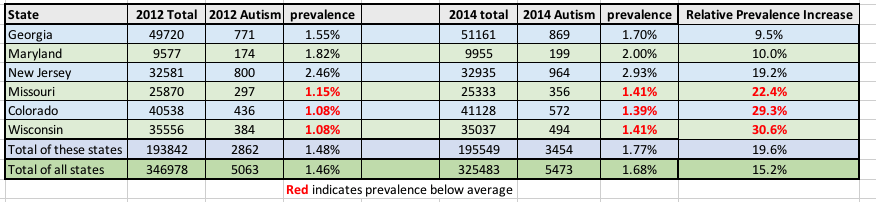
Among the six ADDM sites completing both the 2012 and 2014 studies for the same geographic area, all six showed higher ASD prevalence estimates for 2012 compared to 2014, with a nearly 10% higher prevalence in Georgia (p = 0.06) and Maryland (p = 0.35), 19% in New Jersey (p<0.01), 22% in Missouri (p = 0.01), 29% in Colorado (p<0.01), and 31% in Wisconsin (p<0.01). When combining data from these six sites, ASD prevalence estimates for 2014 were 20% higher for 2014 compared to 2012 (p<0.01).

So, if you only pick the states where there were data in both this study (called 2014 because that’s when the data were collected to be analyzed) and the previous (2012) study, you get about a 20% increase (click to enlarge).
But what happens if you ask “why?”  As in, why do these states show a larger increase than the entire group?

I put some numbers in red and bolded them for emphasis. Those are states with lower than average autism prevalences. Take a moment to think about that–the states with low autism prevalences are showing larger prevalence increases than other states. Start with a low number, and you are bound to get bigger percentage increases.

Missouri, Colorado and Wisconsin started out with very low identification rates.  They’ve improved their identification rates. What if someone were to ask, “how did they do that?  Can we use that elsewhere to serve more unidentified autistic children?”

I’m sure the cherry-picking “let’s find a reason to fit this into the vaccines-cause-autism story” groups have already focused on New Jersey in the above figure.  New Jersey stands out–their autism rate increased by about 19% and they have a much higher autism prevalence rate. New Jersey also stands out for another reason: they aren’t lagging in identifying black or Hispanic autistic children:

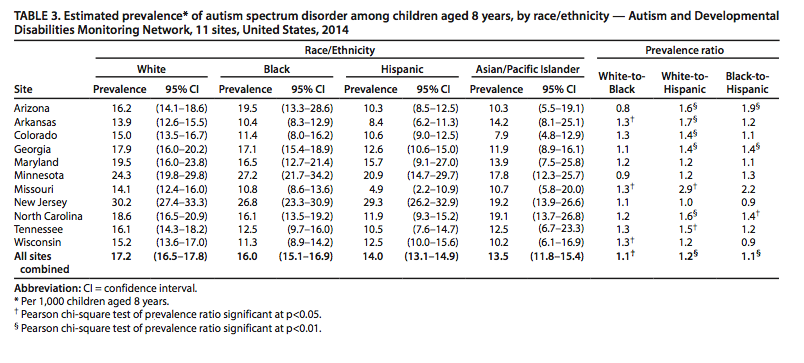
In New Jersey, there was almost no difference in ASD prevalence estimates among white, black, and Hispanic children. Estimates for Asian/Pacific Islander children ranged from 7.9 per 1,000 (Colorado) to 19.2 per 1,000 (New Jersey) with notably wide CIs.

Wouldn’t it be great if someone were to say, “how did New Jersey close the gap in identifying some minority groups?”

Groups advocating for a better future for disabled people would do that.  People trying to keep the failed “it’s all vaccines fault” idea alive won’t.

Some people will be confused, and understandably so, at this point.  These are “autism prevalence” numbers.  Doesn’t that mean that this is a complete and accurate count of the number of autistic kids in each location?  No, they aren’t.  The people at the CDC are working hard and doing a good job with the information they have.  But this is a review of existing records, not a test of each individual kid.  The CDC have access to medical and/or school records (it varies by location what sort of records they have).

Keep in mind–the CDC autism prevalence numbers aren’t “these are the absolute accurate numbers for how many kids are autistic”. We are missing identifying kids. Doctors are missing autistic kids.  Schools are missing autistic kids. The CDC tries to make up for this by reviewing the records to determine which kids are autistic (i.e. they don’t just count existing diagnoses in the records–they “diagnose” from the records).  But they still miss kids in their counts. We need to get better. The fact that New Jersey isn’t leaving minority kids behind is huge.  The fact that lagging states are catching up is huge.

Doing things right–checking on numbers is hard. It takes time. AoA not only doesn’t take the time to be careful (which is typical for the “vaccines cause autism” groups), they know that it’s the simple message that scares people. “Autism increased by 20%”!!!! It may only take 5 minutes to actually dig and see what’s going on. But that’s five minutes most people don’t have time for.

Which is the long winded way to say:

A lie can travel halfway around the world before the truth can get its boots on

Groups like AoA live and breathe on taking advantage of that.  They were fake news long before the term was coined.

That said, I knew with the new autism prevalence numbers people would misuse them. It’s pretty obvious.  They’ve used that misinformation to drag parents into a world of guilt and shame for being part of vaccine injuries that, in at least the vast majority of cases, didn’t happen.  Even more, the autism-is-a-vaccine epidemic community had the resources for over a decade to make a real difference in the lives of autsitic people. As we watch autism fade a bit from the public’s view, it’s difficult to not cry a bit for the lost opportunity. It’s that, not their failed logic or twisted facts that is why I wrote the above.

By Matt Carey

Americans are still failing to identify and serve minority autistic children

27 Apr

The CDC recently published another autism prevalence study. It’s 23 pages long and has 26 authors, took 2 years to put together and no doubt cost millions of dollars. Out of that, the one fact from it that will be quoted is simply–the autism rate is now at 1.68%, or 1 in 59.

There’s so much more. But sometimes focusing on one simple message makes more impact than a lengthy analysis. So I’ll pick my own simple message (of my own):

we are failing to identify minority autistic children. And with that, we are failing to provide them the appropriate services and supports they deserve as citizens and residents of the U.S.

We can and we should do better.

Here is table 3 from the report:

The estimated autism prevalence for Hispanics is 1.4%. For Whites, it is 1.7%. Thousands of Hispanics and other minorities are being missed. Overall, thousands of autistic children, and many, many more adults, are being missed. But that’s another discussion.

By Matt Carey

What Autism Awareness Means

20 Apr

We are often told to be “aware” of autism. But what does that do, really? With awareness comes acceptance. And for my son acceptance means being able to live his life.

A few years ago, I took my son for a walk to our local shopping center. We have done this every weekend day since he was in a stroller. This time we passed Nicco’s hardware store, where they always keep a stock of the American flags my son likes to buy. When they see us pass, they often start a fresh batch of the free popcorn he loves.

At the donut store, Mary and Monica helped him learn to buy things and to wait his turn. We’ve been doing this for years, but they never lose enthusiasm. At the bagel store my son walked right up to the counter as where Sylvia handed him his favorite cinnamon raisin bagel with her traditional “this is for you!” To this day, the workers at the bagel store hand him a bagel with a smile as he walks in. He eats while we wait in line to pay.

At our local market, I got distracted, as parents are wont to do. And my son wandered off, as children are wont to do. I ran to the door panicked because I had to make sure he was safe from traffic. Once I was pretty sure he was still in the store, I ran from aisle to aisle, yelling his name. Still scared. And what I found was a neighbor smiling at me, pointing and saying, “he’s over there”.

She knew us. She was aware that he needed support. When she saw him alone, she kept an eye on him.

He was 7 years old then. He’s 14 now. He still needs a lot of support, and always will.

When my father was growing up, people like my son would be institutionalized. When I was growing up, people with disabilities were hidden. Now that my son is growing up, he lives in a time and a community in which people are aware that he needs support. They accept him and know he deserves respect.

Awareness means my son can be in a community. Acceptance means he can live his life.

With a Perspective, this is Matt Carey.

The above was given as part of the Perspectives program on KQED radio. The original, complete with audio, can be found on the KQED website at What Autism Awareness Means

Donald Trump believes that “the education is flush with cash”. How did he get that “alternative fact”?

23 Jan

Donald Trump was inaugurated last Friday. His speech was overall very poor, but one statement stood out to me above all the others. A statement which is not getting much (if any) press:

But for too many of our citizens, a different reality exists: mothers and children trapped in poverty in our inner cities; rusted out factories scattered like tombstones across the landscape of our nation; an education system flush with cash, but which leaves our young and beautiful students deprived of all knowledge; and the crime and the gangs and the drugs that have stolen too many lives and robbed our country of so much unrealized potential.

Emphasis added.

I don’t think anyone who actually deals with the education system in America would consider it “flush with cash”. That said, no one involved in special education would every say such a clearly false statement.

We absolutely are not serving our students, but this is because our education system is woefully underfunded. My own district cut back on many school days a few years ago when California cut the funding sent to districts. Guess what, when funding returned, the district didn’t restore the days we lost. We have about 10 education days fewer than before the budget crunch.

And that’s just in general. Special Education, since the first law in the 1970’s, was supposed to come with 40% of the costs covered by the Federal Government. OK, they said a “maximum” of 40%, but the Federal government has never come close. Estimates are that the contribution is about 17%.

These are the disabled children of our country. Does “America First” mean, “non disabled American’s first”, Mr Trump? Or will you be the one who finally corrects this injustice? That’s going to be hard to do if you think that schools are “flush with cash”.

You’ve come down from your tower to live in a mansion. One walled off from the world. And you surround yourself with people who, like you, don’t understand the experiences of the majority of Americans. And when you make statements like “flush with cash”, it shows.

I’ll be honest, one disappointment with Mr. Obama’s administration was his failure to live up to America’s commitment to people with disabilities, including funding Special Education. How about you prove you can do better than Mr. Obama–don’t tell us that school systems are “flush with cash”, make them flush with cash.


By Matt Carey