Tag Archives: Autism

Jerry Seinfeld, still not autistic after all these years

4 Dec

Jerry Seinfeld made a bit of a stir in the autism community recently by stating in an interview that, well, let’s use his own words:

I think, on a very drawn out scale, I think I’m on the spectrum.

This statement caused some excitement in some quarters and some vocal pushback in other quarters.  Well, that and this statement:

But, I don’t see it as dysfunctional. I see think of it as an alternate mindset.

My guess is that this second statement caused much if not most of the pushback that Mr. Seinfeld received.  Why?  Because it says that, say, Jerry Seinfeld can have autistic traits and those traits are not dysfunctional for him.  Much more, people expressed a fear that Jerry Seinfeld (or someone else with little or no disability) would become the face of autism and that the significant challenges faced by many on the spectrum would be ignored.

Looking back at the first statement above, note that we never get to hear what “it” is.  Is “it” autism in general?  Or, is “it” that part of Mr. Seinfeld’s experience that he identifies as being somewhat like autism?  It seemed very clear to me that Mr. Seinfeld was talking about his own experience, but I can see how others might not see it that way.  In which case we as a community should have said, “Hey Mr. Seinfeld, could you clarify that statement?”  Sadly there won’t be a clarification.  Likely because of the pushback, largely from a few vocal parents of autistic children who face extraordinary challenges due to autism (and intellectual disability and other disabilities), Mr. Seinfeld has made it clear that he’s not autistic and stopped the conversation there.  I never thought he was saying he was autistic, hence that whole “very drawn out scale” caveat he put in his initial statement.

In a newer interview, on Access Hollywood,  here (my apologies but the embed code doesn’t seem to be working or I’d have that video embedded here) we hear Mr. Seinfeld put the brakes on the entire Seinfeld/autism discussion.  The “money” quotes from that interview?  From Time Magazine’s article:

“I don’t have autism, I’m not on the spectrum,” theComedians in Cars Getting Coffee star said Wednesday. “I was just watching a play about it, and … I related to it on some level”

To this observer, the interview comes across as though Mr. Seinfeld asked, “Hey, I got myself into some difficulty.  Could you interview me and help me get out of it?”.  Whatever the background, Mr. Seinfeld put a stop to the discussion.

In the end, we as a community lost a potential ally by using his celebrity to air our own dirty laundry.   We are certainly a divided community on a few issues.  The one in particular here is the way in which some people don’t want to accept the fact that autism is a spectrum.  Autistics have varying degrees of challenges, both due to autism and to other conditions (e.g. epilepsy, intellectual disability, anxiety, etc.) that are common within the autistic population.  One reason I don’t particularly like the term “spectrum” is that implies a one-dimensional distribution, a line with those requiring constant support on one side and those who can manage independently on another.  Well that’s not really accurate.  By that model, the students in my kid’s classroom are all in one narrow band of the spectrum.  But they aren’t.  They are each unique in their strengths and weaknesses.  Autism for one is not the same as autism for another.

But let’s get back to that division.  Some people spoke out about a “war” between “autistic self advocates and parents of severely autistic children” and that the autism spectrum should be split.  Others said that were Mr. Seinfeld to become one of the public faces of autism, he (like Temple Grandin, somehow) would be used by officials to downplay the significant needs of those with great challenges and, again, the spectrum should be split.

We are so divided that we need some sort of civil war to divide the spectrum.  Really?  Here’s the thing, we don’t.  There is a large, growing and vibrant community I in invite those who want division to join it.  The founder of this blog, Kev Leitch, understood that.  He understood it when he made Left Brain/Right Brain a group blog with parents, professionals and autistics as contributors.  He understood it when he built a discussion forum which was inclusive.  The people at The Thinking Person’s Guide to Autism understood that when they built a community with voices from all over the community.  Their Facebook page has over 108,000 likes at this point.

There is a place for advocates who have a very narrow focus.  Say, only autistics with intellectual disability or only self-advocates.  But when you take that to the level of claiming that we should split the community over some “war”, you are doing harm.  The strongest advocates are those who see beyond their own self interests, who advocate for those in the community whose needs differ from one’s own self-interest (even if that “self” interest is in supporting a loved one).

Or, to put it simply, I expect that self-advocates will support advocacy that directly benefits kids and adults who require 24 hour support, like my kid. Just as I think self advocates deserve advocacy support from parents like myself.

In this whole hullabaloo about Seinfeld and autism I’ve seen some reasonable voices.  I’ve saved them for now.

First, from Jerry Seinfeld and Autism, an article by John Elder Robison (autistic adult) at Psychology Today:

Someone like Mr. Seinfeld – by virtue of his public persona – could easily be seen as a “face of autism,” when in fact we are a very diverse community and many of us want or need far more services and supports than Mr. Seinfeld has so far requested publically. The uninformed public could look at him and say, “autistic people are millionaire comedians,” which is far from accurate. Sure, there are some autistic comedians and some rich ones but most of us are somewhere in the middle. We are all individuals.

Then, from Amy Daniels at Autism Speaks in Celebrate Seinfeld, But Don’t Forget Those Whose Needs Are Great:

So while we celebrate the unique abilities that autism can bring, we must not forget that no one “face” represents autism. We need to remember that around a third of those with autism have co-occurring intellectual disability. A similar number are nonverbal and have tremendous difficulty communicating their thoughts and needs. Thanks to research, we also know that most children and adults with autism have related physical and mental health conditions. These conditions include epilepsy, extreme and chronic anxiety, painful gastrointestinal disorders and disturbed sleep.

We don’t need to fear that the one face of autism will not represent our interests.  We need to make sure that there is no “one face” of autism.  It would have been great if Jerry Seinfeld had been one of those faces.  A face of success (isn’t that what we parents want for our kids?) to serve as a hero for some.  That would not have taken away anything from my kid, as long as we had other faces of autism to represent the whole spectrum.

By Matt Carey

Disneyland and the Disability Access Service Card

2 Dec

When Disney announced that they were going to change how they handled services for disabled guests, I and many others were concerned. The old system was very informal and worked well, in my opinion.  It was just a piece of paper and you showed it to people at the line and they would help you by either putting you in a separate disability line or let you go to the exit and get in line there.  It made it possible to enjoy the park without waiting in long lines where the disabled person and, possibly, others in the line would have a much less than optimal experience.  While it didn’t guarantee short lines, in practice that’s they way it often worked.  So people who just can’t take Disneyland for long periods of time could get a “full day” in a few hours.  With Disney costing $90 for kids, $96 for those 10 and older, it’s a big deal if you can only be there for a few hours and most of that time is spent in line.  I could seriously see getting on one, maybe two major rides and that’s it.

But, sadly, informal systems can be gamed easily.  And that’s what happened.  See Rich Manhattan moms hire handicapped tour guides so kids can cut lines at Disney World for an example.  Or just read the title.

Shannon Rosa wrote about the new system over at The Thinking Person’s Guide to Autism as One Autistic Teen’s Disneyland Success Story.   She and Leo visited Disneyland a few weeks ago (Nov. 2014).  Also, there’s Disney DAS from a diary of a mom describing their trip in May to Walt Disney World.

Shannon mentioned in her article that they were about to change the disability access service again.  And by the time I went with my family, changes had taken place.

I’ll go into more detail below, but the main point in how the disability pass works is this: for rides where they have a fast-pass entrance, the ticket for the disabled person is the disability pass.  That ticket works much like a fast-pass.

So, here’s the “more detail” part:

Step 1: go to City Hall on Main Street (it’s too your left as you enter the park).  Bring your entire party and all the tickets.  I stood in line and called my family when I got to the front (that whole, not doing well with lines, thing).

Step 2: At City Hall they will take the picture(s) of the disabled person(s).  They will scan all the tickets.  You need to specify which ticket(s) belong to the disabled person(s).  They ask you to write that person’s name on the ticket. That ticket has to be used for most rides where he/she wants disability access.

You will also be given a white piece of paper with the terms and conditions for disability access.  You will be asked to sign a copy of these terms and conditions.  Keep your copy–it’s your disability pass for rides without the fastpass like access.

Step 3: They will explain the process to you while they scan your tickets so you can get more accurate and up-to-date information than I’m giving here.

Step 4: The Disney cast member who is helping you will ask which ride you want to go on first.  Tell them that and they will scan your tickets and tell you when you can go on that ride.  For example, we said, “It’s a small world”. It was 10:30am.  We were told that any time after 11am we could go to the disability line.

Step 5: Enjoy the park, other rides, shopping, music, resting, etc. until your time.  Any time after your appointed time, you can go to the disability access line for that ride.  Tickets are scanned and you are allowed in line. For It’s a Small World, there is a separate disability access line.  For other rides, say, Star Tours, one goes to the fastpass person.  That person will scan your ticket and then you are in the regular line.  The Star Tours person gave us a plastic laminated pass that we took with us to the next person in line.  I’m not sure what purpose that serves.

Step 6: Once done with a ride, you can get in another “virtual” line with your pass.  There are three kiosks in Disneyland for this.  One in the Main Street central plaza.  One is in Fantasy Land between Dumbo and the Storybook Land ride.  The third is in Tomorrow Land between Star Tours and the gift shop at the exit of Star Tours.  The person at the kiosk will scan your tickets and tell you what time you can get in the disability access line.

Alternatively, one can go to the fastpass person at the line for the ride you want to get on and ask to be put on the virtual line for that ride (and that ride only).  When I went to some rides I was asked “do you want to get in line or are you already registered”.  So, you don’t have to go to one of the three disability kiosks each time.  I got some mixed messages about that, though.  One person told me that I couldn’t be added.

Not all rides have disability access lines or fastpass.  For example, the train. At the train we asked a cast member what to do and were told to just wait at the exit.  When the train came to the station, we showed another cast member our white pass (remember those terms and conditions discussed above?) and got on the train.  Basically, this is how the old disability access pass worked.

Disney has a web page on disability access and strategies: Services for Guests with Disabilities.  There’s a pdf on the Disability Access Service (DAS) there, and I’ve copied it here: dlr-disability-access-service_2014-11-19.

I bring this up because here’s a key paragraph in that document:

DAS, with its virtual wait, will accommodate many of our Guests with disabilities. We recognize, however, that our Guests with disabilities have varying needs, and we will continue to work individually with our Guests to provide assistance.
In unique situations, our Guest Relations staff will discuss special accommodations for persons who are concerned DAS doesn’t meet their needs (e.g., those whose disability limits the duration of their visit to the park or limits their choice of attractions).

All accommodations will be made in person, on site at Guest Relations. We are unable to provide accommodations in advance of a Guest visit.

This tells me they’ve been paying attention to people like myself who have complained that it isn’t just the lines for each ride that matter.  For some of us, our time in the park is very limited.  And at $100/ticket ($90/kids under 10), it’s a big deal to go to Disneyland.  Even with accommodations, my kid was melting down in the last line and we were not at the park for very long.

Next time I’m printing out that pdf (or whatever they have at the time) and bringing it along.

By Matt Carey

ASAN Series: JRC Survivor Speaks Out

23 Nov

The Judge Rotenberg Center (JRC) is most infamous for it’s use of electric shocks as a behavior modification method.  But electric shocks are not the only aversive technique they use.  In a four part series, the Autistic Self Advocacy Network presents a rare insider’s view of life at the JRC.   So far three parts have been published.  But rather than wait for part 4, I’ve decided to post links to the articles now.

The series starts with this introduction:

The Judge Rotenberg Center (JRC) is a residential facility in Massachusetts where disabled residents are subject to electric shock, sensory assault, food deprivation, prolonged restraint and seclusion, and a host of other horrifying and aversive “treatments.” The United Nations has condemned the JRC’s treatment of its residents as torture, and disability rights advocates have been trying to get the facility shut down for over 30 years. The Autistic Self Advocacy Network has previously published an in-depth piece about the history and practices of the JRC, which you can read here.

This post is the first of a four-part series written by Jennifer, a survivor of the JRC. We are extremely grateful to have her permission to publish this brave account of her own experiences with the so-called “treatments” the JRC provides.

Here are links to the series so far:

JRC Survivor Speaks Out (Part 1)

JRC Survivor Speaks Out (Part 2)

JRC Survivor Speaks Out (Part 3)

By Matt Carey

Andrew Wakefield’s CDC Whistleblower documentary trailer. Words can not do this justice.

20 Nov

Andrew Wakefield, the British former academic surgeon who fueled the MMR scare, has turned to film making as his career.  Someone chose Mr. Wakefield to manage the publicity for what they termed the “CDC Whistleblower” incident. to recap that: a William Thompson from the CDC had the extreme bad judgment to approach Brian Hooker with concerns about an old MMR/autism study.  Mr. Hooker is well known for his antagonistic stance on vaccines and his bad science attempting to link vaccines and autism.  Mr. Hooker published a (now retracted) study based on the information given to him by Mr. Thompson at CDC.  To publicize this “CDC Whistleblower” incident, Mr. Wakefield came out with probably the most over-the-top bad video I’ve ever seen.   It’s basically the Plan 9 From Outer Space of mini documentaries, complete with Mr. Wakefield’s voice over claiming that the CDC are worse that Hitler, Pol Pot and Stalin.  Those dictators, you see, were at least sincere in Mr. Wakefield’s view.

Well it seems Mr. Wakefield wants to expand the “CDC Whistleblower” story to a full documentary.  He has an indigogo campaign to raise funds. As of now, it has collected $2,213 of his $230,000 goal.

And now he has a trailer.  It is seriously worth a look.  And before you read my own commentary on this one.  Here, go ahead:

Thankfully it is not as long at the Hitler/Pol Pot/Stalin video so I could manage to watch it again.  Because on one view I just had to say–really? Is this for real?

We start out with a shadowy figure. Presumably an actor playing the role of the whistleblower (although, physically he looks more like Poul Thorsen than Mr. Thompson).

Feast-shadow figure

Interspersed with video of autistic kids in severe distress, we get images of police in riot gear.  Because, that’s what one does in a documentary, splice in footage that has nothing to do with the story, right?feast-riot gear

And, lest we forget, a helicopter.  Black.  Has to be black.  OK, it looks like only the bottom is black, but as that quick clip went by all I could think was “really?  A black helicopter? ”

feast black helicopter

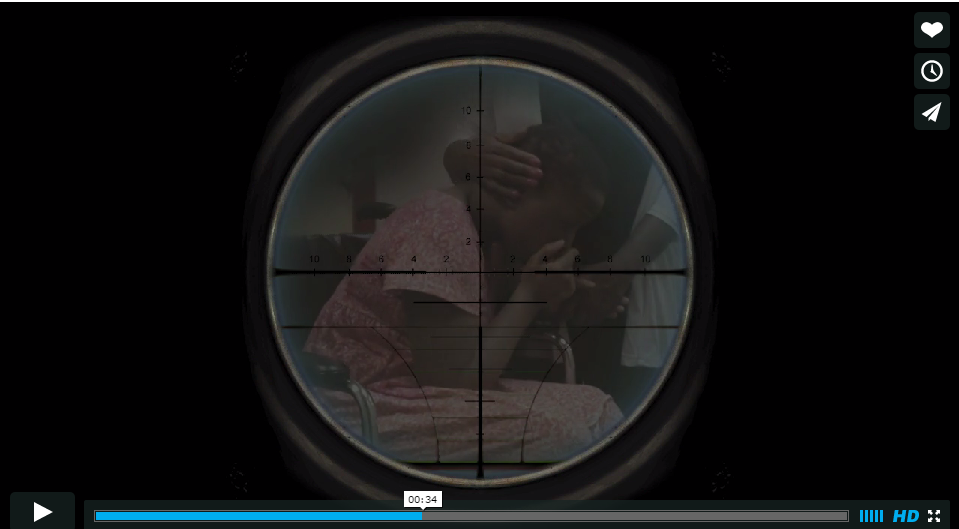
And in case we had any remaining thoughts that this was a documentary, enter the image of a house as seen through a sniper scope.  As the sniper scope zooms in we see that the target is an African American in a wheel chair.

feast sniper

Perhaps this is some sort of allusion to Mr. Wakefield’s first video, the Hitler/Pol Pot/Stalin video where he claimed that the CDC was engaging in a new Tuskegee experiment.   If so, why is the image of an African American female? I ask because the alleged controversy Mr. Wakefield is trying to highlight was about African American males.

The video ends with footage of parents telling us that vaccines cause autism and an actor (presumably representing the “whistleblower”) walking up some stairs.  Finally, Congressman Darrell Issa is shown banging a gavel at a congressional hearing.  From the start of these events, Mr. Wakefield and Mr. Hooker and their team have been calling for a congressional hearing.  I do hope they sent this video (and the Hitler/Pol Pot/Stalin video) to Mr. Issa’s office.  I have a feeling that since the time that Mr. Issa accepted $40,000 in donations from people seeking a congressional hearing, he’s learned a great deal and this video will further his education.

The sad part of this is the exploitative use of autistic children seen under severe distress.  This exploitation does nothing to serve the very real needs of our community.  Also seen towards the end are images of Avonte Oquendo, who went missing from his school and was found dead months later.  Again, exploitation which does nothing to serve our communities.  Mr. Wakefield is grabbing whatever film clips he can whether they are related or not to his purported story.  This is the same trick he used with a previous trailer he produced, where he spliced video from the Judge Rotenberg Center into a completely different story.

If Mr. Wakefield weren’t doing so much damage to my community, his videos would be laughably bad.  I’m not laughing.

By Matt Carey

Final Reminder: 2014 IACC Call for Nominations Closes Friday, November 14, 2014!

13 Nov

The email below was just sent by the Office of Autism Research Coordination to remind the communities that the Interagency Autism Coordinating Committee is being reformed–nominations are still open but only until tomorrow.

In other words: if you want to be considered, or if you want to nominate someone else for consideration, now is the time to get those nominations in.

From OARC:

Final Reminder: 2014 IACC Call for Nominations Closes Friday, November 14, 2014!

Only one more day to send in submissions!

The Office of the Secretary of Health and Human Services (HHS) is seeking nominations of individuals to serve as non-federal public members on the Interagency Autism Coordinating Committee, a federal advisory committee established in accordance with the Combating Autism Act of 2006 (Public Law 109-416, PDF – 49 KB) and reauthorized by the Autism Collaboration, Accountability, Research, Education and Support Act of 2014 (Public Law 113-157, PDF – 211 KB).  The Committee, composed of federal officials and public stakeholders, provides recommendations and advice to the Secretary of HHS regarding issues related to autism spectrum disorder (ASD), including ASD research and services activities.

The Office of the Secretary of HHS has directed the Office of Autism Research Coordination to assist the Department in conducting an open and transparent nomination process. Nominations of new public members are encouraged, and current members may also be re-nominated to continue to serve. Self-nominations and nominations of other individuals are both permitted. Final selections and appointments of public members will be made by the Secretary. The period of service will be from the time of appointment through September 30, 2019.

The call for nominations opened on October 1, 2014 and will close at the end of the day (11:59 p.m.) on November 14, 2014. Please ensure e-mails or standard mail/Fedex are sent and date and time stamped by the given deadline.

Please click on the links below for information about the committee, and the requirements and instructions for submitting a nomination.

London McCabe

8 Nov

London McCabe was a six year old kid.  He was a kindergartner whose principal described him as loving to sing and happy.  He liked hats.

I wish when news outlets would report on murders, they would start with who was killed.  The good points of the person.  What we as a people lost.

I bring that up because, as you likely suspect, London McCabe was killed.  Earlier this week, London McCabe was killed when his mother threw him from a bridge, from which he dropped about 133 feet to the frigid waters of a river below.  That’s about a three second fall.  Three seconds is short, I grant you, but long enough to feel abject terror.

If news articles focused on the victim, perhaps that sort of fact would come forward.  Perhaps we would be put in the place of sympathizing with the victim.

When you think of secondary victims, they would be the family and friends who knew and loved London.   People who had no way to avoid thinking about how he died.  I know I can’t avoid it. I can’t avoid thinking of my own kid terrified and falling.

I wish news articles wouldn’t immediately jump on the disability (or disabilities) of the victim, like the first article I saw.  For London McCabe was autistic.  Nonverbal.

Facts about motive are very scarce right now.  There are indications that the mother suffered from some mental illness.  As a community we’ve seen that argument play out all too often as a “blame the victim” approach: it’s hard to raise an autistic child and the parent buckled under the pressure.  We’ve seen this approach used cynically.  That doesn’t preclude actual mental illness in this case.  We ask for equality in the treatment of those who kill in our community.  Equality means not throwing our friends in the mental illness community under the bus.  The disability of the victim is not an excuse.  It is not a mitigating factor.  Real mental illness is.  Let’s see what the facts are in this case.

London McCabe’s family is not ready to discuss the details, but has released this message at a prayer vigil:

We are deeply touched by the community outpouring of love and support for our family…The best way you can honor him and not let his death be in vein is to purpose in your hearts to respond in kindness, love and respect toward all those people in your lives especially those with special challenges…Don’t allow hatred, anger, bitterness, or revenge to fill your heart

By Matt Carey

Andrew Wakefield: paid $316k to administer $80k in grants by the Strategic Autism Inititiative

7 Nov

When Andrew Wakefield left Thoughtful House (which has since changed it’s name and removed all mention of him from their website), he announced a new effort: the Strategic Autism Initiative. He was going to manage research into the causes of autism. That was in 2010. Now he bills himself as a video director of the Autism Media Channel. Makes one wonder how well that Strategic Autism Initiative thing worked out.

Well, we can’t tell for sure as tax forms are only available through 2012. But the trends tell us that perhaps, just perhaps, the Strategic Autism Initiative lost steam in their fundraising.  Donations are way down.  And a lot of money has gone into salaries and very little into actual programs.

Strategic Autism Initiative 2010 tax form
Strategic Autism Initiative 2011 tax form
Strategic Autism Initiative 2012 tax form

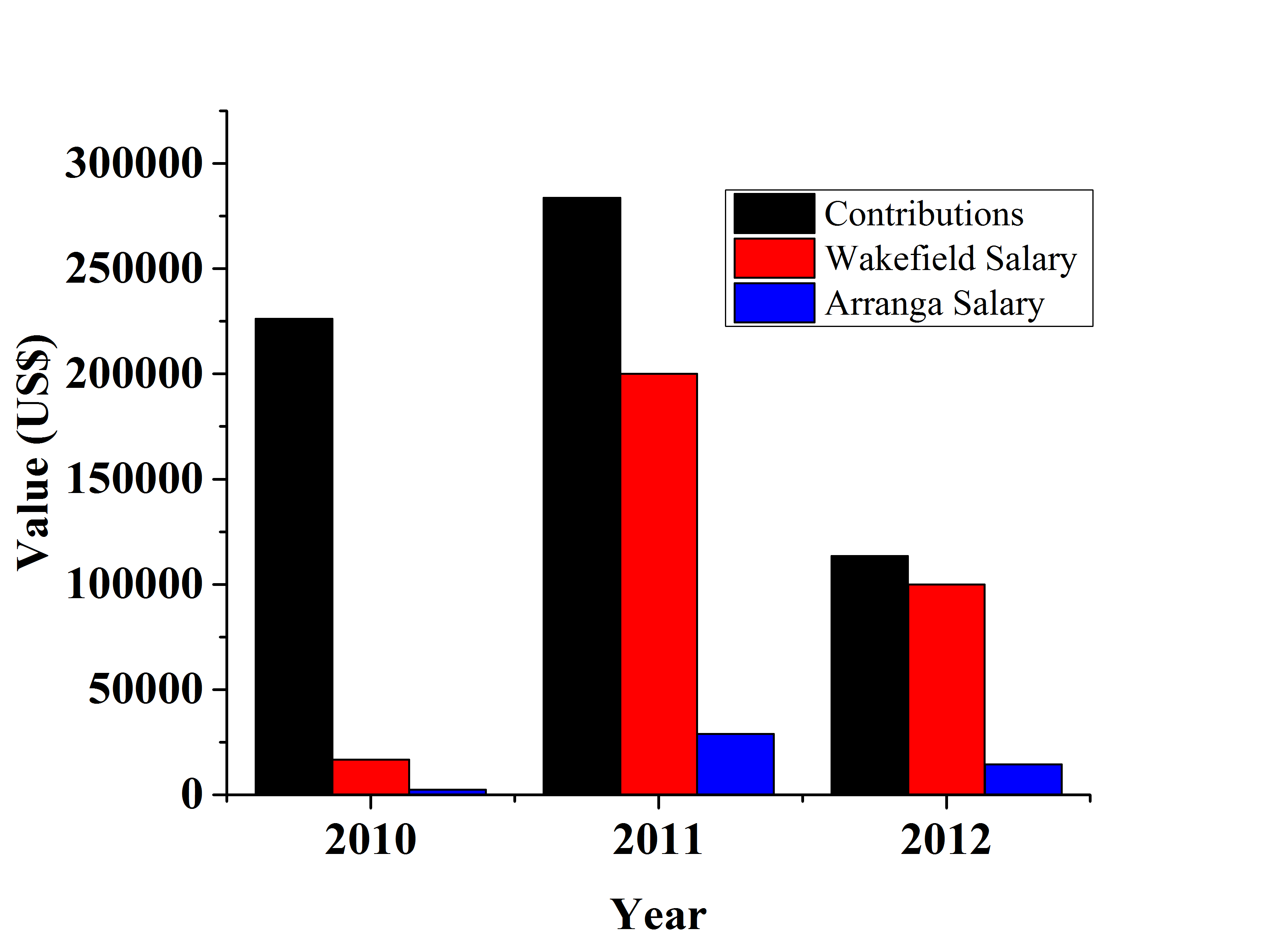
Let’s do a little summarizing. Let’s look at trends for the money they take in (contributions) and the money that they’ve put out in salaries. The Strategic Autism Initiative pays Andrew Wakefield and Terry Arranga.

SAI contributions and salaries

OK, you gotta hand it to Andrew Wakefield–he pulled in $623k in 3 years, basically on his name and reputation. And, he took $316k of that money, about 50%. In total, salaries accounted for 58% of what the SAI took in. The first year of the SAI (2010) was a short year, hence the low salary. Mr. Wakefield’s salary appears to be based on $270,000/year full time. Officially he was working 30hours/week in 2010 and 2011. 15 hours/week in 2012.

Notice that the contributions were way down in 2012. Still a sizable $113k, but down from the previous years.

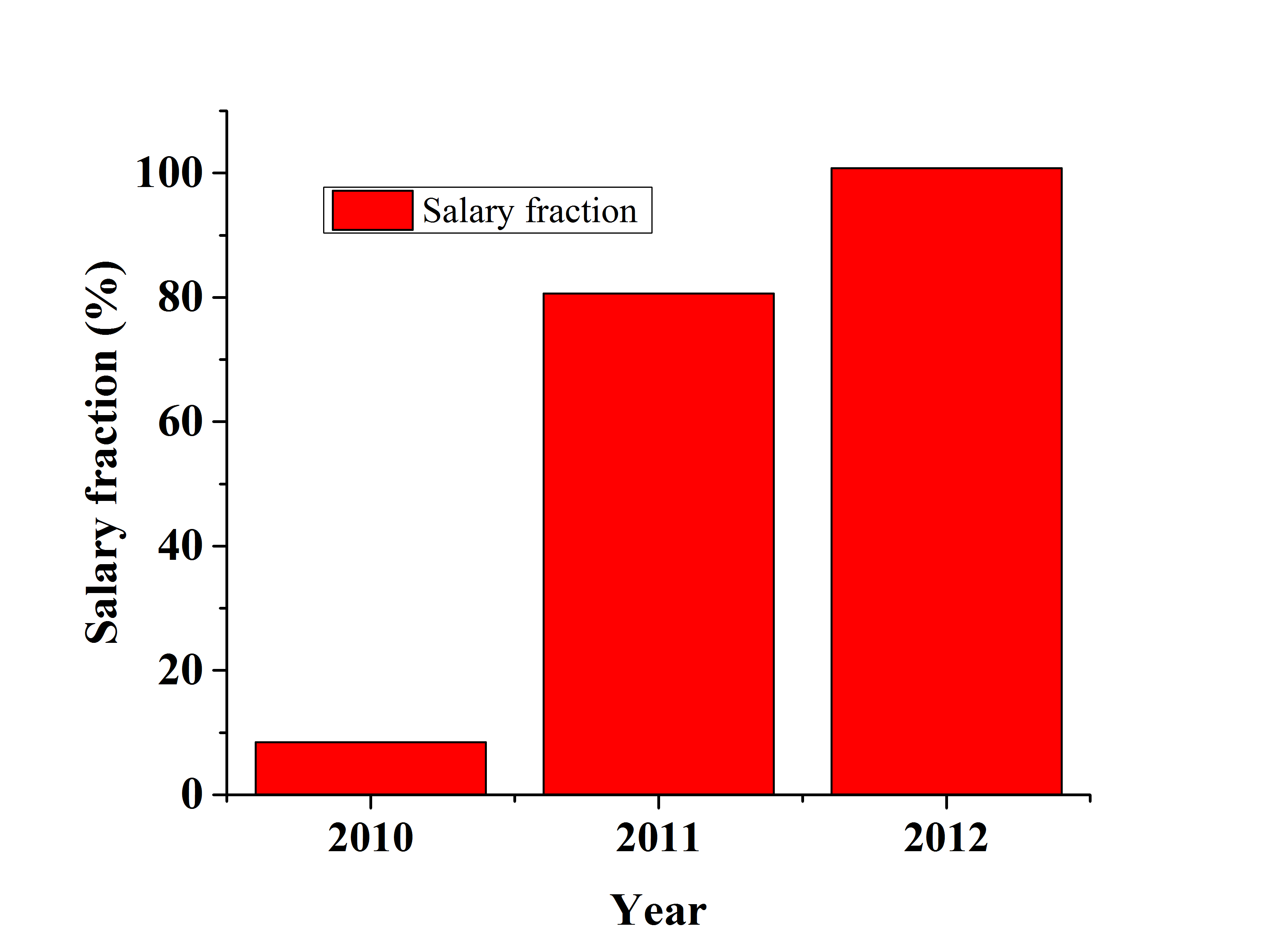
How does the salary outlay compare to the intake over the years? Well, it was relatively low the first year (the short year) and climbed to 80% in 2011 and 100% in 2012.

Salary Fraction

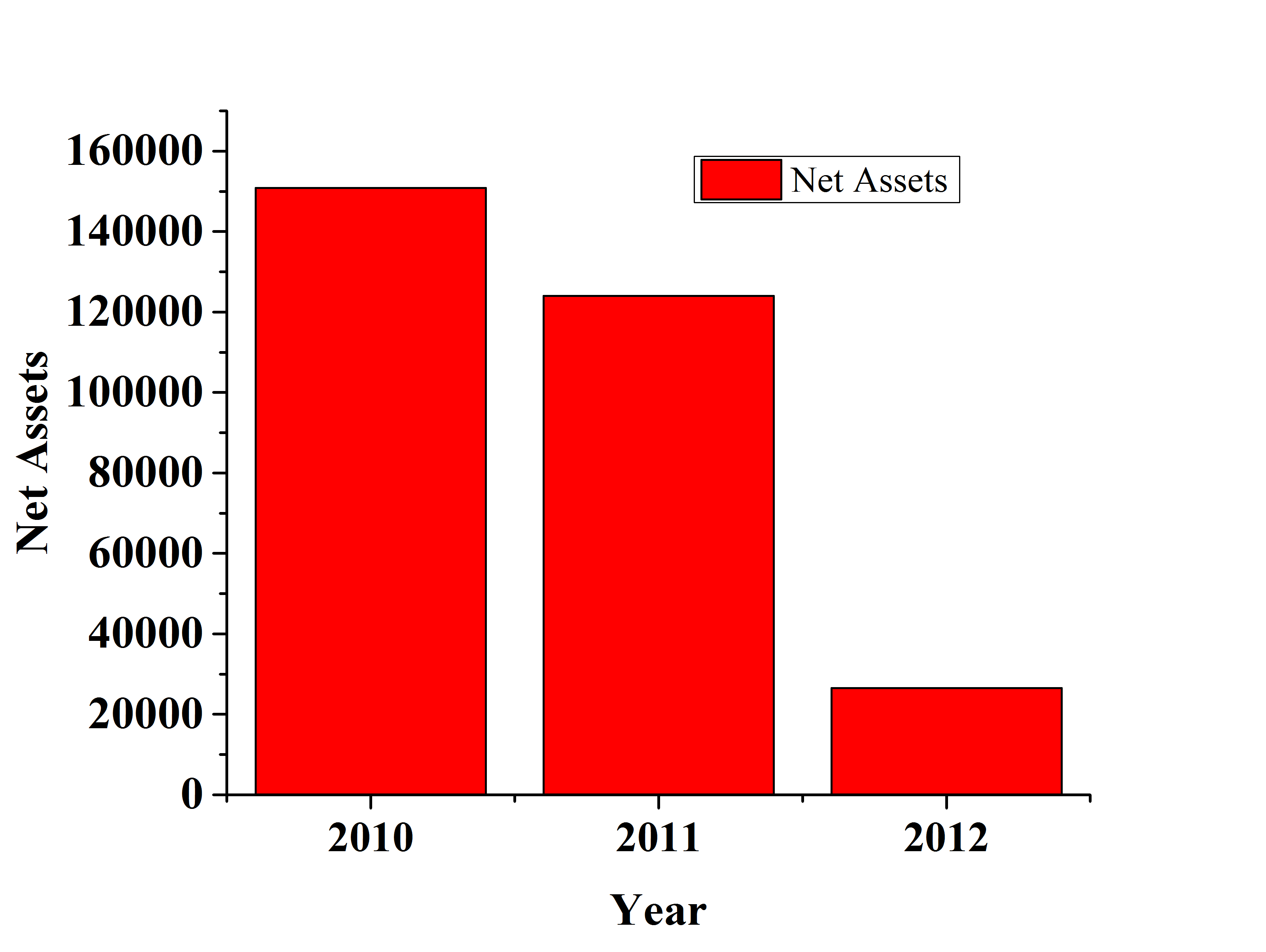
Not what one would call sustainable. Well, I guess if all one does is put money into salaries, that’s sustainable. Not exactly what a charity is supposed to be, though. Which begs the question, how much money did they have on hand at the end of each year?

Assets

Yep, pay out most of your money in salary and watch your assets go down. Also gives a partial explanation for why Mr. Wakefield is only listed as working 15 hours a week in 2012–there wasn’t the money to pay him more. The SAI would be about $70k in debt had they paid him for 30 hours/week.

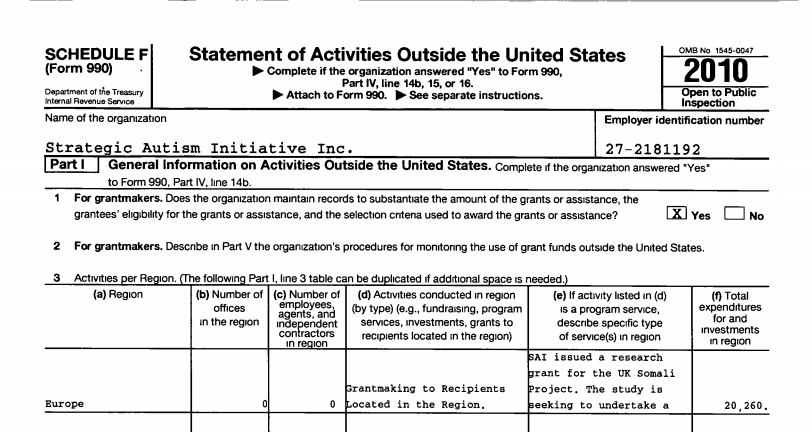
In 2010, they paid out $20,260 in a grant to perform a UK Somali study.

SAI 2010 grants

In 2011 they paid out a $25k grant to Generation Rescue for a “vax/unvax study”

SAI 2011 grants

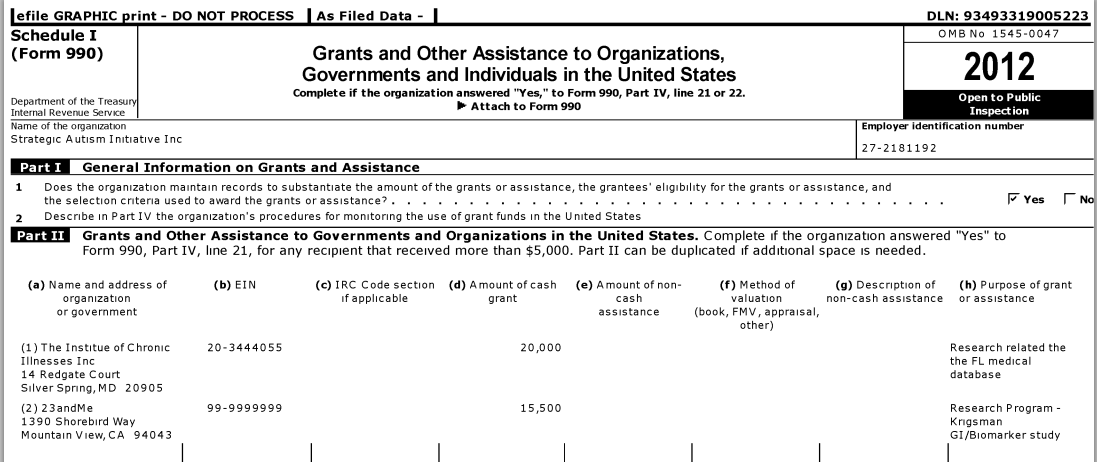
In 2012 they paid out $35k in grants. One to Mr. Wakefield’s former Thoughtful House colleague Arthur Krigsman and another to the Geiers for a study using the Florida medical database.

SAI 2012 grants

So, let’s consider this. In three years, Mr. Wakefield managed to give out 4 grants. Total of about $80k in grants. And for that effort he was paid $316k. What’s the supposed goal of the Strategic Autism Initiative?

SAI mission

“…to promote research in areas of autism and neurological disorders…”

Right. Promote research. About 13% of their budget went to promoting research. And that’s before we even consider the quality of that research.

Some bright people believe Andrew Wakefield. Some wealthy people believe Andrew Wakefield. Why, I don’t know. But even those who believe in what he says may someday question whether getting $0.13 on the dollar to the cause is worth keeping Andrew Wakefield employed.


By Matt Carey

A look at the analysis plan for DeStefano’s MMR study: no evidence of fraud

16 Oct

Andrew Wakefield and Brian Hooker have been making claims that the CDC are involved in misconduct in autism research. In case you haven’t followed the story, it basically goes like this:

1) the CDC planned on a study of MMR and autism using the MADDSP data.

2) That the CDC created a research plan.

3) That the CDC found results they didn’t want to report: an calculated odds ratio for African American boys. So the CDC team allegedly deviated from that plan and didn’t report that result.

4) That the CDC introduced a new analysis after the plan: that they would include birth certificate data.  While the CDC rationale for this new analysis was to provide more data (confounding variables) for the analysis, the allegedly real reason was to dilute the sample set and make statistically significant results disappear.

Here’s a paragraph from one of the press releases about the Hooker study:

According to Dr. Thompson’s statement, “Decisions were made regarding which findings to report after the data was collected.” Thompson’s conversations with Hooker confirmed that it was only after the CDC study coauthors observed results indicating a statistical association between MMR timing and autism among African-Americans boys, that they introduced the Georgia birth certificate criterion as a requirement for participation in the study. This had the effect of reducing the sample size by 41% and eliminating the statistical significance of the finding, which Hooker calls “a direct deviation from the agreed upon final study protocol – a serious violation.”

Or so goes the story. But as is often the case with Andrew Wakefield and Brian Hooker, the facts don’t match the claims.

In a recent video, Mr. Wakefield shows us the research plan the CDC had drafted.  One red flag with Mr. Wakefield’s approach so far has been how he tries to tightly manage the flow of information.  He has not shared the analysis plan in total and only now has he provided us with a couple screenshots.  Begs the question: what are they hiding?

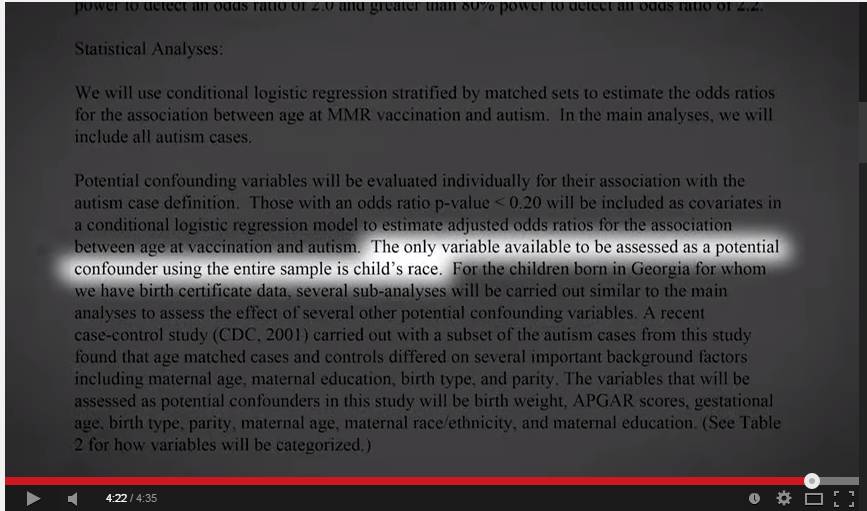
Here’s one screenshot from that video. This one is where he gets the idea that the plan was to report race for the entire sample.

draft analysis plan screenshot 2

Here’s the full text, in case that’s difficult to read:

Statistical Analysis

We will use conditional logistic regression stratified by matched sets to estimate the odds ratios for association between age at MMR vaccination and autism. In the main analyses, we will include all autism cases.

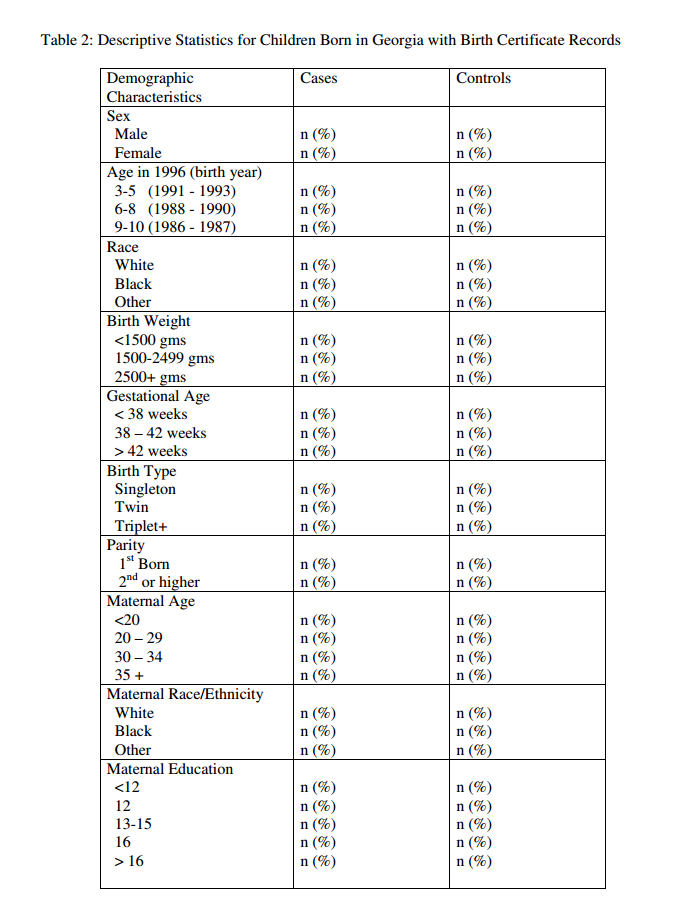
Potential confounding variables will be evaluated individually for their association with the autism case definition. Those with an odds ratio p-value < 0.20 will be included as covariates in a conditional logistic regression model to estimate adjusted odds ratios for the association between age at vaccination and autism. The only variable available to be assessed as a potential confounder using the entire sample is child’s race. For the children born in Georgia for whom we have birth certificate data, several sub-analyses will be carried out similar to the main analyses to assess the effect of several other potential confounding variables. A recent case control study (CDC, 2001) carried out with a subset of the autism cases from this study found that age matched cases and controls differed on several important background factors including maternal age, maternal education, birth type, and parity. The variables that will be assessed as potential confounders in this study will be birth weight, APGAR scores, gestational age, birth type, parity, maternal age, maternal race/ethnicity, and maternal education. (See Table 2 for how variables will be categorized.)

There are two interesting points in the above.  First, the sentence Mr. Wakefield highlights doesn’t say what he claims.  The only variable available to be assessed as a potential confounder using the entire sample is child’s race. The plan doesn’t say that they will test and report race.  Consider the context: this is a section of the plan called “statistical analysis”. Put in context with the entire paragraph, this sentence is clear: the full dataset is limited because it only has one variable available.

The CDC didn’t deviate from the plan when they didn’t report on race for the total sample because that was never in the plan.  If you want more evidence of this, the end of the paragraph says “See Table 2 for how variables will be categorized”.  Table 2 is titled “Descriptive Statistics for Children Born in Georgia with Birth Certificate Records”.  The variables will be categorized in the birth certificate sample.

The second interesting point from the paragraph Mr. Wakefield has shown us is this: the CDC plan included a birth certificate sample.

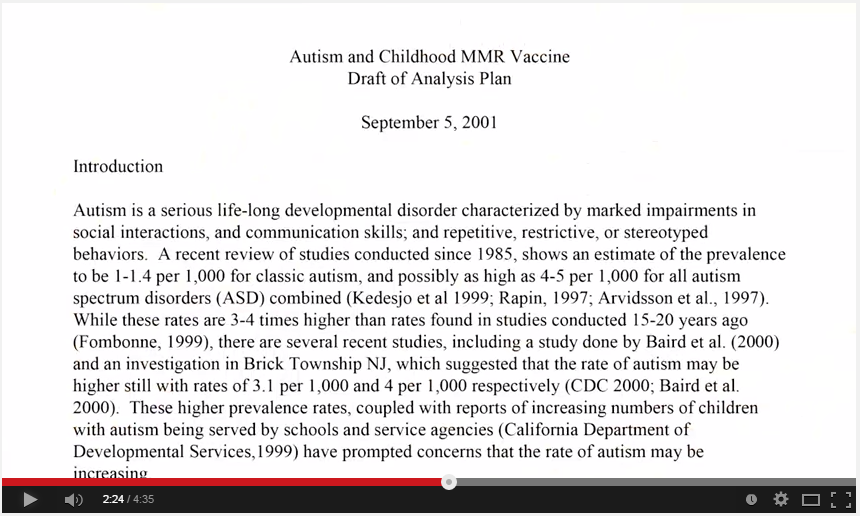
Here’s a screenshot of the analysis plan from that new video, showing the front page of the analysis plan:

draft analysis plan screenshot

Shown with this voice over by Mr. Wakefield (while the screenshot above is shown going up in flames…very dramatic)

“Over the ensuing months, after the data after the data had been collected and analyzed, and strictly forbidden in the proper conduct of science, the group abandoned the approved analysis plan, introducing a revised analysis plan to help them deal with their problem.”

So, in case you were thinking, “that’s an analysis plan, how do we know it’s the analysis plan”, well, you have Mr. Wakefield’s word on it.  This is the “approved analysis plan” that the CDC allegedly had to revise.

What interests me about this as that’s the same plan that I have and was preparing to write about.  It’s nice now to be able to be able to say that this is, indeed, the same document that Mr. Wakefield and Mr. Hooker are working with.

We’ve already seen two big mistakes by the Wakefield/Hooker team: first that the analysis plan doesn’t include a call to report on race separately in the total sample (the group without the birth certificates), second that the CDC “approved analysis plan” included analysis of a subset with birth certificate data.

So, what were the objectives of the study as in the plan?

Objectives:
We did not have information regarding onset of symptoms for most cases in this study and this limited our ability to do certain types of analyses such as case series analyses. In addition, a totally unexposed group (i.e., never received the MMR vaccine or other measles containing vaccine) was not available since measles, mumps, and rubella vaccination are required for school attendance in Georgia. The following objectives are considered the primary objectives for this study.
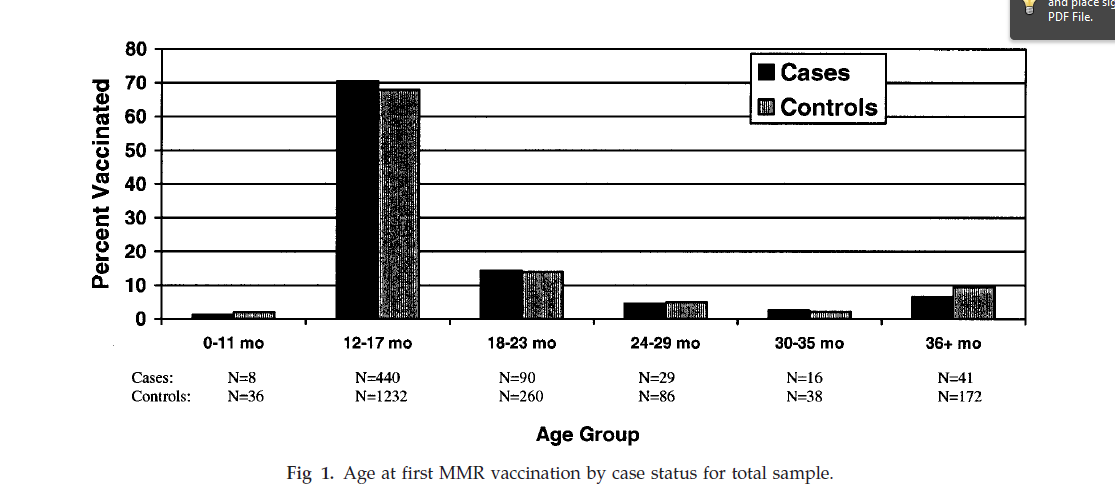
1) To determine if case children were more likely than their matched controls to have been vaccinated with MMR before 36 months of age. DSM-IV criteria for autism require that onset of symptoms occur before 36 months of age. Therefore, the 36-month cut-off is one that by definition can be used to classify a definitely “unexposed” group.
2) To determine whether there was a difference between cases and controls in the proportion of children exposed to their first dose of MMR vaccine before 18 months of age. This objective is based on the research that suggests the timing of first parental concern for the development of autism appears around 18 months of age (Taylor et al, 1999). In addition, Cathy Lord has reported that the range of first parental concern for regression was between 12 and 23 months of age with a mode of 19-21 months.
3) To determine whether the age distribution for receipt of the MMR vaccine differs between cases and controls.

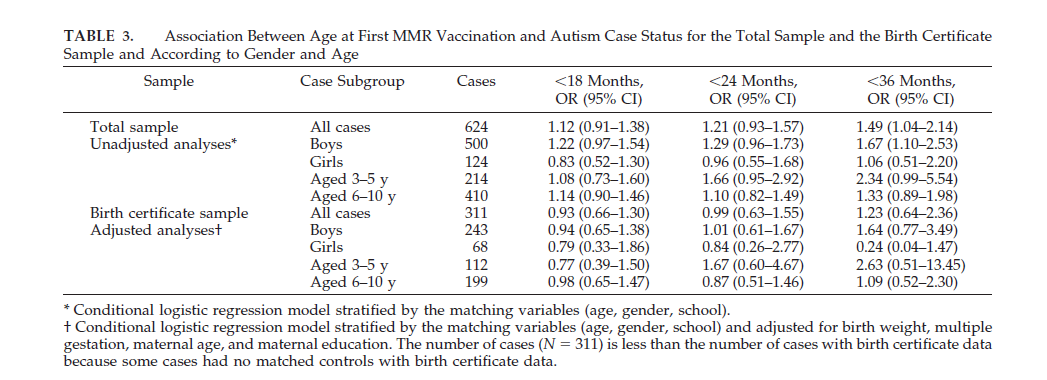
They showed the data for the 36 and 18 month cutoffs.  Age distribution was covered in Table 2.

Analysis of Autism subgroups

The IOM (2001) specifically recommended additional research regarding autism subgroups and MMR. We will examine several subtypes of autism in this study. Data from the Metropolitan Atlanta Congenital Defects Program will be included in the sub-analyses to identify particular sub-groups. The following sub-group analyses will be conducted:

1) Analyses excluding cases with an established cause for autism or a co-occurring condition suggesting an early prenatal etiology (e.g., tuberous sclerosis, fragile X, or other congenital/chromosomal anomalies.)

We propose to conduct a case-control sub-analysis looking at cases without an established or presumptive cause for autism, such as tuberous sclerosis, fragile X, and other congenital/chromosomal anomalies. The purpose of doing this analysis is to create a more homogeneous case group that may be more likely to be impacted by the timing of the MMR vaccine. The objectives from the primary analyses will be replicated in this sub-analysis.

2) Analyses of Isolated versus Non-isolated Autism.

Isolated autism cases are cases with no other co-morbid developmental disability while non-isolated cases do have a co-morbid developmental disability. Previous research suggests that the majority of non-isolated cases have a co-existing developmental disability of mental retardation (CDC, 2001). Both isolated and non-isolated cases will be compared separately to controls. The objectives from the primary analyses will be replicated in this sub-analysis.

3) Analyses examining Gender Effects

Males are at substantially higher risk for autism and may be more vulnerable to the exposure associated with the MMR vaccine. We will analyze males and females separately and replicate the main objectives of the primary analyses as well as examine the potential confounders available from Georgia birth certificates.

4) Analyses excluding autism cases with known onset prior to 1 year of age.

For a subset of autism cases, we were able to identify the timing of parental concern. This sub-analysis will exclude all cases excluded with an established or presumptive cause for autism (e.g., tuberous sclerosis, fragile X, and other congenital/chromosomal anomalies.) and children for whom we have been able to identify first parental concern prior to 12 months of age.

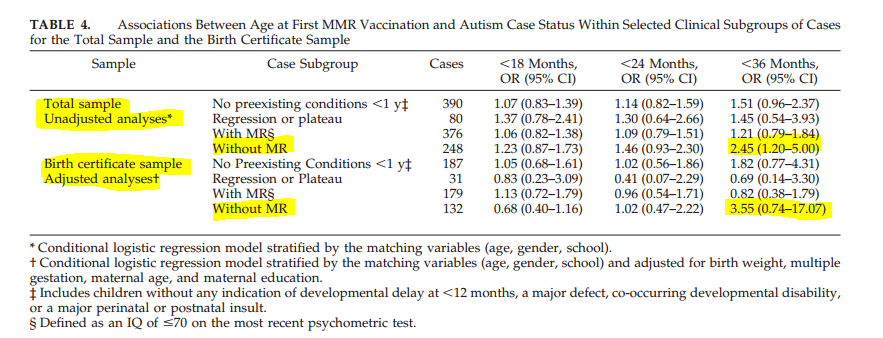
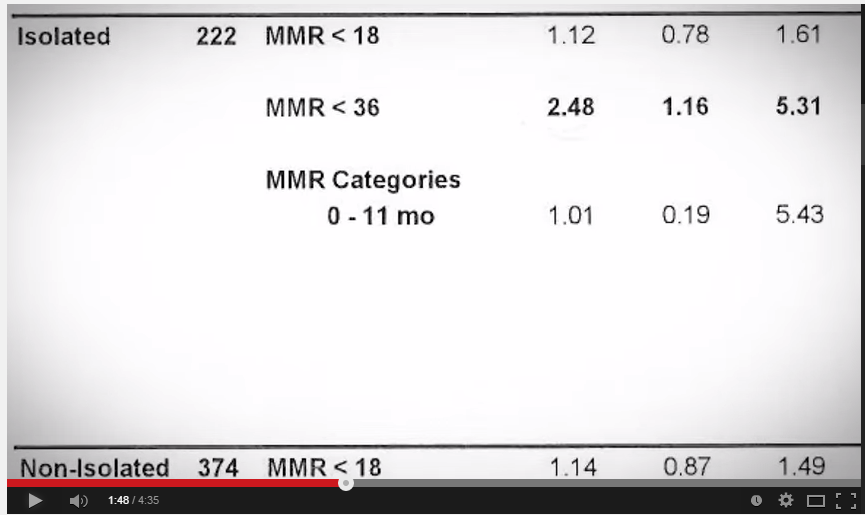
Just in case anyone reading this is one of the few that has been following Mr. Wakefield’s video releases: in a new video Mr. Wakefield is trying to claim that the isolated autism subanalysis was not done.  Except that it was.  They made a minor change to autism without MR, which gave essentially the same result that Mr. Wakefield claims was hidden.

Destefano_table_4 highlighted

Autism without MR has an odds ratio of 2.45 with a 95% confidence interval of 1.20 to 5.00.  I’ll write about this new video soon as there’s much sleight of hand going on, but Mr. Wakefield is claiming that a result of odd ratio = 2.48 with confidence interval of 1.16 to 5.31 was not reported.  Besides ignoring the fact that the data were reported by the CDC, Mr. Wakefield ignores the fact that these are raw-data results.  Total sample, unadjusted analysis.  In the adjusted analysis the result does not suggest an association.

But, getting back to the main point: the claims of fraud are just not founded on fact.  The two main claims of “fraud” are just wrong.  The analysis plan did not state that they would do a subanalysis by race for the total sample.  The addition of the birth certificate data is in the plan, not in some sort of revision.  And Mr. Wakefield and Mr. Hooker knew this.

I am reminded of a quote from an ABC News article recently

“There are always going to be those people at the edges of science who want to shout because they don’t want to believe what the data are showing,” said Dr. Margaret Moon, a pediatrician and bioethicist at Johns Hopkins Berman Institute of Bioethics. She said she thought the study author “manipulated the data and manipulated the media in a very savvy and sophisticated way.”

“It’s not good. It’s not fair. It’s not honest. But it’s savvy,” Moon said.

By Matt Carey

Jude Mirra’s mother takes the stand in murder case

9 Oct

Jude Mirra was an autistic 8 year old.  Was as in he’s dead.  His mother killed him with a fatal overdose of drugs and alcohol.  His mother, Gigi Jordan, is now on trial for his murder.

If you have followed this story, you likely know what a strange story she has told.  At one point someone (presumably associated with her) posted multiple documents online (gigijordanbail.com as I recall).  Rather than focus on her account, let’s consider the facts.  She killed her son.  The only question now appears to be whether she forced the drugs into his mouth or not.  From the New York Times, In Testimony, Mother Who Killed Son, 8, Denies She Forcibly Drugged Him:

The police found the boy, Jude Mirra, dead in a bed at the Peninsula Hotel at about noon on Feb. 5. The door had been barricaded with a chair. Ms. Jordan was on the floor next to the bed, surrounded by pills. A pill crusher and a syringe used to force feed patients were discovered, along with empty vodka bottles.

An autopsy showed Jude had ingested fatal doses of several medications, including the sleeping pill Ambien and the tranquilizer Xanax. A medical examiner testified the boy had bruises on his face and chest consistent with having a mixture of pills forced down his throat.

She claims that her son was being abused by multiple people, including his biological father.  And, her story goes, she was being stalked by her son’s legal father (her former husband) who was trying to have her murdered. And, if I recall correctly, he also was allegedly abusing Jude.  She had to kill her son, you see, to protect him from falling into the hands of his abusers.

The Post discusses her stories in Someone lock up Gigi Jordan once and for all!.  But what do we have except another version of “I had to kill him to protect him”.

CNN is also reporting the story, noting:

“His fate was sealed,” assistant district attorney Matt Bogdanos said in opening statements. “He didn’t die fast. One by one, his vital organs shut down. It didn’t take minutes. It took hours to die.”

While Jude lay dying, Bogdanos said, Jordan sent an email to a financial adviser instructing him to transfer the $125,000 trust she set up for her son to her personal account.

It took him hours to die.  And the mother, who supposedly was attempting suicide, transferred money out of his account while he was dying.  It’s not like the police arrived just in time to save the mother from her pills, either:

The exact time of the boy’s death could not be determined, but Jude’s body temperature was 80 degrees, suggesting that when police arrived, he had been dead for 8 to 14 hours, Bogdanos said.

Sadly, Jude’s mother appears to have been a part of the “cure at all costs” community.  The New York Times is also reporting.

For several years, Ms. Jordan took him to medical specialists across the country, seeking a cure for his symptoms and subjecting him to experimental chemotherapy, injections of powerful steroids and filtering his blood to counteract autoimmune disorders.

How much did the false hope sold by charlatans play into this murder?  We may never know.  Jude died in 2010 at age 8.  He grew up during the height of the “better dead than autistic” rhetoric.

Jude’s mother is reportedly using her defense to obtain a manslaughter conviction rather than murder.  She’s quoted as calling this a “mercy killing”.

This is no mercy killing.  This is murder.  Brutal murder.  I hope the jury sees through Ms. Jordan’s bizarre stories.

Matt Carey

Retracted: Measles-mumps-rubella vaccination timing and autism among young african american boys: a reanalysis of CDC data

5 Oct

About two months ago an autism parent published a study: a “reanalysis” of a CDC dataset. That study: Measles-mumps-rubella vaccination timing and autism among young african american boys: a reanalysis of CDC data.

Here’s a screenshot of how the article looks online today (click to enlarge):

BadStudyRetracted

The retraction reads:

The Editor and Publisher regretfully retract the article [1] as there were undeclared competing interests on the part of the author which compromised the peer review process. Furthermore, post-publication peer review raised concerns about the validity of the methods and statistical analysis, therefore the Editors no longer have confidence in the soundness of the findings. We apologise to all affected parties for the inconvenience caused.

Previously, the editors had an “expression of concern” about the article:

The Publisher of this article [1] has serious concerns about the validity of its conclusions because of possible undeclared competing interests of the author and peer reviewers. The matter is undergoing investigation. In the meantime, readers are advised to treat the reported conclusions of this study with caution.

Further action will be taken, if appropriate, once our investigation is complete.

Comment on

Brian Hooker. Measles-mumps-rubella vaccination timing and autism among young African American boys: a reanalysis of CDC data. Translational Neurodegeneration 2014, 3:16.

An excellent discussion of this study and the questions raised by it can be found at MMR, the CDC and Brian Hooker: A Guide for Parents and the Media


By Matt Carey