Tag Archives: Autism

Brian Deer’s original 2004 Channel 4 report on Andrew Wakefield: MMR: What they didn’t tell you

5 Oct

When Andrew Wakefield presented his hypothesis linking autism to the MMR vaccine in 2014 1998, he fueled a vaccine scare that is still alive today. It wasn’t until 6 years later that specifics about Mr. Wakefield’s actions were to surface. First in a newspaper story by Brian Deer (Revealed: MMR research scandal). Later that year in a BBC Channel 4 investigation: “MMR What they didn’t tell you.” I’ve never seen that Channel 4 program. Until today. Mr. Deer has placed it on YouTube. In three parts.

Part 1 introduces the topic. The MMR scare, the Wakefield 1998 Lancet paper and the press conference and the Royal Free’s video given out to the press. A discussion with an epidemiologist about the fact that there was nothing in Mr. Wakefield’s own work to support the triple MMR vaccine. Which leads us to the Wakefield patent for a substance that could be used as a vaccine–a vaccine which could only reasonably be expected to make a profit if the existing measles vaccine were considered unsafe–and as an autism “cure”.

Mr. Deer speaks with Ian Bruce, a researcher who worked with Andrew Wakefield on the patent. “The interpretation of that is quite clear to me..and that is that they have a vaccine for measles. Which presumably is an alternative to the existing vaccine.”

The thing is, the public was not told that Mr. Wakefield and the Royal Free had these commercial interests prior to Mr. Deer’s show.

Part 2 discusses the patent–the cure and vaccine aspects. The idea was that measles virus would be injected into a mouse. Those would be extracted, frozen, thawed, mixed with human cells, and injected into pregnant goats. The colostrum (part of the goat’s milk) would then form the basis of this vaccine/cure substance.

Sound like a strange idea to you? Well, Mr. Deer interviews medical experts who also think so. “the whole technique doesn’t make sense”. “It’s not credible”. “It’s strange”.

Mr. Deer tries to interview Dr. Roy Pounder, Mr. Wakefield’s former supervisor at the Royal Free. Mr. Pounder at first agrees then refuses to be interviewed.

Mr. Deer then goes to American and interviews Hugh Fudenberg, collaborator with Mr. Wakefield and co-inventor on the patent. Mr. Fudenberg at the time was charging up to $750 an hour to see and treat autistic children. He too considers Mr. Wakefield’s treatment to be unfounded. However, Mr. Fudenberg had a cure of his own, made from his own bone marrow.

Mr. Deer discusses some of the criticism of Mr. Wakefield’s work, including a statement from someone who worked in the Royal Free Hospital, including a comment that the work amounted to abuse.

Part 3 includes a discussion with Nick Chadwick, a student in Mr. Wakefield’s laboratory during the MMR/Autism research. Mr. Chadwick tested the tissues for measles virus, and found there was none in the autistic children being seen by Mr. Wakefield’s team. Also interviewed was Ian Bruce, a colleague of Mr. Wakefield’s, and also a supervisor for Nick Chadwick. Both Chadwick and Bruce are highly confident that if there were measles virus in the tissues, they would have detected it.

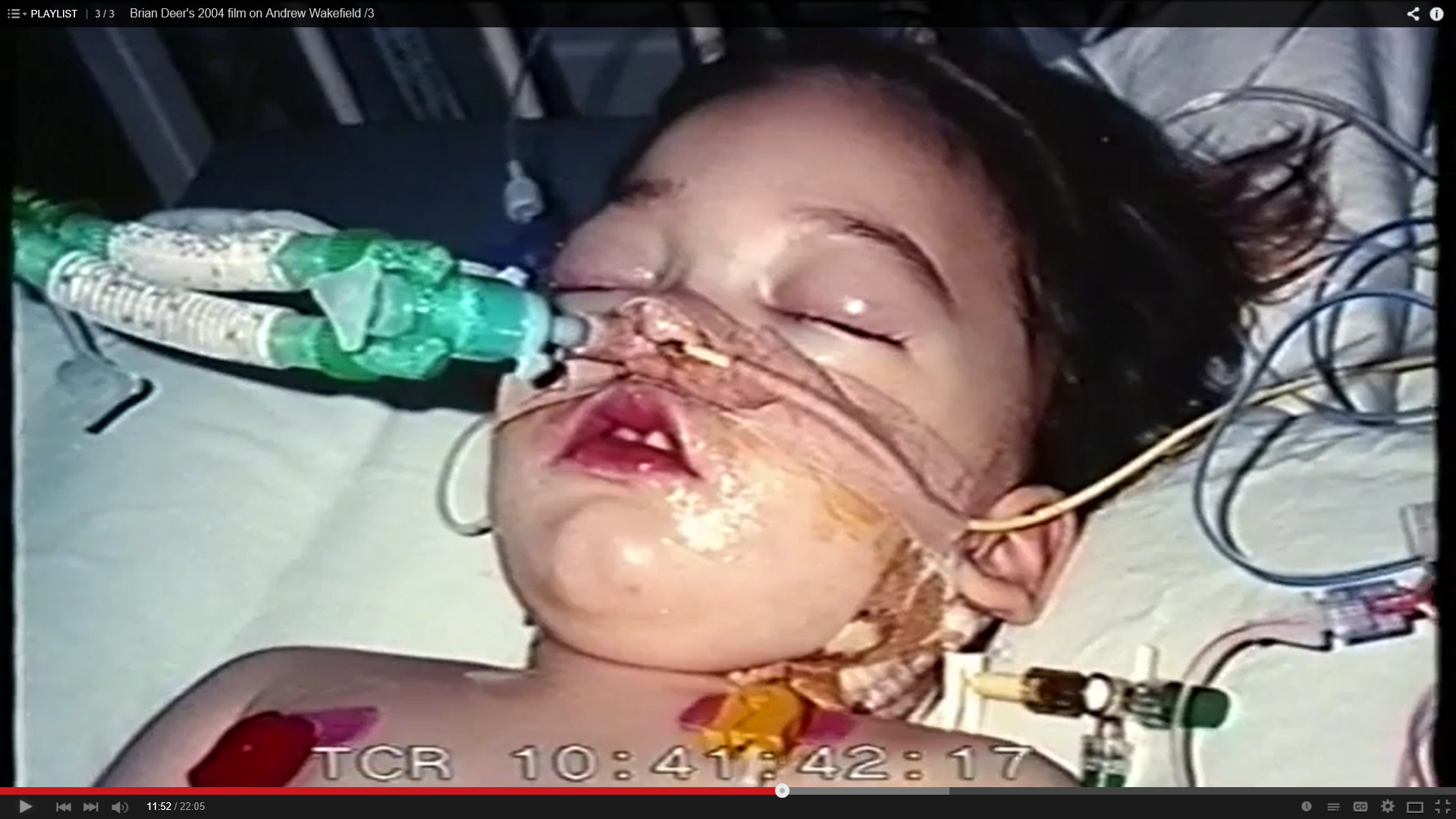
Mr. Deer discusses the 2000 measles outbreak in Ireland. He interviews the parents of one of the children who died in that outbreak. For those who keep saying that measles is mild, that in first world countries no one dies or is injured, here’s what a child dying of measles looks like in the first world. She took 11 months to die.

Result_of_Wakefields_Scare

Mr. Deer then goes to America to find and try to speak with Mr. Wakefield. Mr. Wakefield was listed as “research director” for Jeff Bradstreet’s clinic in Florida, but wasn’t there. The Bradstreet clinic had a host of supplements that one could purchase to “treat” autism. Mr. Deer eventually finds Mr. Wakefield at an Autism Society of America convention. Whereupon Mr. Wakefield runs away.

By the way–Thank you ASA for no longer inviting Andrew Wakefield to speak.

This investigative report together with the Sunday Times articles earlier in 2004 made a huge impact at the time. I know as I lived through it. The retraction of interpretation published by most of Mr. Wakefield’s co-authors on the 1998 Lancet paper (since fully retracted by the journal), was a big statement that this work was not solid. Of course, Brian Deer would eventually go on to win a U.K. Press Award for his MMR journalism and Mr. Wakefield would eventually be found to have been unethical in his research and struck off the register (lose his medical license).

The embedded version below should go through all three parts in sequence.

Autism Science Foundation Named as a Top Rated Nonprofit by Great Nonprofits

2 Oct

The Autism Science Foundation funds research related to autism.  They have been named as a “Top-Rated Nonprofit” by Great Nonprofits.  Below is the overview from the announcement website.

Mission:

The Autism Science Foundation supports autism research by providing funding and other assistance to scientists and organizations conducting, facilitating, publicizing and disseminating autism research. The organization also provides information about autism to the general public and serves to increase awareness of autism spectrum disorders and the needs of individuals and families affected by autism.

less

Results:

ASF has awarded over one million dollars in funding to scientists doing autism research since our founding in 2009. We also provide travel awards for autism stakeholders to attend the International Meeting for Autism Research each year.

We launched an awareness campaign to encourage brain tissue donation so scientists can investigate the neural underpinnings of autism spectrum disorders.

ASF advocated successfully for a new medical classification code for autistic wandering, which became possible after the ASF-funded wandering study published in the journal Pediatrics.

ASF board members and staff are frequently sought after by major national media (CNN, Wall Street Journal, Washington Post, USA Today, etc) to comment on autism related issues.

By Matt Carey

Let’s Talk Autism – next live Prime Ministerial Debate

26 Apr

I just received this message from Carole Rutherford at Autism in Mind and ask all UK readers to join us in trying to get autism discussed at the final televised debate between the party leaders.

The final Prime Ministerial debate takes place on Thursday night. The final debate is about the economy. It is estimated that there are at least half a million children and adults who have a diagnosis of autism. There are many more who have the condition without the diagnosis. There could be as many as 6 million families in the UK alone who are living with autism.

Autism-In-Mind and Asperger Syndrome Action by Parents want the leaders to talk about autism on Thursday night and we need your help now. We want you to submit the following question onto the BBC ‘Election Question’ form. The question is wrapped around the economy and how the money that is being spent on autism every year is being spent. It is important that we all ask the same question. We want 1000,s of people to ask this question by Thursday Night and if we can achieve this then maybe someone will listen to us and will talk about autism.

Question to submit to the BBC

A recent study by researchers at King’s College London estimated that autism costs the UK economy around £28.2 billion per year, and yet thousands of autistic/Asperger syndrome children and adults do not meet the criteria for any provision or services. Autism/Asperger syndrome requires services from the cradle to the grave. The only money attached to the newly published Autism Strategy will be half a million pounds for increasing awareness and understanding of autism among frontline professionals with nothing for service provision.

In the first debate there seemed to be recognition from all three parties that there is a huge social care agenda to be addressed in the future, but will it include autistic/Asperger syndrome and disabled people and what guarantee can you give that it will include them? How are you going to make sure that EVERY autistic child and adult is not left until crisis point before they are given the provision that they need? Many of us would like to know how much of the £28.2 billion is being spent on crisis management.<?b>

Here is where you post the question – you do have to give your name and where you live. You do not have to add a telephone number if you do not want to. If you do want to add this number 07960875526 this phone will be deactivated after Thursday night.

http://news.bbc.co.uk/1/hi/uk_politics/election_2010/8589502.stm

Here are some facts and figures produced about Autism last year by the National Audit Office – This might help you to understand how important it is for the Leaders to ‘Talk about Autism’ on Thursday night.
http://www.youtube.com/watch?v=eEKMsO9t0pU

Polly Tommey poses as advocate for autistic adults

7 Apr

Polly Tommey is in the news again with this piece in the Guardian, Attention-grabbing antics for autism. It concerns her latest poster campaign, timed to coincide with the start of the General Election.
Hello boys polle tommey poster

I have left the following comment.

I have followed Ms Tommey’s attempts to present herself as a mainstream autism advocate for some time now on my blog, Action for Autism, and your headline,”Attention Grabbing Antics” is apt. If Ms Tommey wants us “to move away from the discussion about vaccines because she knows how divisive it is” she could make a start by removing her current Face Book campaign, “Mothers Supporting Andrew Wakefield’s Work.”

Ms Tommey complains about “bickering.” But other organizations have no problem working together. The Autism Act came about with the support of 15 autism organizations working together. Many of their members served on the External Reference Group for the Autism Adult Strategy for England which reported to the government. They mobilized their members to submit over a thousand responses to help shape government strategy. This will be reflected in the statutory guidance that will be published later this year. Ms Tommey’s contribution to all this was nil.

She states that “we haven’t a clue what to do with adults with autism.” That is because she and her supporters have spent the last 10 years arguing that autism is a biomedical disorder of childhood that is treatable with the untested and unproven interventions marketed by her husband. The National Autistic Society has taken a different stance with its Don’t write Me Off campaign Most of us are not interested in what to do with autistic adults. But we we are trying to find out what we can do for them and what they want for themselves.

A Nasty Little Franchise

15 Feb

Wakefield may have the highest public profile but he is just one of many who seek to profit from autism and he is by no means the worst. Remember the Geiers? This father and son team from Silver Springs in Maryland have an unsavoury record that makes Wakefield seem almost reasonable.

Wakefield breached the terms of his hospital’s ethics committee. The Geiers, operating out of the family home, invented their own IRB and granted themselves ethical approval for experiments on children with a powerful drug called Lupron. Lupron is used to treat precocious puberty, a rare condition in young children. It is also used is also used to treat prostate cancer in men, to treat endometriosis in women, and to chemically castrate sex offenders. The Geiers use it on autistic children and young adults.

Kathleen Seidel has catalogued their bad science, plagiarism, inflated academic resumes, the fraudulent IRB, cruel and unnecessary blood draws, attempted deals with TAP pharmaceuticals and the Lupron Protocol itself on her Neurodiversity website. Trine Tsouderos at the Chicago Tribune covers all the basics in her recent profile of the Geiers,  ‘Miracle drug’ called junk science.

The most disturbing part of Tsouderos’ story was the news that the Geiers were rolling out a franchise for others to cash in on their unproven and dangerous protocol. According to their website they offer the following

  • Genetic Markers (DNA Fragile X Syndrome, Blood Chromosome, Chromosome Microarrays, DNA Rett Syndrome, Angelman/Prader Willi Syndrome)
  • Mitochondrial Dysfunction (Carnitine, Lactic Acid, Ammonia, Hand Muscle Testing)
  • Hormone Imbalances (Total Testosterone, Free Testosterone, DHEA, DHEA-S, Androstenedione, Dihydrotestosterone, Total Estrogens, Estrone, Estradiol, ACTH, Aldosterone, Prolactin, FSH, LH)
  • Oxidative Stress/Inflammation (Neopterin, Lipid Peroxides)
  • Detoxification Pathways (Glutathione, Cystathionine, Homocysteine, Methionine)
  • Immune System Function (Immune Deficiency Profile, HLA-Testing, Immune Complexes, Food Allergies, Celiac’s Disease)
  • Heavy Metals (Porphyrins, Blood Metals, Urinary Metals)
  • Neurological Dysfunction (Brain MRI scans, Brain SPECT scans)
  • General Health Status (Comphrensive Metabolic Panel)

And this is the team that will deliver these services.

  • Maryland: Mark Geier MD, geneticist and David Young MD, Obstetrician and gynaecologist.
  • Springfield, llinois: Mary Young MD, psychiatrist and neurologist.
  • Ft. Lauderdale, Florida: David Claymore, neuroradiologist.
  • Parsippany, New Jersey: Paul King, industrial chemist.
  • Indianapolis, Indiana: Melissa Troutman, radiologic technologist.
  • Dallas, Texas: Janet Kern, RN, neuroscientist.
  • Louisville, Kentucky: Janet Pope, RN

And that is it. The only member of the American Academy of Pediatrics is Mary Young who has worked as a child psychiatrist. There are no board certified endocrinologists or anybody with the board certification to diagnose and treat precocious puberty in children.

And what of David Geier BA? He remains vice-president of the non-profit 501(c)3 Institute of Chronic Illnesses, Inc. and the non-profit 501(c)3 CoMeD, Inc. Much of the profit from the franchise will be directed to “these corporations dedicated to
autism research and advocacy efforts.” sure. So families or their insurers will be paying for treatments for their children that have been condemned by real autism experts as junk science. And the profits from this enterprise will be used to fund more junk science. Do they have a GMC in America? Do they want to borrow ours?

Eugenic Arguments in the Times

23 Nov

Today’s Times carries an article that suggests that people with learning difficulties should not be allowed to have children because it would cost to much to support them. The children would suffer and some of these parents are also autistic “which will make loving and consistent parenthood extremely difficult.”

The article is confused and wrong in so many ways. I do not have the time to take it on right now but I hope people can read it and add their comments.

Political abuse and the abuse of autism

5 Nov

“Political autism” has emerged again in a row within the European Union (EU). Despite taking Britain into the EEC (the forerunner of the EU) in 1973, the Conservatives have always been vulnerable to disputes between their pro-European wing and the euro-sceptics who are mistrustful of European federalism and keen to defend British independence. The Labour Party has comparable factions within its ranks.

Thus political leaders of both the main parties have always had to perform a tricky manoeuvre, demonstrating their European credentials to a business community that knows where its markets lie and appealing to an electorate, many of whom prefer to blame faceless European bureaucrats for all our ills. This has led to an inconsistent approach that causes exasperation amongst some of our European partners.

This came to a head again this week over the lack of commitment by the Conservative Party leadership to the European Union. According to the Guardian

Pierre Lellouche, France’s Europe minister, described as “pathetic” the Tories’ EU plans announced today, warning they would not succeed “for a minute”.

Giving vent to frustration across the EU, which has so far only been expressed in private, Lellouche – who said he was reflecting Nicolas Sarkozy’s “sadness and regret” – accused William Hague, the shadow foreign secretary, of a “bizarre autism” in their discussions.

He said: “They have one line and they just repeat one line. It is a very bizarre sense of autism.”

This is not the first time autism has been used as a term of abuse in politics. But the National Autistic Society launched an immediate complaint

Autism (including Asperger syndrome) is a serious, lifelong and disabling condition. Comments such as those attributed to Pierre Lellouche, France’s Europe Minister, in which he seemingly suggests the Conservative Party, and in particular, William Hague, demonstrate a bizarre sense of autism are therefore extremely unhelpful.
To use the terms ‘autism’ and ‘autistic’ in a derogatory or flippant manner can cause deep distress and hurt to people affected by the condition. The National Autistic Society (NAS) is keen to address this issue, in order that these terms are not used lightly, particularly by commentators or people in positions of power or influence.
Autism is much more common than most people think and affects over half a million people in the UK. To use the terms as a criticism, for dramatic effect or to try and gain political advantage only perpetuates the confusion and misunderstanding which people with autism have to cope with everyday. This is simply unacceptable and must stop.

Today’s Times ran with the story of Monsieur Lellouche’s apology.

France’s Europe Minister has expressed his deep regret at causing offence by calling the Conservative Party “autistic”, but also blamed a mis-translation for the furore today.

Pierre Lellouche said that he was voicing his real concern about the Tories’ Eurosceptic slide under David Cameron when he reproached the party for “a very bizarre sense of autism” in an interview with The Guardian.

He also called their hostility to the European Union “pathetic” and said that the party’s policies in the European Parliament had “castrated” them. Aside from the political row, the remarks were condemned by autism advocacy groups.

However, although the minister said today his remarks were “clumsy”, he claimed that the term, which is colloquially used in French to refer to a stubborn person who does not listen, is a common term of political abuse in France.

Leaving politics aside, this derogatory use of autism reflects some very primitive and harmful ideas that still hold sway in France. Two years ago I wrote about an abusive “treatment” known as “packing” that is still going on today

“A French treatment for autistic children with psychiatric problems which involves wrapping the patient in cold, wet sheets from head to foot is undergoing a clinical trial for the first time, which critics hope will see an end to the controversial practice.

The treatment, known as “packing”, involves wrapping a child in wet, refrigerated sheets in order to produce a feeling of bodily limitation and holding, before psychiatrically trained staff talk to the child about their feelings. Critics have called the procedure cruel, unproven and potentially dangerous, but its proponents say they have seen results.”

This cruel treatment has been condemned by advocates for neurodiversity and proponents of biomedical cures alike. I have made my feelings regarding Lorene Amet’s position on vaccines and biomedical treatments perfectly clear here and, more recently, here. But I agree with her that Packing is barbaric.

It is time that the French medical and educational systems came to grips with the reality of today’s autism. Placing autistic children in hospitals, under psychiatric surveillance, refusing their inclusion in proper educational systems, refusing their access to medical examination
and treatments, violating their human rights and dignity, and even worse still allowing interventions such as “packing” to be conducted in hospital settings is unhelpful and has to be stopped.

According to the Times French autism organizations have welcomed the NAS response and are equally condemnatory of the casual use of autism as a term of political abuse in France.

French autism groups said that the affair demonstrated how offensive was the current use of the term in French public discourse.

Patrick Sadoun, a member of the Sesame Autism Association, said: “The English are right to be shocked. I congratulate a country that reacts to this. I am horrified that French politicians, at the slightest occasion, call one another autistic.”

While autism is an acceptable term of abuse autistic people continue to be the victims of unacceptable physical and psychological abuse.

This post is also available on Action for Autism.

Environment of Harmful Ideas

27 Oct

There used to be an email group on Yahoo devoted to the ideas in David Kirby’s book, Evidence of Harm? It was called Evidence of Harm or EOH for short. The book was ostensibly an exercise in investigative journalism.

  • Had there been a dramatic increase in autism amongst children born in the 1990s?
  • Was this increase caused by the increasing burden of mercury resulting from more thimerosal containing vaccines being added to the vaccine schedule at the beginning of the decade?
  • Was the government involved in a cover up?

Supporters of the vaccine-autism hypothesis saw the book as vindicating their beliefs. Hence the EOH group. But Kirby had always been clear about one thing. If mercury was a significant cause of autism then its removal from childhood vaccines should cause the numbers of new cases to fall. When the mercury was removed and numbers continued to rise Kirby wriggled a bit and then invoked environmental toxins as the reason. As a result the yahoo group Evidence of Harm changed its name to Environment of Harm. So now it was environmental mercury and not the mercury in vaccines. Well not any more. All versions of the Vaccine OS are a bit like Microsoft Windows . They have to be backward compatible with previous versions and are consequently laden with bloatware and very unstable. If you read the group today there are very few autism specific posts and lots of general anti-vaccine comments. This has slowed down the usual messages of sympathy for the perpetrator. But one member of EOH still managed this comment

But yesterday someone posted a link to yet another story of an autistic teen allegedly murdered by his mother. It is too early to speculate on the outcome and at least one newspaper has closed its online comment section on legal grounds until the trial is over. This has slowed down the usual messages of sympathy for the perpetrator. But one member of EOH still managed this comment. [edit]

To the group sadly I beleive we will see a rash of cases where , where they put there child to sleep. The same phenomena occured in england over a two year period , that force the UK gouv to increase funding Before they wake up , I suspect we will see many cases

Pierre

So murder is now “putting to sleep.” And heck it works! When parents went on a killing spree in the UK the government increased its spending on autism. I live in the UK I remember a few isolated cases of murder of autistics, no more, but sadly no less than what is happening in the rest of the world. I do not remember it leading to a growth in funding. What we have in the UK is a National Autistic Society that is committed to improving the lives of autistic people and their families. It operates across the lifespan. It does not demonize autism or cry wolf over vaccines and epidemics. Its campaigns section has enabled autistic people to talk directly to lawmakers and the law is changing. More services are on the way. But at no point were the deaths of autistic children exploited for campaign purposes. EOH is well named. If it can foster the sort of twisted thinking and disregard for the facts displayed by Pierre it truly is an environment of harm.

New research proposed for diet and autism

30 Aug

LBRB has a record of coming down hard on so-called complementary and alternative medicine (CAM). We support evidence based treatments and therapies. CAM is all too often an opportunity for snake oil merchants to rip off parents and potentially harm their children.

It may be  that some CAM interventions are beneficial. Properly conducted research may provide the data to support the claims for a particular therapy. So far the record is not good. Secretin has been tried and found wanting. Facilitated Communication could not live up to the hype. Holding Therapy was not only wrong it was abusive. Chelation is based upon fraudulent challenge testing that has been dismissed by the American College of Medical Toxicologists.

But that does not necessarily mean that all CAM therapies are bad. It does mean that they lack evidence and only research can provide that evidence. Note that evidence is not the same as the parent testimonials that CAM practitioners display on their websites and in their literature. Evidence is data collected by disinterested researchers whose methods and results are open to scrutiny. This is more reliable thsn testimonials, which may be influenced by all sorts of factors, including the placebo effect, recall bias and good old fashioned wishful thinking.

One researcher in the UK who has taken a scientific interest in CAM for autism is Professer Ann Le Couteur. She knows that lots of parents use CAM therapies and wants to investigate their effectiveness. In particular she is interested in parental and professional attitudes to dietary interventions, probably the most widespread alternative therapy for autism. To this end her department has sent out the following letter which is also available on the NAS website.

The study

Researchers at Newcastle University would like to find out about parents’ and child health professionals’ experiences of autism research and their attitudes to the use of the gluten- and casein-free diet as an intervention in ASD. We are carrying out two web-based surveys; one for parents/carers and the other for child health professionals who support children with ASD and their families. The results of these surveys will help us plan the design of UK research studies into biomedical and complementary and alternative therapies for children with ASD.

Participants

Parents/carers of pre-school or primary school-aged children with a diagnosed autism spectrum disorder, and child health professionals who support children with ASD and their families, are invited to take part.

What happens next?

If you are interested in taking part, please visit our website: PADIA. When you follow this link, you’ll go to a web page that tells you more about the study, and will ask you to enter some details.

We will then send you a letter of invitation with a unique ID number and the link to an information sheet. This information sheet has the link to the web-based survey.

If you would like any more information about this study, please contact:

Professor Ann Le Couteur
Tel: 01912 821 384
Email: padia@ncl.ac.uk

When I saw this my first thought was “What about the parents whose children have grown up? What about autistic adults? Do their opinions and experiences matter? So I wrote to Professor Le Couteur who promptly replied and gave me permission to share her reply.

MY LETTER

I recently received an invitation for parents of young children and health care professionals to complete a questionnaire that will assist you plan the design of UK research studies into biomedical and
complementary and alternative therapies for children with ASD. May I enquire if you are also interested in the opinions of parents of older children, and indeed of the adults themselves? Many of us have attempted to implement these therapies in the past or had them done unto us and our experience should not be ignored.

PROFESSOR LE COUTEUR’S REPLY

Dear Mike Stanton

I quite agree experiences of parents of older children and personal experiences are of great interest to us.

The research survey was funded for parents of primary school aged children only and the child health professionals that support them. However if you or anyone you know would be prepared to give us information about your/ their experiences in the past that would be really interesting. We cannot include the information in the survey but would be able to use the account to add to our knowledge and to inform our grant applications etc.

I also value personal accounts as these add great value to my talks and presentations if I have permission to share the experiences (in an anonymised form) for teaching and conference events

Thankyou for contacting PADIA

Your sincerely

Ann Le Couteur
Professor of Child & Adolescent Psychiatry
Institute of Health and Society
Newcastle University
Sir James Spence Institute
Royal Victoria Infirmary
Queen Victoria Road
Newcastle upon Tyne
NE1 4LP

Tel: 0191 2821398 (University)
0191 2821384 (University Secretary)
0191 2196455 (Clinical Secretary)

So there you have it: an autism researcher who is open to personal accounts from parents, professionals and autistic adults in order to assist her in formulating and designing her research programme into CAM. This is a positive invitation and I hope people avail themselves of this opportunity in the spirit in whch it is proffered.

Unscientific Americans

25 Aug

In Saturday’s Los Angeles Times, Lori Kozlowski talked to Chris Mooney in an article headed ‘Bringing science back into America’s sphere.’ The piece is about a book that Chris has co-authored with Sheril Kirshenbaum “Unscientific America: How Scientific Illiteracy Threatens Our Future.” It provoked such a lot of comments that they set up a blog so everyone could have their say.

Needless to say, as one of the book’s targets is the vaccine/autism camp and Chris mentions Age of Autism, that nest of anti-vaxers has dominated the comments with an orchestrated campaign. Here is my own attempt to stem the tide.

Those who have argued for a link between vaccines and autism adopt two contradictory positions. On the one hand we have those who point to the epidemiological studies as evidence of an autism epidemic whose growth is supposed to coincide with changes in the United States schedule for early childhood vaccinations. But when population studies fail to find a connection between vaccines and autism we get a different argument. Apparently there is a subset of genetically susceptible children that is too small to show up in population studies of vaccine safety. We have yet to hear a convincing explanation for this alleged genetic susceptibility to vaccine induced autism. But the parents who subscribe to this view are all convinced that, whatever it is, their child must have it.

It is difficult to see how this latter group could be persuaded to abandon their belief that that in their individual cases correlation does indeed equal causation. But I am at a loss to understand why they are willing to make common cause with the autism epidemicists, who are clearly and demonstrably wrong.

Regarding prevalence we have a very good idea why prevalence used to be 4 in 10000 and is now approaching 100 in 10000. In 1966 Victor Lotter carried out one of the earliest epidemiological studies in the county of Middlesex in the UK. He used a very narrow definition of autism in which only children who actively avoided human contact and engaged in elaborate repetitive behaviour qualified for diagnosis. When his students Lorna Wing and Judith Gould repeated the study in 1979 they found a similar rate of between 4 and 5 in 10000. However they also discovered a larger group who also engaged in repetitive behaviour but did not avoid human contact. However they did show difficulties in social communication and interaction. Wing and Gould defined ther problems within the triad of impairments, which also explained the aloof behaviour of the more typical Kanner type autistics. The newly identified members of the autistic spectrum numbered around 15 in 10000. Thus a simple broadening of the criteria lifted the numbers from 4 to 20 in 10000.

Lotter, Wing and Gould had all studied children excluded from mainstream education. In 1993 Stephan Ehlers and Christopher Gillberg went looking for children with the triad of impairments in mainstream education in the Swedish city of Gothenburg. They found a rate of 71 in 10000 for children with an IQ greater than 70. The children who were identified were known by their teachers to be having social and/or educational problems but the nature of their difficulties had not been recognised prior to the study.

So, as early as 1994, on the basis of epidemiological studies by Wing and Gould (1979) and Ehlers and Gillberg (1993) it was apparent that autism in all its manifestations including the classic Kanner type and the Asperger type affected at least 91 in 10000. The National Autistic Society in the UK issued a fact sheet to that effect. The modern version is available on our website.

In 15 years the figure for all autistic spectrum disorders in the UK has moved from 91 in 10000 to 116 in 10000 (Baird et al 2006). Thus it has remained flat at around 1 per cent for the whole period of the so-called autism epidemic. And that 1 percent represents the whole spectrum with perhaps a fifth to a quarter consisting of people with recognizable learning difficulties that are moderate or severe. The rest are more able.

I see no reason to doubt that the CDC estimate of 1 in 150 and the figures from recent studies that more closely approach the overall prevalence figures from the UK contain within them similar proportions of more and less able individuals. It is a shame that it has taken health and education services on both sides of the Atlantic so long to catch up with the true prevalence of autism amongst our children and begin to tailor services to meet their needs.

That still leaves those more able adults, often living a life less ordinary without the benefit of diagnosis and support, but still experiencing difficulties in their daily lives. The recent I Exist campaign by the National Autistic Society in the UK has influenced our government to take adult issues seriously

Comments are still open. Please visit and counter the collective lunacy of the anti-vaxers.