Archive by Author

Court Clarifies: Hannah Poling case “does not afford any support to the notion that vaccinations can contribute to the causation of autism”

8 Jul

One of the most common arguments in the “vaccines-cause-autism” discussion involves the case of Hannah Poling. Miss Poling is autistic and was compensated by the government through the vaccine-court system. Online discussions usually end up going around in circles with people explaining why the concession doesn’t mean the government has stated that vaccines cause autism, and the other side saying “but it does”.

Well, the Court has clarified the situation. Here is a footnote from the decision in Brian Hooker’s case.

I am well aware, of course, that during the years since the “test cases” were decided, in two cases involving vaccinees suffering from ASDs, Vaccine Act compensation was granted.
But in neither of those cases did the Respondent concede, nor did a special master find, that there was any “causation-in-fact” connection between a vaccination and the vaccinee’s ASD. Instead, in both cases it was conceded or found that the vaccinee displayed the symptoms of a Table Injury within the Table time frame after vaccination. (See Section I above).

In Poling v. HHS, the presiding special master clarified that the family was compensated because the Respondent conceded that the Poling child had suffered a Table Injury–not because the Respondent or the special master had concluded that any vaccination had contributed to causing or aggravating the child’s ASD. See Poling v. HHS, No. 02-1466V, 2011 WL 678559, at *1 (Fed. Cir Spec. Mstr. Jan. 28, 2011) (a fees decision, but noting specifically that the case was compensated as a Table Injury).

Second, in Wright v. HHS, No. 12-423, 2015 WL 6665600 (Fed. Cl. Spec. Mstr. Sept. 21, 2015), Special Master Vowell concluded that a child, later diagnosed with ASD, suffered a
“Table Injury” after a vaccination. However, she stressed that she was not finding that the vaccinee’s ASD in that case was “caused-in-fact” by the vaccination–to the contrary, she
specifically found that the evidence in that case did not support a “causation-in-fact” claim, going so far as to remark that the petitioners’ “causation-in-fact” theory in that case was “absurd.” Wright v. HHS, No. 12-423, 2015 WL 6665600, at *2 (Fed. Cl. Spec. Mstr. Sept. 21, 2015).

The compensation of these two cases, thus does not afford any support to the notion that vaccinations can contribute to the causation of autism. In setting up the Vaccine Act
compensation system, Congress forthrightly acknowledged that the Table Injury presumptions would result in compensation for some injuries that were not, in fact, truly vaccine-caused. H.R. Rept. No. 99-908, 18, 1986 U.S.C.C.A.N. 6344, 6359. (“The Committee recognizes that there is public debate over the incidence of illnesses that coincidentally occur within a short time of
vaccination. The Committee further recognizes that the deeming of a vaccine-relatedness adopted here may provide compensation to some children whose illness is not, in fact, vaccine related.”

While the arguments may still not convince those who wish to believe, the conclusion is clear: The compensation of these two cases, thus does not afford any support to the notion that vaccinations can contribute to the causation of autism.

The Special Masters (basically the judges in this special court) are not only the experts in the decisions (they work every day in the court and write the decisions), they are legally bound by the decisions. If a case sets a precedent, they must follow it. Or they will be overturned by higher courts.

I agree that following the logic takes time and effort, but, again, if you don’t have the time to go through that, the conclusion is very clear. And repeated again for emphasis

The compensation of these two cases, thus does not afford any support to the notion that vaccinations can contribute to the causation of autism.


By Matt Carey

TPGA: Black and Autistic – Is There Room at the Advocacy Table?

8 Jul

An excellent article came out on the Thinking Person’s Guide to Autism last month: Black and Autistic – Is There Room at the Advocacy Table?

This article speaks to me because it takes on two topics that are very important to me. First, the under diagnosing and under serving of racial/ethnic minorities in the U.S.. Second, the recent cynical abuse of the African American community by people who are antagonistic towards vaccines.

In Black and Autistic – Is There Room at the Advocacy Table?, Dr. Pierrette Mimi Poinsett gives her perspective. Here’s one paragraph:

As both a Black pediatrician and mother of a son with severe mental health and learning disorders, I know that vaccines prevent diseases, save lives, and do not cause autism. Many studies unequivocally show that there is no connection between vaccine components and the development of autism. Autism manifests independently of the vaccine schedule. The reality is that autism is a complex neurodevelopmental condition that likely has both genetic and environmental components – components that do not include vaccines.

The full article is brief and to the point (my discussion is longer than the original article). I encourage readers to go to TPGA and read it.

This said, let me add a few thoughts of my own.

First, we do a poor job as a society in supporting people with disabilities, but this is a much bigger issue in racial/ethnic minority communities. This is very obvious. I found this over and over as I first explored the question of whether autism was an epidemic caused by vaccines. Countering this failure by our society has been a topic of my advocacy here, on the IACC and elsewhere.

Over the years it has been extremely frustrating to watch the groups who claim vaccines-cause autism deny this under diagnosing and under serving. The fact is that almost all autism prevalence studies show a lower apparent prevalence in minorities. And this presents a problem to the groups promoting autism-as-vaccine-injury: they need to explain why would vaccines (in their view) not affect minorities as much as non minorities?

I will also point out that these vaccines-cause-autism groups seem to be conveniently ignoring their past. Consider this example, an excerpt from an Age of Autism blog article from a few years ago (The Tipping Point: Questions about Autism, History, Race and Melanin)

Two years ago, it was unknown whether African American or Hispanic children had lower rates of autism than white children. Now there’s evidence—for what it’s worth— that certain groups are less affected.

A few years ago they were claiming that the lower rates of autism identification meant that African American and Hispanic children were “less affected” by vaccines. Now, with Brian Hooker’s (retracted) re-analysis of an old CDC dataset, they are claiming the opposite. Either way, they are wrong.

Why do they twist themselves into these logical pretzels? They have to accept that autism prevalence numbers are accurate counts of autistics (they aren’t) in order to support the idea of an epidemic. If they accept the fact that we still not diagnosing all autistics, then the data that shows an epidemic is in question. African Americans and Hispanics have lower reported prevalence numbers in the CDC autism studies. So they are forced to come up with explanations for some groups being “less affected”.

Getting back to that Age of Autism article we read:

Until it unfolded that the highest rate of autism in the world might be among the Minnesota Somali (1/28 or 1/26 depending on the source), it was a vague impression within the vaccine injury community that autism was, for lack of a better expression, a “blonde disease” or even a “redhead disease”. It just seemed to many that, with some exceptions, the paler the kid, the more likely they’d be impacted.

As we now know, the autism prevalence in the Minnesota Somali community is the same as the rest of the community around them. Moving past that point, did you catch that “blond disease” comment? Yes, rather than try to solve the problem of actually helping solve the problem of under diagnosis and lack of services in minority communities, they went into full denial mode and were labeling autism as a “blonde disease”. The same writer then goes into a complex (and confused) argument about how melanin is protective against mercury poisoning.

Did I mention that these Age of Autism articles are confused? The author ties herself into logical knots trying to cover all aspects of the discussion, while considering the conspiracy possibilities of each angle. Consider this line from the article:

On the other hand, if the CDC merely underreported rates of autism among minorities as part of a cover up of lack of assistance of minority children with autism, it would be appalling but not surprising.

Such a profound lack of awareness of facts there. First off, the CDC has been clear that the racial/ethnic disparities could be due to lower identification rates. CDC tends to be conservative in their language, but this early CDC report makes it clear that the disparities could be driven by socioeconomic factors. By this year’s report, CDC are actively calling for “[t]argeted strategies are needed to increase awareness and identification of ASD in minority communities.”

And, of course, there’s that “but not surprising” comment from the Age of Autism. Because one can expect people at the CDC, people who have dedicated their lives to helping people with disabilities, to be engaging in “cover ups”. One can believe this, if one abandons logical thinking. Ironically, it’s the Age of Autism and like-minded people who have abandoned their responsibility to advocate for communities with under-diagnosed autism. Yes, AoA, this is a big example of where you show that you are fake autism advocates and will abandon our community for your own attacks on vaccines.

We can also read this rather astounding logical pretzel–if vaccines don’t affect minorities as much, then that would mean that the CDC and others are somehow less evil than expected. No really, read this:

But if that disparity in autism incidence is real, considering government health agencies’ and mainstream medicine’s history of supporting racist policies like the Federal Violence Initiatives, etc., if differences in melanin or other forms of natural resistance among certain minorities do play a protective role against vaccine toxins, then one thing would be clear: the epidemic probably wasn’t planned. That’s because these same “eugenitic” general authorities and often racially exploitative pharmaceutical corporations (deaths from Pfizer’s Trovan in Nigeria?) would probably never have deliberately culled white children over black and Hispanic in the US.

Yes, somehow in their eugenic plan to use vaccines to to eliminate racial/ethnic minorities, the CDC missed the mark and “culled” whites instead. Per the Age of Autism’s amazing logic.

All this rather than AoA actually advocating for better awareness, better access to diagnosis, better access to services in racial/ethnic communities. You know, the sorts of things the CDC and research community have been working on for some time.

But now with bad Wakefield documentaries and junk science from Brian Hooker the African American community is no longer seen as a liability to the “vaccines-cause-autism” movement.

The sudden turnaround to embrace the African American community is so very cynical and hypocritical.

I could go on as I feel very strongly about the failure of our society to serve racial/ethnic minority communities. But I see that I’ve already written more than Dr. Pierrette Mimi Poinsett did in her excellent article: Black and Autistic – Is There Room at the Advocacy Table?.


By Matt Carey

Double checking Brian Hooker’s story in VAXXED

7 Jul

One of the arguments so often given for “vaccines cause autism” is that of “then why do so many parents tell exactly the same story?”

Well, they don’t. As we saw with JB Handley (Which is it, Mr. Handley?) even a single parent can shift and change stories over time. And he’s just one example. But we have also seen many times that once the stories we are told are compared to the facts, like say the medical records or videos in vaccine court, parent recollection is shown to be wrong.

Well, now we have Brian Hooker’s two stories. We have what he says in Vaxxed, and we have his recent vaccine court case. An in-depth legal analysis is provided by Prof. Dorit Reiss as BRIAN HOOKER’S VACCINE INJURY CLAIM DENIED BY NVICP.

From the video from Vaxxed, we hear Brian Hooker describe his son’s story starting at 3:26.

My son [SRH] was born in [month] of [year].

(home video with Brian Hooker saying: “[SRH] what does the cow say?”).

(second home video: Brian Hooker: “tweet tweet”, SRH vocalizes which parents interpret as “doggie”).

“Two weeks after his 15 month vaccines, then he lost all language. He lost all eye contact. You would pick him up and he would just hang limp.”

That’s pretty dramatic. And the sort of story that convinces many that, yes, indeed, vaccines might cause autism.

But ask this question, if this happened, why doesn’t Brian Hooker’s son’s medical record say anything like that?

From the Court’s decision, we see that the medical records show that Brian Hooker’s son was already delayed at 15 months. In fact, he was already showing signs of delays at 4 months. First, to be clear: Brian Hooker’s argument before the Court changed with time, and this can lead to some confusion. He first argued that one set of vaccines caused his child’s autism. When the Court informed Mr. Hooker that his cases was filed after the statute of limitations (filed more than 3 years from when the alleged vaccine injury occurred), Mr Hooker amended his complaint to add the claim that the 15 month vaccines (the ones he appears to be referring to in Vaxxed) “aggravated” the ASD as well. Since this event was later, it was not “untimely filed”.

In the end the court found that Mr. Hooker’s claims failed on their merits, so timely or untimely filed didn’t matter.

That all said, here’s an excerpt from the Court’s decision that discusses the 15 month vaccinations:

SRH received his 15-month well child examination on [DATE], and was found to be “healthy.” (Ex. 35, p. 13.) However, at this visit his developmental progress chart indicates that SRH had not achieved most of the expected milestones. (Id., p. 24.) His Denver II developmental progress chart indicates that he could not speak six words, could not run or climb stairs, could not remove garments or use a spoon, and could not stack two cubes, — indeed, he failed all but one of the developmental milestones for 15 months. (Id.) Following a physical examination of SRH, Dr. Heller-Bair administered the usually recommended vaccinations — i.e., DTaP #4, Hib #4, and OPV. (Id., pp. 13, 26.) (These vaccinations of [DATE], were the vaccinations that Petitioners now allege to have “significantly aggravated” SRH’s autism.)

OK, that’s the 15 month vaccination visit. But as to “two weeks after his 15 month vaccines” that Mr. Hooker describes in Vaxxed? What does the record show happened? The Court transcript reads:

Nineteen days later, on [DATE], both parents accompanied SRH to the pediatrician’s office, where she recorded that his temperature was 101.8°, and that both tympanic membranes appeared normal. (Ex. 35, p. 14.) She included the following description.

One-year-old with 1-day history of low-grade fever, irritability, decreased appetite, nasal congestion. Child has a history of recurrent ear infections. Is scheduled for typanostomy tube placement by Dr. Fong in about 4 days’ time. Mom is concerned that he may have an ongoing ear infection prior to surgery.

(Id.) No other recent symptoms were noted. Dr. Heller-Bair determined that SRH had a viral upper respiratory infection — in other words, “a cold” — and reassured the parents that he did not have an ear infection. (Id.)

Emphasis added. And now repeated: no other recent symptoms were noted. Not “he lost all language”. Not “he lost eye contact”. Not “he was hanging limp”.

As to signs of autism before the vaccines in question, we read this (Dr. Leventhal was an expert witness for the government):

Also included in Dr. Leventhal’s list of early symptoms of developmental disorders was another symptom particularly indicative of ASD — “evidence of language delay and reports of social interaction problems” at age 12 months. (Ex. C, p. 30, para. g.) Language delay and social interaction problems, are classic symptoms of autism.

Of course, many will discount this as coming from the government’s expert (even though he’s reporting the medical record).

So, what did the parents have to say?

Third, several representations by the Petitioners themselves indicate that SRH was suffering from developmental problems, likely early symptoms of his ASD, well prior to [DATE–about 15 months]. For example, SRH’s parents reported that at one year of age (about [DATE]), he seemed “delayed in interactive skills.” (Ex. 2, p. 46.) On [DATE], SRH’s parents reported that they had been worried about developmental delays “for about 6 months,” which would put the onset around [DATE–about 13 months]. (Ex. 6, p. 19.) And on occasions, SRH’s parents identified the onset of SRH’s developmental problems as occurring about the time of his MMR vaccination, which took place on [DATE–about 12 months]. (See Ex. 5, p. 30 (SRH lost eye contact “after his MMR shot”); Ex. 14, p. 38 (“delays, deterioration of verbal skills coincidental [with] MMR”)).

Emphasis in the original.

Parents reported loss of eye contact at about 12 months. But in Vaxxed Brian Hooker says his child lost eye contact two weeks after the 15 month vaccinations. So again we see that the stories don’t match up. And recall that Brian Hooker apparently didn’t mention this loss of eye contact to the doctor nor did the doctor notice 19 days after those 15 month vaccines.

Finally, it’s worth noting that pretty much the time that Vaxxed has been touring, Brian Hooker and the rest of those doing personal appearances have known that the Hooker case failed. And let’s not downplay this, the case was not even close. The Court decision includes in the conclusion:

After studying the extensive evidence in this case, I am convinced that the opinions provided by Petitioners’ experts in this case, advising the Hooker family that there is a causal connection between SRH’s vaccinations and either the initial causation or aggravation of SRH’s ASD, were quite wrong.

emphasis in the original.

The experts were quite wrong. The science was the same as was extensively argued in the Omnibus Autism Proceeding, and which failed to come close to being convincing then. The case history showed no sign of vaccine injury or developmental regression. On every count, Brian Hooker’s case failed. But we don’t hear that in the public talks. Why would Brian Hooker, Andrew Wakefield and the rest want to tell the public that not only are the “facts” in Vaxxed wrong, but the science had also been tested yet again and failed yet again? I mean, it’s not like they are calling this a “documentary” or anything. Except that’s precisely what they claim.


By Matt Carey

The time is NOW–please give the IACC input on the Strategic Plan

6 Jul

As many readers here may recall, I spent a few years as a public member to the Interagency Autism Coordinating Committee (IACC). The IACC is mandated by the same law that commits the government to funding autism research. The most important thing the IACC does is draft the Strategic Plan. This is the how the autism communities tell the government and other funding agencies what research projects we want performed. That Plan is up for a major revision. Something that hasn’t happened since before I was on the IACC. Now is when the real work of the IACC is going to happen.

And they want your feedback. They need your feedback. There is a website open now to submit feedback: Request for Public Comments – 2016 IACC Strategic Plan. I list the questions below so you can prepare–but go to that website and give feedback. Do it now. Don’t put it off and possibly miss the chance to give feedback.

Maybe you want to give feedback on only one topic. Great. Maybe you want to give a lot of feedback. Great. But do it. Do it now.

Why?

Do you want a major focus on, say, supporting high support adults? Early intervention? Better education supports and strategies for older students?

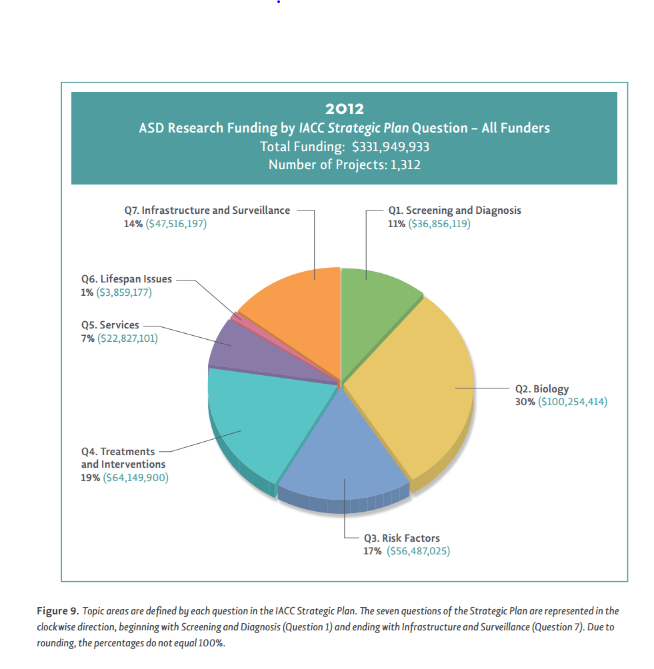
We aren’t talking small amounts of money. Here’s a figure from the IACC’s Portfolio Analysis from 2012. That’s over $300,000,000.00 spent in one year. Three hundred million plus dollars.

Autism Expenses 2012

Is that the breakdown you want to see? Is that what will make a difference in your life, or the life of someone you care about?

It isn’t what I want or need. Research takes time to impact real life. I want autistic adults–especially those with high support needs–to have a better life. I’d like it NOW, but I need it by the time my kid ages out of school. In the pie chart above, “lifespan issues” account for 1% of the total funding. Lifespan issues is the term for issues involving adults.

1%.

That has to change. And I’ll give that feedback, and more.

You may have other areas, or other specific projects you want to see advances in. Let the IACC know. Let them know NOW. Request for Public Comments – 2016 IACC Strategic Plan

Here are the questions you will see on the website.

Question 1: When Should I Be Concerned? (Diagnosis and Screening)

Please identify what you consider the most important priorities and gaps in research, services and policy for Question 1. Topics include: diagnosis and screening tools, early signs, symptoms, and biomarkers, identification of subgroups, disparities in diagnosis

Question 2: How can I understand what is happening? (Biology of ASD)

Please identify what you consider the most important priorities and gaps in research, services and policy for Question 2. Topics include: molecular biology and neuroscience, developmental biology, cognitive and behavioral biology, genetic syndromes related to ASD, sex differences, immune and metabolic aspects, and co-occurring conditions in ASD

Question 3: What Caused This to Happen and Can it be Prevented? (Risk Factors)

Please identify what you cosnider the most important priorities and gaps in research, services and policy for Question 3. Topics include: genetic and environmental risk factors, gene-environment interactions, and the potential role of epigentics and the microbiome

Question 4: How can I understand what is happeing? (Treatments and Interventions)

Please identify what you consider the most important priorities and gaps in research, services and policy for Question 4. Topics include: behavioral, medical/pharmacologic, educational, techonology-based, and complementary/integrative interventions.

Question 5. Where can I turn for services? (Services)

Please identify what you consider the most important priorities and gaps in research, services and policy for Question 5. Topics include: service access and utilization, service systems, education, family well-being, efficacious and cost-effective service delivery, health and safety issues affecting children, and community inclusion.

Question 6. What does the future hold, especially for adults? (Lifespan Issues).

Please identify what you consider the most important priorities and gaps in research, services and policy for Question 6. Topics include: health and quality of life across the lifespan, aging, transition, and adult services, including eduction, vocational training, employment, housing, financial planning and community integration.

Question 7. What other infrastructure and surveillance needs must be met? (Lifespan Issues)

Please identify what you consider the most important priorities and gaps in research, services and policy for Question 7. Topics include: research infrastructure needs, ASD surveillance research, research workforce development, dissemination of research information, and strengthening collaboration.

Go to the website. Request for Public Comments – 2016 IACC Strategic Plan. Give them feedback. Did I mention you should do it now and not wait?


By Matt Carey

The next Hannah Poling. Not vaccine injured. No mitochondrial disease.

27 Jun

One of the main talking points for the idea that autism is a “vaccine induced epidemic” is the case of Hannah Poling. Hannah Poling was chosen as one of the test cases for the Omnibus Autism Proceeding (OAP). But before the case went to hearing, the Department of Health and Human Services conceded her case on the grounds that she met the criteria for a table injury. If you want more details there are a lot of discussions online, including a lot of misinformation. But basically a table injury means that Miss Poling met certain criteria in a prescribed time frame after receiving vaccines, so she is presumed vaccine injured. One can go into length about how this isn’t “the vaccine court decided vaccines caused her autism”, but that’s another story (if you are interested, Prof. Dorit Reiss discusses it in Vaccine Injury Compensation and Mitochondrial Disorders).

At the time, the Poling concession was big news, on CNN and elsewhere. The story broke when David Kirby released some of the details of the concession (the Rule 4c report, a report written by Department of Justice attorneys on behalf of HHS describing the concession.) Kirby was journalist/PR man working with groups promoting the idea that vaccines cause autism. Much of his writing was problematic at best, much more PR than journalism. Kirby stayed with the Poling story for some time, pushing the idea that mitochondrial disorders are highly prevalent in the autistic population and suggesting that these disorders were caused by vaccines. As part of that PR effort, he wrote this article:

The Next Vaccine-Autism Newsmaker: Not Isolated, Not Unusual

Which begins:

In February, I leaked news of the Federal government’s admission that vaccines had triggered autism in a little girl named Hannah Poling. The stunning revelation, though still reverberating around the world, was roundly downplayed by US officials, who insisted that Hannah had an extremely rare, genetic case of “aggravated” mitochondrial disorder, with zero bearing on other autism cases.

Dr. Julie Gerberding, Director of the US Centers for Disease Control and Prevention (CDC), rushed to the airwaves, exhorting parents to adhere to the nation’s intensive and virtually mandatory immunization schedule, and brushing off their legitimate anxieties by saying: “We’ve got to set aside this very isolated, unusual situation.”

Well, the days of setting aside are over: Hannah Poling is neither isolated nor unusual.

In fact, the boy who was selected to replace Hannah Poling as the first-ever thimerosal “test case” in so-called Vaccine Court, has just been found with many of the same unusual metabolic markers as… you guessed it, Hannah Poling.

You see, Hannah Poling was supposed to be a test case for the OAP. One of the arguments the families and attorneys were going to argue in the OAP was that autism is a form of mercury poisoning caused by thimerosal (which used to be in infant vaccines as a preservative.) That idea (and the Wakefield inspired MMR causes autism and bowel disease) failed to even come close to the rather lenient standard of proof of the vaccine court. No one knew for sure before the OAP hearings that the thimerosal argument would fail so completely. Those involved actually had a great deal of confidence. But even with this confidence, some families decided to leave the OAP when the Poling concession was made public.  Most notably Robert Krakow (an attorney and activist in the autism-is-vaccine-injury community) pulled his son’s case from the OAP. His son was to be one of the three thimerosal test cases and is the one Mr. Kirby was discussing in his “Not Isolated, Not Rare” article quoted above.

In many ways it was a strange decision on the part of Mr. Krakow. The expert report on the Krakow boy (made public as part of the OAP and since pulled) made no mention of mitochondrial dysfunction. Also, the court hadn’t decided that the idea that vaccines aggravate mitochondrial disorders causes autism. While many deny this, as an attorney Mr. Krakow must have known this point. Miss Poling was compensated because she showed signs of an encephalopathy soon after vaccination, so it was presumed that encephalopathy was caused by the vaccines. The Krakow boy’s history did not show this.

In another recent case, a vaccine court Special Master noted,

In Poling v. HHS, the presiding special master clarified that the family was compensated because the Respondent conceded that the Poling child had suffered a Table Injury–not because the Respondent or the special master had concluded that any vaccination had contributed to causing or aggravating the child’s ASD.

So the situation for the Krakow boy (and Hannah Poling)  was very, very different than David Kirby painted (as was often true). This wasn’t another Poling case. Mr. Krakow and his attorneys and experts would have to show that (a) his son had real signs of mitochondrial dysfunction, (b) the hypothesis that vaccines vaccines contribute to causing autism was valid (recall, it hadn’t been decided by hearing), (c) this hypothesis applied to his son even though his son didn’t show signs of encephalopathy following vaccination.

As you will see, none of these points were valid.

Mr. Krakow pulled his son’s case  in 2008. The case dragged on for 7 years as the Krakows tried to put together their argument. And it appears that they did not win. Based on the facts presented, these documents appear to be the final decision and a ruling on motions in the Krakow case. These have been anonymized so it is possible that these are not a discussion of the Krakow case, but since the facts so closely match, I will write as though it is the Krakow case for brevity and clarity.

The decisions are lengthy. This case is as involved–if not more–than those in the OAP itself. It’s as if this is the test case for a third OAP argument.

Here is a key paragraph from the documents:

“Petitioners have failed to show that A.K. had an underlying mitochondrial disorder. They have also failed to show that the onset of A.K.’s ASD was in any way related to his influenza vaccinations. Indeed, respondent persuasively presented significant evidence indicating that A.K.’s ASD onset predated his vaccinations. Nor did petitioners establish by preponderant evidence that A.K. experienced any regression of skills related to his ASD or his vaccinations””

The Krakow boy’s history is in no way similar to that of Hannah Poling. Since her case was conceded, we don’t know if she showed signs of autism before vaccination. We do know now that the Krakow boy did show signs of autism. Poling regressed. Krakow didn’t. Poling has evidence of mitochondrial disease. Krakow doesn’t.

There are other interesting statements in these documents. Here are a few. First:

“The measles, mumps, and rubella [“MMR’] vaccines are ordinarily administered in a combined MMR vaccination, but A.K. received his in three separate vaccinations administered on December 1, 2000 (mumps); December 19, 2000 (measles), and January 2, 2001 (rubella), when he was between 13-14 months of age”

Yes. The Krakow family was following the Wakefield-recommended “separate the MMR into single vaccines” schedule. Didn’t prevent autism. This seems like valuable information for the autism community, but Mr. Krakow chose to hold this information back.

The Special Master took on the general idea that vaccines trigger regression in people with mitochondrial disorders. The evidence is very much lacking and “remain speculative”.

Here, petitioners’ experts strained to stretch the idea of mitochondrial regression to encompass vaccines as triggers of such regression. As described above, that extension is completely unsupported by any scientific literature; it was presented in this case almost entirely through the opinion of Dr. Kendall, supported by one case report (Poling, Res. Ex. MM, Tab 14). Doctor Kendall’s and Dr. Shafrir’s further reliance on the Shoffner and Weissman papers was misplaced and their opinions that vaccines can act as triggers of mitochondrial regression were unpersuasive. Evidence that regression in ASD, a well-described phenomenon involving the loss social communication and behavior, “looks like” mitochondrial regression was also nearly non-existent. “Mitochondrial autism” may someday be accepted as a descriptor for co-morbid autism and mitochondrial disorder diagnoses, but there is little evidence that autism itself is caused by such disorder, and no evidence that autism causes mitochondrial disorders. While Dr. Kendall is one of the few mitochondrial disorder specialists in the U.S., her opinion that vaccines can trigger either onset of a mitochondrial disorder with symptoms looking like ASD, or ASD via a mitochondrial regression are insufficiently supported and remain speculative.

We parents are often hit with testimonials about how alternative medicine works wonders on autistic kids. With the OAP cases we heard about a child who had adverse reactions to chelation. In this case we hear that these alternative therapies just didn’t work:

Doctor Boris recommended a gluten-free, casein-free diet for A.K. and began therapies such as chelation, supplements to counteract the effects of his MTHFR gene defect, and autoimmune medications. Tr. at 168-69. He testified that A.K. “did not respond very well to most of the treatments [he] administered.”

In an interesting twist, The Krakow boy’s geneticist  recommended he get vaccinations:

I [the special master] noted that the geneticist who had been seeing A.K. had specifically recommended that he continue to receive vaccinations and indicated that he was a “good candidate” to receive seasonal vaccinations, such as influenza.

Many people have been trying to characterize the “vaccine court” (the Court of Federal Claims) as highly adversarial. But Mr. Krakow writes that “The tenor of VICP proceedings is exceptionally hostile and adversarial”. The record show the Court was far from hostile and adversarial.

Consider this. The record shows that Robert Krakow (an attorney who appears in the vaccine court) and the attorney he chose to take over his son’s case were not proactive in prosecuting their case:

Other than the filing of medical records, petitioners did little to advance their claim during the period in which [A.K.’s father] was attorney of record.

and

However, the glacial pace of progress toward a causation hearing continued for many months thereafter. Mr. McHugh’s representation has been marked with missed deadlines, repeated requests for delays, late filings, and difficulties in properly designating and filing exhibits. His failure to meet deadlines nearly cost petitioners the opportunity to fully litigate their son’s claim.

That last sentence refers to the fact that after years of delays and missed deadlines, the court was finally forced to dismiss the case for inaction:

Accordingly, after petitioners missed the deadlines set forth in my August 18, 2010 order, I ordered them to show cause why their case should not be dismissed for failure to prosecute and comply with court orders. See Order to Show Cause, issued Sept. 3, 2010 (ECF No. 98). After petitioners ignored the deadline in the show cause order, I dismissed their petition on October 13, 2010.

The Court allowed the family to petition and re-enter the vaccine program. Not only that, but the Court granted the motion to redact parts of the dismissal. The dismissal was available on the vaccine court website (where I found and read it) but was pulled.

Many in the “autism is a vaccine epidemic” community call for a repeal of the vaccine act and a return to the time when vaccine manufacturers could sued directly.  How many cases in regular court are dismissed and allowed back in?

We could go on as the decisions are lengthy but instead let’s get back to the key points above.  When David Kirby wrote his article he concluded “And there are many more Hannah’s out there, waiting to be counted.”  Just not so.  First off, the real Hannah Poling case isn’t what Kirby claimed. The Court has stated that neither they nor the government  “…concluded that any vaccination had contributed to causing or aggravating the child’s ASD.”  More importantly, this new  case isn’t about a child with mitochondrial disorder, or even regression. It is a case of a child who showed signs of autism before the vaccines the parents claim caused autism.

This is a case of one of the most vocal proponents of the idea that vaccines cause autism misleading the public.  Mr. Krakow probably believes the story he tells of his child’s development.  He probably believes the story about how contentious the vaccine court is. But the facts tell a very different story.

I am often asked why I can not support the idea that vaccines cause autism.  Thousands of parents tell the same story, I’m told.  The problem is that the parents stories don’t match the facts. We saw this with Jenny McCarthy. We saw this with the Omnibus Autism Proceeding test cases.  We’ve seen this with more vaccine court cases.  We’ve seen this with parent stories shifting in online discussions. And now we’ve seen this with “the next Hannah Poling”.

By Matt Carey

If you are using California data to claim an autism epidemic, you’re doing it wrong. Or:The great anti-epidemic of intellectual disability in California.

22 May

If you’ve been reading about autism online, you have almost certainly read that autism “rates” are on the rise. But what if I told you that here in California intellectual disability has been dropping for over 20 years?

For many years the mainstay of the “autism is an epidemic” idea was the California Department of Developmental Services data. The CDDS keeps track of how many Californians are getting support under a number of specific disability categories. These data are publicly available (although not as easily available in the past), which makes them an easy source of data.

It’s easy to take a cursory look at the CDDS data and think “these are official data. Look at how much autism has increased!” Or claim “the CDDS only serves “severe” autism, there’s no way they were missed in the past.” You can even find a few publications to cite to back up these observations.

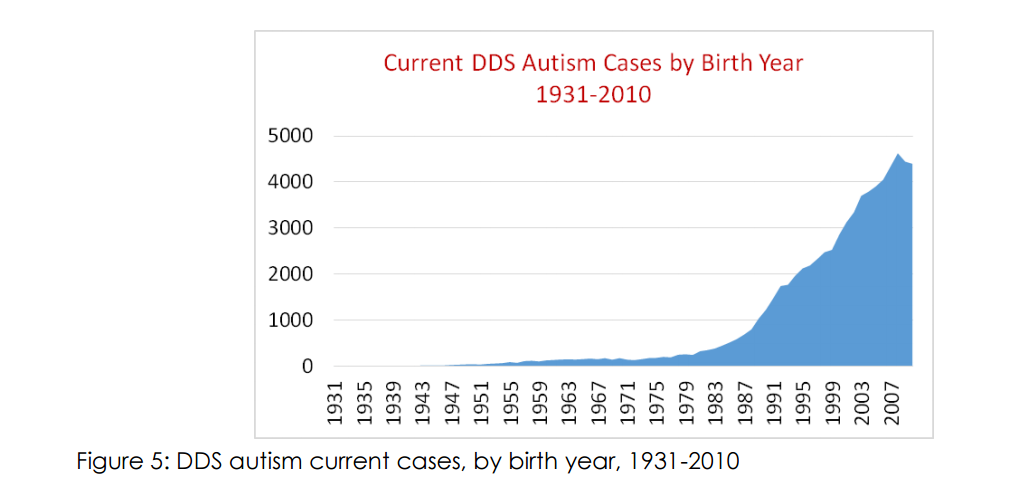
About a year ago I asked CDDS for some data. I hadn’t checked in a while and I wanted to see what trends are ongoing. Coincidentally, the Autism Society of San Francisco put out a report shortly after that: Autism Rising, A Report on the Increasing Autism Rates in California. So I was not alone in asking for data.  The Autism Society of San Francisco made the argument that the CDDS data are accurate and show an epidemic.

The Autism Society of San Francisco graph the data in many different ways, but the one that was closest to the way I was looking at the data was in Figure 5 (click to enlarge):

AS-SF Autism Rising Figure 5

and here is the caption for Figure 5:

Births of individuals later deemed to have DDS-eligible autism have been increasing sharply every year since the early 1980s. Typically intake into the system occurs between 2 and 7 years of age. The data reflects about 200 DDS autism births per year into the 1980s, but now the system is reflecting nearly 5,000 such births per year. The drop off in cases after birth year 2008 is likely attributable to usual delay in cases entering the system, and likely does not represent an actual decrease in DDS-eligible autism cases.

You can stop there and support your argument. And that’s just what most people do. Or you can question–how can I test if this is a “real” autism increase? For example, is the autism rate the same among different races? The answer is no. Is the autism rate the same in, say, San Francisco, Los Angeles, and Kern County? The answer is no. And there are many more questions one can ask of these data and over and over, the answer is no.

Either we aren’t counting all the autistics in our state, or there is something much more complex going on than vaccine, toxins, epigenetics, or whatever the claimed causes of the rise are. And I’ve gone through many of these discussions over the years. Let’s make this simple then. If one claims that the CDDS counts everyone within each disability category accurately and that the definitions they use aren’t changing with time, why is intellectual disability (mental retardation) dropping so fast in California?

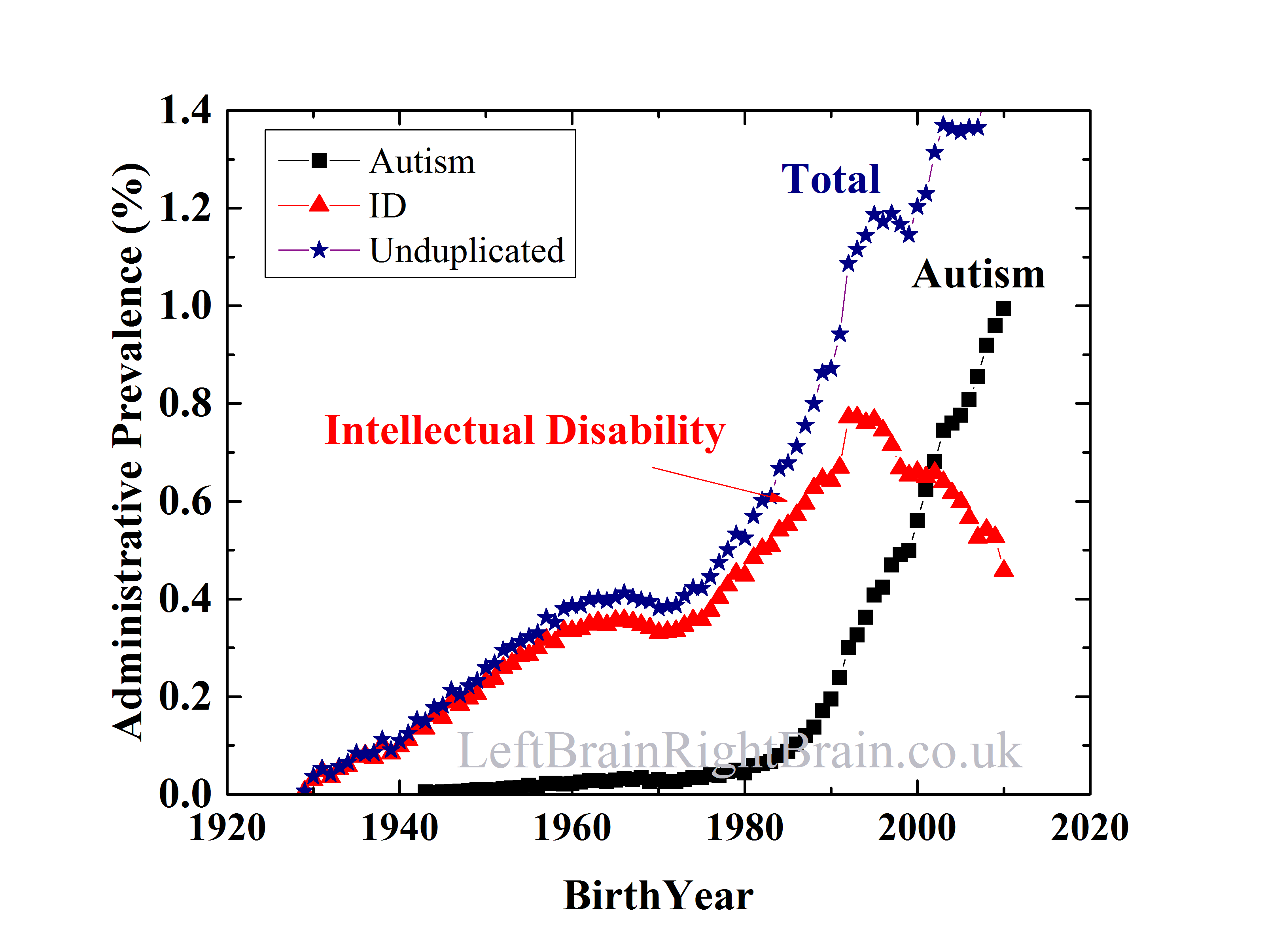
You see I also graphed intellectual disability. I got autism counts, intellectual disability counts and “unduplicated” (total, each disabled person counted once) by birth year. I also got census data by birth year. And I graphed them. And anyone claiming CDDS data show an autism epidemic needs to do the same and to explain this graph, complete with the sharp peak for birth year 1993. (click to enlarge):

CDDS including ID

Intellectual disability has dropped. Off about 40% of the peak value.

If you think your idea for the rise in autism is correct, let’s take the failed vaccine idea as an example, you need to also explain how that resulted in far fewer people with intellectual disability. Plain and simple. And none of these claimed causes of an “epidemic” can explain the drop in ID.

Why bother challenging the people claiming an autism epidemic? Because it denies the existence of undiagnosed autistic adults. We have very little effort to identify those who were missed in past generations. And the likelihood is that these people–our people–are not being supported appropriately because of their misdiagnoses. And not only are we abandoning the misdiagnosed, we are failing to learn. What worked for past generations, the adults of today? What failed? What are the appropriate supports for the various needs of autistic adults? We don’t know today. And are unlikely to know by the time my kid is an adult, especially if we aren’t even looking at autistic adult needs today.

And then there’s the whole autism causation question. People spending their time trying to correlate CDDS data–data clearly confounded by numerous social influences–are unlikely to ever find a real answer.

But, for those who want to keep trying, include all the data. Give an explanation for this and you may be on to something.

CDDS including ID

By Matt Carey

The perils of reading history backwards: John Donvan and Caren Zucker, In a Different Key: The Story of Autism, Penguin 2016

20 May

John Donvan and Caren Zucker, In a Different Key: The Story of Autism, Penguin 2016

Hard on the heels of Steve Silberman’s award winning Neurotribes comes another grand scale history of autism, at 688 pages, even exceeding the 544 pages of its predecessor. (See http://www.spiked-online.com/review_of_books/article/why-we-shouldnt-celebrate-autism/17468#.VrST-MvcuAg)

The books have much in common: both are written by journalists with an eye for story and character. Both provide comprehensive accounts of the clinical and scientific advances of the past half century, and offer sketches of key figures on both sides of the Atlantic. They cover issues of institutionalisation and de-institutionalisation, parental campaigns (challenging professionals and bureaucrats to raise awareness, provide education and social support), and controversies (over causation, diagnostic labels, treatments, interventions and ‘cures’) and the new wave of internet-facilitated activism by adult autistics.

These histories also share common weaknesses.* Apart from their inordinate length, the narratives are often poorly organised and tend to favour description over analysis – Donvan and Zucker seem particularly reluctant to make judgements on the contribution of authorities or draw conclusions in relation to controversies. For example, in their discussion of the late Ivar Lovaas, the pioneer of ‘applied behaviour analysis’, they criticise his use of ‘aversive’ punishments to reinforce changes in behaviour – though such methods were commonplace in homes throughout the Western world up to the 1980s – and they also recycle gossip about his womanising. But they fail to provide any answers to the questions about whether modern developments of these techniques are legitimate or effective in teaching children with autism.

The authors’ proclivity for retrospective moral judgements (also a feature of Silberman’s book) gets them into murkier waters in their accounts of the work of the two authorities who first advanced the label ‘autism’ in the 1940s – Leo Kanner in the USA and Hans Asperger in Austria. From a perspective that assumes a contemporary state of enlightenment, they adopt a distinctly sanctimonious posture towards the prejudices of the past, notably in relation to issues of sexuality and race, as well as diverse forms of disability and difference, where cultural attitudes have changed dramatically over recent decades. Their criticisms of both Kanner and Asperger for their accommodations to the doctrines of eugenics fail to take account of the strength of the scientific and medical consensus supporting these theories in the first half of the twentieth century. They also seem to have little sense of the mass psychosis into which Germany and Austria in general and the medical profession in particular had descended in the period of the Third Reich. (See Robert Jay Lifton, The Nazi Doctors: Medical Killing and the Psychology of Genocide, 1986 and Saskia Baron, Science and the Swastika: The Deadly Experiment; Science and the Swastika: Hitler’s Biological Soldiers, https://vimeo.com/user6162058)

Donvan and Zucker are critical of Kanner for his approval of the sterilisation of individuals with severe learning disabilities (such procedures were carried out on a larger scale in the USA than in Germany prior to the Nazi period), even though he opposed a proposal for euthanasia, made in a leading psychiatric journal, in 1942. In relation to Asperger, In A Different Key repeats allegations made by the Austrian historian Herwig Czech in a 2010 lecture, that he made excessive compromises with the Nazi Party and was complicit in the killing of children with severe disabilities in wartime Vienna. The main problem with these allegations is that they have only the status of hearsay – though it is five years since Czech’s lecture, his evidence has not yet been published in a form which allows other authorities to scrutinise his claims and decide on their authenticity. An additional problem is that the authors fail to draw out the consequences for our evaluation of Asperger’s work, and the status of his eponymous syndrome.

Donvan and Zucker begin and end their history of autism with the story of Donald Triplett, ‘Case 1’ in Kanner’s 1943 paper that launched the diagnosis of autism into the world. Now in his early eighties, Donald is still living in his family house (though his parents are long dead) in the small town of Forest, Mississippi, where he enjoys a good quality of life in a sympathetic and supportive community. It is a heart-warming story – already told by the authors in an article in The Atlantic in 2010 (and also included in Silberman’s book) – and it reflects significant progress in the understanding and acceptance of autism over the course of Donald’s lifetime. Unfortunately, such positive outcomes are far from universal, either in the USA or in Britain, where almost every day brings new stories of people with autism suffering from mental health problems and from neglect or ill-treatment in the context of grossly inadequate therapeutic and social care services. (Meng Chuan-Lai, Simon Baron-Cohen, Identifying the lost generation of adults with autistic spectrum conditions, Lancet Psychiatry 2015; 2: 1013–27.) A recent report from Scandinavia confirms dramatically higher rates of mortality, affecting individuals across the autistic spectrum, from a wide range of medical causes, epilepsy and suicide linked to mental health problems. (Tatja Hirvikoski, et al, Premature Mortality in Autistic Spectrum Disorders, British Journal of Psychiatry, 20 November 2015, DOI: 10.1192/bjp/114.160.192).

In his thoughtful and challenging survey of the politics of identity associated with diverse forms of disability, Andrew Solomon comments on the particularly ‘polarised and fragmented’ autism community. (Andrew Solomon, Far From the Tree: parents, children and the search for identity, 2012). He contrasts this with the sphere of deafness, in which ‘medicine and activism are galloping’ – whilst in autism ‘both are trudging’. Whereas, in other forms of disability, medical advances have led to a decline in prevalence and severity, in autism, prevalence has risen apparently inexorably – in the absence of any significant advance in terms of therapeutic intervention. Though Donvan and Zucker, like Silberman, have made a valuable contribution in recording the key events in the rise of autism over the past half century, this particular chronicle still awaits rigorous historical analysis.

Michael Fitzpatrick 7 February 2016

*One is an occasional inaccuracy: Nikolas Tinbergen, associated with ‘holding therapy’, was an ethologist – not an ‘ornithologist’; Andrew Wakefield did not, in his notorious 1998 Lancet paper, report ‘traces of measles virus in the intestinal tracts’ of children with autism.


IMFAR (the International Meeting For Autism Research) starts tomorrow.

11 May

IMFAR is the world’s largest autism science conference. I don’t recall the exact statistics, but there are probably over 1000 researchers who attend. Literally hundreds of presentations on various topics. I am not attending, but I will try to write a few articles about abstracts and topics that I think of are interest.

I do know that this year Shannon Rosa (twitter: @shannonrosa) and Carol Greenburg will be attending and tweeting and probably putting some thoughts up at the Thinking Person’s Guide to Autism (twitter: @thinkingautism, Facebook and the TPGA blog.

IMFAR shows what a huge effort is going on in autism research. People are working hard to understand autism and (more importantly) make a difference in the lives of autistics.


By Matt Carey

FDA proposes a ban on electric shock devices such as used at the Judge Rotenberg Center

28 Apr

I’ll keep this simple and direct: the FDA has proposed a new rule: Banned Devices; Proposal to Ban Electrical Stimulation Devices Used to Treat Self-Injurious or Aggressive Behavior.

Here’s the summary from that document:

SUMMARY: The Food and Drug Administration (FDA or we) is proposing to ban electrical stimulation devices used to treat aggressive or self-injurious behavior. FDA has determined that these devices present an unreasonable and substantial risk of illness or injury that cannot be corrected or eliminated by labeling. FDA is proposing to include in this ban both new devices and devices already in distribution and use.

Also:

We are aware of only one manufacturer, JRC, that has recently manufactured ESDs and that currently uses ESDs, including devices that we have not previously cleared.

JRC is the Judge Rotenberg Center, a residential school in Massachusetts for disabled students, many of whom are autistic. The JRC uses the ESD’s (electrical stimulation devices) as punishments to try to control behavior for some of their students. According to the document, the JRC used their devices (called GED at the school) on 82 individuals in 2014.

The document states that a parent group from the school and 2 former students provided comments in support of keeping the shock devices. One student and

In addition to NASDDDS and a JRC parents group, referenced earlier, 15 other organizations concerned with the treatment and the rights of individuals with disabilities spoke at the Panel Meeting, all of which supported a ban. Twenty-two disability rights organizations submitted written comments to the Panel Meeting docket, one of which was signed by 23 disability rights groups. Nine of these organizations were among the 15 represented at the Panel Meeting. All of these comments support the ban. FDA also received a comment from the U.S. Department of Justice Civil Rights Division supportive of a ban, and we considered information from the National Council on Disability, the National Institutes of Health, and the United Nations Special Rapporteur on Torture.

The FDA is not just relying upon community input. They also note the scientific literature which shows significant risks of PTSD and anxiety and other adverse events following the use of shock devices.

Here is a survivor’s letter, an account from a former JRC student who was subjected to the shocks.

The JRC was in the news after a student was tied to a board for 7 hours and shocked 31 times. The original news story links are no longer valid, but I will try to find them and link to them here.

The shock devices just do not have a sound backing–scientifically or ethically. If this FDA rule goes into place, the days when disabled students in America can be subjected to electric shocks like these will come to an end.

By Matt Carey

Andrew Wakefield to Grace Hightower: “your family’s life [has] been blighted by autism”

22 Apr

One thing I have noticed over the years–those who are antagonistic towards vaccines are quite willing to use the disability community, but are rarely willing to offer us respect. Consider Andrew Wakefield, who introduced one book with a fictionalized account of a mother murdering her autistic child. He framed it as an act of love by the mother. Or his film, “who killed Alex Spourdalakis”. Alex was an autistic young man with extraordinary needs. Andrew Wakefield tried to make Alex’s life  into an episode for his (now failed) reality TV show. When Alex was brutally murdered by his mother and another caregiver, Wakefield took his footage and made a film.  It was an apology piece for the murders, using Alex as a hammer to attack mainstream medicine.

So now we have Wakefield apparently leaking his celebrity emails and showing again his misunderstanding for and contempt of autistic people. This is discussed at length by ScienceMom at JustTheVax: Paging De Niro and Hightower…Wakefield isn’t really in it to help autistics

I’ll just quote one email:

On Mar 29, 2016, at 9:18 AM, Andy Wakefield wrote:
Grace, whatever may have happened – and I guess I will never know – in truth my heart goes out to you and Bob. Not only has your family’s life been blighted by autism, but you have experienced some of the relentless and ruthless pressure that has been my life for as long as I can remember.
In truth and healing
Andy

Andy Wakefield
Director
Autism Media Channel

Just to be clear, Mr. Wakefield:

My child is not a blight. On me, my family or on anyone else.
My child is not blighted.
My life is better for my child. Challenges, struggles and all.

Just to be clear Ms. Hightower: if you didn’t respond to Mr. Wakefield in a way similar to the above, shame on you. But, while I am at it, shame on you for promoting this man and his damaging message. If you believe him, take a moment and ask yourself: if he’s lying (he is) how much harm has he caused to me, my family and mostly my son?

When you dehumanize people Mr. Wakefield, you make it easier for people to murder my child. You made it easier for people to abuse my child. You make it easier for people to disrespect my child. It is already a struggle to get adequate supports and assistance. How much will people be willing to help the “blighted”?

My child doesn’t need the charity of pity. My child needs the helping hand of respect.

And you, Mr. Wakefield, are in the way of that.

People ask me why do I spend my time countering your misinformation. This is why.


By Matt Carey