Archive | Authors RSS feed for this section

Comment on: What should autism research focus upon? Community views and priorities from the United Kingdom.

6 May

A paper came out in the past few days: What should autism research focus upon? Community views and priorities from the United Kingdom. I haven’t seen the whole paper but here’s the abstract:

The rise in the measured prevalence of autism has been accompanied by much new research and research investment internationally. This study sought to establish whether the pattern of current UK autism research funding maps on to the concerns of the autism community. Interviews and focus groups were conducted with autistic adults, family members, practitioners and researchers to identify their priorities for research. We also captured the views of a large number of stakeholders via an online survey. There was a clear disparity between the United Kingdom’s pattern of funding for autism research and the priorities articulated by the majority of participants. There was general consensus that future priorities for autism research should lie in those areas that make a difference to people’s day-to-day lives. There needs to be greater involvement of the autism community both in priority setting and in research more broadly to ensure that resources reach where they are most needed and can make the most impact.

My comment is simple: Yes. Yes. And yes:

1) There was a clear disparity between the United Kingdom’s pattern of funding for autism research and the priorities articulated by the majority of participants.
2) There was general consensus that future priorities for autism research should lie in those areas that make a difference to people’s day-to-day lives.
3) There needs to be greater involvement of the autism community both in priority setting and in research more broadly to ensure that resources reach where they are most needed and can make the most impact.


By Matt Carey

Andrew Wakefield threatens another libel suit

6 May

One of the advantages of taking some time off writing and the internet autism discussions is not hearing about Andrew Wakefield. Otherwise it seems a day can’t go by without some news article or blog post going up where the same 4-5 people will descend and tell us, once again, about how Andrew Wakefield isn’t an unethical guy but a combination of Nelson Mandela and Jesus Christ rolled up into one.

If you don’t recall and think I’ve gone way over the top with that phrase: it’s a quote. Yeah, really. J.B Handley, co-founder of Generation Rescue actually said that to a reporter at the New York Times for his article The Crash and Burn of an Autism Guru.

A decade ago Brian Deer exposed the first of the ethical lapses to come to light involving the MMR/Autism research Mr. Wakefield had undertaken. That’s when it became clear that Mr. Wakefield had financial conflicts of interest, hidden from the public and even his own colleagues. While this ground has been gone over many times in the past 10 years, it’s worth reading about it again if only to hear Mr. Wakefield’s colleague, Simon Murch, chime in on what it was like to discover that Mr. Wakefield had hidden financial interests:

Simon Murch, one of the leading doctors involved with Wakefield’s research at the Royal Free, said yesterday that news of the £55,000 legal funding was “a very unpleasant surprise”. “We didn’t know. We were pretty taken aback. The timing of it before the paper is something we have all been shocked by. If you have a colleague who has not told you, if you have not been informed you are going to be taken aback.”

He went on: “I am not going to join the queue of people rushing up to kick Andy. But it is right that this has come out: there has been a complete conflict of interest.”

Murch said it was never made clear that the payment was in place before the report was published. “We never knew anything about the £55,000 — he had his own separate research fund,” said Murch. “All of us were surprised . . . We are pretty angry.”

In response for his 2004 reporting of such stories, Mr. Deer was served with a lawsuit. A lawsuit that Mr. Wakefield eventually dropped, paying Mr. Deer’s legal fees. But before it was dropped, a judge made the following statements in a judgment and those comments are worth reading again (at least I think so):

It thus appears that the Claimant wishes to use the existence of the libel proceedings for public relations purposes, and to deter other critics, while at the same time isolating himself from the “downside” of such litigation, in having to answer a substantial defence of justification.

The Claimant in the above being Mr. Wakefield. Who appears to have been facing a rather strong rebuke for “us[ing] the existence of the libel proceedings for public relations purposes..” etc..

Before we get to the matter at hand, here’s one more paragraph of background. Readers of Left Brain Right Brain may be aware that Mr. Wakefield has again sued Mr. Deer, this time for articles which appeared in the BMJ. Mr. Wakefield lost the first round of this lawsuit against the BMJ and Brian Deer and is appealing (docket here). Mr. Wakefield took exception to his work being called fraudulent and himself being called a fraud. Well, he took exception to the word fraud in the BMJ and spoken by Mr. Deer, but as Todd W notes at Harpocratese Speaks, Mr. Wakefield has since let a lot of other mentions of the word “fraud” go by unchallenged. Most notably, to me, a Time magazine article: Great Science Frauds.

Mr. Wakefield has now taken offense at an article written by Emily Willingham, Ph.D., a researcher and science writer whose work appears, among other places, on Forbes.com. Emily Willingham wrote an article, Blame Wakefield For Missed Autism-Gut Connection in which she used the “f” word (fraud):

So why is it that no one attends to this clear (to me) link when it come to autistic children? Well, the Pediatrics review by McElhanon et al. happens to cite that reason several times: Wakefield’s MMR/autism/gut red herring and the subsequent noxious cloud that his fraud (link added 5/2/14) left over any research examining autism and the gut. So we don’t know anything about the real underlying causes of these digestive problems among autistic children. The Pediatrics authors state it unequivocally, as they have done before (link added 05/02/14):

It is clear that greater clinical and research scrutiny is needed to increase awareness on this topic and thus support development of the best standards of care. Previous controversy surrounding the MMR vaccine and proposed causal link between ASD and infection of the GI tract probably deterred investigators from dedicating resources to examine GI functioning in this population while fostering uncertainty in the ASD community regarding the validity of this line of inquiry.

Mr. Wakefield responded with a letter (linked at Forbes) in which he has informed Willingham and Forbes that while he isn’t bringing a suit forward now but he intends to bring suit. He also sent a copy of the letter sent to the Age of Autism blog which posted it.

Let’s go to the heart of Mr. Wakefield’s assertion, where he pulls a line out of the Forbes article and comes to a conclusion of malicious intent (he starts with a quote from the Forbes article):

Well, the Pediatrics review by McElhanon et al. happens to cite that reason several times: Wakefield’s MMR/autism/gut red herring and the subsequent noxious cloud that his fraud… The Pediatrics authors state it unequivocally:

On any ordinary reading, the intent of your statement is clear: to imply that the authors of the Pediatrics paper cite fraud on my part. What McElhanon et al actually say is substantially different from your false and defamatory allegation i.e.,

Well, I guess by Mr. Wakefield’s standards I did not give the article an “ordinary reading” as I did not see that purported intent. I stand apart from Mr. Wakefield on many standards. Why didn’t I make the association Mr. Wakefield claims?. Because I know without reading the Pediatrics article that no where in it does it have the phrase “noxious cloud that his fraud”. I know this because I read scientific journals, write for scientific journals, have edited an issue of a journal and more. Perhaps Mr. Wakefield missed the obvious conclusion that the phrase he focuses upon is clearly in Emily Willingham’s voice and that is obvious “on any ordinary reading”.

Mr. Wakefield asserts that the Forbes article was written “maliciously” and that “[Emily Willingham’s] defamatory statements about me will undoubtedly cause me to suffer significant personal and financial damage.” Now, I can’t speak for Emily Willingham, but I can speak for myself–when I write my opinions of Mr. Wakefield and his work, I don’t think about it in terms of causing him damage. Frankly, if forced to consider it, I’d guess that when I write I likely enhance his stature among his supporters and donors, by supporting the image of Mr. Wakefield as some wronged maverick with myself as cast in the role as part of the machine which is grinding him down.

When I saw that Mr. Wakefield had threatened Forbes and Emily Willingham I thought, has he never heard of the Streisand Effect? I mean, here was a blog post at Forbes that had a couple of thousand views and was quickly on its way to the archives. Then I thought, yep, I bet he has heard of the Streisand Effect. I wouldn’t be surprised if he’s counting on me and others writing about him. What was it that judge said 10 years ago in a different suit? It thus appears that the Claimant wishes to use the existence of the libel proceedings for public relations purposes. I could be wrong. Probably am. I can no more read minds than can Andrew Wakefield, who projects malicious intent where I see none.

Consider a very recent interview he gave for a podcast. He’s introduced as “one of those dudes… [who] won’t back down” who has been “through living hell”. That group, by the way, is helping raise money for Mr. Wakefield.

So, here I am, playing into the mythos that is Andrew Wakefield, a man bravely facing critics like me in order to do what he does best: listen to the mothers of autistic children with GI disease. Except when those mothers disagree with him, apparently. Oh, did you miss that? Emily Willingham *is* the mother of an autistic child. And *two* of her kids have dealt with GI diseases. It’s in the comments of the article on Forbes.

In case it is not clear in the above, this is far from a trivial matter. Threats of legal action are never minor. I recall when Kathleen Seidel (autism parent and writer) was subpoenaed by Cliff Shoemaker, a vaccine attorney (Mr. Shoemaker was sanctioned). I recall when J.B. Handley threatened Kev Leitch (disabled adult, father of an autistic child and founder of Left Brain Right Brain). Even when you know you are in the right, lawsuits create a lot of uncertainty and distress.


By Matt Carey

FDA: Beware of False or Misleading Claims for Treating Autism

2 May

The Food and Drug Administration (FDA) in the U.S. has issued a statement: Beware of False or Misleading Claims for Treating Autism.

The statement is copied below. I applaud the FDA for taking this move. At same time, while this statement is encouraging:

According to Gary Coody, R.Ph., FDA’s national health fraud coordinator, the agency has warned a number of companies that they are facing possible legal action if they continue to make false or misleading claims about products and therapies claiming to treat or cure autism

I’ve had difficulty finding the warning letters on the FDA website. Consider this, in 2010, the FDA issued a statement on MMS (‘Miracle’ Treatment Turns into Potent Bleach). Last year, they issued a statement on HBOT (Hyperbaric Oxygen Therapy: Don’t Be Misled. And, yet, these are still promoted. HBOT promotion appears to have peaked and chelation is nothing like it was a few years ago (a recent survey had fewer than 1% of families subjecting their children to chelation). It’s difficult to judge the actual popularity of MMS, but it is promoted year after year at the AutismOne conference (with the title this year “Healing Autism” and the claim that it has contributed to children losing their autism diagnosis. These would seem to be the type of specific claims that the FDA could act upon).

This said, the FDA has had some successes. As noted, chelation is down. My guess is this is largely due to the fact that thimerosal is out of vaccines and it’s extremely clear that thimerosal didn’t cause the upsurge in autism diagnoses seen in the US in the past few decades. The FDA put a stop to the marketing of a synthetic chemical (OSR #1) that was promoted as a “supplement” but was, in fact, an industrial chelating compound.

Here is the FDA statement:

April is National Autism Awareness Month, a fitting time to think about the growing need for concern and awareness about autism.
One thing that is important to know up front: There is no cure for autism. So, products or treatments claiming to “cure” autism do not work as claimed. The same is true of many products claiming to “treat” autism. Some may carry significant health risks.

The Food and Drug Administration (FDA) plays an important role in warning these companies against making false or misleading claims.

back to top

About Autism
According to the Centers for Disease Control (CDC), about 1in 68 children has been identified with an autism spectrum disorder (ASD). ASDs are reported to occur in all racial, ethnic and socioeconomic groups, and are almost five times more common among boys (1 in 54) than among girls (1 in 252).
The National Institutes of Health (NIH) describe autistic children as having difficulties with social interaction, displaying problems with verbal and nonverbal communication, exhibiting repetitive behaviors and having narrow, obsessive interests. These behaviors can range in impact from mild to disabling.

“Autism varies widely in severity and symptoms,” says Amy Taylor, M.D., M.H.S., a pediatrician at FDA. “Existing autism therapies and interventions are designed to remedy specific symptoms and can bring about improvement,” she adds.

In addition, FDA has approved medications that can help some people manage related symptoms of ASD. For example, the FDA has approved the use of antipsychotics such as risperidone and aripripazole to treat children 5 or 6 years of age and older who have severe tantrums or aggression and self-injurious behavior. Before using any behavioral intervention or drug therapy (prescription or over-the-counter), check with your health care professional.

The Association for Science in Autism Treatment (ASAT), a not-for-profit organization of parents and professionals committed to improving the education, treatment, and care of people with autism, says that since autism was first identified, there has been a long history of failed treatments and fads.

back to top

FDA Cracks Down on False Claims

According to Gary Coody, R.Ph., FDA’s national health fraud coordinator, the agency has warned a number of companies that they are facing possible legal action if they continue to make false or misleading claims about products and therapies claiming to treat or cure autism. Some of these so-called therapies carry significant health risks and include:

“Chelation Therapies.” These products claim to cleanse the body of toxic chemicals and heavy metals by binding to them and “removing” them from circulation. They come in a number of forms, including sprays, suppositories, capsules, liquid drops and clay baths. FDA-approved chelating agents are approved for specific uses, such as the treatment of lead poisoning and iron overload, and are available by prescription only. FDA-approved prescription chelation therapy products should only be used under medical supervision. Chelating important minerals needed by the body can lead to serious and life-threatening outcomes.

Hyperbaric Oxygen Therapy. This involves breathing oxygen in a pressurized chamber and has been cleared by FDA for certain medical uses, such as treating decompression sickness suffered by divers. It has not been cleared for autism, among other conditions.

Miracle Mineral Solution. Also known as Miracle Mineral Supplement and MMS, this product becomes a potent chemical that‘s used as bleach when mixed according to package directions. FDA has received reports of consumers who say they experienced nausea, severe vomiting and life-threatening low blood pressure after drinking the MMS and citrus juice mixture.
Detoxifying Clay Baths. Added to bath water, these products claim to draw out chemical toxins, pollutants and heavy metals from the body, falsely offering “dramatic improvement” for autism symptoms.

CocoKefir probiotics products. Product claims include being a “major key” to recovery from autism, but they are not proven safe and effective for this advertised use.

Coody offers some quick tips to help you identify false or misleading claims.
Be suspicious of products that claim to treat a wide range of diseases.
Personal testimonials are no substitute for scientific evidence.
Few diseases or conditions can be treated quickly, so be suspicious of any therapy claimed as a “quick fix.”

So-called “miracle cures,” which claim scientific breakthroughs and secret ingredients, may be a hoax.

The bottom line is this—if it’s an unproven or little known treatment, talk to your health care professional before buying or using these products.
This article appears on FDA’s Consumer Updates page, which features the latest on all FDA-regulated products.

April 25, 2014

The Korean Community Services, Autism Speaks, the University of Pennsylvania and the George Washington University partner to provide autism resources to Korean Americans

17 Apr

There are many groups in American where the autistics are under-diagnosed and underserved including many racial and ethnic minorities. A recent partnership (press release below) has been formed to address the issues of providing resources to the Korean American communities in the U.S..

We need more outreach such as this. More efforts to identify and serve all Americans with disabilities, including autism.

FOR IMMEDIATE RELEASE
THE KOREAN COMMUNITY SERVICES, AUTISM SPEAKS, THE UNIVERSITY OF PENNSYLVANIA AND THE GEORGE WASHINGTON UNIVERISTY PARTNER TO PROVIDE AUTISM RESOURCES TO KOREAN AMERICANS

Launch Autism Hotline for Concerned Families

FLUSHING, N.Y. (April 10, 2014) – The Korean Community Services of Metropolitan New York, Inc. (KCS), Autism Speaks, the world’s leading autism science and advocacy
organization, the Center for Mental Health Policy and Services Research at the Perelman School of Medicine at the University of Pennsylvania, and the George
Washington University, today announced the establishment of the KCS Kids’ Line. KCS Kids’ line is a hotline service that provides referrals, information, and support for families
in the Korean community who are concerned that their children may have an autism spectrum disorder (ASD).

KCS will hold a press conference today at 3:00 p.m. ET at the Korean Community Services of Metropolitan New York, 35-56 159th Street in Flushing, to introduce the new
KCS Kids’ Line program. In attendance will be New York State Assemblyman Ron Kim, the Community Advisory Board members of the Project and local early intervention
providers. A two-year study, the New York Korean City Community Autism Project, funded by Autism Speaks, identified many barriers to early detection and access to
services for Korean families of children with autism.

Kwang S. Kim, the President of KCS, said, “KCS Kids’ Line service aims to help family and caregivers promptly respond to development issues and autism-related signs they
find in their children and get them appropriate services as soon as possible. We learned that early intervention is very important for children with autism because it allows them
practice and learn social and communication skills so they could better adapt to the society. I would like to thank University of Pennsylvania and Autism Speaks for
supporting this project for Korean-American community and hope that this program will help a lot of Korean-American children and their families affected by autism.”

KCS Kids’ Line Service Overview
The Asian-American Federation Census Information Center reports that Koreans are the third largest Asian group in the New York City, with a current population of more
than 100,000. According to the NYC Department of Education, Asians comprise 16% of New York City students; among those diagnosed with autism only 8% are Asian. This
difference suggests substantial under-diagnosis of autism in the Korean community. A recent study on the prevalence of autism in South Korea found similar results, with twothirds
of those on the autism spectrum previously undiagnosed and receiving no specialized services.

Under-diagnosis of autism in the Korean community may be driven by lack of awareness, stigma, and lack of access to linguistically and culturally appropriate
services. Language is a significant barrier among Korean-Americans seeking services in New York.

The goals of the KCS Kids’ Line are to ensure Korean-American children with autism in the greater New York area receive timely and appropriate services, to provide better
support for parents and families of those on the spectrum, and to promote autism awareness and greater access to resources about ASD.

The KCS Kids’ Line will serve, but not be limited to, parents of children from birth to 3 years of age with concerns about autism or other developmental delays. These parents will be able to call, e-mail or walk in to receive information. Autism-specific toolkits and resources that have been translated into Korean will be available for parents at the
event and also online at Autism Speaks’ website: http://www.autismspeaks.org/korean. KCS will continue to build knowledge about autism and related services in the greater
New York City area and develop relationships with schools and community organizations to connect older children and their parents with resources they need.

KCS has partnered with Autism Speaks, the George Washington University and the University of Pennsylvania to prepare the KCS Kids’ Line service. Autism Speaks
supports KCS by sharing their toolkits and resources, providing KCS coordinators with relevant trainings, education, and guidance. George Washington University and the
University of Pennsylvania helped KCS base the structure and content of the call line on previous research findings, translated existing materials for families into Korean, and
provided general guidance on the implementation of the call line. The University of Pennsylvania will evaluate the Kids’ Line service to determine its effectiveness in
increasing the number of Korean children with suspected autism who are referred for evaluation and services.

About Autism
Autism is a general term used to describe a group of complex developmental brain disorders – autism spectrum disorders – caused by a combination of genes and
environmental influences. These disorders are characterized, in varying degrees, by communication difficulties, social and behavioral challenges, as well as repetitive behaviors. An estimated one in 68 children in the U.S. is on the autism spectrum.

About KCS
Korean Community Services of Metropolitan New York (KCS) was founded in 1973 as the first community-based service agency in the Korean community. KCS is a non-profit
organization supported by government agencies, foundations, corporations and concerned individuals. KCS serves primarily but not limited to the Asian-American
immigrant population within the greater New York area. KCS’ objectives are to develop and deliver a broad range of community services to meet the various needs of the
community. To achieve these objectives, KCS provides various professional community services within the areas of Aging, Community, Workforce Development, and Public Health.

About Autism Speaks

Autism Speaks is the world’s leading autism science and advocacy organization. It is dedicated to funding research into the causes, prevention, treatments and a cure for
autism; increasing awareness of autism spectrum disorders; and advocating for the needs of individuals with autism and their families. Autism Speaks was founded in
February 2005 by Suzanne and Bob Wright, the grandparents of a child with autism. Mr. Wright is the former vice chairman of General Electric and chief executive officer of
NBC and NBC Universal. Since its inception, Autism Speaks has committed nearly $200 million to research and developing innovative resources for families. Each year
Walk Now for Autism Speaks events are held in more than 100 cities across North America. On the global front, Autism Speaks has established partnerships in more than
40 countries on five continents to foster international research, services and awareness. To learn more about Autism Speaks, please visit AutismSpeaks.org.

Jenny McCarthy tries to position herself as in the “grey area” on vaccines

16 Apr

Jenny McCarthy seems a bit angry at bloggers. She’s written an op-ed for the Chicago Sun Times Jenny McCarthy: The gray area on vaccines. She’s not antivaccine, she wants us to know.

Well, Jenny, I don’t call you antivaccine. I call you irresponsible. And I stand by that. Mostly for your promotion of autism “therapies” which range from useless to abusive. Will you be speaking at the AutismOne conference this year? If so, will you speak out on forcing disabled children to drink diluted bleach solutions or undergo repeated diluted bleach solution enemas? Really, it’s time to grow a spine and stop lending your name to nonsense.

Back to vaccines, here’s what you say now:

For my child, I asked for a schedule that would allow one shot per visit instead of the multiple shots they were and still are giving infants.

But only a few short years ago you told us you wouldn’t vaccinate if you had another child. A very different statement. What are young parents supposed to listen to? “I’m pro vaccine” or “I wouldn’t vaccinate my child”.

Irresponsible.

You hide behind straw-man arguments, even now:

I believe in the importance of a vaccine program and I believe parents have the right to choose one poke per visit. I’ve never told anyone to not vaccinate. Should a child with the flu receive six vaccines in one doctor visit? Should a child with a compromised immune system be treated the same way as a robust, healthy child? Shouldn’t a child with a family history of vaccine reactions have a different plan? Or at least the right to ask questions?

Parents have the right to pick their schedule. You know that. You said that in your “Green Our Vaccines” rally (3:20). The schedule is “recommended”. Children need to be vaccinated to attend school, but no one checks when they got their vaccines. Why do children need to be vaccinated? Well, for one thing, those children with compromised immune systems you talk about. They are at high risk for infectious diseases. They are not treated the same as other children, either by their pediatricians (yes, I’m calling you out on a straw man there) nor in school, where we are expected to help protect them.

Here’s what I call irresponsible: scaring people about vaccines with your ill founded opinions. Telling people that you wouldn’t vaccinate your baby, but claiming to be “pro vaccine”.

KING: Jenny, will you agree that some cases have nothing to do with vaccines, which makes it more puzzling?

MCCARTHY: Absolutely. You know, environmental toxins play a role. Viruses play a role. Those are all triggers. But vaccines play the largest role right now and something needs to be done. You know, testing these kids for immune issues, you know, that would help so much, changing the schedule. You know, I don’t understand — as a precautionary measure, why don’t they do this?

So, vaccines play the largest role right now? Based on what data? I’ve seen your “studies” and they are junk. Do you still believe that “vaccines play the largest role”? The evidence is even more against you now. You had a chance to clarify your position on autism and vaccines in your op-ed and you avoided it.

Here are more scary statements, without evidence:

But I believe that’s — it’s an infection and/or toxins and/or funguses on top of vaccines that push children into this neurological downslide which we call autism.

Here you are with Mr. Carrey:

MCCARTHY: Go back to 1989 schedule when shots were only 10 and the MMR was on that list. I don’t know what happened in 1990, there was no plague that was killing children that we had to triple the amount of vaccines.

CARREY: What happened back in 1989 that warranted 26 more vaccines?

MCCARTHY: Greed.

CARREY: Are all of them absolutely necessary?

KING: Because they want to make money?

MCCARTHY: Of course.

Vaccines are only necessary because people want to make money. That’s “pro vaccine”? More to the point, that’s responsible? Sure, let’s go back to the time when Hib infections caused lasting harm or even death. Let’s go back to the 1980’s. The vaccine is just there to feed greed, right?

Irresponsible.

I can go on and on with various irresponsible quotes of yours. Again, your statement that you would not vaccinate if you had another child is probably the most irresponsible when it comes to vaccines. Here’s what the founder of your autism organization had to say about his team’s efforts:

With less than a half-dozen full-time activists, annual budgets of six figures or less, and umpteen thousand courageous, undaunted, and selfless volunteer parents, our community, held together with duct tape and bailing wire, is in the early to middle stages of bringing the U.S. vaccine program to its knees.

You once shouted down someone saying that vaccines were beneficial, shouting “bullshit” on Larry King live. When you have the guts to distance yourself from the above statement, perhaps I’ll agree that you have guts. That you mean what you say. For now, it’s just Jenny McCarthy, putting her name in the press, yet again. Jenny McCarthy, selectively quoting herself to make herself seem responsible.


By Matt Carey

IACC Issues Statement Regarding Implications of Changes in the Diagnostic Criteria for Autism Spectrum Disorder

7 Apr

The update of the DSM to the DSM-5 was met with a great deal of discussion by the autism communities. The U.S. Interagency Autism Coordinating Committee (IACC) has prepared a statement “IACC Statement Regarding Scientific, Practice and Policy Implications of Changes in the Diagnostic Criteria for Autism Spectrum Disorder“. The statement can be found online and as a pdf.

The press release for the statement is below.

For Immediate Release
Wednesday, April 2, 2014

Contact: Office of Autism Research Coordination/NIH
E-mail: IACCPublicInquiries@mail.nih.gov
Phone: (301) 443-6040

IACC Issues Statement Regarding Implications of Changes in the Diagnostic Criteria for Autism Spectrum Disorder (PDF – 115 KB)

Today, on World Autism Awareness Day 2014, the Interagency Autism Coordinating Committee (IACC) issued a statement regarding the scientific, practice, and policy implications of changes in the diagnostic criteria for Autism Spectrum Disorder (ASD) that were made in the most recent update of the Diagnostic and Statistical Manual of Mental Disorders (DSM). This link exits the Interagency Autism Coordinating Committee Web site

In 2013, DSM was revised for the release of its fifth edition, consolidating previous autism-related diagnoses together into a single “autism spectrum disorder” diagnosis defined by two groups of symptoms—social communication impairments and restricted, repetitive behaviors—while including intellectual and language disabilities as additional labels that can be added onto a primary ASD diagnosis.[1, 2] To address a variety of issues surrounding the implementation of the new criteria, the IACC assembled a planning group composed of IACC members and invited experts in the field to advise the IACC on this subject.[3] Based on the group’s findings, the IACC issued a statement, describing a range of scientific, practice, and policy implications that have arisen as a result of the changes in the DSM criteria, and providing recommendations for future research and implementation of the new criteria.

“The new criteria reflect advances in our understanding of ASD. At the same time, many in the community have raised questions about how the changes will affect people in the community,” stated Dr. Geraldine Dawson, who chaired the DSM-5 planning group. “In this report, we considered how the diagnostic changes might affect individuals and families, as well as the future of the field, and tried to anticipate needs that will arise in the research, clinical practice, and services arenas. We hope this report will help address some of the concerns that have been raised and provide valuable guidance to individuals, families and professionals.”

In the statement, the IACC acknowledged concerns about the potential for changes in the diagnostic criteria to impact access to services, urging that, “Any revision of the diagnostic criteria must be made with great care so as to not have the unintended consequence of reducing critical services aimed at improving the ability of persons with autism.” The Committee recommended research to further assess the reliability and validity of the DSM-5 ASD criteria, and to understand the potential impact of these new criteria on diagnosis, prevalence estimates, and access to services.

The IACC also identified several key practice and policy issues that will be important for the community to consider as DSM-5 is implemented in real-world settings, especially with respect to services. As the new criteria have not yet been rigorously tested in young children, adults and ethnically-diverse populations, the Committee cautioned clinicians to pay special attention to individuals with obvious ASD symptoms who narrowly missed being diagnosed with ASD according to the new criteria. In addition, the Committee strongly emphasized that, “Services should be based on need rather than diagnosis; it would not be appropriate for a child to be denied ASD-specific services because he or she does not meet full DSM-5 criteria if a qualified clinician or educator determines that the child could benefit from those services.”

With this statement and its list of recommendations for future research, practice and policy, the IACC endeavors to support implementation of DSM-5 with appropriate caution and rigor. Using these criteria to benefit people with ASD remains the primary goal, ensuring access to interventions, services and supports that will help people on the autism spectrum optimize their health and well-being, and meaningfully participate in all aspects of community life.

References

1 American Psychiatric Association. 2013. Diagnostic and Statistical Manual of Mental Health Disorders: DSM-5 (5th ed.). Washington, DC: American Psychiatric Publishing.

2 Diagnostic Criteria for ASD from the Fifth Edition of the Diagnostic and Statistical Manual of Mental Disorders (DSM-5)

3 Roster of the IACC DSM-5 Planning Group

DSM-5 Resources

Additional resources related to the DSM-5 and autism spectrum disorder can be found on the IACC website.

Note: I serve as a public member to the IACC but my statements here and elsewhere are my own.


By Matt Carey

Presidential Proclamation — World Autism Awareness Day, 2014

6 Apr

April is Autism Awareness month and April 2nd was World Autism Awareness day. Below is the Presidential Proclamation about this.

Presidential Proclamation — World Autism Awareness Day, 2014

BY THE PRESIDENT OF THE UNITED STATES OF AMERICA

A PROCLAMATION

Each year, people across the globe take time to recognize the millions of people living on the autism spectrum, including 1 out of every 68 American children. Americans with autism contribute to all aspects of society and are an essential thread in the diverse tapestry of our Nation. On World Autism Awareness Day, we offer our support and respect to all those on the autism spectrum.

Because our whole Nation benefits when Americans with autism succeed, we must ensure our health care and education systems work for them. Thanks to the Affordable Care Act, insurers can no longer deny coverage to people because they have autism, and new plans must cover preventive services — including autism and developmental screenings — at no out-of-pocket cost to parents. My Administration remains committed to eliminating discrimination against students with autism and to giving schools the resources to help them hone unique talents, overcome difficult challenges, and prepare for bright futures.

We must also do more to improve our understanding of the autism spectrum, which is why I was proud to sign legislation that continued critical investments in research, early detection, and support services for children and adults with autism. Last year, I launched the Brain Research through Advancing Innovative Neurotechnologies (BRAIN) Initiative, a program that aims to revolutionize our understanding of the human mind. By unlocking new knowledge of the brain, we can pave the way for myriad medical breakthroughs, including a greater appreciation for the science of autism. What makes America exceptional are the bonds that hold together the most diverse Nation on earth. Today, let us celebrate our differences — but let us also acknowledge our responsibilities to each other and move forward as one.

NOW, THEREFORE, I, BARACK OBAMA, President of the United States of America, by virtue of the authority vested in me by the Constitution and the laws of the United States, do hereby proclaim April 2, 2014, World Autism Awareness Day. I encourage all Americans to learn more about autism and what they can do to support individuals on the autism spectrum and their families.

IN WITNESS WHEREOF, I have hereunto set my hand this first day of April, in the year of our Lord two thousand fourteen, and of the Independence of the United States of America the two hundred and thirty-eighth.

BARACK OBAMA


By Matt Carey

IACC Meeting this Tuesday

6 Apr

The U.S. Interagency Autism Coordinating Committee (IACC) will meet this Tuesday, April 8. The meeting will be held at the NIH campus in Bethesda, Maryland. For those who can not attend in person, the meeting is videocast live and a listen-in conference call number is available (Dial: 888-950-8042, Access code: 8689681)

The draft agenda is below.

9:00 AM Welcome, Introductions, Roll Call and Approval of Minutes

Thomas Insel, M.D.
Director, National Institute of Mental Health (NIMH) and Chair, IACC

Susan Daniels, Ph.D.
Director, Office of Autism Research Coordination (OARC), NIMH and
Executive Secretary, IACC

9:15 Science Update

Thomas Insel, M.D.
Director, NIMH and Chair, IACC

9:30 CDC Prevalence

Jon Baio, Ed.S.
Epidemiologist
U.S. Centers for Disease Control and Prevention (CDC)

10:00 Birth to 5: Watch Me Thrive!

Linda Smith
Deputy Assistant Secretary and Inter-Departmental Liaison
Early Childhood Development
Administration for Children and Families (ACF)

10:15 Break

10:30 The White House BRAIN Initiative

Story Landis, Ph.D.
Director, National Institute of Neurological Disorders and Stroke (NINDS)

10:45 Autism Research Program (ARP), Congressionally Directed Medical
Research Programs (CDMRP)

Donna Kimbark, Ph.D.
Program Manager, Autism Research Program, Congressionally Directed
Medical Research Programs
U.S. Department of Defense (DoD)

11:15 Teaching a Neurodiversity Course

John Elder Robison
Self Advocate, Parent, Author
Neurodiversity Scholar in Residence
College of William & Mary

11:35 Lunch

1:00 PM Public Comment

1:45 Discussion of Public Comment

2:00 Services Research for Autism Spectrum Disorder across the Lifespan
(ServASD)

Denise Juliano-Bult, M.S.W.
Program Chief, National Institute of Mental Health (NIMH)

2:15 TBD

2:30 Committee Business

Thomas Insel, M.D.
Director, National Institute of Mental Health (NIMH) and Chair, IACC

Susan Daniels, Ph.D.
Director, Office of Autism Research Coordination (OARC), (NIMH) and
Executive Secretary, IACC

3:30 Break

3:45 Committee Business – continued

4:00 Round Robin

5:00 Adjournment

Note: I serve as a public member to the IACC but all statements here and elsewhere are my own.


By Matt Carey

Yep, measles is still a killing disease

21 Mar

Vaccines are a side show to the autism discussion, I know. And, yes, I know I spend a lot of time on this side show. One reason is that the autism parent community has a segment which does a lot to harm public health by creating fear of vaccines. With the resurgence of measles in the U.S., we are seeing the discussion rise again. For example, Dr. Robert “Bob” Sears has chimed in on facebook (see a discussion at Respectful Insolence here) as has Dr. Jay Gordon on twitter (see a discussion at The Poxes).

Inevitably these discussions include statements about how people suffer injuries or even death from measles. This is then countered by claims that with good nutrition, sanitation and vitamin A, no one will suffer lasting consequences. The CDC makes this very clear:

Even in previously healthy children, measles can be a serious illness requiring hospitalization. As many as 1 out of every 20 children with measles gets pneumonia, and about 1 child in every 1,000 who get measles will develop encephalitis. (This is an inflammation of the brain that can lead to convulsions, and can leave the child deaf or mentally retarded.) For every 1,000 children who get measles, 1 or 2 will die from it. Measles also can make a pregnant woman have a miscarriage, give birth prematurely, or have a low-birth-weight baby.

But people think this is an acceptable risk, or downplay this risk. One way they do this is to estimate risk of harm by the fraction of the total population, not the fraction of the population infected. That made some sense in the old days when a sizable fraction of the population was infected each year and everyone would be infected at some point in their lives.

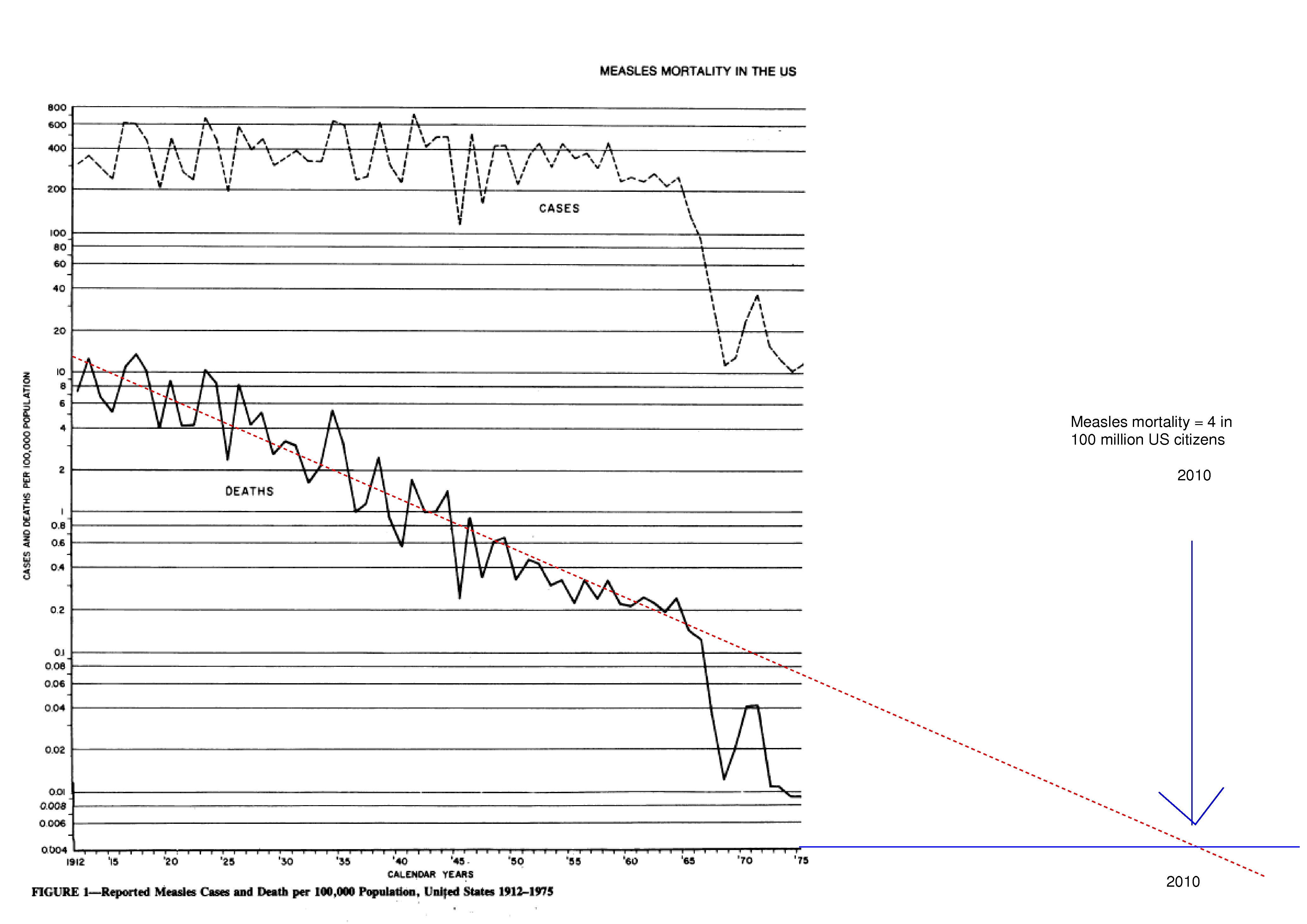
Consider this old graph. In a bit we will get to the edit that was done and how deceptive that is (click figure to enlarge):

measlesmortalityusa1971-75_1

The rate of measles infection dropped by about 30x between 1964 (before the introduction of the vaccine) and 1971. With that came a drop in deaths from measles. A factor that is very interesting, and very much misused, is the fact that the death rate from measles was steadily dropping before the introduction of the vaccine. Hence the “vaccines didn’t save us” myth. Had we just waited, the death rate would have dropped to the same level anyway. There’s a line extrapolating from the data that “shows” that.

First off–hooray for medical advances. They have improved the survival rate from measles. Damned glad they did. But, what about that line? Well, you can draw a line through pretty much anything if you try hard enough. It doesn’t mean anything if you don’t understand the mechanism causing the trend. Why should we expect the trend before 1965 to continue for the next 45 years?

While engaging in online discussions about measles outbreaks, I ran across this website from the U.K.. The table is “Measles notifications and deaths in England and Wales, 1940-2013”. The public health officials in the UK are supposed to be “notified” of every person infected with measles, so “notifications” are “cases”. Let’s consider the notifications. (click figure to enlarge)

Measles Notifications UK

This isn’t normalized to the total population, it’s just the raw number of cases in any given year. I’ve taken the liberty to point out some events which happen to coincide with changepoints in the graph. First is the introduction of the measles vaccine, after which the number of cases per year dropped dramatically. Second is the introduction of the MMR vaccine which, again, was followed by drops in the number of cases. Lastly we see the publication of Andrew Wakefield’s now-retracted Lancet study. Shortly after which, the number of cases started to rise again. Yes, correlation is not causation, but time after time, with vaccine after vaccine we see the same thing: introduce a vaccine and the incidence of that disease decreases.

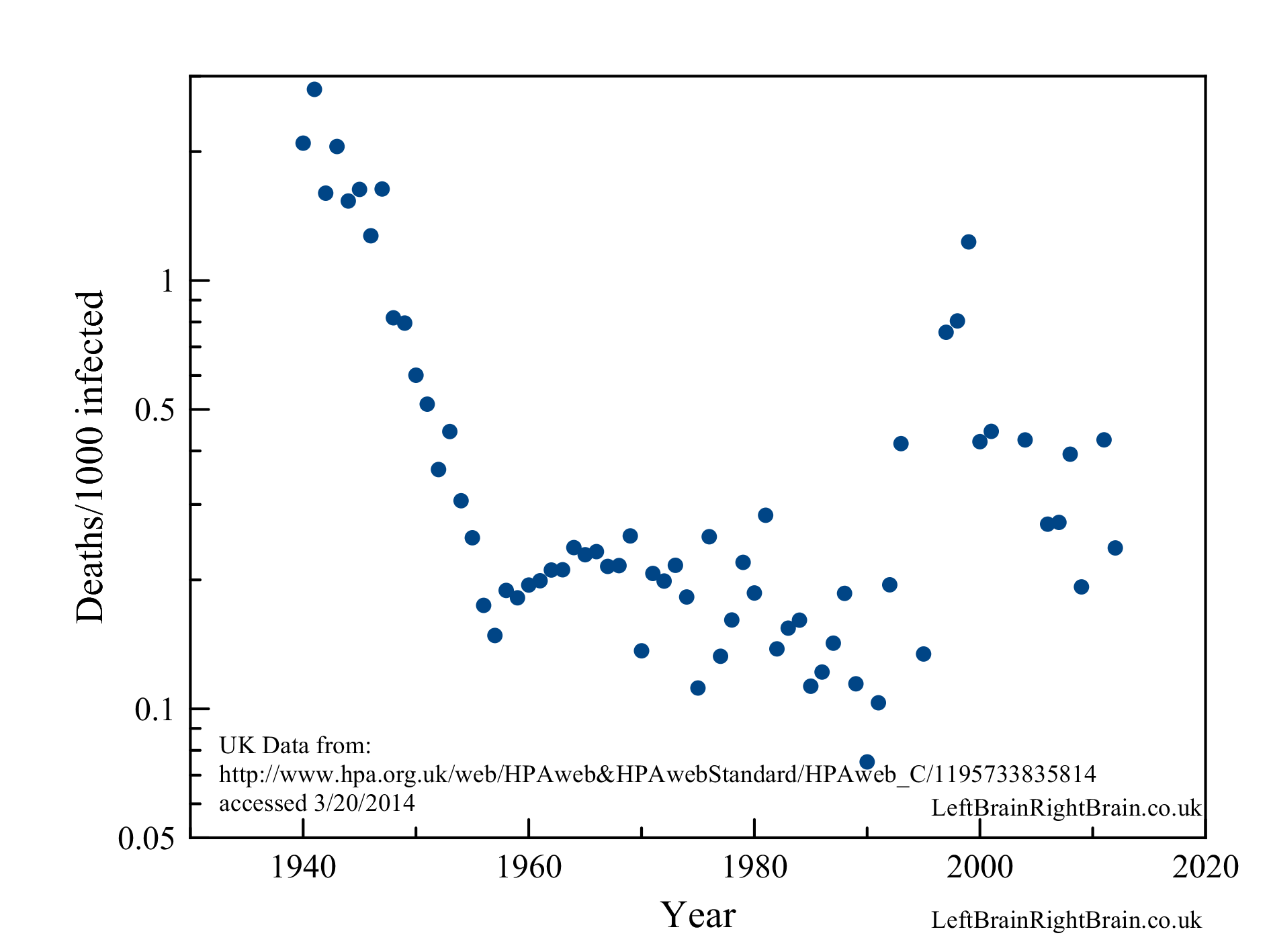
OK, we’ve looked at notifications. What about deaths? Let’s take the number of deaths and normalize by the number of notifications. In other words, let’s look at what fraction of those infected died.

Measles Deaths UK

Pre 1960 there was a steady drop in the fraction who died. Again, yay medicine. And, yes, yay nutrition and sanitation. After 1960, though, the fraction who died leveled off. 2-3 people per 1000 infected died. (it averages to about 2.6/1000 from 1960 onward).

None of this is news. In Measles Elimination in the United States, a team from the CDC writes:

By the late 1950s, even before the introduction of measles vaccine, measles-related deaths and case fatality rates in the United States had decreased markedly, presumably as a result of improvement in health care and nutrition. From 1956 to 1960, an average of 450 measles-related deaths were reported each year (∼1 death/ 1000 reported cases), compared with an average of 5300 measles-related deaths during 1912–1916 (26 deaths/ 1000 reported cases)

Catch that–that’s people from the CDC saying “yay healthcare! Yay nutrition!” and “yay vaccines!”.

Did nutrition, sanitation and improved medical care reduce the fraction of people who died from measles infection? Absolutely. Was it enough? No. Can we draw lines from old data and claim that the number who would die today would be 4 in 100 million today? Well, sure, you can draw the line. It’s dishonest, but given the source that’s not surprising. As I wrote above, you can draw a line through anything. Doesn’t make it true. If you don’t know the reason why a trend is happening, or the limitations on that trend, it’s meaningless. In this case there was a “hard floor”. There are deaths from measles that sanitation, nutrition and modern medicine can’t prevent. People still die from measles. Measles deaths in France (modern sanitation, nutrition and medicine) were seen at a rate of 3/1000 in recent years. Pregnant women, fetuses, small children and the infirm are more likely to suffer. Which is why when people like “Dr. Bob” Sears and “Dr. Jay” Gordon downplay the risks of measles–in effect telling their readers to keep relying on the rest of us to provide herd immunity–people like me speak up. Yes it’s a diversion from autism, but it’s a diversion fed by some of my fellow autism parents. And it’s an important diversion.


By Matt Carey

Meeting of the Interagency Autism Coordinating Committee

11 Mar

The U.S. Interagency Autism Coordinating Committee (IACC) will meet next month. People are invited to attend in person, by phone or webinar. People are also invited to submit written comments or present comments live.

Note: I serve as a public member to the IACC but all comments and opinions here and elsewhere are my own.

Here is the announcement:

Meeting of the Interagency Autism Coordinating Committee

Please join us for an IACC Full Committee meeting that will take place on Tuesday, April 8, 2014 from 9:00 a.m. to 5:00 p.m. ET at the National Institutes of Health, 31 Center Drive, Building 31, C Wing, 6th Floor, Conference Room 10, Bethesda, MD 20892. Onsite registration will begin at 8:00a.m.

Agenda: The committee will discuss committee business, agency updates and issues related to autism spectrum disorder (ASD) research and services activities.

Meeting location:
National Institutes of Health
31 Center Drive
Building 31, C Wing, 6th Floor, Conference Room 10
Bethesda, MD 20892

Nearest Metro stop:
Medical Center – Red Line

In the interest of security, NIH has instituted stringent procedures for entrance onto the NIH campus. All visitor vehicles, including taxicabs, hotel, and airport shuttles will be inspected before being allowed on campus. Visitors will be asked to show one form of identification (for example, a government-issued photo ID, driver’s license, or passport) and to state the purpose of their visit.

Pre-Registration:
The meeting will be open to the public and pre-registration is recommended. Seating will be limited to the room capacity and seats will be on a first come, first served basis, with expedited check-in for those who are pre-registered. Please visit the IACC website for access and information about registering.

Public Comment – Deadlines:
Notification of intent to present oral comments: Tuesday, April 1st by 5:00p.m. ET
Submission of written/electronic statement for oral comments: Wednesday, April 2nd by 5:00p.m. ET
Submission of written comments: Wednesday, April 2nd by 5:00p.m. ET

Remote Access:
The meeting will be remotely accessible by videocast (http://videocast.nih.gov/) and conference call. Members of the public who participate using the conference call phone number will only be able to listen to the meeting.

Conference Call Access
USA/Canada Phone Number: 888-950-8042
Access code: 8689681

Individuals who participate using this service and who need special assistance, such as captioning of the conference call or other reasonable accommodations, should submit a request to the contact person listed above at least five days prior to the meeting. If you experience any technical problems with the conference call, please e-mail at helpdeskiacc@gmail.com or call the IACC Technical Support Help Line at 415-652-8023.

Please visit the IACC Events page for the latest information about the meeting, including registration, remote access information, the agenda, materials and information about prior IACC events.

Contact Person for this meeting is:

Ms. Lina Perez
Office of Autism Research Coordination
National Institute of Mental Health, NIH
6001 Executive Boulevard, NSC
Room 6182A
Rockville, MD 20852
Phone: 301-443-6040
E-mail: IACCpublicinquiries@mail.nih.gov