Archive | Extreme biomed RSS feed for this section

Mayer Eisenstein files for bankruptcy…again

22 Jan

Mayer Eisenstein is a go-to person in the vaccines-cause-autism community. He heads a large practice in the Chicago area and claims that his unvaccinated children do not have autism. He also was or is a part of the “Lupron Franchise”—a group of practitioners who took on the Geier idea that shutting down sex hormone production in autistics could be a treatment. It was a profoundly bad idea.

Mayer Eisenstein was the subject of an article in the Chicago Tribune: Autism doctor: Troubling record trails doctor treating autism. From that article:

Yet his suburban Chicago practice, currently known as Homefirst, garnered an alarming record: It was on the losing side of one of the largest U.S. jury verdicts — $30 million — ever awarded to the family of a newborn in a wrongful-death suit.

In court records dating back three decades, the families of dead and brain-damaged children repeatedly alleged that doctors who work for Eisenstein made harmful mistakes — sometimes the same error more than once. His practice also has been dogged by accusations in court records that its offshore malpractice policy was phony.

After the $30M verdict, Mayer Eisenstein filed bankruptcy. Which was not permitted. Again from the article above:

With bankruptcy off the table, a Cook County judge acknowledged the practice’s claim of insolvency, consolidated the $30 million verdict, five remaining malpractice cases and two civil fraud cases and ordered mediation.

Last July, the judge approved a $1.275 million settlement that Homefirst must divide among six families over seven years. Eisenstein’s practice made the first $100,000 payment last September, four months before he opened the autism clinic.

It appears that the $1.275M settlement noted above is the topic of a battle ongoing in the current bankruptcy filing by Dr. Eisenstein. Per the complaint:

The aggregate Settlement Amount of $1,275,000 represents a small fraction of the total of claims by the Personal Injury Plaintiffs, some of which had reached verdict and judgment.

In other words, it appears Mayer Eisenstein wasn’t allowed to avoid payment by filing bankruptcy, but he did reduce the payments dramatically. The settlement also included a payment schedule. The families claim that four annual payments for a total of $430,000 were made, then the payments stopped after 2011. They claimed (as of August 2013):

Installments to Be Paid on or Before: Amount

September 22, 2012 (not paid when due). . . . . . . . . . . . $ 140,000.00

September 22, 2013 (not yet due). . . . . . . . . . . . . . . . . . $ 150,000.00

September 22, 2014 (not yet due). . . . . . . . . . . . . . . . . . $ 160,000.00

September 22, 2015 (not yet due). . . . . . . . . . . . . . . . . . $ 395,000.00

Total due and unpaid and to become due $ 845,000.00

Per the docket, the case was scheduled to go to hearing last month.

In short, it appears that a multiple families were injured by Mayer Eisenstein and/or member of his practice. They sought and were granted damages, only to have Dr. Eisenstein negotiate those down in a 2004 bankruptcy filing. Dr. Eisenstein made some payments, but then stopped. And he now appears to be trying to avoid further payments as part of his new bankruptcy filing, which the families are fighting. Again.

Why, one might ask, didn’t the families get some secutity pledged to cover the settlement should Dr. Eisenstien stop payments? Seems a reasonable thing to do. The answer is they did. It appears that the property he pledged as security was not under Mayer Eisenstien’s control. In other words, when the families sought to get the property in lieu of the payments, they found that Dr. Eisenstein (who holds a law degree in addition to his medical credentials) couldn’t directly hand it over.

The records of the Office of the Recorder of Deeds of Cook County, Illinois disclose the following transactions for the property at 1101 Dodge, Evanston, Illinois, PIN 10-24-

208-032-0000:

(a) Karen Eisenstein (Mayer Eisenstein, M.D.’s spouse) took title by a deed recorded on April 29, 2002 as document number 0020384408.

(b) Karen Eisenstein transferred title to North Star Trust Co. Tr. # 36189 by a deed in trust recorded on June 11, 2003 as document number 0316239026.

25. Paragraph 6 of the Circuit Court order of July 12, 2008 further provides:

“6. Plaintiffs are to have secured creditor status in the event of an applicable bankruptcy filing.”

So, it would appear that Mayer Eisenstein pledged a property as security for the settlement—a property which he had transferred to his wife in 2002 and which she had transferred to a trust company, in 2003. In other words, to this layman, it appears that at the time he put the property up, it was effectively shielded from actually being used as security.

Another question that one would reasonably ask is why weren’t these claims paid by malpractice insurance? That gets very convoluted, but the original settlement agreement included the statment

“I. Defendants in this matter affirm that they do not have any liability insurance coverage for any of the claims of the remaining plaintiffs.”


Defendants would be Mayer Eisenstein and his practice. And here is where it gets convoluted. The current complaint states

45. At one of the meetings pursuant to Section 341 of the Bankruptcy Code, Mayer Eisenstein, M.D. stated that from time to time he has malpractice insurance to allow him to be on staff at an area hospital.

46. At that same meeting, Mayer Eisenstein, M.D. stated that he did not submit any of the claims to that malpractice insurance carrier, because, as he claimed, if he had the insurance would have been cancelled, and he could no longer use the hospital

47. If Mayer Eisenstein, M.D. had medical malpractice insurance coverage in place at a time when the claims or one or more of the Personal Injury Plaintiffs cases arose, then the
statement was false.

Maybe he didn’t have insurance. Maybe he did and didn’t submit the claims.

Let’s take a look back at the Chicago Tribune article. In addition to discussing the Lupron clinic Dr. Eisenstein set up, it also discusses his history with insurance:

He also dabbled in group health plan sales to Illinois families but tangled with state insurance regulators in the mid- to late 1990s. Regulators warned consumers in a newsletter that Eisenstein “continued to illegally market” the Homefirst Health Plan, based in the British Virgin Islands, even after they told him the plan was ineligible. Despite this, he continued selling the plan, records show, and they ordered him to “cease and desist.”

In an interview, Eisenstein said he was offering a “fraternal health plan,” not traditional health insurance, so he said he didn’t have to listen to regulators. He no longer sells health plans.

And, later:

After Nathan Howey’s death, Weiss Hospital sued Homefirst, Rosi and Eisenstein for fraud, alleging they misrepresented their Caribbean-based malpractice policy. Eisenstein testified that he was in St. Kitts helping one of his daughters, a veterinary student there, buy a condo when the lawyer who helped arrange the sale told Eisenstein he also sold malpractice insurance.
“I was tickled pink to get insurance,” he said under oath.

A Cook County judge called it an “improperly underwritten insurance plan.” Eisenstein, who says the policy is legitimate, agreed to pay Weiss $50,000 after mediation.

Yes, “tickled pink” to get insurance. From a Caribbean island real estate/insurance salesman.

For those interested, here are some of the documents from the case discussed above.

Case 13-01050, lawsuit

Exhibit A

Exhibit B


By Matt Carey

Looking back at two decades of Geier

20 Oct

In the past Mark and (to a lesser extent) his son David Geier were frequently being discussed online. It struck me that given how far back the Geier saga goes, many may not be aware of the myriad stories of the Geiers. How often and from how many angles the news has come about just how bad the Geier legacy is. They’ve been involved in the vaccine court (and from the outset–1993–showing “intellectual dishonesty“), publishing questionable research and running a clinic whose special “therapy” is so clearly wrong.

I went back to an article I wrote in 2007 where a Special Master (the judge in the “vaccine court”) wrote that the Geiers’ work was of such poor quality that the court would no longer pay for them to act as experts. I was going to just re-run that article (and it is copied in full below) when I thought it worthwhile to list some of the more notable actions of the Geier team.

The best writing on the Geiers was done by Kathleen Seidel of Neurodiversity.com (some of the best investigative reporting ever). Unfortunately a server crash took down the site, but one can find the articles on the Wayback Machine (archive.org).

Just a few specific examples:

Maryland Authorities Charge “Lupron Protocol” Promoters With Unprofessional Conduct, Unlicensed Practice of Medicine ·

Significant Misrepresentations: Mark Geier, David Geier & the Evolution of the Lupron Protocol

A Silent Withdrawal (details behind the withdrawal of a Geier paper).

The withdrawal followed and was likely caused by Ms. Seidel’s investigations, laid out in this letter to the Journal (autoimmunity reviews) in which she noted (among other facts) that the Geiers actions were questionable from an ethics standpoint. In specific, in regard the their IRB (Institutional Review Board) approval for their study:

The Office of Human Research Protection registration of the IRB of the “Institute for Chronic Illnesses” was submitted by Mark Geier in February 2006 — fifteen months after the commencement of the research the Geiers describe in this article, which began in November 2004, the same month in which Dr. Geier testified in court that he had no prior experience in the diagnosis or treatment of autistic children. (13,14) The seven-member IRB consists of Mark and David Geier; Dr. Geier’s wife; two of Dr. Geier’s business associates; and two mothers of autistic children, one of whom has publicly acknowledged that her son is a patient/subject of Dr. Geier, and the other of whom is plaintiff in three pending vaccine-injury claims. The membership of the IRB gives rise to misgivings about the independence of ethical review of Dr. and Mr. Geiers’ research. Every member has discernible conflicts of interest, and none has any discernible expertise in endocrinology — expertise crucial to the competent oversight and conduct of research involving pharmaceutical manipulation of children’s hormones.

Yes, they got “approval” from themselves after they did the research. Just astonishingly bad. Completely circumventing the entire purpose of an IRB.

There’s so much more good work at Neurodiversity.com. But let me switch to articles here at Left Brain/Right Brain:

David Geier ordered to pay $10,000 for practicing medicine without a license

Is Mark Geier finished as an expert witness in the vaccine court? A quote from this vaccine court decision:

I will not likely be inclined to compensate attorneys in any future opinions for consultant work performed by Mark Geier after the publication date of this opinion.

Note that the question is whether to pay Mark Geier as a consultant. This was in 2011, after it was established that he was not an expert and would not be compensated for work as an expert. This didn’t stop attorneys tried to keep him on the payroll as a “consultant”.

How about the Geier theory behind using Lupron to shut down hormone production in autistic kids? It started as a way to enhance chelation. Chelation is without merit in autism treatment to begin with, but the Geiers took it a step further. One of their collaborators, and apparently the parent of one of the first kids to be subjected to the “Lupron Protocol” quoted David Geier as saying, “We figured something new out…..we think we can get rid of the mercury by lowering the testosterone”. The “science” behind the “Lupron Protocol” AutismOne throws their support behind the Geiers in Autism Science Digest is ridiculous. Even the Geiers shifted away from their original theory, leaving out the mercury angle: The Geier Story on Testosterone Shifts Again.

In their research, the Geiers cite Simon Baron-Cohen, whose has worked on the idea that exposure to testosterone in-utero could be a cause of autism. Baron-Cohen’s work had no scientific relevance to the Geier work. But, thankfully, Baron-Cohen was quoted in a news article about the Geiers:

Simon Baron-Cohen, a professor of developmental psychopathology at the University of Cambridge in England and director of the Autism Research Center in Cambridge, said it is irresponsible to treat autistic children with Lupron.

“The idea of using it with vulnerable children with autism, who do not have a life-threatening disease and pose no danger to anyone, without a careful trial to determine the unwanted side effects or indeed any benefits, fills me with horror,” he said.

Mark Geier lost his medical licenses. Yes, licenses plural. Lost in many states. He had franchised his Lupron work out. It took a cease and desist order issued to make him really stop practicing medicine.

Criticism of Mark Geier’s “expertise” was not limited to the “vaccine court”. In Boyd Haley and Mark Geier: Experts? we see how he failed to meet the standards of an expert in a civil court.

The Geiers’ have done well, financially. Charging over $50k/year, plus over $10k in tests, could do that. Here’s their home in Florida (The Geiers’ Second Home)

As part of the action to strip Mark Geier of his medical license: Maryland Board of Phyicians: Mark Geier “endangers autistic children and exploits their parents”

In Crist backer Gary Kompothecras bullies Florida health officials, we learned that political pressure was being brought to bear to give the Geiers access to Florida’s health records to perform a study.

The Geiers requested over $100,000 for work on the Hepatitis B Omnibus, including multiple trips to Europe. (almost $24k for one trip alone). Much of the request had no documentation (bills, airline tickets, etc.)

Quotes from the special master in the decision in that case:

I found that the articles authored by Dr. Geier unpersuasive and not scientifically sound, based on my prior reading of the articles and critiques of them. I am also aware that Dr. Geier is trained as a geneticist and obstetrician, not an immunologist, epidemiologist, or rheumatologist, and that my fellow special masters and several other judges have opined unfavorably on his qualifications and testimony as an expert.

and, in regards to David Geier (who holds no advanced degrees):

“In summary, the undersigned finds the costs for David Geier’s efforts to be obviously unreasonable as Mr. Geier is not qualified to address the medical issues involved in the Program and his work was duplicative of the efforts by Dr. Geier. Thus, the undersigned denies the request for costs for David Geier in its entirety.”

The egregious billing activities of the Geiers amount to treating the vaccine program as their personal piggy bank, in my opinion.

In the courts, in their research and in their clinics, the Geiers have time and again shown behavior which is just reprehensible.

Below is the article I wrote in 2007 which prompted this summary: For your own good, don’t use that study!.

____________________________________________

I just read something interesting on the web.  Someone was telling a petitioner in a Vaccine Court trial that she would have a better chance of winning if her expert witness didn’t use a research report by the Geiers.

Was this a blog?  Was this a yahoo group?  Nope, this was a decision on the Vaccine Court’s website.  This was the opinion of Special Master Vowell.

If that name sounds familiar, it’s because she is one of the three Special Masters working on the Autism Omnibus Proceedings.  What exactly did she say?

“I suggested that, in view of the criticisms leveled at Dr. Geier and his research, petitioner would be better served if her expert could opine favorably at the hearing without relying on the cited articles. “

and

“In attempting to assist this petitioner in presenting the strongest possible case for vaccine causation of her illness, I urged her counsel to caution her expert against relying on the Geier articles he cited.”

Ouch.

In case you were wondering, I wasn’t just reading the Vaccine Court decisions for fun.   I was prompted by something that Mark Geier said on NightLine.  Dr. Geier made a comment about “Wining” in vaccine court.

This struck me as a very odd statement.  Petitioners (plaintiffs) win.  Lawyers win.  Expert witnesses?  They can help someone win, but I don’t see them as “winning”.  Besides, there was something in the way he said it.  Something like when a kid says, “of course I did my homework” and you know you have to go check.  So, check I did.

I looked through the published and unpublished decisions and searched for “Geier” in each.  These go back to 1997 for published decisions.   “Decisions” include actual cases as well as pre- and post-trial actions.  The one quoted above is a good example of “pretrial”.  Post-trial Decisions are often about whether everyone should get paid what they billed.  Or, at least, this seems to be the case in more recent times.

Not all Decisions are trials.  Keep in mind, a single trial could have multiple Decisions.  I haven’t tried to group them together by case, I just made a list of all of the ones I could find involving Dr. Mark Geier.

With all that out of the way, what did I find?  There are 31 Decisions posted that involve Dr. Geier.  Of those, three are cases “won” where Dr. Geier was involved.  A further 3 may be considered “mixed” or “neutral”.  Figure that in 80% of the cases, the Petitioner and/or Dr. Geier loses.  I consider that a generous take.  It really is more like 90%.

Let’s look at those “winners”.

1999: The petitioner won the case.  “The court’s decision in this case is not based on Dr. Geier’s testimony, but neither will the court discard his testimony as unreliable.”  Not the most ringing endorsement.

2000: The petitioner won the case.  Dr. Geier submitted an affadavit which was used to “buttress” the case made by the expert witness who actually testified.

2006: Discussion of fees where Dr. Geier’s fees and use is found to be reasonable. ” In the instant case, $1562.50 in expert witness fees for Dr. Mark Geier’s services is reasonable.”

Yes, in the last 10 years, those are the “good ones”.   Not impressive.

I have seen people post that somehow the Special Masters are trying to discredit Dr. Geier because he is so effective.  People seem to imply that his recent stances on mercury and autism caused the Government to try to neutralize Dr. Geier. 

With that in mind I looked to see if the tone of the rejections has changed with time.  I didn’t really see that.  Keep in mind that some of the well known comments about Dr. Geier predate all these decisions.  For example, he was called “intellectually dishonest” way back in 1993!

Here is a sampling of quotes from other decisions through the past 10 years:

1997: Dr. Geier’s opinion, which is in an area outside his expertise, was not persuasive to the court.

1998: The court is unpersuaded by the opinions of Drs. Kinsbourne and Geier.

1999: This conclusion itself effectively renders the rest of Dr. Geier’s theory useless to petitioner in this case.

2002: “First of all, Dr. Geier is wholly unqualified to testify concerning the two major issues in this case”

2003: “Intellectual rigor is missing from Dr. Tornatore’s testimony and the stealth witness Dr. Geier’s submission after trial. ”

2004: “He is however a professional witness in areas for which he has no training, expertise, and experience”

2005: “The Special Master also noted that Dr. Geier’s opinions have been increasingly criticized in other vaccine cases. See Decision at 5. The Special Master identified seven cases in which Special Masters had rejected the expert opinion offered by Dr. Geier because the opinion related to areas outside Dr. Geier’s areas of education, training and experience.”

2006: This was a question of charges.  Dr. Geier charged $29,350.  In the end, they found $8,520 was reasonable.  It was  found that he was (1) not qualified as an expert, (2) charging for work on his own publications and (3) charging for time spent working in a related civil case.

“Since Dr. Geier did not possess the necessary expertise to testify in this case, the Court will reduce his hourly rate from $250.00/hour to $200.00/hour. Petitioner will not be compensated for costs that can be directly attributed to Dr. Geier’s original publications, attorney/lawyer consultations, and physician consultations. Additionally, the work billed for petitioner’s civil cases is not compensable.”

2007: Again Dr. Geier’s payment is cut. 

“For the reasons stated above, the undersigned finds 13.5 hours to be excessive. Dr. Geier  will be compensated for only those hours that are reasonable. Based on the undersigned’s experience with the Vaccine Program, Dr. Geier will be awarded compensation for five hours of  his time which is a reasonable, indeed generous, number of hours for a literature search and review of articles. ”

Again, that is just a sampling,  No attempt was made to be random.  The tone has been increasing against Dr. Geier, though.  As noted in 2005, “The Special Master also noted that Dr. Geier’s opinions have been increasingly criticized in other vaccine cases”.  So it is increasing.  But that is only increasing by going from Bad to Worse. 

You are welcome to go through the decisions and see if I have been quote mining.  One thing you will see is the possible reason why the Special Master has started warning petitioners to avoid Dr. Geier’s studies.  There are statements to the effect of, “If I had known Dr. Geier was useless as an expert witness, I would have hired someone else”.

Sounds like good advice. 

Mark Blaxill on the Geiers: they do sloppy work

13 Oct

Mark Geier and, more recently, his son David have been active promoting autism as vaccine injury for over 10 years (Mark Geier has been active as an expert in, and been criticized for his lack of quality work, the vaccine court on non-autism issues for about 20 years). They have written multiple papers, ranging from bad to worse, attempting to argue the case that vaccines (and especially thimerosal) are a primary cause of autism.

There are multiple discussions over the years of the Geiers here on Left Brain/Right Brain, Respectful Insolence as well as many other places. The best work was done by Kathleen Seidel at Neurodiversity.com, but due to a server crash much of that content is not readily available. (although it is worth searching for the cached versions or the versions on the Wayback Machine).

The work of the Geiers is so poor that it has always been a wonder to me that no criticism has come from anyone promoting the idea that vaccines caused an epidemic of autism. It isn’t that those promoting the vaccine-epidemic idea are not bright, leaving me wondering if they are too biased by their beliefs or just unwilling to speak publicly against an ally. But, recall, these are the same people who closed ranks around Andrew Wakefield in the face of clear and proved ethical violations.

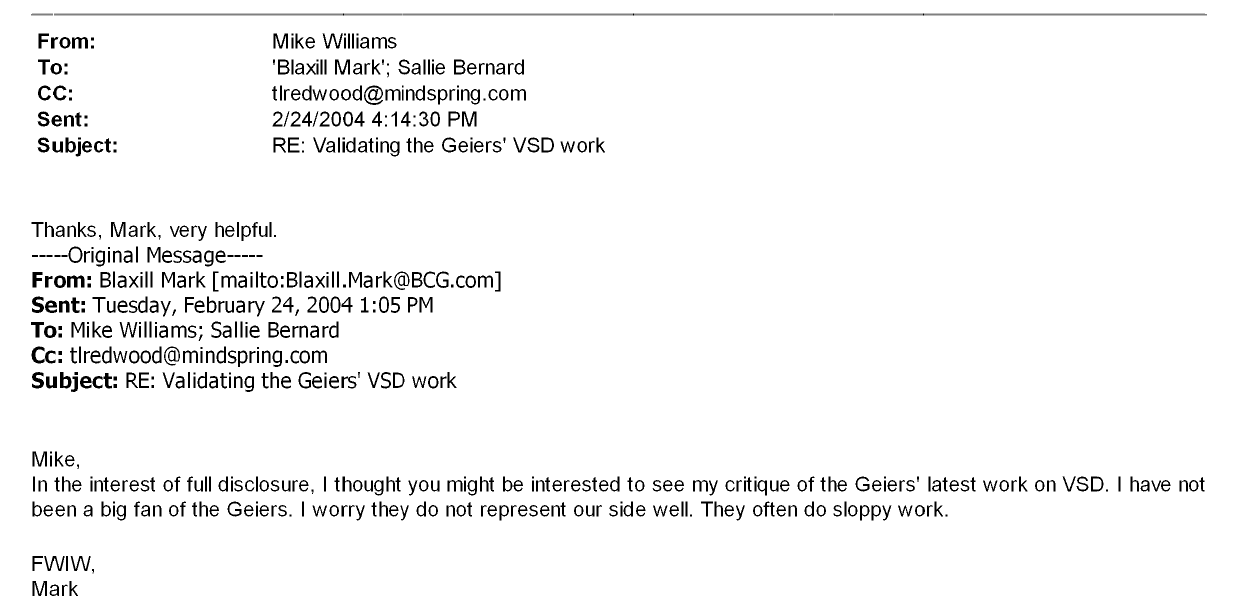
If we are to believe Jake Crosby, former writer for the Age of Autism blog, it appears that the tacit approval of the Geiers has, at least in part, been a case of “circle the wagons”. I.e. people defending an ally over speak their opinions. Mr. Crosby has blaxillwilliams and quotes more emails where Mark Blaxill (former board member of SafeMinds and a long-time proponent of the idea that mercury in vaccines are a primary cause of autism) expresses his views about the Geiers to Mike Williams (attorney involved representing the families in the Omnibus Autism Proceeding).

In an email image on Mr. Crosby’s blog, Mr. Blaxill is reported to have stated:

In the interest of full disclosure. I thought you might like to see my critique of the Geiers’ latest work on VSD. I have not been a big fan of the Geiers. I worry they do not represent our side well. They do sloppy work.

In another email (quoted by Mr. Crosby, the link to the original is nonfunctioning) quotes Mr. Blaxill as stating:

“As to the Geiers, I may be a bit of a minority voice here, but I worry very much that they can do our cause more harm than good. They are not very good scientists, write bad papers (both writing badly and reporting in sloppy fashion) and attract too much attention to themselves as individuals. In this last regard, they don’t show nearly as well as Andy Wakefield but they’re trying to play the same role. Frankly, if I were on the other side and were asked to critique their work, I could rip it to shreds. I’m surprised they haven’t been hit harder. So I think you are wise to diversify.”

Mr. Crosby’s stance is that this constitutes “interference” in the Omnibus Autism Proceeding. I.e. Mr. Crosby seems to imply that the Geiers are not sloppy scientists whose work is poor, but that the Geiers should have been allowed a more active role in the Omnibus.

In this case I find myself agreeing, in part at least, with Mr. Blaxill. The work by the Geiers is poor. Where I don’t agree is Mr. Blaxill’s decision to hold back on making those statement public. Not just because it’s hard to take the stance that one is a only “…interested in the quest for the truth” when one holds back on key information like an entire critique of the Geiers’ VSD paper. No. It goes deeper than that. The Geiers’ junk science went beyond promotion of the idea that thimerosal is a primary cause of autism. The Geiers ran a clinic for many years. Mark Geier was a licensed physician, David Geier worked in the clinic (and has been accused of practicing medicine without a license). Through their papers and their talks at autism parent conventions like AutismOne, the Geiers became well known. One of the “brand name” autism clinics. They reached this level of respect within their community because no one within that community dared to speak out.

I’ve noted on Left Brain/Right Brain many times before that these parent conventions differ markedly from real science conferences in that no one ever seriously challenges the speakers. They can present almost any theory or idea, especially if they tie it to autism as vaccine injury, without anyone standing up and saying, “that makes zero sense”. These aren’t science presentations, they are advertisements. It would be interesting to see how many of these conventions Mr. Blaxill attended and yet remained silent on the “sloppy” work that could be “ripp[ed] to shreds” that the Geiers presented. Instead, parents were presented a view that the Geiers were good scientists who suffered unjust criticism for their “brave” stance on vaccines.

The Geiers were promoters of chelation as a treatment for autism. Not only does chelation have no scientific basis to be an autism treatment, a study just out this week using rodents states that chelation could be harmful if there is no real heavy metal toxicity:

Finally, we also found that succimer treatment produced lasting adverse neurobehavioral effects when administered to non-lead-exposed rodents, highlighting the potential risks of administering succimer or other metal-chelating agents to children who do not have elevated tissue lead levels. It is of significant concern that this type of therapy has been advocated for treating autism.

It is highly likely that Mr. Blaxill would disagree with the statement that chelation has no good scientific basis as a treatment for autism. He’d be wrong, but that’s been covered over and over before. The Geiers moved on from standard chelation to stranger, more dangerous therapies. As an aside, if chelation was a successful treatment one has to wonder why the Geiers were prompted to move on to using Lupron as an autism treatment. Lupron is very serious medicine and it shuts down sex hormone production in the body. Why Lupron, one might ask? The Geiers convinced themselves (or convinced themselves that they could pass off this explanation) that mercury bound itself to testosterone in the brain, making it hard to chelate. They cited a paper showing that if one heats testosterone and mercury salts in benzene, one could form these mercury/testosterone complexes. They actually claim (yes, they tried to patent this idea to make money off it) that this paper shows that “It is known in the art that mercuric chloride binds arid forms a complex with testosterone in subjects”. The “subjects” are beakers of benzene, not animals and not people. Add to that the lack of an explanation of how shutting down hormone production would break up these complexes. The Geier “science” supporting Lupron would be laughably bad if it wasn’t used to subject disabled children to Lupron injections.

Lupron clearly has no basis as an autism therapy. In fact, the “lupron protocol” played a major part in Mark Geier losing his medical licenses. One has to ask, how did the get such traction for such an obviously bad idea? For one thing, the Geiers were considered respected scientists in the vaccine injury/alternative medicine autism community due to their previous and ongoing work trying to link thimerosal and autism. Work which Mark Blaxill considered “sloppy” and worthy of being ripped to shreds. But instead of sharing his views on the Geier papers with the public, Mr. Blaxill shared them privately within his own circle.

It’s worth noting that the email quoted above was written before the “Lupron Protocol” was developed. We don’t know if Mr. Blaxill was alarmed by the emergence of the “Lupron Protocol”. I can’t find where he spoke out against it. We can see that his blog (under a different writer) promoted the idea as “MERCURY, TESTOSTERONE AND AUTISM – A REALLY BIG IDEA!“. Mr. Blaxill doesn’t seem to have commented there. For all the papers the Geiers have published, Mr. Blaxill only mentions them once in his book “Age of Autism. But as we’ve seen, tacit approval (silence) may not be the same thing as real approval.

Mr. Blaxill had the courage to testify before a congressional hearing last year. A hearing where the politicians had been lobbied in advance to be favorable to his cause. When it came to disagreeing with one of his allies, that courage was lacking. He allowed “sloppy” science from an ally to go unchallenged. An example of the fallout of such a decision, in my opinion had he stood up he could have slowed or even stopped the “Lupron Protocol”, a therapy which in my opinion amounts to the abusive treatment of disabled children in an uncontrolled and unapproved experiment.


By Matt Carey

FDA warning: hyperbaric oxygen therapy (HBOT) has not been clinically proven to cure or be effective in the treatment of cancer, autism, or diabetes

24 Aug

The FDA issued a warning yesterday about hyperbaric oxygen treatment (HBOT) that includes autism. HBOT has not been shown to cure or be an effective treatment for autism, among the myriad conditions for which HBOT is touted.

The warning is quoted below.

No, hyperbaric oxygen therapy (HBOT) has not been clinically proven to cure or be effective in the treatment of cancer, autism, or diabetes. But do a quick search on the Internet, and you’ll see all kinds of claims for these and other diseases for which the device has not been cleared or approved by FDA.

HBOT involves breathing oxygen in a pressurized chamber. The Food and Drug Administration (FDA) has cleared hyperbaric chambers for certain medical uses, such as treating decompression sickness suffered by divers.

HBOT has not, however, been proven to be the kind of universal treatment it has been touted to be on some Internet sites. FDA is concerned that some claims made by treatment centers using HBOT may give consumers a wrong impression that could ultimately endanger their health.

“Patients may incorrectly believe that these devices have been proven safe and effective for uses not cleared by FDA, which may cause them to delay or forgo proven medical therapies,” says Nayan Patel, a biomedical engineer in FDA’s Anesthesiology Devices Branch. “In doing so, they may experience a lack of improvement and/or worsening of their existing condition(s).”

Patients may be unaware that the safety and effectiveness of HBOT has not been established for these diseases and conditions, including:

AIDS/HIV
Alzheimer’s Disease
Asthma
Bell’s Palsy
Brain Injury
Cerebral Palsy
Depression
Heart Disease
Hepatitis
Migraine
Multiple Sclerosis
Parkinson’s Disease
Spinal Cord Injury
Sport’s Injury
Stroke
Patel says that FDA has received 27 complaints from consumers and health care professionals over the past three years about treatment centers promoting the hyperbaric chamber for uses not cleared by the agency.

back to top

How HBOT Works
HBOT involves breathing oxygen in a pressurized chamber in which the atmospheric pressure is raised up to three times higher than normal. Under these conditions, your lungs can gather up to three times more oxygen than would be possible breathing oxygen at normal air pressure.

Patel explains that your body’s tissues need an adequate supply of oxygen to function. When tissue is injured, it may require more oxygen to heal. “Hyperbaric oxygen therapy increases the amount of oxygen dissolved in your blood,” says Patel. An increase in blood oxygen may improve oxygen delivery for vital tissue function to help fight infection or minimize injury.

Hyperbaric chambers are medical devices that require FDA clearance. FDA clearance of a device for a specific use means FDA has reviewed valid scientific evidence supporting that use and determined that the device is at least as safe and effective as another legally U.S.-marketed device.

Thirteen uses of a hyperbaric chamber for HBOT have been cleared by FDA. They include treatment of air or gas embolism (dangerous “bubbles” in the bloodstream that obstruct circulation), carbon monoxide poisoning, decompression sickness (often known by divers as “the bends”), and thermal burns (caused by heat or fire).

What are the Risks?
Patients receiving HBOT are at risk of suffering an injury that can be mild (such as sinus pain, ear pressure, painful joints) or serious (such as paralysis, air embolism). Since hyperbaric chambers are oxygen rich environments, there is also a risk of fire.

“If you’re considering using HBOT, it’s essential that you first discuss all possible options with your health care professional,” Patel says. “Whatever treatment you’re getting, you need to understand its benefits and risks. Your health care professional can help you determine which treatment is your best option.”

In addition, any problems experienced with these devices can be reported to MedWatch, the FDA safety information and adverse events reporting program.

This article appears on FDA’s Consumer Updates page, which features the latest on all FDA-regulated products.

August 22, 2013

More discussion at Forbes from Emily Willingham


By Matt Carey

Currently, there is insufficient evidence to support instituting a gluten-free diet as a treatment for autism.

24 May

Perhaps the most commonly cited alternative therapy approach for autism is the gluten free/casein free diet. The idea was promoted largely based on the “leaky gut” and “opiod excess” idea of autism. The basic idea was that the intestines of autistics are for some reason “leaky” and incompletely digested proteins from gluten (grains) and casein (milk) enter the bloodstream and act much like an opiod (drug) causing (somehow) autism. Multiple research teams have looked for evidence of these “opiods” without success. But the idea that eliminating gluten and/or casein as an autism treatment.

Timothy Buie is perhaps one of the most respected gastroenterologists in the autism communities. He has recently written a literature review on the topic: The relationship of autism and gluten.

Here is the abstract:

BACKGROUND:

Autism is now a common condition with a prevalence of 1 in 88 children. There is no known etiology. Speculation about possible treatments for autism or autism spectrum disorders (ASD) has included the use of various dietary interventions, including a gluten-free diet.

OBJECTIVE:

The goal of this article was to review the literature available evaluating the use of gluten-free diets in patients with autism to determine if diet should be instituted as a treatment.

METHODS:

A literature review was performed, identifying previously published studies in which a gluten-free diet was instituted as an autism treatment. These studies were not limited to randomized controlled trials because only 1 article was available that used a double-blind crossover design. Most publish reports were unblinded, observational studies.

RESULTS:

In the only double-blind, crossover study, no benefit of a gluten-free diet was identified. Several other studies did report benefit from gluten-free diet. Controlling for observer bias and what may have represented unrelated progress over time in these studies is not possible. There are many barriers to evaluating treatment benefits for patients with autism. Gluten sensitivity may present in a variety of ways, including gastrointestinal and neurologic symptoms. Although making a diagnosis of celiac disease is easier with new serology and genetic testing, a large number of gluten-sensitive patients do not have celiac disease. Testing to confirm non-celiac gluten sensitivity is not available.

CONCLUSIONS:

A variety of symptoms may be present with gluten sensitivity. Currently, there is insufficient evidence to support instituting a gluten-free diet as a treatment for autism. There may be a subgroup of patients who might benefit from a gluten-free diet, but the symptom or testing profile of these candidates remains unclear.

To paraphrase the conclusions: The evidence is not there for eliminating gluten from the diets of autistics. Perhaps some minority has a gluten sensitivity but so far there is no good test for this possible subgroup.


By Matt Carey

Two steps forward, one step back

21 May

Good News: British groups supporting unorthodox biomedical approaches to autism are distancing themselves from theories attributing autism to vaccines.

Bad News: These groups are still promoting treatments – such as stem cell therapies – for which there is no coherent scientific rationale and no good evidence of efficacy or safety.

Treating Autism, with an address in Bow, East London, and the Autism Treatment Trust, based in Edinburgh, have circulated ‘advocates and organisations involved in the care of patients with Autism Spectrum Disorder’ with a package including a (curiously anonymous) ‘scientific review’ entitled Medical Comorbidities in Autism Spectrum Disorder, a flyer for a conference in Edinburgh in June entitled Changing the Course of Autism: The Science and Intervention, and a complimentary copy of The Autism Revolution: Whole Body Strategies for Making Life All It Can Be, by the American paediatric neurologist Martha Herbert.

The most striking – and most welcome – feature of this package is that it contains no mention of the cause with which both these groups have been most closely associated over the past decade – the campaign claiming a link between childhood immunisations, particularly MMR, and autism. Bill Welsh, former property developer and president of the ATT and of its predecessor Action Against Autism, has been a leading figure in the anti-vaccine campaign in Scotland since 1998. Wakefield himself was a platform speaker at Treating Autism’s first two conferences, in 2007 and 2009, and TA members were prominent in the protests in support of Wakefield outside the GMC when he was struck off the medical register in 2010.

In relation to the current TA/ATT package, MMR is, like the dog that did not bark in the night, significant in its absence.It might be too much to expect that these groups would acknowledge the harm that the anti-MMR campaign has caused to families affected by autism (particularly in encouraging so many into the futile and demoralising litigation) and to child health more widely (confirmed by the recent measles outbreaks).Yet, on a more positive note, Martha Herbert, the keynote speaker at the forthcoming Edinburgh conference, makes the forthright declaration – ‘I strongly encourage vaccination’- in her book (The Autism Revolution, p103). This is progress indeed.

The TA/ATT focus on ‘medical co-morbidities’ – conditions, such as sleep disorders, gastro-intestinal disturbances and epilepsy, that may co-exist with autism – is also a welcome and timely initiative. The ‘scientific review’ draws attention to a number of recent studies that reveal the unsatisfactory standards of medical care experienced by people on the autistic spectrum, highlighting inadequacies in relation to examination, investigation and treatment. It is unfortunate that this review appears to rely largely on North American, Australian or even Middle Eastern sources, and appears to be unaware of the extensive work – both in terms of research and advocacy – carried out by Mencap and others in the UK, in relation to the wider population of people with learning disabilities. This work has been summarised in the Confidential Inquiry into Premature Deaths of People with Learning Disabilities, http://www.bris.ac.uk/cipold/fullfinalreport.pdf.

It is also unfortunate that the discussion of co-morbidities has a perfunctory character in the TA/ATT review, being largely confined to a brief introduction. The question of medical co-morbidities is subsequently conflated with a quite distinct issue – the author’s claim that recent studies confirm a ‘paradigm shift in our understanding of ASD’. From this perspective autism is ‘now increasingly recognised as a whole body disorder, with the core deficits in communication, social interaction, restrictive/stereotypic behaviours that have been attributed to ASD, being surface manifestations of a systemic and complex disease process’. In fact, this is not a new ‘paradigm’, and nor is it ‘increasingly recognised’. It is the familiar dogma promoted by the ‘unorthodox biomedical’ fringe associated since the early 1990s with the (now defunct) Defeat Autism Now! group in the USA. (For an account of the emergence of this movement from the ‘metabolic psychiatry’ of the 1960s, and its incorporation of biochemical and immunological theories in the 1970s and 1980s, see my books, MMR and Autism: What Parents Need To Knowand Defeating Autism: A Damaging Delusion.) The TA/ATT review includes a plethora of references to recent studies claiming to confirm ‘earlier findings of widespread biomedical abnormalities in autism’. On past experience, these claims, based on preliminary laboratory studies or small scale – and often poorly constructed – clinical trials, will turn out to be of dubious significance.

Though the TA/ATT review includes little commentary on interventions, it resorts to selective quotation of mainstream academic sources to provide legitimacy for interventions favoured by unorthodox biomedical practitioners, notably exclusion diets. For example, in relation to the gluten-free, casein-free diet the author cites a recent authoritative Cochrane systematic review in the following terms: ‘from the existing trial evidence it concluded that “the diet poses no disbenefit or harm” [emphasis in original], and it identified positive effects of this diet relating to improvement in overall autistic traits, social isolation, and overall ability to communicate and interact (Millward et al., 2008)’. This is a significant distortion and misrepresentation of the Cochrane review (http://www.ncbi.nlm.nih.gov/pubmed/18425890).This review does not contain the sentence quoted, but in the discussion section it comments, in relation to two major studies of the GFCF diet (Knivsberg, 2003, Elder et al,2006), that ‘neither study reported disbenefits including harms and costs of these diets’. The statement presented by the TA/ATT review as the judgement of the Cochrane authors is in fact their (critical) description of the Knivsberg and Elder papers. The Cochrane authors’ categorical conclusion is that ‘we cannot recommend these diets as standard treatments’. Not only is this ignored by the TA/ATT review, it is immediately contradicted by an endorsement of the GFCF diet by Paul Whiteley and Paul Shattock, Britain’s leading advocates of this diet (and of the wider unorthodox biomedical campaign) over the past 20 years.

The TA/ATT offers several highlighted quotations from the recent ‘consensus report on the evaluation, diagnosis and treatment of gastro-intestinal disorders in individuals with ASD’, produced by of the American Academy of Paediatrics. (See: http://www.ncbi.nlm.nih.gov/pubmed/20048083) Yet it neglects prominent statements from this report which contradict the approach recommended by the TA/ATT review. For example, echoing the Cochrane review, the AAP concludes that ‘available research data do not support the use of a casein-free diet, a gluten-free diet, or combined gluten-free, casein-free diet as a primary treatment for individuals with ASDs.’ Furthermore, it dismisses the sorts of claim made by the TA/ATT review for the significance of various immunological and microbiological factors in relation to autism:

‘A direct cause-and-effect relationship between immune dysfunction and autism has yet to be proven.’

‘The role of gut flora in the pathogenesis of gastro-intestinal disorders in individuals with autism is not well understood.’

The TA/ATT review presents a dozen brief case histories to illustrate its claims – and to demonstrate a 100% success rate from the interventions it recommends. Given the lack of clinical detail – or any information about how these cases were selected – it is impossible to offer any evaluation. However, it is worth noting that in eight of the 12 cases, improvement appeared to follow treatment with antibiotics. The AAP consensus statement observes that ‘it should be noted that empirical antibiotic and antifungal therapy in patients with ASD is not recommended.’

The programme for the Edinburgh conference includes only one speaker on the question of co-morbidities – Dr Daniel Goyal. He is also scheduled to advise attenders on ‘How to Approach Your GP and Paediatrician’. This seems a bold enterprise for a doctor who is qualified as neither a GP nor a paediatrician and whose main experience is in occupational health. His experience in relation to autism appears to have been acquired entirely in private practice, at the Breakspear Clinic in Hertfordshire (recently sanctioned by the GMC over chelation treatment) and at his own Sincere Health ‘nutritional and environmental medicine’ clinic in Harley Street. It is striking that the TA/ATT approach cannot attract the support of a single paediatrician, paediatric gastroenterologist, child psychiatrist or autism specialist working in the National Health Service in the UK.

The most worrying feature of the Edinburgh conference is the prominent place on the platform allotted to Drs Nicola Antonucci and Dario Siniscalco (who are scheduled to give three talks in the course of the weekend). Antonucci, a psychiatrist who acquired training in DAN! therapies in the USA, has teamed up with Siniscalco, formerly a pain researcher with a background in chemistry and pharmacology, to provide stem cell therapy for children with autism at a clinic in Bari in southern Italy. The pseudoscience behind this treatment, now available in the Ukraine, Costa Rica, Mexico, Panama and China as well as Italy (but illegal in the USA and the UK) is discussed in Defeating Autism (pp 114-115). At last year’s Treating Autism conference in London, stem cell therapy was promoted by Dr Jeffrey Bradstreet, a Florida preacher and vitamin salesman and former colleague of Andrew Wakefield, who was severely chastised for his role as both expert witness and treating physician in the ‘omnibus autism proceedings’ in the USA in 2009. (See:http://www.spiked-online.com/site/article/6283/) It is alarming to discover that Antonucci and Siniscalco have collaborated with Bradstreet in various publications.

Whatever my reservations about Martha Herbert’s misanthropic evangelical environmentalism (see Defeating Autism, pp19-22), she offers sound counsel against the use of some of the more dangerous therapies currently popular in the unorthodox biomedical world, notably hyperbaric oxygen and heavy metal chelation. I hope that she will take advantage of her place on the Edinburgh platform to remind attendees (and fellow speakers) of this judgement from her book:

‘Stem cell therapy is an example of a treatment that does not make biological sense to me for autism, is wildly expensive (in part because it’s not legal in the United States), has made some kids whom I know worse, and carries a high risk of danger. I would avoid it.’ (The Autism Revolution, p65)

Michael Fitzpatrick 21 May 2013

In the News: John L. Young, a partner of Mark Geier, had his medical license suspended

6 Mar

The Baltimore Sun has an article up: USM regent said to have used controversial therapy for autism, subtitled: John L. Young, a partner of Mark Geier, had his medical license suspended.

USM in the Univiersity System of Maryland. John L. Young was a Regent of USM. And a former business partner for Mark Geier. From the article:

In the order suspending Young’s license, the Board of Physicians concluded he wrote Lupron prescriptions for nine of Geier’s patients, who ranged in age from six to 17 and who all lived outside of Maryland. The board also said in the order that Young, who sometimes used Skype to speak with patients, broke restrictions against prescribing medicine for people who live outside of the state.

Young’s actions “constitute a substantial likelihood of risk of serious harm to the public health, welfare and safety,” the board wrote in the suspension order. The board did not say Young used chelation therapy.

If I interpret this correctly, after his license was supsended, Mark Geier was using his partner to continue the Lupron perscriptions.

Geier’s theory was that autism was the result of high levels of mercury from vaccinations and that too much testosterone exacerbates the symptoms, hence the use of both Lupron and chelation therapy. Geier diagnosed the children with early-onset puberty, usually a rare diagnosis, and used Lupron to control their hormone development.

I note that the patients range in age from 6 to 17. 17’s a bit old for “precocious puberty”.

Mr. Young was to serve as a regent until 2014. He is not presently on the website for the board of regents.

It appears that the Maryland medical board is recognizing that prescribing Lupron itself as an autism treatment is worthy of censure.


By Matt Carey

MMS, yeah, it’s bleach

11 Jan

Last year the AutismOne parent convention hosted a talk by someone promoting MMS as a treatment for autism. MMS is a bleach. But MMS supporters and defenders rush to discussions of MMS with claims that it is not a bleach and calling it a bleach is fear mongering.

Only, it is a bleach. As in, apply it to cloth and the color goes away. Don’t believe me? Check out MMS: Yes, It Is Bleach, an article by Emily Willingham at The Thinking Person’s Guide to Autism.

What has become of Autism Science Digest?

26 Dec

Autism Science Digest was an effort by AutismOne to publish their take on autism science in a magazine format for a general audience. AutismOne is best known for their annual parent convention which focused largely on alternative medicine and vaccine causation.

It is about the time that AutismOne should be publishing their speaker list for next year’s conference so I checked their website. For those interested, the speaker list reads like most past lists.  Andrew Wakefield, the former researcher who promoted the idea that the MMR vaccine causes autism, will speak. So will Keri Rivera, who last year gathered much criticism for promoting forcing disabled children to ingest bleach or undergo bleach laced enemas. Interestingly, neither Mark nor David Geier are on the list. The Geiers have been frequent speakers at AutismOne and other venues favorable to their failed ideas about mercury in vaccines causing autism, as well as bizarre proposals that using drugs to shut down sex hormone production can be used to treat autism.  While not a regular at AutismOne, Luc Montagnier will not make a return visit.  Last year Dr. Montagnier brought the prestige of a Nobel Laureate to the convention. While his presence was touted strongly by supporters of AutismOne, Dr. Montagnier’s ideas were lacking the scientific rigor one might expect from a Nobel laureate (to put it mildly). Of course Jenny McCarthy returns, perhaps to tell us all once again that those who don’t follow her ideas wish for our children to remain disabled so we can bask in the sympathy of our acquaintances.

That all said, while perusing the AutismOne website I noted that the cover for their “Autism Science Digest” hadn’t changed since my last visit.  That was some time ago. The cover informs readers about the then upcoming 2012 AutismOne convention (last April), so my interest was piqued and I checked the page for the “Digest” and found this announcement: Autism Science Digest is temporarily unavailable.

One is left wondering how “temporary” temporary is in this case. Autism Science Digest was launched in August 2011 so the lifespan (should temporary=permanent) seems a bit short.


By Matt Carey

Bloomberg: Autism Cures Promised by DNA Testers Belied by Regulators

22 Dec

Bloomberg has an article out on how genetic testing is being misused by alternative medical practitioners to justify their “treatments”. The article includes names which might be familiar to those who have followed the online discussions of autism and alt-med: Amy Yasko whose RNA therapy has been widely criticized for implausibility; James Laidler, a doctor who once worked with the DAN movement; and parent-writer Kim Wombles.

The article, Autism Cures Promised by DNA Testers Belied by Regulators begins:

April Hauge, a nurse practitioner in Weimar, California, spent $500 on a genetic test for her autistic son in 2009 that led to purchasing thousands of dollars in vitamins and supplements. Impressed with the results, she’s now selling advice on the approach to others.

There’s just one problem: the DNA tests and related treatments have scant backing from science and U.S. government officials. They’re untested, unproven, and may constitute “health fraud,” doctors, regulators and concerned parents said.

Yes, practitioners order genetic testing ($495 in one example) and then sell therapies supposedly based on these results which can cost the consumer thousands of dollars over the course of “treatment”. The tests are marketing, not science.  There is no real link between the tests, the condition and the treatment.

Discussion of “Dr. Amy’s” RNA therapies go back at least six years.  The idea that ingesting small doses of RNA could treat anything fails the biological plausibility test. Per the Photon in the Darkness blog:

This would be earth-shaking news…if it were true. The sad fact is that the cells in our body have a “thing” about stray RNA. There are enzymes – RNAse’s – that chew up RNA in order to prevent unauthorized “communication” from RNA viruses. These enzymes are in every cell and every body fluid.

There is enough RNAse in a fingerprint to degrade milligrams (1000 micrograms) of RNA in a few minutes. And it’s even worse if you try to ingest the RNA. There are high concentrations of RNAse in both saliva and pancreatic digestive enzymes, so it is highly unlikely that any RNA would survive to be absorbed.

Yes, one’s body is designed to attack and destroy foreign RNA. The full discussion The Alternate RNA Universe. Another can be found at Science Blogs as Autism & RNA????.

Government agencies are aware of the claims made and the lack of a logical link between the tests and the “treatments”.

“A lot of this skims on the edge of health fraud,” said Janet Woodcock, director of the Center for Drug Evaluation and Research at the U.S. Food and Drug Administration, referring to the use of DNA testing to recommend alternative therapies.

But for now, those offering the tests are allowed to “skim” health fraud laws. Laws which may change:

Following public hearings in July 2010, the agency developed guidance for regulating complex genetic and other tests sold by laboratories. The rules have been under review by the Obama administration since late 2011, he said. Until they are finalized, the agency is “somewhat hamstrung” in cracking down on companies that sell the tests, Gutierrez said.

The full article, Autism Cures Promised by DNA Testers Belied by Regulators is online at Blomberg.com


By Matt Carey