Archive | Science RSS feed for this section

Andrew Wakefield gives NBC “talking points”

11 Sep

Dr. Wakefield “took issue” with a recent Dateline episode discussing him and his work. Thoughtful House (his clinic) has offered Dateline some talking points to, I gather, give “the full story” that Dateline supposedly missed.

Since there is next to zero chance that Dateline will act on them, I thought I would take a look at the talking points:

A. There has been extensive replication of the finding of bowel disease in children with autism (ASD) from five different countries. These findings have been published in peer-reviewed journals or presented at scientific meetings. It is therefore incorrect and misleading of Matt Lauer to have stated that every aspect of my original hypothesis has been disproved. On the contrary, the main findings of the original Lancet paper, that is, bowel disease in autistic children, has been repeatedly confirmed. This obvious inaccuracy requires clarification by NBC.

One of my many failings is that I am a sloppy writer and, yet, I key in on imprecise language in the work of others. Case in point:

“On the contrary, the main findings of the original Lancet paper, that is, bowel disease in autistic children, has been repeatedly confirmed. ”

“…the main point of the Lancet paper, bowel disease in autistic children…”

Very imprecise. What about bowel disease in autistic children is the finding of the Lancet article that Dr. Wakefield wants us to know? The statement is so vague that all we are left with is the fact that some autistic children have bowel disease.

This is misdirection on Dr. Wakefield’s part. It isn’t even good misdirection. The Dateline story wasn’t “the career of Andrew Wakefield, what he got right and wrong”. It was about the assertions that MMR cause autism.

Dr. Wakefield makes it appear that this statement was Matt Lauer’s. It is a fine point, but Matt Lauer didn’t state that “…every aspect of my original hypothesis has been disproved”. The statement was from the American Academy of Pediatrics, which Matt Lauer quoted with attribution.

It’s worth recalling what the Lancet paper stated. The concluding paragraph of the 1998 Lancet article was:

We have identified a chronic enterocolitis in children that may be related to neuropsychiatric dysfunction. In most cases, onset of symptoms was after measles, mumps, and rubella immunisation. Further investigations are needed to examine this syndrome and its possible relation to this vaccine.

Had Dr. Wakefield himself distanced himself from the MMR-causation theory in the last 10 years, even a little, I’d think it reasonable for him to emphasize the the idea that he brought to light GI disturbances in autistic kids. But he hasn’t. It isn’t what the Dateline story was about.

The big question, if he thought this was important, why didn’t Dr. Wakefield himself emphasize that in the interview?

Dr. Wakefield’s second point:

B. The shortcomings and the flaws of the studies quoted by Dr. Offit, claiming to disprove an association between vaccines and autism, were not discussed in the program. In my interview with Mr. Lauer I took as an example a paper from Dr. DeStefano from the CDC claiming to exonerate MMR that actually showed that a younger age of vaccination with MMR is associated with a greater risk of autism. This study confirms the association and has been falsely portrayed as vindicating the vaccine. This should have been included in order to provide balance to the program.

Can someone tell me what DeStefano paper and what analysis he is talking about?

C. Reference was made to an autistic child in the vaccine court whose claim for MMR damage was overturned by the judge. No reference was made to the successful vaccine court case on behalf of the child Bailey Banks, coming just one week after the unsuccessful claim described by Mr. Lauer, in which the judge ruled that MMR vaccine can cause autism. Therefore, in the view of vaccine court, it is not a question of whether or not MMR can cause autism, but rather how many children are affected.

The case referred to in the Dateline episode was that of Michelle Cedillo. Her’s was the first “test case” to be heard by the Autism Omnibus Proceeding.

Her case was first heard by a “special master”, who denied compensation. The case then was appealed, and the judge didn’t “overturn” anything. The judge upheld the original decision.

The Bailey Banks case is one that gets debated a lot on the net. Rather than go into that again, let’s ask: how does this relate to Dr. Wakefield’s research? Perhaps I missed it as I did some very quick searches, but I didn’t find anything in the Bailey Banks decision that had anything to do with digestion/inflamation/enterocolitis/constipation/diarrhea… I think you get the idea–the case has nothing to do with Dr. Wakefield’s ideas about autism and the gut.

I.e. Wakefield’s point C is another diversionary tactic.

D. There was a complete absence of comment on the lack of any adequate safety studies of childhood vaccines and the vaccine schedule in particular. There was no mention of the admission by vaccine regulators that there is no data on the long-term safety of vaccines, the chronic disease burden caused by vaccines, and the likely potentially harmful interactions between various vaccines in the routine schedule.

Have you heard the phrase “diversionary tactic” too often yet? What does any of this have to do with whether Dr. Wakefield’s research? This is a favored diversion in online discussions of vaccines/autism. When people run out of real ammunition (and they do quickly), switch to trying to debate general safety of vaccines–and it almost worked. Instead of addressing some of your comments, I’ll move on to your fifth point:

E. Undue credibility was given to Brian Deer, a discredited freelancejournalist, whose false reporting has caused so much misunderstanding and damage to children through the misrepresentation of the doctors and parents who were seeking answers to the vaccine-autism question. Deer has repeatedly misled the public and the medical profession and has been unable to respond to clear evidence of his false reporting in the Sunday Times through the UK’s Press Complaints Commission.

Nice slam, there, Dr. Wakefield. Given the sloppy nature of your previous comments, I am impressed that you pulled this together so well.

You make it seem like it is accepted that Brian Deer is “discredited”. I guess if you don’t get out of Thoughtful House or autism-parent conventions, you might think that.

The “unable to respond…” bit is pretty classic. The Press Complaints Commission isn’t hearing the complaint until after your own GMC hearing, correct? So, I guess he has been unable to respond at the PCC. But, did that really stop him from responding? I seem to recall a pretty sharp worded response that Orac hosted on Respectful Insolence.

Didn’t you, Dr. Wakefield, bring that complaint to the PCC? If so, nice job leaving out the fact. It would come across quite differently had you stated: “…and has yet been unable to respond to clear my claims of his false reporting in the Sunday Times through the UK’s Press Complaints Commission.”

F. It was not disclosed that I have repeatedly invited Dr. Offit to take part in public debate on the safety of MMR vaccine and the false and misleading claims that he has made in the media and his book. He has refused to accept this invitation and has continued to hide from an open and honest debate.

Why would NBC waste time on this? Was it pertinent to the discussion? Answer: no.

I think they did you a favor by not mentioning it. No one looks good with the “So and So won’t debate me” argument. They just don’t. The “please debate me” argument is a staple of the crank. I doubt you wish to appear to be in that category, do you?

Academics “debate” in the literature, not on some stage. If you want to debate Dr. Offit, come up with some good research. Publish it.

Alternatively, if you want to see how a Wakefield/Offit debate comes out, read “autism’s false prophets”. If that is “hiding”, he hasn’t done a very good job of it.

G. NBC alluded briefly to the fact that Richard Horton, editor of The Lancet, was informed of my participation as a medical expert in the MMR litigation almost one year before publication of the Lancet paper in 1998. NBC failed to clarify that when Horton was challenged to respond to the fact that when he so enthusiastically denounced me and the paper in 2004 the Lancet staff was already fully aware of the facts and at that time did not consider them to be relevant. Horton refused to be interviewed by NBC and the interview segment shown was from 2004. This refusal is in sharp contrast to his willingness to denounce me in the media in 2004. NBC also failed to mention that in the light of these facts Horton has been reported to UK’s General Medical Council on an allegation of perjury.

Even if true, this is just more diversions. If you thought it important enough to fax all this information to the Lancet, why didn’t you include a conflict of interest statement in the article itself? The referees would have appreciated that, I believe. Was there any mention of potential conflicts of interest in your cover letter to The Lancet when you submitted the paper? Or in the cover letter for your acceptance? All of those were places where you should have made such statements.

H. It was unfortunate that NBC, having stated their determination to resist external pressure to distort the balance of the program, yielded to such pressure from the American Academy of Pediatrics, allowing them the final word in the program while denying representation from the National Autism Association who put forward to NBC a rational and well reasoned call for further science to resolve this very real issue.

I’m sorry, but are you seriously putting he “National Autism Association” on equal footing with the American Academy of Pediatrics? How many members does the NAA have? (a lot less than the AAP) What is the name of their journal (they don’t have one) What is the impact factor of their journal? (Pediatrics is a very well respected journal).

Given the NAA’s recent childish antics with their attempted slime job against Dr. Offit (which you, Dr. Wakefield, participated in), I think that Dateline has been proven correct for not airing their comments.

I. Dr. Offit cited a large population study of autism and MMR from Denmark in support of his claim to ‘certainty that there is no link.’ This study was so flawed that it was rejected from consideration by the gold standard scientific review by the highly influential Cochrane Collaboration. Dr. Offitt, who is not an epidemiologist, was clearly at a loss to understand the study’s fatal flaws.

“Dr. Offitt, who is not an epidemiologist…” What’s up with that comment? I’m sorry, is Dr. Wakefield an epidemiologist? Answer: no. Do you have to be an epidemiologist to understand the study or it’s strengths or flaws? No.

What fatal flaws is Dr. Wakefield referring to? The big Danish study was by Madsen, et al.. The Cochrane Review lists this study as one of the “cohort studies included in the review”. Not “rejected from consideration”.

That aside, I have the Cochrane Review “Vaccines for measles, mumps and rubella in children (Review)” open. The version I have open is noted: “This is a reprint of a Cochrane review, prepared and maintained by The Cochrane Collaboration and published in The Cochrane Library 2009, Issue 3”, so I think it is the most recent.

I guess if the Cochrane review is “highly influential” and the “gold standard” it would make sense to see what they think of the autism/MMR hypothesis, eh? The review states:

No credible evidence of an involvement of MMR with either autism or Crohn’s disease was found.

Was this because they didn’t know about Dr. Wakefield’s work? Hardly. Four of Dr. Wakefield’s papers were listed. All were listed in the “excluded studies” section.

So where does this leave us? We have, what, nine talking points which are mostly diversions or misrepresentations. Anyone wonder why I don’t think Matt Lauer will be responding to these soon?

Genetic tests and insurance

10 Sep

Does your insurance cover genetic testing?

Many do. But often only in the case of high risk pregnancies or amniocentesis. If you want a diagnosis for your self or your already born child, it’s on your dime.

In other words, if you would like to consider terminating your pregnancy and not bringing a heavy user of insurance covered medicine into the world, the insurance companies are happy to help. If you might be looking for answers, which may result in greater medical expenses, the insurance company doesn’t want to help.

Are autistic kids in the foster care system being over medicated?

8 Sep

Who should we as a society be watching out for more than kids with disabilities who are in foster care? They are kids. They are disabled. They don’t have their parents to advocate for them. They are our responsibility once they enter into the foster care system.

What if they are being over medicated?

One subject that comes up a lot in the online autism community is the use of psychotropic medication on autistics. Note that the following is my opinion and not from the paper: medications, including psychtropic medications, have their place and can be beneficial, but great care and monitoring must be taken to insure that they are appropriately used. Psychotropic medications should not be used as chemical restraints.

That is why I was very interested when I saw that this paper was going to be published in Pediatrics: State Variation in Psychotropic Medication Use by Foster Care Children With Autism Spectrum Disorder.

The paper has been out for a while but I couldn’t blog it right away. I wanted to take the time to do this paper justice. In the end, I don’t know if I have as I’m trying to find a good “voice” for this post. I keep switching between trying to give an uncolored presentation of the data and being outraged.

Yes, outraged.

The paper authors are David M. Rubin, MD, MSCE, Chris Feudtner, MD, PhD, MPH, Russell Localio, PhD, and David S. Mandell, ScDd.

If you are a regular reader of this blog, you may know that I have a great admiration for Dr. Mandell and his group. He asks important questions, often about groups like autistic racial/ethnic minorities or about autistic adults. Groups I consider to be the underdogs in the struggle for recognition and services in the autism communities.

Who could be more of an underdog than disabled kids in foster care?

One of the reasons the authors give for studying autistic kids in the foster care system is:

Second, beyond the cumulative impact of trauma on psychiatric symptoms after maltreatment, children with ASD in foster care are particularly vulnerable to the social and psychological disruptions that foster care placements can create, such that an excessive variation in the use of psychotropic medications between states may indicate problems in the ability of different foster care systems to achieve placement stability for these children or adequately provide for their well-being.

My read on that–autistic kids are more vulnerable to being traumatized by the foster care system, and the states using more meds may be worse at being able to care for these kids.

The authors list a number of factors that could play into this, including lack of resources and lack foster parent or caseworker training. One big factor–the possibility that these kids are frequently moved around. This is hard on all kids, but is obviously going to be especially tough on ASD kids.

The objective of the study was:

The objective of this study was to compare on a national cohort of children with autism spectrum disorder (ASD) the concurrent use of >=3 psychotropic medications between children in foster care and children who have disabilities and receive Supplemental Security Income, and to describe variation among states in the use of these medications by children in foster care.

They are looking at kids getting three or more psychotropic medications at a time.

Psychotropic medications include:

neuroleptic, antidepressant, stimulant, anticonvulsant/mood stabilizer, anxiolytic, and hypnotic agents. Lithium was categorized with the anticonvulsants.

What did they find? For starters, 20.8% of autistic kids in foster care were using three or more classes of psychotropic medications. This double the number of kids who were classified as having a disability (10%).

I could see people arguing that by the nature of the disability, autistic kids might be expected to use more psychotropic medications. Or, that kids in foster care might be more likely to use multiple psychotropic medications. The authors acknowledge this, but point out that:

Nevertheless, Although one might expect the overall use of psychotropic medications to be higher for children in foster care than for other children, state-to-state differences in the average use of medication by their children, although expected to vary to some degree randomly, would not be expected to vary excessively unless system-level factors were exhibiting a high level of influence on such use independent of children’s needs.

My interpretation: there is no obvious reason why the use of psychotropic medications should vary much from state to state. There may be some statistical variation, but each state should be pretty close to the average.

That is, unless there are “system-level factors” which have “a high level of influence on the use of psychotropic medications independent of the children’s needs”.

My interpretation: if there is a variation by state, something other than the needs of the children is likely to be causing it.

And, yes, they did find a state-to-state variation in psychotropic medication use:

Forty-three percent (22) of states were >1 SD [Standard Deviations] from the adjusted mean for children who were using >=3 medications concurrently, and 14% (7) of the states exceeded 2 SDs.

Statistically, they would expect 2 states, not 7, to be more than two standard deviations from the average.

OK. My guess is that this point most people’s eyes are starting to glaze over. 14 states instead of 2 are more than two standard deviations away from the average in terms of foster care autistic kids using 3 or more psychotropic medications. Not exactly a sound byte you can take to your congressman, is it?

How about this, in some states over half of the autistic kids in foster care are getting more than 3 psychotropic medications. Half of the kids. Or, how about this–the state-to-state variation in the raw numbers vary by a factor of 10.

Yes. In some states about 5% of the kids are getting three or more psychtropic medications, while in others it is as much as 60%.

Take a look at the figure below (click to enlarge). Pay special attention to the figure on the left, which is the raw data.

Figure 2 from paper on use of psychotropic medication on foster autistic kids

Figure 2 from paper on use of psychotropic medication on foster autistic kids

The raw data show the huge variation in use of psychotropic medications by state.

Why do the raw data and the adjusted data differ so much? The adjusted data is controlled for other diagnosed clinical conditions. These include depression, bipolar disorder, anxiety disorder, attention deficit disorder, conduct disorder, schizophrenia and mental retardation.

ASD kids are more likely to have other diagnoses if they are in foster care. 32% of ASD kids have another diagnosis, while 54% of ASD kids in foster care have 1 or more additional diagnoses. They are more likely to be given medications as well. This is shown in Figure 1.

Table 1 from paper on state variations in medication of foster care ASD kids

Table 1 from paper on state variations in medication of foster care ASD kids

Again, my read on this: A study like this can’t discern why ASD foster kids have more diagnoses and get more medication. It could be that these kids actually have more conditions and need the medications. It is possible that the trauma of the foster care system is affecting these kids greatly. It is also possible that some kids are being given extra diagnoses in order to justify the medications.

The authors note this as quoted below:

Furthermore, we are concerned that the true magnitude of variation might be larger than we report, because our method of analysis adjusted conservatively for other psychiatric conditions listed in the children’s records; if these diagnoses were not accurate (as has been suggested by others)[ref 15] and were instead recorded as a means to justify treatment with medication, then our analysis might have underestimated the true extent of state-to-state variation.

I am very glad they included the raw data in this case. It highlights the big potentiality that there is a bigger state-to-state variation than in the adjusted data.

Seriously, why would ASD foster-care kids in Arizona be more likely to have a second (or third or fourth) diagnosis than the similar kids in Tennessee?

There is a lot more in this paper. But as one final note, here is a comment about the youngest kids in the study:

Finally, we also note that younger children in foster care were proportionately using more medication; as many as 1 in 8 children aged 3 to 5 years in foster care was receiving medications from >=3 psychotropic classes in this sample from 2001

As I mentioned at the outset: who is more vulnerable than a disabled child in the foster care system? For Americans like myself, the kids in this study are our responsibility.

It looks to me like we are failing them.

Ultrasound: “unlikely to increase the risk of ASD”

5 Sep

A couple of years ago I remember a lot of discussion on the groups I follow about ultrasound as a cause of autism. A lot of parents were concerned that they might have done something that resulted in their child’s autism diagnosis.

A recent study in the Journal of Autism and Developmental Disorders looked into the possibility.

Antenatal Ultrasound and Risk of Autism Spectrum Disorders
by Grether JK, Li SX, Yoshida CK, Croen LA..

Here is the abstract:

We evaluated antenatal ultrasound (U/S) exposure as a risk factor for autism spectrum disorders (ASD), comparing affected singleton children and control children born 1995-1999 and enrolled in the Kaiser Permanente health care system. Among children with ASD (n = 362) and controls (n = 393), 13% had no antenatal exposure to U/S examinations; case-control differences in number of exposures during the entire gestation or by trimester were small and not statistically significant. In analyses adjusted for covariates, cases were generally similar to controls with regard to the number of U/S scans throughout gestation and during each trimester. This study indicates that antenatal U/S is unlikely to increase the risk of ASD, although studies examining ASD subgroups remain to be conducted.

The study doesn’t rule out ultrasound completely, but perhaps this will be welcome news to those parents who were concerned.

Is the rate of autism recovery going down with time?

2 Sep

There is evidence that autism recovery is real. At least that is what we are being told on blogs based on data from the latest “National Survey of Children’s Health (NSCH)“.

We’ve already discussed some of the misinterpretations of the NSCH dataset on this site. I had a long post about this question prepared, but let’s just cut to the chase. If biomedical interventions are resulting in more kids recovering from autism, the “recovery rate” would go up with time. Kids born in the early 1990’s, before ideas like chelation and special diets were popular, wouldn’t be recovered at the same rate as kids born in, say, the last 10 years.

This just isn’t the case.  I graphed the “recovery rate”.  Take the number of kids whose parents were told that the kid had autism minus the number where the parents are reporting the child does not presently have autism.  Divide by the total number of kids whose parents were told the kid had autism.  Show as a percentage (click on graph below).

"recovery" rate from the NSCH data

"recovery" rate from the NSCH data

The “recovery rate” is going down. The rate was about 40% for kids born in 1990 but has dropped to below 30% for kids born in 2004.

Note that there is a high “recovery” rate datapoint for birth year 2005. Those kids were 2 years old for the survey and there were very few of them (only 15 kids total compared to about 90 for most birth years). I wouldn’t try to draw any conclusions from that point.

But, what’s the bottom line? The NSCH data don’t support the concept that introduction of “biomedical interventions” are “recovering” kids with autism. If you really wanted to take the data at face value, you would have to say exactly the opposite: the recovery rate has gone down with the growth of “biomed”. I don’t buy that. The easiest explanation is this: older kids have had more time for some medical person to say, “he/she might be autistic”.

Autism Research Today

31 Aug

What is really important in autism research today? Believe it or not, the online world may give you a slightly skewed idea of what is really considered important.

Dateline had a special tonight on Autism. I’ve stayed away from it so far, but I saw this additional material on the MSNBC website and wanted to post it here.

It includes intereviews with Dr. Margaret Pericak-Vance, head of the new John P. Hussman Institute for Human Genomics and Dr. Eric CourchesneH of U.C. San Diego.

She is head of a new, $100M center and he is one of the top cited researchers in autism. Dr. Courchesne has been asking important questions and writing important papers since the 1990’s.

The video clip doesn’t go into depth about the research, but it is worth the watch.

Visit msnbc.com for Breaking News, World News, and News about the Economy

New research proposed for diet and autism

30 Aug

LBRB has a record of coming down hard on so-called complementary and alternative medicine (CAM). We support evidence based treatments and therapies. CAM is all too often an opportunity for snake oil merchants to rip off parents and potentially harm their children.

It may be  that some CAM interventions are beneficial. Properly conducted research may provide the data to support the claims for a particular therapy. So far the record is not good. Secretin has been tried and found wanting. Facilitated Communication could not live up to the hype. Holding Therapy was not only wrong it was abusive. Chelation is based upon fraudulent challenge testing that has been dismissed by the American College of Medical Toxicologists.

But that does not necessarily mean that all CAM therapies are bad. It does mean that they lack evidence and only research can provide that evidence. Note that evidence is not the same as the parent testimonials that CAM practitioners display on their websites and in their literature. Evidence is data collected by disinterested researchers whose methods and results are open to scrutiny. This is more reliable thsn testimonials, which may be influenced by all sorts of factors, including the placebo effect, recall bias and good old fashioned wishful thinking.

One researcher in the UK who has taken a scientific interest in CAM for autism is Professer Ann Le Couteur. She knows that lots of parents use CAM therapies and wants to investigate their effectiveness. In particular she is interested in parental and professional attitudes to dietary interventions, probably the most widespread alternative therapy for autism. To this end her department has sent out the following letter which is also available on the NAS website.

The study

Researchers at Newcastle University would like to find out about parents’ and child health professionals’ experiences of autism research and their attitudes to the use of the gluten- and casein-free diet as an intervention in ASD. We are carrying out two web-based surveys; one for parents/carers and the other for child health professionals who support children with ASD and their families. The results of these surveys will help us plan the design of UK research studies into biomedical and complementary and alternative therapies for children with ASD.

Participants

Parents/carers of pre-school or primary school-aged children with a diagnosed autism spectrum disorder, and child health professionals who support children with ASD and their families, are invited to take part.

What happens next?

If you are interested in taking part, please visit our website: PADIA. When you follow this link, you’ll go to a web page that tells you more about the study, and will ask you to enter some details.

We will then send you a letter of invitation with a unique ID number and the link to an information sheet. This information sheet has the link to the web-based survey.

If you would like any more information about this study, please contact:

Professor Ann Le Couteur
Tel: 01912 821 384
Email: padia@ncl.ac.uk

When I saw this my first thought was “What about the parents whose children have grown up? What about autistic adults? Do their opinions and experiences matter? So I wrote to Professor Le Couteur who promptly replied and gave me permission to share her reply.

MY LETTER

I recently received an invitation for parents of young children and health care professionals to complete a questionnaire that will assist you plan the design of UK research studies into biomedical and
complementary and alternative therapies for children with ASD. May I enquire if you are also interested in the opinions of parents of older children, and indeed of the adults themselves? Many of us have attempted to implement these therapies in the past or had them done unto us and our experience should not be ignored.

PROFESSOR LE COUTEUR’S REPLY

Dear Mike Stanton

I quite agree experiences of parents of older children and personal experiences are of great interest to us.

The research survey was funded for parents of primary school aged children only and the child health professionals that support them. However if you or anyone you know would be prepared to give us information about your/ their experiences in the past that would be really interesting. We cannot include the information in the survey but would be able to use the account to add to our knowledge and to inform our grant applications etc.

I also value personal accounts as these add great value to my talks and presentations if I have permission to share the experiences (in an anonymised form) for teaching and conference events

Thankyou for contacting PADIA

Your sincerely

Ann Le Couteur
Professor of Child & Adolescent Psychiatry
Institute of Health and Society
Newcastle University
Sir James Spence Institute
Royal Victoria Infirmary
Queen Victoria Road
Newcastle upon Tyne
NE1 4LP

Tel: 0191 2821398 (University)
0191 2821384 (University Secretary)
0191 2196455 (Clinical Secretary)

So there you have it: an autism researcher who is open to personal accounts from parents, professionals and autistic adults in order to assist her in formulating and designing her research programme into CAM. This is a positive invitation and I hope people avail themselves of this opportunity in the spirit in whch it is proffered.

Are more rich kids autistic?

28 Aug

That is the question researchers at the University of Wisconsin studied in a recent paper in the Wisconsin Medical Journal: Socioeconomic Disparity in the Prevalence of Autism Spectrum Disorder in Wisconsin.

The brief report looked at the data used in the 2002 CDC prevalence study that reported 1 in 150 children are diagnosed with autism in the U.S.. The data are collected through the Autism and Developmental Disabilities Monitoring (ADDM) Network.

Here is one of the tables
:

Prevalence vs SES for Wisconsin

Prevalence vs SES for Wisconsin

What’s it say? Basically, if you are wealthy or have a high level of education, your kid is much more likely to be diagnosed autistic.

The authors are pretty limited in what they can say. They didn’t look into the “why”. That they did say was this:

Although the positive association with SES reported here is consistent with early observations of autism and some previous epidemiologic studies,2-3,5 the reason for this association and the potential role of SES differences in access to health and educational services for ASD cannot be determined from the data available.

and:

Further research is also needed to examine whether the association reported in this paper is a result of differential access to health services, other sources of ascertainment bias, or SES differences in the risk of developing ASD.

Do I think that kids of wealthy parents are really 2.5 times more likely to *be* autistic? No. But, are they more likely to *get* a diagnosis? It sure looks like it.

I am not surprised. There are very large disparities by geography (state to state, rural vs. urban) and by ethnicity in much of the CDC’s ADDM network data. I was surprised that the disparity by socio-economic-status was so large.

Are autistic kids less healthy?

27 Aug

This is a question that comes up a lot: is the general health of autistic children lower than, say, typically developing children or children with other developmental delays?

Actually, few people make the comparison to other developmental delays, but it is worth doing.

The National Survey of Children’s Health gives us some information to address this question. It is not a perfect set of data to study, but it will give us an idea.

Parents were asked to grade their child’s health with the question “In general, how would you describe [S.C.]’s health? Would you say [his/her] health is excellent, very good, good, fair, or poor?”

The overall population showed the following distribution:

Excellent: 64.9%
very good: 22.9%
good: 9.8%
fair: 2.0%
poor: 0.3%

So, in general, American kids are pretty healthy.

How about autistic kids*? Here’s the distribution:

Excellent: 34.3%
very good: 29.5%
good: 23.0%
fair: 8.8%
poor: 4.3%

That is a big difference from the general population. From 65% “excellent” down to 34% for autistic kids. We don’t know how parents considered “autism” as being in “poor health”, though. In other words, parents could consider their child to not be in “excellent health” just because he/she is autistic. I throw that out for consideration, not as an explanation of these numbers. We just don’t know if this is a factor.

A clearer indication that autistic may have more medical health problems (at least to my eye) is the fact that “poor” is 4.3% for autistic kids, vs. 0.3% for their typical peers. I could be wrong, but I don’t see many parents listing their child’s health as “poor” just because the kids are autistic. I could see parents downgrading from “excellent” to “very good”, for example.

Compare the autistic group to children “who currently have developmental delay problems”. Note that this group includes many of the autistic kids. Here is the distribution for the kids with developmental delays:

Excellent: 30.1%
very good: 29.5%
good: 25.6%
fair: 10.9%
poor: 3.8%

To my eye, autistic kids and developmentally delayed kids are the same in terms of health grades.

In other words: yes, the general health of autistic kids looks like it is worse than the general population. However, the general health of autistic kids looks like it is basically the same as that for all kids with developmental delays.

To answer the obvious complaints:

1) I am not saying that autistic kids do not have health problems. Being autistic does not make one immune to serious health problems. If anything, autistic kids do have lower health grades than typical kids. However, autistic kids do not have lower health grades than developmentally delayed kids.

2) One (probably me) should look at health grades of autistic children who are rated as being more “severe” and see if the general health grades are lower for that subgroup.

3) This is not definitive data, but a response to a survey. However, within the limitations of a survey, I think these data are interesting to consider.

*Autistic kids being children whose parents told the survey team that the child currently has autism or an ASD.

Huffington Post uses erroneous data to promote autism epidemic

26 Aug

correction:

As noted in the comments below, Mr. Kirby appears to be basing argument suggesting that the Hepatitis B vaccine could have caused autism on ADDM data, not on the NSCH dataset, as I assumed.

A recent blog post on the Huffington Post contains serious errors and should be edited or pulled.  At the very least a public acknowledgment of the error must be made.

Using data from the recently published 2007 National Survey of Children’s Health to estimate autism prevalence, a Huffington Post blogger (David Kirby) attempted to draw a connection between the Hepatitis B vaccine and an “explosion” of autism . Here is what he wrote:

If there is an environmental component to autism, hopefully scientists will want to know which exposures might have increased between, say, 1992 and 1996.

One possible answer is the Hepatitis B vaccine, (which also contained 25 micrograms of mercury containing thimerosal).

Introduced in 1991, it was the first vaccine ever given on a population basis to newborn babies (within the first three hours after delivery) in human history.

But according to the CDC’s National Immunization Survey (which also includes parental telephone interviews), only 8% of infant children received the Hep B vaccine in 1992, when that birth cohort showed an ASD rate of 60-per-10,000.

By 1994, the number of children receiving Hep B vaccine had reached just 27% — and the cohort showed an ASD rate of 66-per-10,000.

But the Hep B coverage rate had risen to 82% by 1996, when that cohort’s ASD rate exploded to around 100-per-10,000.

Correlation, obviously, does not equal causation. And no one is suggesting that Hepatitis B vaccine is the singular “cause” of autism. But the uptake rate of that particular immunization is at least one environmental factor that did demonstrably change during the period in question.

Emphasis is mine. I emphasized the data which  are the data that are incorrect.

The analysis is simple. Here are the actual results compared to what Mr. Kirby misreported:

1992 “birth cohort*”:
102 per 10,000 (not 60 per 10,000 as on HuffPo)

1994 “birth cohort*”:
113 per 10,000 (not 66 per 10,000 as on HuffPo)

1996 “birth cohort*”:
111 per 10,000 (close to the “around” 100 per 10,000 quoted).

Or, to put it very simply: Mr. Kirby’s statement that there was an “explosion” in the autism rates is incorrect. The evidence that the introduction of the Hepatitis B vaccine is somehow related to the increase in autism rates is false.

That entire statement isn’t even a misinterpretation–it is just simply, demonstrably, false.

Unfortunately, this isn’t Mr. Kirby’s first clear and serious error. He has a history of mistakes. Unfortunately, he doesn’t have a history of correcting his mistakes. Consider these examples:

In June 2008, epiwonk publish a blog post “David Kirby: HuffPost Report on CDC’s Vaccine Safety Datalink Uninformative and Completely Misleading“, demonstrating clear errors in Mr. Kirby’s post “CDC: Vaccine Study Design “Uninformative and Potentially Misleading“”.

The errors were serious enough that Mr. Kirby rewrote his blog post as CDC: Vaccine Study Used Flawed Methods. This included the following introduction:

NOTE: My original post on this topic mischaracterized the 2003 CDC vaccine investigation as an “Ecological Study,” which it was not. I am reposting this piece to reflect that information accurately, but also to point out that many of the weaknesses identified in the CDC’s data and methods apply to the published 2003 “retrospective cohort” study, as much as they do to any future “ecological” ones. I regret and apologize for the error.

Mr. Kirby “regrets” and “apologizes” for the error. Yet his original, erroneous blog post is still on the Huffington Post website. He never took it down. He didn’t even add an apology or correction note to the piece. Anyone following a link to it would have no idea that even the author acknowledges the serious flaws in that piece.

It is also worth noting that the “corrected” version of Mr. Kirby’s blog post was also in error. Again, as noted by epiwonk, this time in his piece “David Kirby HuffPost, Take 2: My Original Story was Flawed, So Here’s A Second (”Corrected”) Story That’s Still Flawed, But I Hope I Can Snow You Under Again This Time…

Mr. Kirby compounded this error when he recreated it in his first “congressional briefing”, September 2008. Mr. Kirby misquoted a report by the National Institute of Enviornmental Health Sciences, and he was caught by a knowledgeable staffer.

Again, Mr. Kirbty has failed to correct his error.  He posted his power point presentation to his website, but without any acknowledgment of the error on page 6.  In the transcript for this talk, he only states, “NOTE: This statement omits important details of the CDC response” and sends you to other sites “For a more detailed explanation”. The “transcript” makes no reference to the exchange between Mr. Kirby and the congressional staffer, nor does it acknowledge that the omission was critical to the point being made. The transcript is noted as being a “Rush transcription by Nancy Hokkanen”. Being in a rush is not an excuse to leave important flaws unexplained.

Math errors are also not new to Mr. Kirby. In May 2008, Mr. Kirby wrote a piece analyzing data from Scotland. In doing so, Mr. Kirby misread a graph resulting in a factor of 10 error in a key piece of information (he misread a bar graph . After his error was blogged, Mr. Kirby corrected his Huffington Post piece. What he didn’t do, and he should have, was to note in the blog piece that he made the error and corrected it.

Mr. Kirby placed his Scotland data post in two sites: Huffington Post and the Age of Autism blog. In yet another odd move by Mr. Kirby, he left the original version of his post, complete with the factor of 10 error, on the Age of Autism blog (it still has 34,000 instead of 3,400). As noted above, Mr. Kirby obviously knows about the error, since he corrected it on the Huffington Post.

Since he clearly knew that his post on the Age of Autism blog had a big error, why didn’t he make a correction (with acknowledgment of the error) there?

Mr. Kirby had a bit of a problem with understanding the difference between Change.Org Change.Gov (the Obama transition team’s website) and Change.Org (a website that hosts blogs on important topics, including autism) (also noted here and here) He made a clear correction on the Huffington Post. However, his post on the Age of Autism blog just disappeared without a comment.

But let’s get back to the present. Mr. Kirby has blogged erroneous data and used this to show a false correlation between the Hepatitis B vaccine introduction and the rise in autism rates.

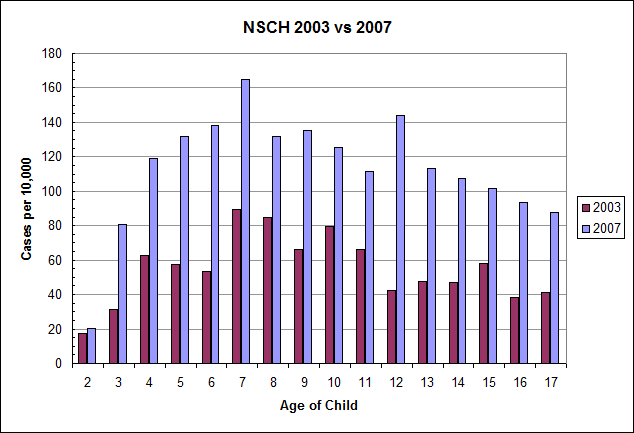
In case anyone is thinking, “are you sure you checked your own numbers, Sullivan?” The answer is yes. I double checked. I asked a frequent commenter on this blog, Dawn, to check my numbers. Another commenter independently collected and graphed the NCSH data as well. No evidence for an “explosion” of autism rates. Take a look at the graph. Mr. Kirby claimed that the 2007 survey data showed autism rates of about 60/10,000 for kids aged 13 and 15. There are no rates below 80 per 10,000 for the kids in those age ranges in that dataset.

So here we have a man with a history of errors, and with a history of failing to adequately correct his errors. He now has a new, big, obvious error. This error is likely the most serious of those listed here, in my opinion. Mr. Kirby has convinced people that the Hepatitis B vaccine could be causing autism. That was a serious accusation, and it was wrong. The question before us now is this: what will Mr. Kirby do now that he knows he made a mistake?

I’m very curious about that, so I’ve emailed Mr. Kirby and one of the editors at the Huffington Post with this information. I’ll let you all know what I hear back.

*note: the NSCH data are not given as “birth cohorts”. Instead, they are given by age. The survey was performed in 2007 and 2008. So, the 15 year old age group is roughly the “1992 birth cohort”. Likewise, 13 year olds are the 1994 “cohort” and 11 year olds are the 1996 “cohort”.

EDIT: Note that I too have a problem with keeping Change.Org and Change.Gov separate. This correction was made after the post was published.