A few years ago a new “treatment” appeared in the alternative medical world: MMS or Miracle Mineral Solution. As just criticism came out on this treatment, the name has morphed. One can now find it called CD (chlorine dioxide) or CDS (chlorine dioxide solution) or even the “parasite protocol). It goes by many names and it’s a scam. It is a well marketed scam and it’s taken in a lot of smart people. If you haven’t heard of it before you may be wondering what it is. Essentially, it’s a bleach (sodium chlorite) which is supposed to be mixed with a weak acid to make another bleach (chlorine dioxide). There are some effective marketing materials posing as scientific talks that use the classic alt-med sales techniques: testimonials and science-like discussions. In the autism world, this means claiming that it makes autistic kids non-autistic. Usually they avoid the “c” word (cure) because that is a quick way to get noticed by the people who are supposed to protect us from such scams.
MMS is sold often with a wink and a nod as a water purification solution. Such appears to be the case with a team charged with defrauding regulators and the sale of MMS as a cure or treatment. Per the press release below, it seems that this U.S. based team was importing their materials from Canada. At some point they “smuggled sodium chlorite into the United States from Canada using fraudulent invoices to hide the true end use of the product. In these invoices, according to the indictment, they falsely claimed that the ingredients they were purchasing for MMS were to be used in wastewater treatment facilities.” Their website shows them selling 4 ounce bottles of the solution. It would take a lot of those bottles to supply a wastewater treatment facility.
Here’s a point I haven’t seen made about MMS. One can purchase the base material, sodium chlorite, for about 50 cents a pound. Alibaba shows the liquid selling for $100-300 per metric ton. (click to enlarge)

But, let’s look at the website of this team selling the sodium chlorite solution. For only $20 you could get a 4-ounce bottle. That’s a savings of $5 off the regular price! Anyone want to do the calculations of how many 4-ounce bottles could be filled with a metric ton purchased for a few hundred dollars?
If one doesn’t want a ton shipped from China, Canada (where this team was sourcing their material) has sellers selling seven pound jars of the solid for $200. Not as big a profit margin as buying by the ton, but still a notable markup.
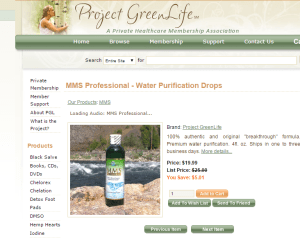
The “project green life” team point out that they are selling it as a water purification product only. If, by chance, you are planning on doing the “MMS protocol” they will provide you with information “for your safety and convenience”. And just in case, they have a one-stop shop in that they will sell you the second part of the MMS protocol, citric acid.

Wink. Nod. It’s just a water purification product, right? Sold at a huge profit. And for a small additional fee, one could also get the second part of the MMS product.
Apparently after this one team had their production facility inspected by the FDA, they moved production on to the property of one of their team members. There’s a silicon valley legend about companies starting in garages. It’s one thing for making electronics or computers. It’s another thing when we are talking about something sold (even with the wink) for human consumption.
Here is the press release from the Justice Department about when the charges were made.
Louis Daniel Smith, 42, and Karis Delong, 38, both of Ashland, Ore., were charged with defrauding regulators and suppliers in a scheme to manufacture and sell industrial bleach as a cure for numerous illnesses, including arthritis, cancer, and the seasonal flu. Also charged were Chris Olson, 49, and Tammy Olson, 50, of Nine Mile Falls, Wash. A federal grand jury returned an indictment, unsealed yesterday, charging Smith, Delong and Tammy Olson with one count of conspiracy, four counts of interstate sales of misbranded drugs, and one count of smuggling. The grand jury charged Chris Olson with one count of conspiracy, one count of the interstate sale of a misbranded drug and one count of smuggling.
The indictment alleges that Smith and Delong operated a business called “Project GreenLife” (PGL) from 2004 to 2011. PGL provided various health products for sale over the internet. According to the indictment, Smith and Delong arranged the manufacture and sale of the “Miracle Mineral Supplement” (MMS), a mixture of Sodium Chlorite and water. Sodium chlorite is not meant for human consumption. Suppliers of the chemical include a warning sheet with the chemical that states that it is harmful if swallowed.
According to the indictment, PGL provided consumers directions to combine MMS with citric acid to create Chlorine Dioxide, and the instructions told consumers to drink this mixture to cure numerous illnesses. Chlorine Dioxide is a potent agent used to bleach textiles, among other industrial applications. In humans, Chlorine Dioxide is a severe respiratory and eye irritant that can cause nausea, diarrhea and dehydration.
As part of the scheme to manufacture MMS, the indictment alleges that Smith, Delong, and others smuggled sodium chlorite into the United States from Canada using fraudulent invoices to hide the true end use of the product. In these invoices, according to the indictment, they falsely claimed that the ingredients they were purchasing for MMS were to be used in wastewater treatment facilities.
According to the charging documents, Smith and Delong were the managing members of PGL Smith co-founded the company, and Delong frequently handled financial transactions for the company and recruited friends and family to participate in the business. The indictment alleges that Smith and Delong paid Tammy Olson to handle all customer inquiries regarding the product. It is alleged that Tammy Olson continued selling MMS on her own website after federal agents shut down the Project GreenLife website and production facilities.
The indictment also alleges that Smith and Delong paid Chris Olson to clandestinely manufacture MMS in a building on his property after regulators from the Food and Drug Administration (FDA) inspected PGL’s original manufacture and shipping locations.
“The Department of Justice is committed to protecting the health and safety of people with cancer and other serious medical conditions,” said Stuart F. Delery, Principal Deputy Assistant Attorney General for the Justice Department’s Civil Division. “Our most vulnerable citizens need real medicine – not dangerous chemicals peddled by modern-day snake oil salesmen.”
Charges contained in the indictment are simply accusations, and not evidence of guilt. Evidence supporting the charges must be presented to a federal trial jury, whose duty it is to determine guilt or innocence.
The case was investigated by agents of the FDA’s Office of Criminal Investigations and the U.S. Postal Inspection Service. The case is being prosecuted by Christopher E. Parisi, a Trial Attorney at the Department of Justice’s Consumer Protection Branch in Washington, D.C.
The defendants have made a number of motions and at least one appears to be defending himself (filing pro se). Here’s an example of one such motion:
In his motion to strike for lack of standing, ECF No. 37, Mr. Smith disputes whether the “United States” and the “United States of America” are “legally one and the same.”
I’d want a real attorney if I were a part of this group, but that’s me.
—
By Matt Carey



![photo+%25286%2529[1]](https://leftbrainrightbrain.co.uk/wp-content/uploads/2015/01/photo2528625291.jpg)



Recent Comments