Archive by Author

Jenny McCarthy tells the story two different ways…again

29 Jan

Yep, this doesn’t have anything to do with autism. Well, aside from the fact that we will discuss how one public face for autism is once again showing that her stories don’t match over time. You see, Jenny McCarthy has a reality TV show now and the story of her divorce presented in that show doesn’t match what she wrote in her book 8 years ago. I found the new story in a recent article in the Washington Post: Jenny McCarthy tries to mend her anti-vaccine reputation with reality TV. It’s too little, too late in which Emily Yahr writes:

The show is filled with such heart-to-hearts, with McCarthy recounting her ordeals as a single mom, starting with her ex filing for divorce in 2005 the same week that Evan was diagnosed with autism.

Now, it’s been a while since I read Jenny McCarthy’s “Louder than words” book. A long while, but that statement didn’t strike me as consistent with what she wrote in her book. The sentiment is the same: harsh on her kid’s father while putting herself in a good light, but the details didn’t match.

What did she say in her 2007 book? She says that she asked for the divorce. She was the mommy warrior, taking charge in that book. Now in her reality show she’s the object of sympathy, dumped by her husband just when she needed him most.

LTW-divorce

In fact, if you read the book, she talks about thinking about divorce for some time before she finally asked for it. Because that whole “same week as the diagnosis” thing in the TV show isn’t what she wrote in 2007 either. Between the autism diagnosis and her asking for a divorce, there are weeks, if not months of stories in her book. Stories that include Ms. McCarthy asking her husband to leave, and him refusing.

Who knows what the actual story was. All we hear is the story that fits the image she wants to portray at the moment. Her ex husband is taking the high road and not returning fire.

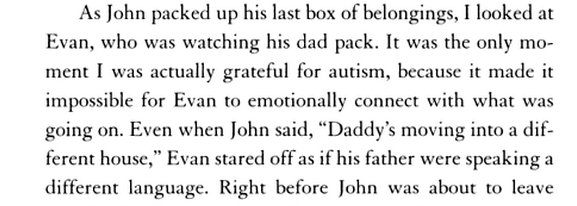
Oh, and if you are worried about how her son took the divorce, don’t. According to Ms. McCarthy, autism renders one incapable “emotionally connecting” with such events.

LTW-downplay-evan-reaction

Sorry to be sarcastic there. But, really, Ms. McCarthy? Autism renders one incapable of emotionally connecting with what was going on? Couldn’t be that the kid was unable to understand why his mother was making his father leave, just as any kid would?

No real surprises here. Ms. McCarthy has been inconsistent over the years. She had multiple stories of her first encounter with Barbara Walters when Ms. McCarthy was a guest on The View. She has informed us that her son is no longer autistic. Then, a few years later, she tells us that he is. (Jenny McCarthy Slams Rumor That Her 11-Year-Old Son Evan Doesn’t Have Autism). She hammers away at vaccines, but tells us she’s pro-vaccine. And to cap it all, she heads an autism charity that focuses on treatment, but won’t speak out against the faux treatments (like bleach enemas) that are promoted at her orgs conventions.


by Matt Carey

Measles are back but where is Jenny McCarthy?

28 Jan

It takes a lot of courage to stand up and make yourself heard on unpopular topics. But it’s only really courageous if you are willing to accept responsibility for being wrong. Jenny McCarthy stood up. She made herself heard. In the process she got a lot of media attention, led a march on Washington (the Green Our Vaccines rally), and sold a lot of books. That was years ago. Now we are seeing the outbreaks of disease that so many, even Ms. McCarthy, predicted based on the path she set. Back then she at least had the guts to say, “it’s not my fault” (I disagree). Now she’s just absent from the public’s eye on this topic. Instead we get her new reality show.

Today, a measles outbreak originating in Jenny McCarthy’s old backyard (southern California) has reached about 100 people infected (50 in the state, 23 more whose connection to the epicenter of the outbreak is unknown and more out of state). And, no comment from Ms. McCarthy. But she wasn’t always so quiet. Consider this statement from an interview in Time Magazine:

I do believe sadly it’s going to take some diseases coming back to realize that we need to change and develop vaccines that are safe. If the vaccine companies are not listening to us, it’s their f___ing fault that the diseases are coming back. They’re making a product that’s s___. If you give us a safe vaccine, we’ll use it. It shouldn’t be polio versus autism.

The idea that somehow a resurgence of disease would lead to a change in vaccines didn’t make sense to me back then. It seemed like some nasty game of “chicken” where Ms. McCarthy was going to frighten enough people about vaccines that outbreaks would be possible. Frighten with statements like “they’re making a product that’s shit” and that the vaccines are not safe. Somehow, once this fear was instilled and the drop in vaccination rates happened, outbreaks would happen and these would prove her point that the vaccines are “shit” and the vaccines would be reinvented.

Apparently Ms. McCarthy realized that this logic wasn’t sound as she started distancing herself from the vaccine message years ago. Instead of being at the forefront of her movement today, ready to force the changes she predicted, she brings handlers to interviews to deflect questions on vaccines. She points people to her nonpology and nosplenation of her views in an op-ed published by the Chicago Sun Times, Jenny McCarthy: The gray area on vaccines

Here’s a defensive paragraph (and a straw man argument) in that op-ed:

“People have the misconception that we want to eliminate vaccines,” I told Time Magazine science editor Jeffrey Kluger in 2009. “Please understand that we are not an anti-vaccine group. We are demanding safe vaccines. We want to reduce the schedule and reduce the toxins.”

Here’s the thing. Many people have called out Jenny McCarthy over the years for her irresponsible statements about vaccines. She spread a lot of fear. One doesn’t read “They’re making a product that’s shit” or a correction of that view at the Sun Times. One doesn’t hear blanket statements that vaccines are all unsafe (“If you give us a safe vaccine, we’ll use it.”) One doesn’t read her statements that vaccines are behind the rise in diagnosed autism rates. One doesn’t hear her state that if she had another child, she wouldn’t vaccinate (a statement she made back when she was more vocal). No, all we get is her “grey area” on vaccines.

Also, not comment about the impending outbreaks.

Which brings me back to: where’s the courage in hiding and dodging the consequences of your actions, Ms. McCarthy? Are you going to point me back to your claim that “it’s not my fault” made on Larry King Live?

KING: Isn’t the problem here, Jenny, that people sometimes listen with one ear are going to panic. And not vaccine at all?

MCCARTHY: Probably. But guess what? It’s not my fault. The reason why they’re not vaccinating is because the vaccines are not safe. Make a better product and then parents will vaccinate.

I didn’t buy it then, I don’t buy it now.

And a similar sentiment

KING: Probably due to you, jenny, and programs like this, the percentage of children getting vaccinations is dropping.
Do you think that’s good?

MCCARTHY: I think it’s only good because it’s the only thing that’s going to shake up the CDC to do something about it.

Yes, they and others have been doing something about “it”. It being the drop in vaccination rates, not the alleged problems with vaccines you were intending. Many people have spent a lot of time trying to prevent or reduce the outbreaks we are seeing now. The question is why weren’t you working on avoiding this?

As I stated at the outset, it’s only courageous to stand up against prevailing opinion if you are willing to take responsibility and fix problems if/when you are proved wrong.

Ms. McCarthy, you were wrong. You were wrong to spread fear. And you can’t get out of it with a simple “it’s not my fault”. It is partly your fault that outbreaks are happening.

And are these outbreaks causing people to accept your position and make the changes you asked for?

No.

And all this doesn’t even touch on the problems of your promotion of unsafe “therapies” for autism, an issue much closer to my heart.


By Matt Carey

Autism and mercury: never held a lot of interest, and now almost none

25 Jan

10 years ago if one went into online discussions about autism, one would find those discussions dominated by parents and one would find a few parents in those discussions trying to dominate the discussions with comments about how autism is caused by mercury in vaccines. David Kirby’s flawed book, Evidence of Harm: Mercury in Vaccines and the Autism Epidemic: A Medical Controversy came out in 2006. Robert Kennedy Jr.’s even more flawed article “Deadly Immunity” had come out in 2005. Both caused a stir, no doubt. Kirby got a best seller out of it and there were even talks of a movie. But even then, only small fraction of parents were engaging in chelation of their children (thankfully a small number, but it should have never been used as an autism therapy). But, what the autism/mercury movement lacked in numbers they made up for with volume. Aided by some wealthy people who made sure the idea got publicity.

But, how much interest has there really been in the autism and mercury? And where are we now?

I used a simple method to look at interest: Google trends. Google Trends gives us a measure of how often a search term is used over time.

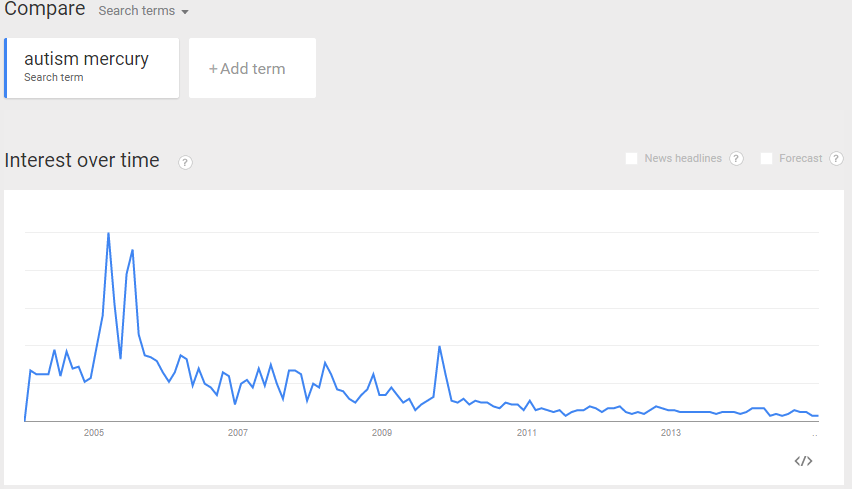
So, what does the trend look like for the search terms autism mercury? (click to enlarge)

Autism Mercury

One sees those spikes in the 2005-06 time frame. But what since? Aside from some noise, a steady decline. People just aren’t searching on autism and mercury much anymore.

And “much” is a relative term. Let’s consider autism as a search term on it’s own. (Click to enlarge)

autism

Lot’s of spikes, but interest is relatively flat over time. So the drop in the “mercury autism” search isn’t due to a drop in autism interest. Sure, some people are likely just entering “autism” and looking for autism and mercury, but, still, interest is way down for mercury.

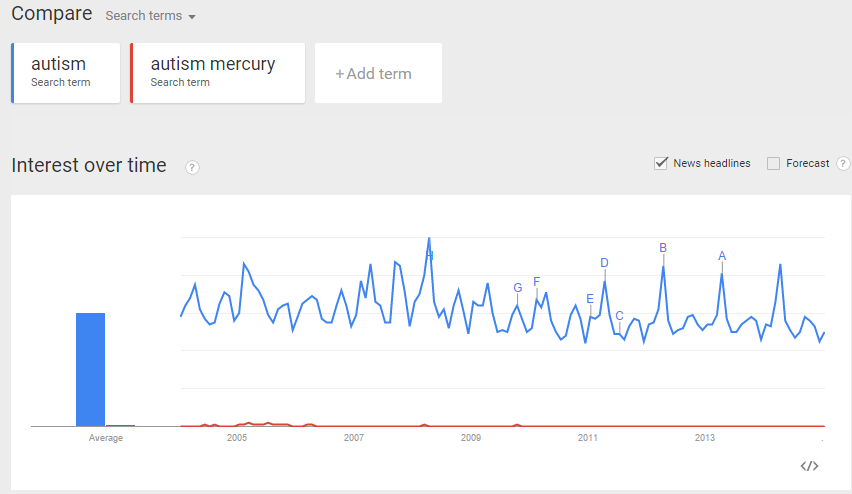
One thing about Google trends is that they normalize their graphs. They take the highest interest level and set that at 100. So the two graphs above don’t tell us how the “autism mercury” search compares with interest in autism in general. Let’s graph them both, shall we? (click to enlarge)

autism and autism mercury comparison

Blue is autism. Red autism mercury. Yes, that line at the bottom that is so small you can’t see the trend at all is autism mercury. And that’s the point that I found most interesting. For all the noise made by the “mercury moms” in the past, the mercury idea was never as big a movement as they would like you to believe.


By Matt

From NIMH: Director’s Blog: Childhood and Beyond – Services Research for ASD

23 Jan

I realized that I forgot to actually publish this. This is an article written by Tom Insel (director of the U.S. National Institute of Mental Health and chair of the IACC). This article was written last year. I copy it in its entirety here. As a government publication, I believe it is OK to reproduce it.

From NIMH: Director’s Blog: Childhood and Beyond – Services Research for ASD


On August 8, President Obama signed into law the Autism CARES Act (for Collaboration, Accountability, Research, Education and Support). The law ensures the continued work of the Interagency Autism Coordinating Committee (IACC), but it also brings new opportunities to focus attention on an area of concern for many parents—what happens when their children with autism spectrum disorder (ASD) mature into adulthood? Navigating the landscape of interventions and services is difficult enough when a child with ASD is at home with his or her parents, but older youth and adults have to find ways to negotiate new and often more complex challenges: post-secondary education, employment, housing, and the evolving demands for social functioning. The problem: services are fragmented, difficult to identify and obtain, and may lack the needed research evidence to qualify for coverage under healthcare plans.

Last year, NIMH solicited grant applications for research to address these problems.1 This month, 12 grants were awarded for projects to develop and test the effectiveness of strategies to ensure that children aged 0-2, youth (within 2 years of leaving secondary education), and adults not only have access to services, but that diagnosis, intervention, and connection to services would be built into routine care. Achieving those outcomes requires coordination across a number of settings—primary care, social services and other community support agencies, education systems, vocational and disability programs, and private health care funding. The models to be developed and tested must be effective across community and cultural settings in order to reach the broadest number of people with ASD and to reduce or eliminate disparities in access to care. The funded projects will evaluate the success of efforts to provide services to the broadest population of people with ASD, including those from ethnically diverse and low-income populations.

Research has shown that early intervention can improve the social and language abilities of children with ASD. Five of these newly funded projects will address the essential next step: how to ensure that every child who would benefit from intervention gets it. The new projects are an effort to show how best practices identified by research can be incorporated into mainstream care.

Connecting children with ASD to interventions and services is an urgent need; so also is providing support for the increasing number of young people and adults with ASD, some of whom were not diagnosed until adulthood, after years of struggling with independent functioning. Among all age groups with ASD there are widely varying capabilities that require personalized supports for optimal functioning. This service delivery challenge is one that the newly funded grants are designed to address: four are aimed at transition age youth; three at adults with ASD.

Exploring the biological underpinnings of ASD is important, but research also has a role to play in testing what services and supports can demonstrably improve quality of life in the short term for people with ASD. Coincidentally, on the same day that we announced the NIMH grants, Drexel University in Philadelphia announced an anonymous gift of $3.6 million to its A.J. Drexel Autism Institute  to launch new initiatives addressing quality of life issues for people with ASD across the lifespan. This work will encompass research on the effectiveness of existing services and look at innovative approaches to providing services for persons of all ages with autism.

What’s the vision? Every and any child or adult with ASD will be connected to appropriate and state of the art interventions and services. The ability to access care should ultimately depend not on the savvy, resources, and tenacity of families but on the broad availability of high quality, evidence-based service systems addressing unmet needs. With new funding from NIMH and from an anonymous private donor, we are beginning to realize that vision.

References

1 National Institute of Mental Health. RFA-MH-14-100. Services Research for Autism Spectrum Disorder across the Lifespan (ServASD): Research on Early Identification and Linkage to Services for ASD (R01) . 2013 May.

National Institute of Mental Health. RFA-MH-14-101. Services Research for Autism Spectrum Disorder across the Lifespan (ServASD): Pilot Research on Services for Transition-Age Youth (R34) . 2013 May.

National Institute of Mental Health. RFA-MH-14-102. Services Research for Autism Spectrum Disorders across the Lifespan (ServASD): Pilot Studies of Services Strategies for Adults with ASD (R34) . 2013 May.

No, gastrointestinal symptoms are not a sign that autism is environmentally caused

21 Jan

There is a great deal of misinformation in the vaccines-caused-an-autism-epidemic message. The most commonly discussed misinformation is the fear that is spread about vaccines. But there is also a great deal of misinformation about autism causation and biology. For example, it is often stated that environmentally derived disabilities can be treated and that genetically derived disabilities can not. Some of the recent proposed treatments for autism have come from studies of fragile-X syndrome (a genetic condition with a high prevalence of autism). People with Down Syndrome are living longer and more healthy lives due to improvements in treatment. Another misunderstanding that get promoted is that co-morbid conditions, especially gastrointestinal symptoms, in an individual indicate that his/her autism is a result of environmental influences. Much of this impression likely results from the work of Andrew Wakefield, who tried to tie autism, GI disease and the MMR vaccine together.

While it has been long known that this “GI disease means environmental causation” idea is false, a recent paper helps to illustrate that. Gastrointestinal problems in 15q duplication syndrome discusses how gastrointestinal problems are very prevalent in individuals with the genetic 15q duplication syndrome. 15q duplication syndrome, like fragile-X, is a condition with a high prevalence of autism. About 80% of people with 15q duplication syndrome have GI problems, and this number is the same whether or not the individuals also have an autism diagnosis.

Chromosome 15q duplication syndrome (Dup15q syndrome) is a neurodevelopmental disorder involving copy number gains of the maternal chromosome 15q11.2-q13 region, characterized by intellectual disability, developmental delay, autism spectrum disorder (ASD), and epilepsy. Gastrointestinal (GI) problems in Dup15q syndrome have been reported only rarely, mostly focused on neonatal feeding difficulties. A retrospective review of the medical records of 46 patients with Dup15q syndrome was conducted to assess GI issues and their treatments in this population. GI symptoms were present in 76.7% of subjects with an isodicentric duplication and 87.5% with an interstitial duplication. There was no clear association between GI issues and ASD, with symptoms occurring in 78.9% of all subjects and 78.2% of ASD subjects. The most commonly reported symptoms were gastroesophageal reflux (56.7%) and constipation (60%), with 30% of subjects reporting both. The most common treatments were polyethylene glycol for constipation and proton pump inhibitors for reflux. Behaviors such as irritability and aggressiveness improved with treatment of GI symptoms in several subjects. The results indicate that GI symptoms are common in Dup15q syndrome and may have an atypical presentation. Diagnosis may be difficult, especially in individuals who are nonverbal or minimally verbal, so increased awareness is critical for early diagnosis and treatment.

Genetic conditions are frequently multisystemic. Consider Down Syndrome:

People with Down syndrome have an increased risk for certain medical conditions such as congenital heart defects, respiratory and hearing problems, Alzheimer’s disease, childhood leukemia, and thyroid conditions. Many of these conditions are now treatable, so most people with Down syndrome lead healthy lives –

It seems to be a relatively small point I know. It is a topic that I see come up a great deal. And given the guilt that is instilled in parents and the way that the vaccine-causation idea is used as a hook for people selling useless and often risky alternative treatments, it really isn’t such a small point.


By Matt Carey

So, the National Vaccine Information Center has a Twitter bot?

20 Jan

Nonprofit organizations’ tax forms are public records. One can find them on many sites, and most nonprofits even host them on their own website. I was looking over the 2012 tax form for the National Vaccine Information Center recently and found something very interesting. The NVIC is one of the organizations that continues to push the failed idea that vaccines cause autism. This idea has caused a great deal of harm in the autism communities, but we get to be their hammer against vaccines.

The NVIC has a “vaccine ingredient calculator” or VIC (The NVIC Vaccine Ingredient Calculator: A disingenuous deceptive instrument of vaccine fear mongering).

Lately I’ve seen a lot of social media chatter where vaccine antagonistic people and groups are claiming that any opposition they see is being coordinated by “twitter bots”. Programs designed to create tweets.

So, imagine my response when I saw this on the NVIC 2012 tax form (click to enlarge):

NVIC tweet machine

Yes, the NVIC created a “Tweet Machine” which produced 8,760 tweets in one year. That’s one an hour over a 365 day year.

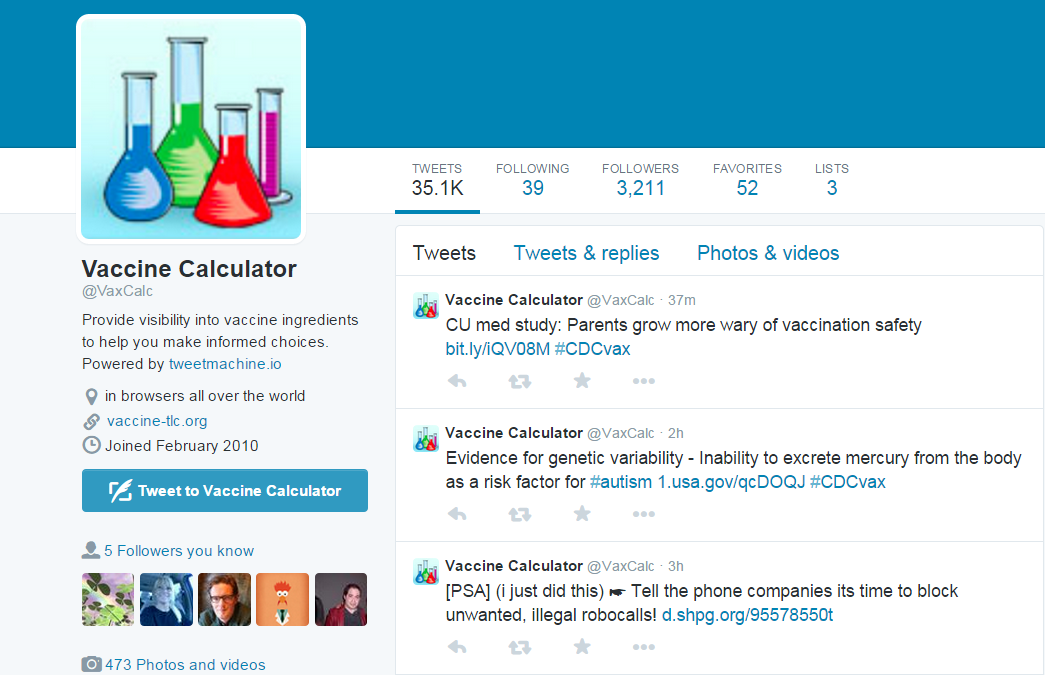
I am assuming that is this Twitter account.

VIC twit

See how they are still pounding the old, failed “autism is mercury poisoning” idea? That idea led to many kids being subjected to unnecessary chelation and other alternative treatments that range from useless to harmful.

Also, they want a stop to robocalls. Because that’s on topic for a vaccine discussion. And not at all ironic given the NVIC’s “Tweet Machine”


By Matt Carey

If MMS, CD, chlorine dioxide, “parasite protocol” is safe, why does ClO2 dissolve tissue?

15 Jan

One of the marketing ploys for MMS* is that it somehow attacks viruses, bacteria, parasites, heavy metals, toxins and more but doesn’t affect human tissue. It’s safe! Of course this is from the same people who said that it isn’t a bleach. Emily Willingham did a very simple and elegant demonstration that, MMS: Yes, It Is Bleach. Put a few drops on a black cloth and, lo an behold, it bleaches it.

photo+%25286%2529[1]

I thought about taking this to the next step–putting some drops on raw meat to see how much tissue would be bleached. Then I thought, I wonder if there’s a study on this already? Consider this paper, Comparison of Organic Tissue Dissolution Capacities of Sodium Hypochlorite and Chlorine Dioxide (full paper here).

Organic tissue dissolution capacity. In other words: how well do these solutions dissolve tissue.

According to the main site promoting MMS as an autism cure:

What is MMS?

MMS stands for Master Mineral Solution. It’s chemical name is Chlorine Dioxide (ClO2). ClO2 is a gas that is produced as a result of combining 2 liquids, Sodium Chlorite (NaClO2) and citric acid. When added to the sodium chlorite, the citric acid brings the combined pH level to under five, causing the sodium chlorite to become unstable and release chorine dioxide. (ClO2) Chlorine dioxide is an oxidizer with a lower oxidation potential (.95 V) than any of the other oxidizers in the human body.

MMS starts out as sodium chlorite, not the hypochlorite as mentioned in the paper. But the final solution contains ClO2, the same as one tested in the above paper. In that paper they were exploring whether these solutions (sodium hypochlorite and ClO2) could be used in dental work. They wanted to test whether ClO2 solutions would have an effect on tissue, in this case the pulp from the inside of teeth. They already knew that sodium hypochlorite dissolved tissue.

What did they find? When they put tooth pulp (taken from cows) into these solutions, after 20 minutes about 28% of the tissue was dissolved.

Dissolved.

In ClO2 solution.

But wait, you say. That’s a paper using cow teeth, published in Turkey. Realizing that this argument would come up, I searched for more papers. Such as Effect of chlorine dioxide and sodium hypochlorite on the dissolution of human pulp tissue e An in vitro study. Which concludes

5% Chlorine dioxide is capable of dissolving human pulp tissue but sodium hypochlorite was more effective.

Or

Comparison of Organic Tissue Dissolution Capacities of NaOCl and ClO2

Conclusion: Within the limitations of this in vitro study, it was concluded that ClO2 is efficient as well as NaOCl in dissolving organic tissue.

Not all tissues are the same. Skin, especially the dead skin in the outer layer, is likely more resistant than tooth pulp. But, how about the intestinal lining (a consideration for those using this as an enema solution)? Or once absorbed in the stomach (for those taking an oral route) or the esophagus?

OK, it dissolves tissues. But why go to these papers? How about just looking at the MSDS? People have long brought out the MSDS for thimerosal to tell us that it should be removed from vaccines. The MSDS for thimerosal shows that the LD50 level (the exposure where 1/2 of the test animals died, lethal dose 50) is Acute oral toxicity (LD50): 75 mg/kg [Rat] for thimerosal. A chlorine dioxide solution of 0.054 weight% Chlorine Dioxide is less toxic than thimerosal, with an LD50 (oral) rats: 292 mg/kg. So, it would take about 4 times as much chlorine dioxide solution at this concentration to kill a rat as thimerosal.

The thing is, people don’t drink thimerosal solutions. Or do so repeatedly. People are encouraged to drink MMS.

Consider what happens if we increase the concentration of ClO2. Up the concentration to 3% ClO2 in water and it is as toxic as thimerosal. But, again, dose makes the poison and the dose of ClO2 from MMS is much higher than the dose of thimerosal from a vaccine.

The idea that MMS, or CD or Chlorine Dioxide is somehow a magical solution which rids the body of harmful substances while having no effect on human tissues is just flat out incorrect. It dissolves organic tissue. It’s toxic and the doses are significant.

(*MMS is “miracle mineral solution”, a relatively new bit of alternative medicine that is being sold as an autism cure. It has been promoted at parent conventions such as Autism One and by the blog The Age of Autism. It is a scam and if the discussion above wasn’t clear: it should be avoided.)


By Matt Carey

163 Children Healed From Autism? Nope.

14 Jan

Nothing sells unproven “treatments” like testimonials. For autism it has been true since the days of chelation and even before that. Tell people that your “treatment” cures autism and you have testimonials to show it and you can just about guarantee sales.

Such is the case with bleach. It’s called many things: MMS, CD, Chlorine Dioxide, parasite protocol. It’s all a scam. One which is easy to fall for, but a scam nonetheless.

Point out that this “treatment” is nonsense and amounts to abuse and you get attacked for opposing treatment. You are told, “Yeah, what about those 162 kids who were cured?!?”

Well, let’s meet MMS/CD success story number 163. It’s an amazing story. And fabricated. And Kerri Riviera, the woman most prominently pushing MMS/CD on the autism community, accepted it without any effort to corroborate the story. None.

No More Bleach

Dear Internet,

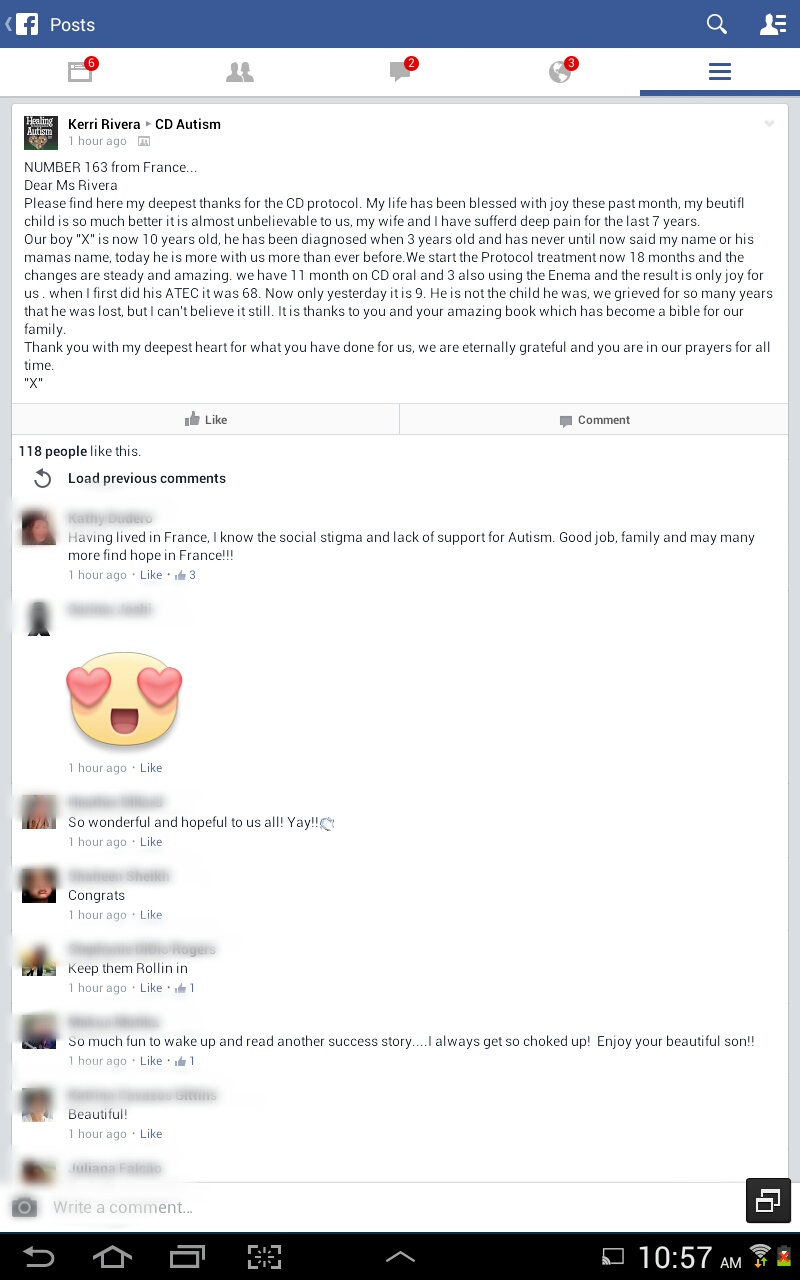
The bleach people claim they gave healed 163 kids from autism,  but have they really? After spending months in their forum,  you begin to wonder. Every so often,  a new story pops up and the bleach people rejoice.  The latest was #163 from France:

image

As it turns out, there is no #163. This child, the one who was miraculously healed,  does not exist.  This story was fabricated by someone questioning the authenticity of Kerri Rivera’s claims.  As suspected,  Ms. Rivera took credit and used this story as further “proof” that CD can cure autism.  You can read the entire account of how this went down here:
http://saulniercamaut.tumblr.com/

And when you’re finished,  share it with your friends. These kids are being abused and the parents are being lied to.  Kerri Rivera belongs in jail, along with anyone else recklessly promoting this dangerous snake oil.

Until Next Time,
#nomorebleach

View original post

Yes, it may be illegal to sell MMS

14 Jan

A few years ago a new “treatment” appeared in the alternative medical world: MMS or Miracle Mineral Solution. As just criticism came out on this treatment, the name has morphed. One can now find it called CD (chlorine dioxide) or CDS (chlorine dioxide solution) or even the “parasite protocol). It goes by many names and it’s a scam. It is a well marketed scam and it’s taken in a lot of smart people. If you haven’t heard of it before you may be wondering what it is. Essentially, it’s a bleach (sodium chlorite) which is supposed to be mixed with a weak acid to make another bleach (chlorine dioxide). There are some effective marketing materials posing as scientific talks that use the classic alt-med sales techniques: testimonials and science-like discussions. In the autism world, this means claiming that it makes autistic kids non-autistic. Usually they avoid the “c” word (cure) because that is a quick way to get noticed by the people who are supposed to protect us from such scams.

MMS is sold often with a wink and a nod as a water purification solution. Such appears to be the case with a team charged with defrauding regulators and the sale of MMS as a cure or treatment. Per the press release below, it seems that this U.S. based team was importing their materials from Canada. At some point they “smuggled sodium chlorite into the United States from Canada using fraudulent invoices to hide the true end use of the product. In these invoices, according to the indictment, they falsely claimed that the ingredients they were purchasing for MMS were to be used in wastewater treatment facilities.” Their website shows them selling 4 ounce bottles of the solution. It would take a lot of those bottles to supply a wastewater treatment facility.

Here’s a point I haven’t seen made about MMS. One can purchase the base material, sodium chlorite, for about 50 cents a pound. Alibaba shows the liquid selling for $100-300 per metric ton. (click to enlarge)

Alibaba Sodium Chlorite

But, let’s look at the website of this team selling the sodium chlorite solution. For only $20 you could get a 4-ounce bottle. That’s a savings of $5 off the regular price! Anyone want to do the calculations of how many 4-ounce bottles could be filled with a metric ton purchased for a few hundred dollars?

If one doesn’t want a ton shipped from China, Canada (where this team was sourcing their material) has sellers selling seven pound jars of the solid for $200. Not as big a profit margin as buying by the ton, but still a notable markup.
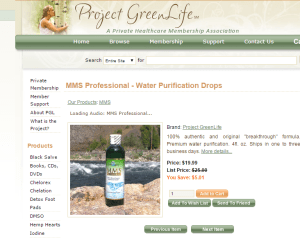
pgl

The “project green life” team point out that they are selling it as a water purification product only. If, by chance, you are planning on doing the “MMS protocol” they will provide you with information “for your safety and convenience”. And just in case, they have a one-stop shop in that they will sell you the second part of the MMS protocol, citric acid.

pgl2

Wink. Nod. It’s just a water purification product, right? Sold at a huge profit. And for a small additional fee, one could also get the second part of the MMS product.

Apparently after this one team had their production facility inspected by the FDA, they moved production on to the property of one of their team members. There’s a silicon valley legend about companies starting in garages. It’s one thing for making electronics or computers. It’s another thing when we are talking about something sold (even with the wink) for human consumption.

Here is the press release from the Justice Department about when the charges were made.

Louis Daniel Smith, 42, and Karis Delong, 38, both of Ashland, Ore., were charged with defrauding regulators and suppliers in a scheme to manufacture and sell industrial bleach as a cure for numerous illnesses, including arthritis, cancer, and the seasonal flu. Also charged were Chris Olson, 49, and Tammy Olson, 50, of Nine Mile Falls, Wash. A federal grand jury returned an indictment, unsealed yesterday, charging Smith, Delong and Tammy Olson with one count of conspiracy, four counts of interstate sales of misbranded drugs, and one count of smuggling. The grand jury charged Chris Olson with one count of conspiracy, one count of the interstate sale of a misbranded drug and one count of smuggling.

The indictment alleges that Smith and Delong operated a business called “Project GreenLife” (PGL) from 2004 to 2011. PGL provided various health products for sale over the internet. According to the indictment, Smith and Delong arranged the manufacture and sale of the “Miracle Mineral Supplement” (MMS), a mixture of Sodium Chlorite and water. Sodium chlorite is not meant for human consumption. Suppliers of the chemical include a warning sheet with the chemical that states that it is harmful if swallowed.

According to the indictment, PGL provided consumers directions to combine MMS with citric acid to create Chlorine Dioxide, and the instructions told consumers to drink this mixture to cure numerous illnesses. Chlorine Dioxide is a potent agent used to bleach textiles, among other industrial applications. In humans, Chlorine Dioxide is a severe respiratory and eye irritant that can cause nausea, diarrhea and dehydration.

As part of the scheme to manufacture MMS, the indictment alleges that Smith, Delong, and others smuggled sodium chlorite into the United States from Canada using fraudulent invoices to hide the true end use of the product. In these invoices, according to the indictment, they falsely claimed that the ingredients they were purchasing for MMS were to be used in wastewater treatment facilities.

According to the charging documents, Smith and Delong were the managing members of PGL Smith co-founded the company, and Delong frequently handled financial transactions for the company and recruited friends and family to participate in the business. The indictment alleges that Smith and Delong paid Tammy Olson to handle all customer inquiries regarding the product. It is alleged that Tammy Olson continued selling MMS on her own website after federal agents shut down the Project GreenLife website and production facilities.

The indictment also alleges that Smith and Delong paid Chris Olson to clandestinely manufacture MMS in a building on his property after regulators from the Food and Drug Administration (FDA) inspected PGL’s original manufacture and shipping locations.

“The Department of Justice is committed to protecting the health and safety of people with cancer and other serious medical conditions,” said Stuart F. Delery, Principal Deputy Assistant Attorney General for the Justice Department’s Civil Division. “Our most vulnerable citizens need real medicine – not dangerous chemicals peddled by modern-day snake oil salesmen.”

Charges contained in the indictment are simply accusations, and not evidence of guilt. Evidence supporting the charges must be presented to a federal trial jury, whose duty it is to determine guilt or innocence.

The case was investigated by agents of the FDA’s Office of Criminal Investigations and the U.S. Postal Inspection Service. The case is being prosecuted by Christopher E. Parisi, a Trial Attorney at the Department of Justice’s Consumer Protection Branch in Washington, D.C.

The defendants have made a number of motions and at least one appears to be defending himself (filing pro se). Here’s an example of one such motion:

In his motion to strike for lack of standing, ECF No. 37, Mr. Smith disputes whether the “United States” and the “United States of America” are “legally one and the same.”

I’d want a real attorney if I were a part of this group, but that’s me.


By Matt Carey

Autism services: questions the next IACC should address part 1

14 Jan

Take a look at the original law that set up the structure for how the U.S. coordinates autism research: public law 109-416 (sometimes called the “combating autism act”) and you will find paragraphs like:

(5) develop and annually update a strategic plan for the conduct of, and support for, autism spectrum disorder research, including proposed budgetary requirements

Now take a look at the wording of public law 113-157 (what was called the “Autism Cares Act“)

(5) develop a strategic plan for the conduct of, and support for, autism spectrum disorder research, including as practicable for services and supports for individuals with an autism spectrum disorder and the families of such individuals, which shall include–

“(A) proposed budgetary requirements; and
“(B) recommendations to ensure that autism spectrum disorder research, and services and support activities to the extent practicable, of the Department of Health and Human Services and of other Federal departments and agencies are not unnecessarily duplicative;

See that whole bit about “including as practicable for services and supports for individuals with an autism spectrum disorder and the families of such individuals”? There’s a big emphasis on services in the new law and the next IACC will be addressing this in the future strategic plans.

There are so many areas of services that could use attention it is difficult to find one to single out as the first I’d like to see given attention. But I am going to say that services for autistic adults need more attention. With that I can predict that some people are thinking I’m saying jobs and independent living. And sadly some people don’t see that as important. But this is not what I’m focusing upon here. No, I’m thinking of what services are needed to make supportive living most appropriate for autistics. There is so much discussion of the unique and specific educational needs of autistics, especially in preschool, but there isn’t much discussion of what makes an appropriate placement for adults. If I’ve learned anything from observing many, many classrooms it’s that people with


By Matt Carey