Below is a copy of statements posted to the Tribeca Film Festival (TFF) Facebook page. Responding to criticism about hosting a film promoting Wakefield’s failed views on vaccines and autism, Mr. De Niro first acknowledged that he had taken an active role in placing the film at TFF. Later, Mr. De Niro announced that the film was pulled from TFF and why.
I would like to thank Mr. De Niro for pulling TFF’s support from this film. While Mr. Wakefield will certainly find another venue to present this film, the stamp of legitimacy of having his film a “Tibeca Film Festival Official Selection” would have given Mr. Wakefield’s message a level of legitimacy it does not deserve.
”
However, it must be said: this film should never have been a Tribeca Film Festival selection to begin with.
Here are the statements from Robert De Niro, from their Facebook page:
UPDATE: 3/26/2016 Statement from Robert De Niro, co-founder of the Tribeca Film Festival, regarding VAXXED at the Festival:
“My intent in screening this film was to provide an opportunity for conversation around an issue that is deeply personal to me and my family. But after reviewing it over the past few days with the Tribeca Film Festival team and others from the scientific community, we do not believe it contributes to or furthers the discussion I had hoped for.
The Festival doesn’t seek to avoid or shy away from controversy. However, we have concerns with certain things in this film that we feel prevent us from presenting it in the Festival program. We have decided to remove it from our schedule.”
3/25/2016 Statement from Robert De Niro, co-founder of the Tribeca Film Festival, regarding VAXXED at the Festival:
“Grace and I have a child with autism and we believe it is critical that all of the issues surrounding the causes of autism be openly discussed and examined. In the 15 years since the Tribeca Film Festival was founded, I have never asked for a film to be screened or gotten involved in the programming. However this is very personal to me and my family and I want there to be a discussion, which is why we will be screening VAXXED. I am not personally endorsing the film, nor am I anti-vaccination; I am only providing the opportunity for a conversation around the issue.”
Remember the disasterous “Who Killed Alex Spourdalakis” movie? That’s the one where Andrew Wakefield was trying to create an autism reality TV show where he would swoop in with his “A”utism TEAM and solve problems for families and show that he was right all along. Except that after the “A”utism team filled a family with false hope, Alex’s mother and godmother brutally murdered Alex. Wakefield took on no blame. Instead he shifted blame from those who committed the act to mainstream medicine. Basically whitewashing a gruesome murder of a disabled young man.
Wakefield has been working for some time to make a feature length film out of the Brian Hooker/CDC story. He has an early trailer for “Feast of Consequences” (as it was called then). Just as with the Alex Spourdalakis story, this trailer includes video unrelated to his actual story (the video of a police standoff and the pictures of the girl in the wheelchair appear to be from the Maryanne Godboldo story).
Well, not to be deterred from the film making business, Mr. Wakefield is at it again. This time with the full length movie, now called “Vaxxed”. Here’s the trailer:
The trailer starts with what appears to be a reenactment of a conversation between Brian Hooker (vocal advocate for the failed idea that vaccines cause autism) and William Thompson (CDC researcher):
Brian Hooker:
My phone rings and it’s Dr William Thompson
This is followed by recordings of a phone call with William Thompson:
“you and I don’t know each other very well. You have a son with autism, and I have great shame now.”
Then a narrator.
“There’s a whistleblower from the CDC who is going to come out and say that the CDC had committed fraud on the MMR study and that they knew that vaccines were actually causing autism”
Sit back for a moment and consider what your first impressions of this intro are. I know mine–they seem to be setting this up as the first or perhaps one of the early phone calls between Thompson and Hooker. Since the actual audio clips from Thompson weren’t that sensational, the narrator is quickly pulled in to tell us what really happened.
But this is Andrew Wakefield. And if we’ve learned anything about Andrew Wakefield over the years it’s that you have to check every single detail of what he’s saying. He does a lot of leading you to the conclusion he wants you to believe, whether the facts say something entirely different or not.
Let’s start with a small detail. I suspect many have already wondered why I referred to the clips from Thompson in the plural. It’s because that 10 seconds or so of audio is actually two different comments from Thompson spliced together. And taken out of context. We know this because a book was released with the transcripts of the calls that Brian Hooker secretly recorded.
“You and I don’t know each other very well” is from this part of a conversation. Well into the second call that Hooker secretly recorded. And Hooker didn’t start recording calls until later in their relationship, so this isn’t an introduction at all. We will get into the discussion of what Thompson meant later:
“You have a son with autism, and I have great shame now.”
OK, the two clips are from completely different parts of a phone call that happened well into the Hooker/Thompson relationship. Wakefield spliced them together to create a story and, just in case we missed his point, brought in a narrator to tell us what the story “really” is.
So, documentary producer/director he is not. But we didn’t really expect that, did we?
Let’s take a look at those two exchanges in a bit more detail, shall we?
First, “we don’t know each other very well”, was Thompson saying that even after multiple previous exchanges, Hooker doesn’t understand Thompson’s motivations and fears. Hooker appears to be digging for dirt. Something about the behaviors of people at CDC. Likely to smear them later. This seems to be a bit of a trigger for Thompson as he has battled mental illness. He’s not comfortable because he can already see the day when people will say, “Well, he’s [Thompson] mentally ill and why would you believe anything he says, it’s just hearsay”. Hooker assures him that it’s none of their business, and that “I [Hooker] don’t want that to happen, period.”
That’s a heavily ironic thing to read now. Why? The only reason people know about Thompson’s personal medical history is that Brian Hooker and Andrew Wakefield made it public. Hooker and Wakefield filed a complaint with the Department of Health and Human Services and included this statement from William Thompson:
Ya know, I’m not proud of that and uh, it’s probably the lowest point in my career that I went along with that paper and I also paid a huge price for it because I became delusional.
And this exchange between Hooker and Thompson
Dr. Hooker: Did you raise that…did you raise that issue at the time?
Dr. Thompson: I will say I raised this issue…I will say I raised this issue, the uh…two days before I became delusional.
and
Dr. Thompson: It is one of the reasons I became delusional because I was so paranoid about this being published.
So, not only is “you and I don’t know each other very well” not a “Hi, you don’t know be very well, but I’m about to spill the beans” sort of statement, it’s basically Thompson saying that one of his big fears is, well, exactly what Hooker did to him: out his struggles with mental illness.
With friends like Brian Hooker…
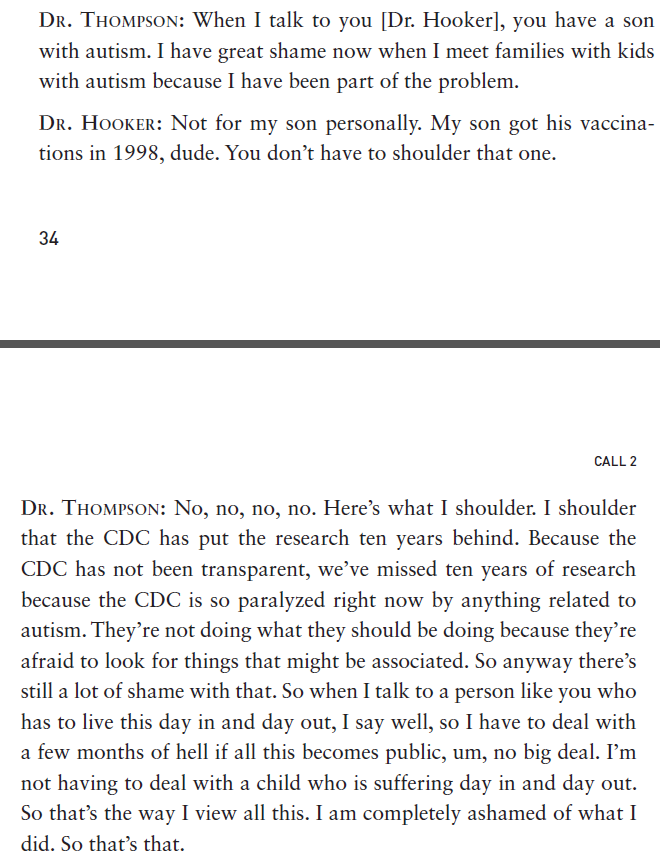
So, the second part of the spliced statement that Wakefield included in his trailer, what is that in context? “You have a son with autism, and I have great shame now.” Is it, as the narrator leads us to think, a statement about fraud and that vaccines are proved to cause autism?
No. Or, in Thompson’s own words:
“No, no, no, no. Here’s what I shoulder. I shoulder that the CDC has put the research 10 years behind. Because the CDC has not been transparent, we’ve missed 10 years of research because the CDC is so paralyzed right now by anything related to autism.”
It’s a statement that in William Thompson’s view, the CDC hasn’t done enough vaccine/autism research. It’s a sentiment that I disagree with, given how much effort has been spent on researching the failed idea that vaccines are a primary cause of autism. But let’s move on.
Let’s instead move to the narrator. Recall his statement
“There’s a whistleblower from the CDC who is going to come who is going to come out and say that the CDC had committed fraud on the MMR study and that they knew that vaccines were actually causing autism”
So, what about Thompson saying the CDC committed fraud on the MMR study? Didn’t happen, that’s what. Yes, he had criticisms. He starts his one voluntary public statement with, “I regret that my coauthors and I omitted statistically significant information in our 2004 article published in the journal Pediatrics. ” But let’s stick to what we know Thompson said, rather than what Wakefield and Hooker claim he said in regards to fraud, shall we? What makes the decision to not report a finding “fraud” over a scientific decision? Well, Thompson never says in his statement that there was fraud or misconduct by the CDC team. He does say “Reasonable scientists can and do differ in their interpretation of information.”
Let’s back up a bit, what is the Hooker/Wakefield claim of fraud? In a nutshell, they claim that the CDC team found a result they didn’t want to make public and then changed the research plan/protocol so they wouldn’t have to report that. In this exchange from a phone call we can see Hooker apparently trying to get Thompson on tape saying this. Trying because Thompson refuses to say it:
Dr. Hooker: And then you basically deviated from that particular plan in order to reduce the statistical significance that you saw in the African American Cohort.
Dr. Thompson: Well, we, um, we didn’t report findings that, um…All I will say is we didn’t report those findings. I can tell you what the other coauthors will say.
As to the claim by the narrator that Thompson stepped forward and stated that …”that [The CDC] knew that vaccines were actually causing autism”. Nope.
Consider this part of the public statement by Thompson, a statement I doubt will be prominent in Wakefield’s movie
I want to be absolutely clear that I believe vaccines have saved and continue to save countless lives. I would never suggest that any parent avoid vaccinating children of any race. Vaccines prevent serious diseases, and the risks associated with their administration are vastly outweighed by their individual and societal benefits.
That is not the statement of a person who believes that vaccines have been shown to cause autism and that the studies to the contrary are “fraud”.
Also, Thompson provided a summary statement to Member of Congress Bill Posey. That was made public along with a great deal more documents when I released them here. What does Mr. Thompson have to say about the study in question showing that vaccines “actually cause autism”?
The fact that we found a strong statistically significant finding among black males does not mean that there was a true association between the MMR vaccine and autism-like features in this subpopulation.
Let’s give this finding the greatest benefit of the doubt. Let’s ignore that it is an incredibly weak and almost certainly spurious result. Even then, it doesn’t show causation. A study like this can’t. And anyone who has done scientific research (such as Brian Hooker and Andrew Wakefield) should know that.
But, hey, let’s just make this simple–if Thompson had said something clearly claiming fraud, clearly claiming that the CDC knew vaccines cause autism, Wakefield would have included that in his video. Instead he splices disparate conversations together and has his narrator tell us what we should think.
In other words, if Wakefield had the facts, he’d use them. Instead all I see is more smoke and mirrors.
And that’s just the beginning. The first 30 seconds. We could go on and on, dissecting the trailer frame by frame. It’s that bad. And this is just the trailer. He has a full film out now.
One of the most aggravating arguments one sees in the never ending online discussions of whether autism is a “vaccine epidemic” (it isn’t) is the “where are all the old people with autism?” This invariably comes from faux autism advocates (think Age of Autism and their sponsors) who have done nothing to support an actual answer to the question. Have they backed an effort to study autistic adults, their needs, what has worked, what has failed? No.
Well, thankfully the autism community and the autism research community do consider the question of autism and adults to be important. No where near enough research goes into this field, but some does.
Now, a major Swedish study provides a wider perspective on premature mortality among people with autism. Neuropsychologist Tatja Hirvikoski and colleagues at the Karolinska Institute compared mortality rates of people with autism with the general population over two decades. Speaking from Stockholm, Dr Hirvikoski says that she was “shocked and horrified” at the results. Her team found that the mean age of death of somebody with autism was 54 – compared with 70 for the general population. For people with autism and a learning disability, life expectancy was a mere 40 years.
Read that again–the life expectancy for autistics like my son is 40 years.
One might claim that I am using this paper to criticize those who promote the “autism is a vaccine epidemic idea”. First off, they deserve criticism. They have wasted 2 decades of advocacy efforts chasing a failed idea. Perhaps some small fraction will read Dr. Fitzpatrick’s article and heed the wake up call–we need to put our efforts into advocating for a better life for adult autistics. By “we” I mean autism parents. Thank god we have autistic adults who are fighting this fight now. Rather than dismiss them with the standard, “you are not like my kid” arguments we autism parents throw around, it’s time to ally with people who are working to make a difference.
I can already write the responses to this study that will come from faux autism advocates and the vaccine antagonistic: “Look at the high mortality rate for autistic adults. That’s the damage that vaccines cause!”
If you are even thinking that, you are part of the problem, not the solution.
And if you are thinking, “this is only a problem for autistics with intellectual disability”, here’s a line from Dr. Fitzpatrick’s article to consider:
For people with autism who do not have a learning disability, the key factor is suicide, for which the rate is nine times greater.
As John Elder Robison (autistic adult) has discussed, suicide is a risk for those without intellectual disability.
What sort of supports–housing, employment, day programs, medical–do adult autistics need? What contributes to early death vs. living a long life? These questions are real. These questions deserve our advocacy. And the entire story of “autism is a vaccine epidemic” is built around denying that there is a large group of undiagnosed adult autistics. It is built around diverting advocacy away from pushing for a better life for people with disabilities and into opposing vaccines.
We just spent a couple years here in California trying to restore funding to the disability services system. You would never know that if you were reading the sites focused on vaccines, like the Age of Autism blog, or Robert “Dr. Bob” Sears’ Facebook page. You would see a big effort wasted on lobbying against a California vaccine bill (complete with Dr. Bob claiming he represents my kid along with all autistic students in California–where the hell were you Bob when we actually needed you?).
The message is simple and clear–autistic adults die much sooner than the general population. If nothing changes, my kid will likely never reach my age. There is a very loud advocacy effort focused on vaccines. OK, even if you don’t agree with me that you are wasting your time, you need to be putting real effort into areas that will make change in how we support autistic adults.
For those–think Anne Dachel of the Age of Autism for one–who keep on saying “where are the older adults with autism”. Keep saying that. And watch nothing change. And blame someone else for it. For those who actually want a better life, no time like the present to start affecting change.
My apologies for not posting this right away. For those who have been following the battle in the California Legislature to restore some of the lost funding to disability services, WE WON!
OK, we started out trying for a 10% increase and got 7.5%, but this is a heck of lot better than when we got nothing in the new budget.
The ARC and United Cerebral Palsy California Collaboration spent a lot of time getting support for this and deserve a lot of thanks from our community. The letter announcing the final decision is below.
Dear Friends,
The Assembly and Senate just passed the bills to save our community services. The bills now to Governor Brown for his signature, which is certain.
As Assembly Speaker Toni Atkins said, “The passionate advocates for this funding should be proud of their persistence” – two years of persistent, vocal, united community advocacy.
The bipartisan vote on the key bill to provide the funding was 28-11 in the Senate and 60-16 in the Assembly. To find out how your assemblymember voted, clickhere. The Senate vote isn’t up yet, but the 28 “aye” votes were all the Democrats and two Republicans, Senator Huff and Senator Cannella.
If your senator and/or assembly member voted “aye,” please call them now to thank them. Click here to find them. If you talked to someone in their office before, call that person and let them know we don’t just complain, we thank them when they deserve it. And save their name and number; there will be more fights.
If your senator or assembly member is among those Republicans who for one reason or another felt they couldn’t vote for it, don’t hold it against them! The Republicans’ vocal support for months was a big reason why we got this far. And if they had tried to stop their fellow Republicans from voting “aye” today, they probably could have stopped them, which would have blocked the bill — but they didn’t.
This isn’t the last fight. As Assemblymember Mark Stone said to all his colleagues who voted for the package, “Stay with us next year, the year after that, the year after that, to protect this particularly vulnerable community.”
(Actually, we can’t even wait till next year. Today’s action will, for the most part, stop the deterioration of our community services, but we have some gaps to try to fill in the budget that will get adopted in June. Stay tuned.)
But for now, it’s time to celebrate.
And thank you for your advocacy.
Greg
Greg deGiere
Public Policy Director
The Arc & United Cerebral Palsy California Collaboration
1225 Eighth Street, Suite 350, Sacramento, CA 95814
The California developmental disabilities community has been fighting a long and hard fight to regain lost ground in support for services. Basically, the budgets keep leaving us out and with inflation we keep losing ground.
The budget support is coming up for vote on Monday. I know I’ve asked many times for calls, faxes, emails, etc., but with luck this is the last time. Make it count–make your needs heard. Details are below in a letter from Tony Anderson of the Arc California and the Lanterman Coalition.
The Vote to Save Our Services is Set for Monday!
Dear Friends,
From everything we hear, we’re going to win in both the Senate and Assembly on Monday! We appear to have the two-thirds, bipartisan majorities we need to pass the compromise agreement to save our community services.
But just be safe, we’re asking everyone to make two more calls before noonMonday – one to your state senator, and one to your assembly member. Click here to find who they are.
As usual, if you already have talked to someone in your senator’s or local office, call him or her. Otherwise, call their Capitol office in Sacramento.
The message is even simpler than usual – just give them your name and address, and ask them to please vote yes on ABx2-1 and SBx2-2 to save ourt developmental services. There’s no need for confrontation at this time, we just need the policymakers to know we are watching close and we want their vote on Monday.
As we acknowledged earlier, the agreement doesn’t achieve everything needed – our community is going to need to stay united to fight for the rest iof what we need in the months and years ahead — but it is a critically important step to provide relief and recovery.
London McCabe was a young autistic boy. News reports say he loved hats and pictures of him show him as a smiling beautiful kid (all kids are beautiful, by the way). He only lived to age six. He was murdered when his mother threw him off a bridge. Yes, threw him off a bridge.
That was 2014. Many of us have worried that his mother would try the “raising an autistic kid is too much” defense. So I, for one, am relieved that she plead guilty. This doesn’t bring back London. This isn’t really justice. But this is the next best step in moving forward. I wish his family well. If I lost a kid, I don’t think any court proceeding would bring closure, but a lack of a sentence would make things worse.
McCabe pleaded guilty to murder Monday in Lincoln County Circuit Court and was sentenced to life in prison with the possibility of parole after 25 years.
The mother has shown no remorse for the death of her son, Branam said. She appeared happy in jail, didn’t mention her son’s name for months and gleefully discussed the books she’d read while behind bars.
Internet search history from October 2014 included inquiries by McCabe on the chances of surviving a fall into water from 133 feet — the height of the Yaquina Bay Bridge — as well as searches on an insanity defense and news stories on parents who have thrown their children from bridges, Branam said.
But also,
`
Matt McCabe said the loss of his son has left a large void in his life. He said the sentencing of his now-ex-wife brings him no closure.
“I can’t say enough about this boy,” the ex-husband said Tuesday. “He was my pride and joy. He was the center of my attention; his loss leaves a black hole in the center of my life.
“If you know an autistic individual, he needs love, too. Maybe more than you and I.”
I haven’t been writing lately about the fight to get funding reinstated for the California developmental services system, but that doesn’t mean that the fight was lost. Far from it. The fight goes on and NOW is the time to make a big push.
Below is an email message I received from The ARC and UCP coalition. Details for what to do are inside–call now. Act now and we can make a better life for people with disabilities in California.
Dear Friends,
The Lanterman Coalition has been fighting for the survival of the California developmental services system for well over a year now. Yesterday we finally came to an agreement for the best way forward! While the agreement doesn’t achieve everything needed, it is a critically important step to provide relief and recovery now to move towards a future of hope and full participation in communities across this state.
However, we’re not there yet to take that step for our future, and we needYOU more than any other time during this campaign. The Legislature is likely to vote very soon — probably next week, but possibly as early as TODAY. Your Senate and Assembly representatives need to hear from you, so let’s finish strong!
Please call NOW and implore them to vote for the developmental services agreement! (Sorry, there’s no bill number to give them yet.) Here’s a short summary:
A 7.5% across-the-board increase for salaries and benefits to stop the damaging high staff turnover at community providers and regional centers.
A 2.5% across-the-board increase for community provider and regional center administrative and other costs.
A restoration of the supported employment rates to 2006 levels (a 10% increase from now).
A 5% increase for supported and independent living services.
A 5% increase for in-home and out-of-home respite services.
A 5% increase for transportation services.
An effective 5% increase for intermediate care facilities, via a 3.75% increase and elimination of prior cuts.
The creation of competitive integrated employment programs with paid internships and incentive payments for helping individuals obtain and retain employment.
An increase in vendor audit thresholds, eliminating wasteful spending requirements.
A rate study plan aimed at permanantly sustainable funding.
Funding for regional center bilingual staff, cultural competency training, and parent education efforts.
Now more than ever, thank you for your advocacy!
Tony Anderson
Executive Director, The Arc California and
Chair, The Lanterman Coalition
1225 Eighth Street, Suite 350, Sacramento, CA 95814
916-552-6619
PS. And please forward this Action Alert far and wide. Victory is in sight, and we need everyone’s help NOW.
Andrew Wakefield recently participated in a cruise/meeting called the ConspiraSea cruise. Among the audience was Colin McRoberts, a skeptic. He reported back during the cruise and, as you will see below, interviewed Dr. Wakefield. Since much of the interview involves William Thompson, Mr. McRoberts asked for my input.
The interview is below. Mr. McRobert’s words are in black, Mr. Wakefield’s in red and mine in green. (If there are any mistakes in that formatting below, they are mine.)
Andrew Wakefield and I were both on the ConspiraSea Cruise in January 2016. By the last full day of the cruise, we’d had a few encounters ranging from standing in the same line for coffee to a fairly tense exchange during one of his lectures. I asked Wakefield after that lecture if he would answer a few questions regarding the so-called “CDC Whistleblower.” He consented, and this is the interview that resulted. Wakefield was aware that I was recording and that I am a critic of his position on vaccines and autism; he did not refuse to answer any of my questions.
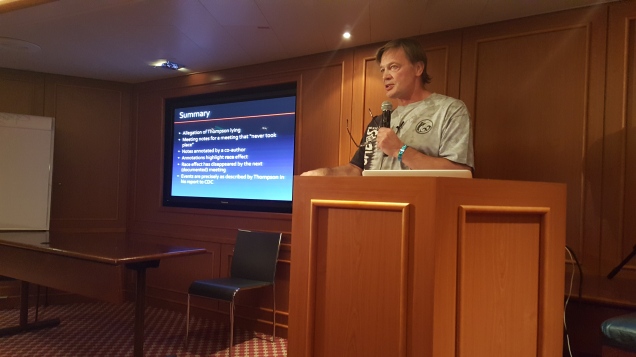
Wakefield lecturing on the cruise
This transcript is my own work, and I welcome any corrections. I’ve edited it slightly to make it more readable and remove irrelevant dialog. I have also added parenthetical comments to note where a statement is inaudible on the recording, which is not of high quality, and provide my best guess at what was said in a few places. I have not changed the substance of any question or answer.
Wakefield answered several questions before I turned the recording on. According to my memory and my notes, I asked him questions about the Thompson documents such as what specific deviations there were from the approved study plan (as he had alleged such deviations in two lectures). He referred me generally to his letter of October 2014, written with Brian Hooker and attorney James Moody, and directed to the federal Office of Research Integrity. He indicated both that he had documents from Thompson at the time he wrote that letter, and that Congressman Posey subsequently received additional documents from Thompson. At that point I began the recording.
I am not an expert in the documents Wakefield discussed. So in order to provide context for these answers, we have asked Matt Carey of Left Brain Right Brain to provide commentary. Carey is a published scientist, a parent of an autistic child, and extremely familiar with the Thompson documents. He has written an in-depth analysis of the Thompson documents and was able to provide an important counterpoint to Wakefield’s claims. Please read that excellent analysis prior to this interview if you are not familiar with the affair. The questions and answers will make little sense without context.
My questions are in black, Wakefield’s answers are in red, and Carey’s comments are in green. We welcome your own comments as well.
So the Posey documents that were released are, as far as you know, the documents Posey was given? He hasn’t held anything back?
I think he has probably given Posey more documents than he’s given me. The reason for that is that I’ve just been given the Posey documents, and they’ve been released and they’re available to anyone—you can get them.
I’ve got them.
And I have not been through them as yet, so I do not know to what extent they overlap completely with the documents I’ve got. And the reason I say that is that there may be additional documents he provided to Posey on Thimerosal or other things, because he was involved in two other vaccine safety studies. I have (inaudible: “all the”?) documents relevant to the MMR studies.
The two thimerosal studies were much larger studies and are more significant than the DeStefano MMR study in the evidence against the idea that vaccines cause autism. Given that, it’s interesting that there isn’t much on the thimerosal studies in the Thompson documents. In Thompson’s personal statement he makes no indication that the results of those studies are anything but valid or that the CDC team acted in any way other than ethically in performing those studies.
And then do you know if there are documents you have from Thompson that Posey does not?
I have documents that Posey does not because Thompson and I were in private correspondence.
And when you say that, are they documents that were that correspondence, or were they documents from the DeStefano days?
They are correspondence between us.
So do you have documents from the research or from his work at the CDC that Posey doesn’t have, other than the correspondence?
I don’t know, because I haven’t been through Posey’s documents yet.
One has to ask why he has not yet been through those documents? They’ve been public for some time. I put them online January 4th, nearly 3 weeks before the cruise. A journalist announced he had received the documents from Representative Posey’s office. That was in November of last year. Dr. Wakefield could have submitted his own request then. If Dr. Wakefield felt there was a possibility of evidence of misconduct in these documents, wouldn’t he have read through them at his first opportunity? In his role as creating a documentary about these events, why isn’t he jumping at the chance to add to or confirm his story?
That will answer a lot of my questions, actually. So, Hooker’s study came out, and again, I’m not a scientist—I’m not qualified to review or really have intelligent commentary on a statistical research study. Do you support the conclusions Hooker drew? Do you endorse them?
Do I –
It would be interesting to know what conclusions Dr. Wakefield is thinking of when he responds. There are the conclusions in the paper and there are the conclusions Dr. Hooker has stated publicly since. The last sentence of Dr. Hooker’s retracted study is “Additional research is required to better understand the relationship between MMR exposure and autism in African American males.” That’s quite different from concluding that the study shows a causal link between the MMR vaccine and autism. I believe both Dr. Wakefield and Dr. Hooker have made the latter claim publicly. It is worth noting that an epidemiological study like Hooker’s cannot, on its own, show a causal connection even if the correlation found is strong. The African American males/autism correlation in the Hooker reanalysis is far from strong.
Do you endorse the conclusions Hooker drew in his study based on the DeStefano research?
Yes, I do. I know, and I know you’re going to say it was retracted. It was retracted on the basis that the did not disclose a conflict of interest. There was absolutely no – on the initial basis, the initial rationale for the retraction was nothing to do with the scientific analysis. Which was a very simple analysis, a very simple statistical manip- analysis, which replicated what Thompson found. It was withdrawn on the basis that there was an undisclosed conflict. And that’s why it was withdrawn. There was no undisclosed conflict, and I suspect that there was pressure on the journal to withdraw [inaudible].
First, as I noted above, we aren’t entirely sure what conclusions he stands behind.
As to the retraction, Dr. Wakefield only gives part of the reason why the Hooker study was retracted. Here is the full statement from the journal:
“The Editor and Publisher regretfully retract the article [1] as there were undeclared competing interests on the part of the author which compromised the peer review process. Furthermore, post-publication peer review raised concerns about the validity of the methods and statistical analysis, therefore the Editors no longer have confidence in the soundness of the findings. We apologise to all affected parties for the inconvenience caused.“
The editors were concerned about the validity of the methods and analysis and “no longer have confidence in the soundness of the findings.” That’s a pretty stinging rebuke of the study itself in a retraction and completely avoided by Dr. Wakefield.
But you don’t know that.
No I don’t.
I’ve heard, and again I’m not qualified to even understand the criticism, that Hooker misunderstood how to analyze case control studies. Are you familiar with that criticism?
No I’m not. The criteria for the, if you go to the criteria for the journal, Translational Neurodegeneration, it says papers will be published on the basis of expert peer review. And only when they pass that expert peer review will they be published. The paper went expert peer review which included a statistical analysis and whether he used appropriate methodology. So it passed muster on the basis of the journal’s own rigorous criteria. That gives me cause for concern, because there was nothing in Hooker’s analysis which substantiates or supports the contention that he did not know how to analyze a case control study.
Again, look to the retraction statement by the Journal: Furthermore, post-publication peer review raised concerns about the validity of the methods and statistical analysis, therefore the Editors no longer have confidence in the soundness of the findings. Peer review specifically looking at the statistical analysis found the paper lacking.
I’ve peer reviewed many papers, and even edited the proceedings of a large conference. Some peer reviewers are more rigorous than others. We don’t know what “statistical analysis” Dr. Wakefield is claiming that the reviewer(s) performed. A referee could not replicate Dr. Hooker’s analysis as the data are not in the paper. And datasets like these are not “public use”, they are intended only for those who have shown in their application to be “qualified researchers.” Dr. Hooker should not be sharing the dataset with referees or others.
Also, one question that has been in a lot of people’s minds was who did the first peer review of the paper. Often an author can suggest to a journal potential referees and can use that to get people involved who would be favorable to the authors and/or their conclusions. I can’t say for certain that this occurred in this paper, but it is a possibility.
And of course it’s possible that the peer review was just not very rigorous. A while back a peer reviewed paper included the parenthetical comment, “should we cite the crappy … paper here?” That inappropriate comment made it past referees, editors, type setting, and proofs.
Would it be fair to say that you’ve analyzed the statistical work Hooker did, or –
No I didn’t. I’m not a statistician, although I’ve been involved in a lot of statistical analyses, I would not consider myself an expert in statistics and I am not qualified, certainly over and above the expert who clearly was involved in peer review of the paper, to approve or disapprove of it.
First, in statistics simple is not always the most valid approach. In this case it certainly is not the most valid approach. Second, and more importantly, this isn’t a statistics study. It’s an epidemiological study. In epidemiology strong studies are those that correct for factors that can lead to false conclusions. Here’s a simple example: rich people can afford healthcare and, as a result, tend to see doctors more often. They are more likely to be diagnosed for many diseases because they seek out healthcare. If a study ignores such factors—takes a “simple statistical technique” it could erroneously conclude that rich people get some diseases more than poor people. Dr. Hooker’s analysis is not only too simplistic statistically, it is too simplistic from an epidemiology standpoint.
Here are two technical critiques of the statistical analysis Dr. Hooker used:
If you’re comfortable saying so, are you still in contact with Thompson?
No. When we – let me qualify that. I write to Thompson. Updating him on our progress. I do not anticipate a response. Because in getting him or encouraging him to get a whistleblower lawyer, his lawyer advised as any good lawyer should that he should make no further comment until a congressional hearing or the equivalent. And therefore I have not heard back from him.
If Dr. Thompson has whistleblower protection, why does he need to only comment in a congressional hearing? The vast majority of whistleblowers are not called before congressional committees.
More to the point, if Dr. Thompson felt that there was ongoing harm—that there was strong evidence of an actual connection between vaccines and autism–he would be ethically compelled to come forward and speak out. In fact, in his public statement Dr. Thompson made it very clear that parents should vaccinate:
“I want to be absolutely clear that I believe vaccines have saved and continue to save countless lives. I would never suggest that any parent avoid vaccinating children of any race. Vaccines prevent serious diseases, and the risks associated with their administration are vastly outweighed by their individual and societal benefits.”
And just to make sure I understand, is that what you understand what his lawyers have told him to do or what you expect his lawyers would tell him to do?
He has said something to that effect in a text. I can’t remember precisely what it is, but he said based upon my lawyer’s advice, I can now have no further contact. So it’s explicitly based on his lawyers.
I’m not surprised. You made a comment that I hadn’t heard before, that it was not true that the data Thompson released showed a protective effect for on-time MMR vaccinations in non-African American male children.
Sorry…
It’s an awkward question. So I had understood that the Thompson data showed a protective effect for on-time MMR vaccinations in non-male, non-African American children. And in your first –
Quite the opposite, quite the opposite. This is the greatest, one of the most misleading things of all, is when the head of science over Autism Speaks, Dr. Wang, was interviewed by Ronan Farrow, that was precisely what he said and what he took from the fraudulent paper. And that underlines just how deceitful the paper was, that the head of science for an organization which is the biggest autism charity in the world, gets it completely wrong when presenting in national media, that giving MMR vaccination on time appears to be protective against autism is the most egregious of all of the sins that they committed.
Dr. Wakefield appears to be misremembering the interview. The Paul Wang/Ronan Farrow interview can be found here. In discussing the DeStefano study, the one that Hooker reanalyzed, Paul Wang stated:
“If you look at children who got the vaccine on time, there is no increased risk.”
Not that there is a “protective effect” but that there is “no increased risk.”
Later in the interview, discussing a different study, Wang mentioned the “protective” effect found. A good discussion of this can be found at Forbes. Allow me to include a few paragraphs from that discussion because it makes an important point about why simplistic statistical analyses can lead to possibly false findings:
Even more surprising was the relative risk among children who had an older sibling with autism: in this smaller group, children with 2 doses of MMR were just 44% as likely to be diagnosed with autism as unvaccinated children. This statistically significant finding indicates, unexpectedly, that vaccines might actually protect children from autism.
The authors were quick to note that there are other good reasons for this apparent protective effect of vaccines: in particular, if parents of autistic children withheld vaccines from their younger children, this could explain the effect. Why? Because we know that autism has a genetic component, and that if one child has autism, his younger sibling is more likely (because they share many genes) to have autism as well. Jain and colleagues explained that if these parents withheld vaccines–because of fears spread by the anti-vaccine movement–then their children could contribute to the apparently lower rate of autism in children who were vaccinated. The authors couldn’t rule out a protective effect of vaccines, but scientifically it seems unlikely, and they wisely offered an alternative explanation.
The “protective” effect is likely an artifact of the study design and the authors acknowledged it. The first thing a good researcher does when she/he finds a result is to challenge it, test it. “If I do a more in-depth analysis, does this finding hold up?” “Is there an alternate explanation that could be causing this and make this result spurious?” Simple is not elegant, as Dr. Hooker asserts. Simple is the first step. And if you don’t take the next steps, your study is weak and your conclusions more likely to be wrong.
This may also be in the letter you told me to look up, but the destruction of documents—are you aware of specific documents that were destroyed, or types of documents that were destroyed? Or was it just an allegation that documents were destroyed?
Well, what I have are all of the serial outputs of the data covering that period during which the documents were destroyed, and what was quite clear was that the data tables showing highly significant association between autism and vaccination [inaudible: “on time”?] were there before the alleged destruction of documents and were gone afterwards. In other words, the documentary evidence provided by Thompson confirms exactly what he said, that data were destroyed.
This is the story made public in the “garbage can quote” read into the Congressional record by Representative Bill Posey. That can be found in the statement by William Thompson included with the document provided by the Representative to me (and made public by me). Here’s the end key paragraph quoted by Representative Posey. Note that the last line was not read into the record:
However, because I assumed this was illegal and would violate both FOIA laws and DOJ requests, I kept hard copies of all my documents in my office and I retained all the associated computer files. This included all the Word files (agendas and manuscript drafts), Excel files with analysis and results, and SAS files that I used to generate the statistical findings. I also kept all my written notes from meetings. All the associated MMR-Autism Study computer files have been retained on the Immunization Safety Office computer servers since the inception of the study and they continue to reside there today [emphasis added].
Emphasis added. All the files have been retained. If printouts were shredded but the files kept, what’s the controversy? Dr. Hooker and Dr. Wakefield appear to have been claiming that Hooker recreated the CDC team’s analysis solely using the dataset maintained by the CDC and provided upon request to qualified researchers. So, again, what data was deleted?
One might think, well personal notes were shredded and those could show actions that indicate wrongdoing on the part of the CDC team. We don’t know what notes the other researchers retained. But we do have William Thompson’s notes—notes by the person most likely to record wrong doing. We don’t have statements in his personal notes–taken while the study was ongoing–that suggest fraud. In fact one of the few notes that goes to the mindset of the research team states, “we all have good intentions.”
I don’t understand what that means in this context. You have a report of what’s on the servers? Or you have a report of what was in file cabinets? Or you have –
No, I have printouts, or well, sorry, I have email documents. These are documents generated in Word with a date of creation, so that you can confirm that those documents were created contemporaneously with when Thompson said they were created. And they reflect meetings that took place on a serial basis every month, or twice monthly, between the group, the coauthors for that paper. And in September 2002, when Thompson alleges these documents were destroyed, then the African American effect, for example, and the isolated autism effect, were there. And then afterwards, they were completely gone. So that would support Thompson’s contention that documents were destroyed.
The story is much more mundane than Dr. Wakefield is implying here. What is clear in these documents is that this timeframe–around Sept. 2002–is when the research phase of this project ended. Dr. Wakefield tells us, “And then afterwards, they were completely gone.” When you go through the documents you see that after September 2002 there are pretty much no more research group meetings. There were a handful of meetings after this, but the analysis was over and the figures basically finalized. A preliminary draft of the study manuscript is dated Oct. 2002. So the idea that the team met to discuss what to archive and what to shred, and that the figures were finalized about this time is not only not surprising, it’s expected.
And this is where it’s good to have the actual documents. Dr. Wakefield did not share the documents he had, only quotes and screenshots. Bits that supported the arguments he was making. When we see the actual documents we see a different story. When I put up my own analysis of the documents, I made the documents publicly available so people could form their own opinions. From what I can see Dr. Wakefield did not do this.
Speaking of mundane, yes the documents “reflect meeting that took place on a serial basis” as Dr. Wakefield states. In one folder there are about 500 pages of agendas, tables and graphs for those meetings. And when one goes through these documents one finds they are very redundant. The same talking points, the same graphs and tables meeting after meeting. We are asked to be shocked that the CDC team discarded documents. I’ve posed this question publicly–what in those documents needed to be kept? Do we really need multiple researchers archiving every meeting agenda? The answer is simple: no, we don’t. I not only expect them to discard much of this paperwork, I hope they aren’t hanging on to all this paperwork for every project they work on.
I still don’t understand quite what this means. So there was a word document, and in that document, it refers to the African American effect, the isolated autism effect –
It shows the data. It shows the data table.
And in later versions of that document, those tables are gone?
I’ll give you an example. All of the data are contained in a table called Table 5. That table is there in September and it’s gone in October. Never to be seen again.
The last one of these documents– that has “table 5” is, as Dr. Wakefield says, in September 2005. So is Table 8, which includes things like variables “M_AGEC11” and “B_MULTB.” Why is that important? Because those are variable names important to the researchers but were obviously not intended for the final study. The fact that Table 8 (or table 5 for that matter) got cut isn’t a smoking gun, just evidence that these were preliminary tables and that study hit the turning point of finalization.
Most of the attention in this discussion goes to the African American effect. Let’s consider the “isolated autism” effect. “Isolated” autism means autism without other disabilities. What happened to that? The CDC team published it. They narrowed it down to autism without MR, but it’s basically the same thing as “isolated.” They also showed that in the simple analysis (the sort that Dr. Hooker claims is “elegant”) there is an apparent association, but that association disappears when one does a more rigorous analysis. Aside from debunking the controversy over “isolated” autism, this serves as another example of why simple isn’t the best.
But the data that was used to create Table 5 – was that destroyed?
Very good question, was the data destroyed. No. No it was not. Because it was not – it was intended to be destroyed. All of the – it was Thompson’s claim that all of the hard copy documents, and all of the computer files, relevant to this paper were targeted for destruction. The original data tables or data files from which the tables were generated were preserved by Thompson and are available and can be reconstructed in order to generate the information. As an example, the data tables – the excel – sorry, they were SAS spreadsheets – provided to Hooker, by which he then did an analysis.
Personally, I want to check the source every time Dr. Wakefield or Dr. Hooker claim to be speaking for William Thompson. Thompson has made very few public comments, plus a few conversations secretly recorded by Brian Hooker and since released by Hooker. Given this, let’s ask ourselves: instead of Dr. Wakefield giving his interpretation of what Dr. Thompson said, why not just quote Thompson? For example, consider the very strong claim “it was Thompson’s claim that all of the hard copy documents, and all of the computer files, relevant to this paper were targeted for destruction.” Now Thompson’s statement, “All the associated MMR-Autism Study computer files have been retained on the Immunization Safety Office computer servers since the inception of the study and they continue to reside there today.”
We don’t know what hard copy documents were kept by the other authors. Or what notes were in notebooks they kept. We hear that they discarded some, but we don’t know that they may have kept. Also, consider this: if “all the hard copy documents” were “targeted for destruction” why meet to decide which documents to shred if the decision is to shred them all? Is it so they can watch everyone discard documents? If so, consider this: we know from Thompson’s own statements that one of the MMR study leaders was missing from the “garbage can” meeting. The story just doesn’t make sense.
We should address the question of discarding research documents: is it unethical? I’ve been a researcher for 30 years. It is common practice to periodically decide what documents to keep in my office, which to archive to a warehouse and which to discard. When I would clear out documents my company would provide me large confidential bins. They look like “garbage cans” except the lid is locked and the only access is through a slot in the top so people can’t fish documents out. After these bins are collected they are sent to a confidential shredder. [Colin: Although I’m not a scientist, I’ve seen similar procedures in very many offices where confidential documents like legal or financial files are used.] I would expect the CDC to have a similar procedure. A researcher keeps the documents that are required to recreate the final analysis and, in my case, determine dates of invention.
Bins like these are used to dispose of confidential documents in many offices, to protect privacy when clearing out old hard copies containing things like social security numbers or health records.
As long as we are talking about the few public statements Dr. Thompson has made, allow me to repeat this one:
So that data exists, so far as you know, only in Thompson’s files and not in the CDC’s main files, wherever those may be?
According to Thompson, all of those – he was the only one who preserved all of those records. Beyond that, I do not know the infrastructure of the CDC’s filing system, so I don’t know – I think I’ve probably reached the limit of my knowledge about that. Is there some sort of backup system that retains the original SAS files, I don’t know [inaudible].
“I don’t know.” I believe he should. I see it as ironic that Dr. Wakefield claims to speak for Dr. Thompson (“According to Thompson”) while having not read all the documents Dr. Thompson released to Representative Posey. As I’ve already noted above, Dr. Thompson made it explicitly clear that all the associated MMR-Autism Study computer files have been retained on the Immunization Safety Office computer servers since the inception of the study and they continue to reside there today. At the very least, the raw data exist. Clearly, since Dr. Hooker used those data for his analysis. Also, I’d be curious how Dr. Wakefield knows that Thompson “was the only one who preserved all of those records”. We know that some documents were discarded, but we don’t know what was kept by the other team members.
And then are you referring to statements that Thompson made that have been released, or statements that are still confidential regarding his allegation that those files were deleted?
Both. Both. So his statement to Bill Posey and other documents that I have obtained that are in the documentary. Documents which are not publicly released.
If by the “statement to Bill Posey” Dr. Wakefield means the full statement that Representative Posey excerpted in his House speech, that is indeed publicly released. I released the documents Representative Posey’s office provided to me. I discussed the full statement here.
The full statement is much longer than the excerpts that Representative Posey read. It includes the statement:
“The fact that we found a strong statistically significant finding among black males does not mean that there was a true association between the MMR vaccine and autism-like features in this subpopulation.”
Emphasis added. I’ll be curious to see if this statement (and others that are problematic for Dr. Wakefield’s story) appear in the documentary.
You mentioned that you’ve analyzed the notes, and that you know who the coauthor was who made some handwritten annotations. Would you disclose who that coauthor is?
No.
Would you disclose how you did the analysis?
No.
Will that be in the documentary?
Yes.
Both the type of analysis and the name of the author?
As yet undecided. [Inaudible: “As yet”?] a matter of discussion.
I was talking to Nick Begich earlier as he dropped these off [pointing to DVDs], and he kind of referred to the breadth of opinions expressed at the conference. And some – I wouldn’t say alarm, but some surprise at some of the views that have been expressed here. And I know that you haven’t been at all the various panels that haven’t involved vaccines or autism, but I think you’ve heard some relatively wild statements. Would you be comfortable establishing a line at which you feel it’s irresponsible to speculate about the cause of autism, or about conspiracies related to medical care?
So sorry, is there a line –
At which you’d object to some of the speculation that’s gone on at the conference.
My reason for coming, or what persuaded me to come, was that Jeffrey Smith was presenting. And Sherri Tenpenny. The other people I don’t know. I’ve met one other person one time. So I know nothing about any of the other people. But I’ve been someone who’s followed Jeffrey Smith for a long time. And I think his approach to his subject is very thorough, is informed, and very valuable. And so every time I get an opportunity to listen to him then I’m very grateful. Sherri similarly. A great deal of knowledge and understanding of the subject. The others, as you say I haven’t been to the talks. I don’t know what their discussions were about.
I am less interested in his “reason for coming” as for why he didn’t consider association with many speakers a reason for not coming.
I’m thinking for example of Len Horowitz’s discussion of the 528 frequency –
Yeah, I didn’t hear that. [Inaudible: “I wasn’t there”?] I just don’t know. So no, I just don’t know. I wasn’t there. So it would be unfair of me to comment on [inaudible].
I heard you speak in Austin, when we were still living there, at an Autism Speaks conference. [I was mistaken; it was an Autism Trust event called the “Give Autism a Chance Summit.”] You were MCing, I think it was Autism Speaks, at the music center downtown in Austin. There were people on the stage like Dr. Kriegsman, and I can’t think of the other guy’s name, who was instructing parents to turn off their routers and their cell phones so the EM waves wouldn’t hurt their autistic children. And I was hoping at the time you would comment to the parents in the room as to whether you thought that was reasonable advice or not, and you haven’t made a statement on it as far as I know. Is that kind of advice something you think is reasonable?
I don’t – if I do not know the subject, I’m not going to give advice. I’m just not going to do it. It’s irresponsible. I’m not going to give advice that could even be potentially construed as medical if I have not done a thorough analysis of the data. Now that said, I keep my mind open to the possibility that there are co-factors that may influence autism risk [inaudible]. I don’t know what those co-factors are. But I’m never going to advise people on what to do based on something about which I know nothing. I’m going to confine myself to the things which I know and I’ve worked on and I’ve read and understood. And where I don’t know I’m going to say I don’t know. If someone has a competing theory of autism, OK, let them talk about it.
One of the reasons my wife and I came to this country is that has a constitution that includes the values we respect. And god forbid that people should be censored or excluded from expressing opinions. Just like the journalists on this trip feeling threatened, that they couldn’t be in discussions, that’s not right, that’s not the way I operate. I encourage dissent because in the end, it’s only through the presentation of competing arguments that truth is going to win. Just in the same way that I talked to you about how it was not our job to censor the parents’ story just because others found it inconvenient or didn’t believe it. It’s not my job to censor other people expressing opinions that may not concur with my own.
Do you feel that given your high profile, your presence might be an endorsement, or at least perceived that way by people who don’t have a chance to talk to you personally?
Well if that is the case, then I should shut myself in a cave on a high mountain, become a hermit. And that’s not going to happen because that’s not the way in which knowledge is going to spread. If people take it as that then it is because they want to take it as that. Because that’s the spin that’s placed on it.
I wanted to ask just one more question.
Go, one more question.
And feel free not to answer. What evidence would change your mind, about a link between autism and vaccines?
What evidence would change my mind… [long pause] What is my position, firstly let’s define what my position is. That’s very very important. Vaccination should operate from a position of an abundance of caution. What you’re doing is you’re taking healthy children and exposing them to a risk or a potential risk. And you’re doing it on the background of the available data on the safety and efficacy of that vaccine. It’s not like you’re taking patients with end-stage cancer, where you say, “Look, you’ve got a fifty percent chance of dying and a fifty percent chance of living, and there may be some benefit but we don’t know.” You’re taking entirely healthy children and you’re giving them an exposure, which incurs a risk. And the risks are all spelled out in the product insert.
So my position, and the position that medicine should be in, is that you operate from an abundance of caution. If there is even a possible risk of harm, then you do everything in your power to either exclude that risk or stop the vaccination policy. First do no harm.
So my position is not that it’s black and white. It is that you operate from an abundance of caution. You have to be very very clear that what you are doing has a minimal, an absolutely minimal risk, for the maximum benefit.
The interesting thing here is the for years the narrative that I recall from his supporters was that Dr. Wakefield didn’t say that vaccines cause autism. He was just posing questions.
That said, see what Dr. Wakefield has done here? He’s framed the question as though there is only one source of risk–vaccinating (and implies falsely that one of those risks is autism). He doesn’t even approach the question of the risk in not vaccinating and leaving one’s self vulnerable to disease. Ignoring that is hardly an “abundance of caution.” Quite the opposite, it’s an abundance of irresponsibility in my opinion.
The positions and the rhetoric that you’ve taken at this conference make it pretty clear you feel that there is extremely good reason to believe that the MMR vaccine in particular, and possibly vaccines in general, and possibly GMOs as well, have a causative link to autism.
Yes.
What would change your mind?
That is because I’ve sat in this field now for twenty years, and nothing has persuaded me that the science is wrong. And what now convinces me that there is a real cause for concern is William Thompson coming forward and saying that a hypothesis that I put forward in the year 2000 is proven to be correct by the year 2001 and was kept concealed for 13 years. How would you feel in that position? Would you feel that it reaffirmed your concern that the parents’ story was right? Or would you think, well, we can dismiss that because – no. It is quite clear that there is a problem they have covered up. So it makes me feel more strongly than ever that we need good, independent science—and I mean independent, independent of the CDC, independent of influence by government or the pharmaceutical industry—that gives us the answers. Will we ever get that? No. We will not get that. Why? Because the system is so distorted, and that’s very very sad. And I’m a scientist, I’ve published 140 papers and I’ve never committed fraud in my life. And I’ve published papers which suggest my hypotheses is wrong. Very few people do that. I publish them. I publish papers – and you can look them up, in the Journal of Medical Virology, saying “we do not find this virus in these tissues.” Despite that being our hypothesis [inaudible]. So I’m perfectly open to the counter-argument. But nothing so far has persuaded me that there isn’t a link, and Thompson’s revelations have reaffirmed to me that there is a link. There is no question, there is a link, they’ve found it. [inaudible] So there we are.
Let’s take on the most important statement here first:
“But nothing so far has persuaded me that there isn’t a link, and Thompson’s revelations have reaffirmed to me that there is a link. There is no question, there is a link, they’ve found it. [inaudible] So there we are.”
But that is not what Thompson says. Again, I’ll quote him directly:
“The fact that we found a strong statistically significant finding among black males does not mean that there was a true association between the MMR vaccine and autism-like features in this subpopulation.”
Thompson doesn’t say there is a link. He doesn’t say “without question.” So, there we are.
Also, it’s worth noting that the above response is worthy of a politician. Ask yourself, did Dr. Wakefield ever answer the question (what would change your mind)? If so, I don’t see it.
If I may, let me discuss the general question of vaccines and autism. I’ve taken this very seriously from the start. This is personal to me in a way that it will never be to Andrew Wakefield as I have an autistic child. I am also a researcher, a Ph.D. I’ve immersed myself in the literature—especially that which claims to show a link between vaccines and autism.
Actually it is Dr. Wakefield’s science, and that of many others who purport to show a link, that showed me that there is no substance to the claim of vaccines being linked to autism. And from that I can say this: it isn’t a question of refuting that claim, it’s a matter of the fact that the claim just isn’t strong at all to begin with.
For example, look at Dr. Wakefield’s conclusion here “Thompson’s revelations have reaffirmed to me that there is a link.” He ignores the bulk of even Hooker’s analysis (most groups show no increased risk of autism) and clings to one small subgroup. OK, that’s a weak stance on his part, but it gets worse. He claims that subgroup result shows not only a correlation, but causation. Even though such a study as this cannot show causation. Even though Thompson himself says this finding “…does not mean that there was a true association.”
There is a large body of evidence, epidemiological and biological, that says that the Wakefield MMR/Autism hypothesis is wrong. But the fact is that the Wakefield MMR/autism hypothesis was never very strong. It’s built on arguments such as “Thompson’s revelations have reaffirmed to me that there is a link.” And, ironically, Wakefield’s work is some of the strongest in the “vaccines cause autism” portfolio.
This post has been edited to restore formatting to the links in Carey’s comments.
Daniel Joost becomes the latest autistic who has been killed by a family member and made the news. Mr. Joost was 18 years old. Daniel Joost and his mother, Margaret Joost, were strangled by Daniel’s father David Joost, who then committed suicide. The Chicago Tribune has the story: Family dead in murder-suicide struggled with financial problems.
(note, I should have put this up before the article about supports and strategies for families facing very great challenges. I ended up mixing the article about the passing of Mr. Joost with the support information. Always we need to keep the victims first, especially when as so often happens when a disabled person is murdered, it is the murderer who gets the focus of news stories.)
Daniel Joost becomes the latest autistic who has been killed by a family member and made the news. Mr. Joost was 18 years old. Daniel Joost and his mother, Margaret Joost, were strangled by Daniel’s father David Joost, who then committed suicide. The Chicago Tribune has the story: Family dead in murder-suicide struggled with financial problems.
Little is public so far about Daniel Joost. The Tribune reports that he spent much of his time playing computer games and that he “would spend time with several other autistic children who are members of the congregation” of his church.
Being disabled makes life harder. Yes, that’s obvious but that fact is usually skipped over when people mention that parenting is tough and parenting a disabled child is even more tough. While there is no report yet indicating that Daniel’s family faced more struggles than others, now is a good time to consider the resources and strategies available to families who are facing tough times.
One reason autistics and their families might need extra support is aggression and self injury. Again, we have no indication that Daniel Joost faced these challenges, but again this is a good opportunity to discuss resources for autistics and their families who do face these challenges. At the Thinking Person’s Guide to Autism we have this article (another by Shannon Rosa): When Autistic Kids and Teens Are Aggressive or Self-Injurious: Overview
There is always an option other than murder. Anyone even considering killing needs to reach out. Find a different option. Yes, it sounds simplistic, but murder is not an option.
Yes, this is a different topic than typical for this blog. But, let’s consider a simple and obvious lie by our president: the As is typical for this president, this project involves multiple lies. Here are but two. First, the White House would not be changed itself. Just added to. As noted in a recent […]
How does one recapture trust in the public health system? I can tell you one way to make it worse. Put Mark Baxill to work at the CDC. Mr. Blaxill is a long time anti-vaccine activist who has done a lot of harm promoting the “vaccines cause autism” lie. We on this blog have been […]
The same people who might value your efforts with Operation Warp Speed will also be able to do the simple math in their heads that says Mr. Kennedy’s approach is going to kill people. Mr. Trump, there is a lot of chatter about you wanting the Nobel Peace Prize. OK, I know you’ve publicly stated […]
We pay for the CDC. It isn’t there to support Mr. Kennedy’s agenda. It’s there to generate good information that Mr. Kennedy can use or, sadly, not use. He can’t ask them to sign off on dangerous vaccine policy and then cry “restore trust” to excuse firing the trusted experts who are, in his own […]
I will state this straight out–I believe the anti vaccine movement has put good people at risk for decades with their rhetoric. And I also believe Mr. Kennedy has contributed a great deal to this climate of hate. How much or how directly he may have influenced the gunman who opened fire at the CDC […]

 ”
” 

 Left Brain Right Brain
Recent Comments