Archive | Vaccines RSS feed for this section

Mark Blaxill on the Geiers: they do sloppy work

13 Oct

Mark Geier and, more recently, his son David have been active promoting autism as vaccine injury for over 10 years (Mark Geier has been active as an expert in, and been criticized for his lack of quality work, the vaccine court on non-autism issues for about 20 years). They have written multiple papers, ranging from bad to worse, attempting to argue the case that vaccines (and especially thimerosal) are a primary cause of autism.

There are multiple discussions over the years of the Geiers here on Left Brain/Right Brain, Respectful Insolence as well as many other places. The best work was done by Kathleen Seidel at Neurodiversity.com, but due to a server crash much of that content is not readily available. (although it is worth searching for the cached versions or the versions on the Wayback Machine).

The work of the Geiers is so poor that it has always been a wonder to me that no criticism has come from anyone promoting the idea that vaccines caused an epidemic of autism. It isn’t that those promoting the vaccine-epidemic idea are not bright, leaving me wondering if they are too biased by their beliefs or just unwilling to speak publicly against an ally. But, recall, these are the same people who closed ranks around Andrew Wakefield in the face of clear and proved ethical violations.

If we are to believe Jake Crosby, former writer for the Age of Autism blog, it appears that the tacit approval of the Geiers has, at least in part, been a case of “circle the wagons”. I.e. people defending an ally over speak their opinions. Mr. Crosby has blaxillwilliams and quotes more emails where Mark Blaxill (former board member of SafeMinds and a long-time proponent of the idea that mercury in vaccines are a primary cause of autism) expresses his views about the Geiers to Mike Williams (attorney involved representing the families in the Omnibus Autism Proceeding).
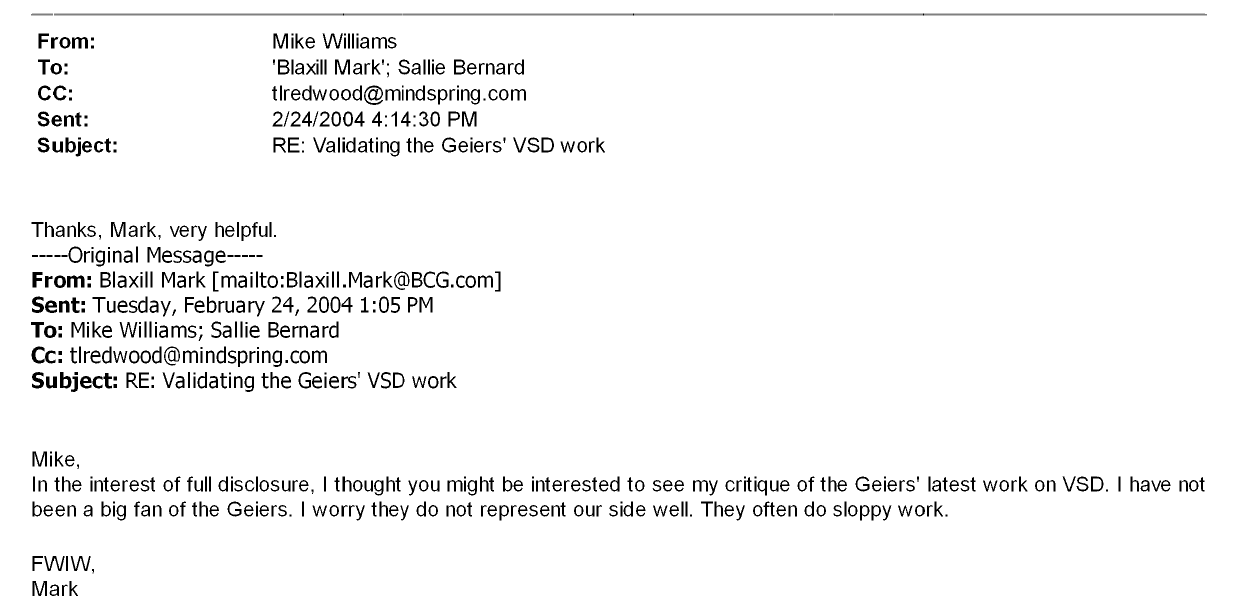
In an email image on Mr. Crosby’s blog, Mr. Blaxill is reported to have stated:

In the interest of full disclosure. I thought you might like to see my critique of the Geiers’ latest work on VSD. I have not been a big fan of the Geiers. I worry they do not represent our side well. They do sloppy work.

In another email (quoted by Mr. Crosby, the link to the original is nonfunctioning) quotes Mr. Blaxill as stating:

“As to the Geiers, I may be a bit of a minority voice here, but I worry very much that they can do our cause more harm than good. They are not very good scientists, write bad papers (both writing badly and reporting in sloppy fashion) and attract too much attention to themselves as individuals. In this last regard, they don’t show nearly as well as Andy Wakefield but they’re trying to play the same role. Frankly, if I were on the other side and were asked to critique their work, I could rip it to shreds. I’m surprised they haven’t been hit harder. So I think you are wise to diversify.”

Mr. Crosby’s stance is that this constitutes “interference” in the Omnibus Autism Proceeding. I.e. Mr. Crosby seems to imply that the Geiers are not sloppy scientists whose work is poor, but that the Geiers should have been allowed a more active role in the Omnibus.

In this case I find myself agreeing, in part at least, with Mr. Blaxill. The work by the Geiers is poor. Where I don’t agree is Mr. Blaxill’s decision to hold back on making those statement public. Not just because it’s hard to take the stance that one is a only “…interested in the quest for the truth” when one holds back on key information like an entire critique of the Geiers’ VSD paper. No. It goes deeper than that. The Geiers’ junk science went beyond promotion of the idea that thimerosal is a primary cause of autism. The Geiers ran a clinic for many years. Mark Geier was a licensed physician, David Geier worked in the clinic (and has been accused of practicing medicine without a license). Through their papers and their talks at autism parent conventions like AutismOne, the Geiers became well known. One of the “brand name” autism clinics. They reached this level of respect within their community because no one within that community dared to speak out.

I’ve noted on Left Brain/Right Brain many times before that these parent conventions differ markedly from real science conferences in that no one ever seriously challenges the speakers. They can present almost any theory or idea, especially if they tie it to autism as vaccine injury, without anyone standing up and saying, “that makes zero sense”. These aren’t science presentations, they are advertisements. It would be interesting to see how many of these conventions Mr. Blaxill attended and yet remained silent on the “sloppy” work that could be “ripp[ed] to shreds” that the Geiers presented. Instead, parents were presented a view that the Geiers were good scientists who suffered unjust criticism for their “brave” stance on vaccines.

The Geiers were promoters of chelation as a treatment for autism. Not only does chelation have no scientific basis to be an autism treatment, a study just out this week using rodents states that chelation could be harmful if there is no real heavy metal toxicity:

Finally, we also found that succimer treatment produced lasting adverse neurobehavioral effects when administered to non-lead-exposed rodents, highlighting the potential risks of administering succimer or other metal-chelating agents to children who do not have elevated tissue lead levels. It is of significant concern that this type of therapy has been advocated for treating autism.

It is highly likely that Mr. Blaxill would disagree with the statement that chelation has no good scientific basis as a treatment for autism. He’d be wrong, but that’s been covered over and over before. The Geiers moved on from standard chelation to stranger, more dangerous therapies. As an aside, if chelation was a successful treatment one has to wonder why the Geiers were prompted to move on to using Lupron as an autism treatment. Lupron is very serious medicine and it shuts down sex hormone production in the body. Why Lupron, one might ask? The Geiers convinced themselves (or convinced themselves that they could pass off this explanation) that mercury bound itself to testosterone in the brain, making it hard to chelate. They cited a paper showing that if one heats testosterone and mercury salts in benzene, one could form these mercury/testosterone complexes. They actually claim (yes, they tried to patent this idea to make money off it) that this paper shows that “It is known in the art that mercuric chloride binds arid forms a complex with testosterone in subjects”. The “subjects” are beakers of benzene, not animals and not people. Add to that the lack of an explanation of how shutting down hormone production would break up these complexes. The Geier “science” supporting Lupron would be laughably bad if it wasn’t used to subject disabled children to Lupron injections.

Lupron clearly has no basis as an autism therapy. In fact, the “lupron protocol” played a major part in Mark Geier losing his medical licenses. One has to ask, how did the get such traction for such an obviously bad idea? For one thing, the Geiers were considered respected scientists in the vaccine injury/alternative medicine autism community due to their previous and ongoing work trying to link thimerosal and autism. Work which Mark Blaxill considered “sloppy” and worthy of being ripped to shreds. But instead of sharing his views on the Geier papers with the public, Mr. Blaxill shared them privately within his own circle.

It’s worth noting that the email quoted above was written before the “Lupron Protocol” was developed. We don’t know if Mr. Blaxill was alarmed by the emergence of the “Lupron Protocol”. I can’t find where he spoke out against it. We can see that his blog (under a different writer) promoted the idea as “MERCURY, TESTOSTERONE AND AUTISM – A REALLY BIG IDEA!“. Mr. Blaxill doesn’t seem to have commented there. For all the papers the Geiers have published, Mr. Blaxill only mentions them once in his book “Age of Autism. But as we’ve seen, tacit approval (silence) may not be the same thing as real approval.

Mr. Blaxill had the courage to testify before a congressional hearing last year. A hearing where the politicians had been lobbied in advance to be favorable to his cause. When it came to disagreeing with one of his allies, that courage was lacking. He allowed “sloppy” science from an ally to go unchallenged. An example of the fallout of such a decision, in my opinion had he stood up he could have slowed or even stopped the “Lupron Protocol”, a therapy which in my opinion amounts to the abusive treatment of disabled children in an uncontrolled and unapproved experiment.


By Matt Carey

No, the thimerosal in the flu vaccine does not explain why autism rates did not go down

6 Oct

Surprisingly enough, there are still people promoting the idea that the rise in autism diagnoses observed over the last decades was caused by thimerosal in vaccines. The original argument was this–vaccines were added to the vaccine schedule in the 1990’s and with them the infant exposure to thimerosal increased. Concurrent with this rise in infant thimerosal exposure was a rise in autism diagnoses. Add to this a poorly concocted argument that autism resembles mercury intoxication and you have the basis for the mercury hypothesis.

Thimerosal was phased out of infant vaccines over 10 years ago. Thus, if the thimerosal hypothesis were true, reported autism rates should be declining by now. As far back as 2005 David Kirby (whose book “Evidence of Harm” played a major role in promoting the mercury hypothesis) acknowledged this point in a statement

If the total number of 3-5 year olds in the California DDS system has not declined by 2007, that would deal a severe blow to the autism-thimerosal hypothesis.

It’s 2013. Autism rates in California have not declined. Not in Special Education. Not in the CDDS roles. And, yes, we are six years past the 2007 deadline that David Kirby gave us.

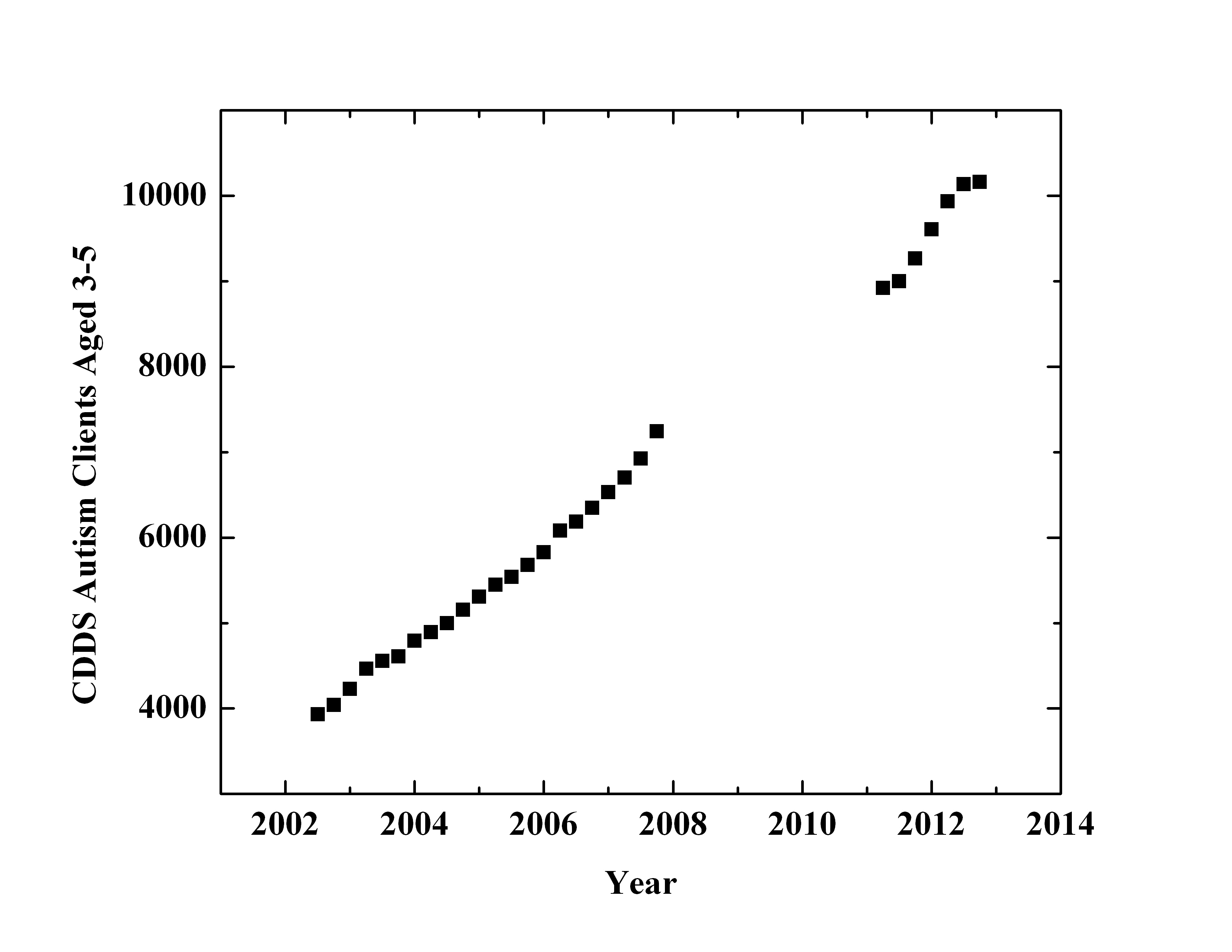
To be specific, let’s use the same method that David Kirby and others used to claim a thimerosal induced autism epidemic in the 1990’s (namely the California DDS client count–which not a good method, by the way). Autism “rates” have gone up by over 150% since thimerosal was phased out of infant vaccines. The age 3-5 bracket had about 4000 children in 2003 and is currently over 10,000.

CDDS 3-5

So we have more kids in California receiving services under the autism label than when thimerosal was in vaccines.

This is but one in a huge list of reasons why the thimerosal hypothesis doesn’t work.

But let’s go back in time a bit. Not so long ago one would hear proposals that we go back to the vaccine schedule of the early 1980’s when, it is claimed, the autism rate was 1 in 10,000. Fewer vaccines, less thimerosal, less autism. So goes the logic.

Generation Rescue, in fact, used to recommend the 1983 schedule as one of their alternative schedules

Turn back the clock
Comment: This is the schedule from 1983. If it worked for kids then, why doesn’t it work for kids now?”

Does it make sense to go back to the 1983 schedule? No. Why? OK a lot of reasons, but let’s focus on the fact that infants were exposed to more thimerosal in the 1980’s than today. Infant vaccines have no or only trace amounts of thimerosal.  So if thimerosal were the (or even a single) primary cause of autism risk, we would see autism rates lower today. To not only 1990’s levels, but to something like 1980’s reported levels. Assuming that the reported rates in the 1980’s were an accurate count of how many autistics there were then (a bad assumption but it’s the one they use).

To recap–Infant thimerosal exposure from vaccines peaked at nearly 200 micrograms in the 1990’s, up from about 100 micrograms in the 1980’s and is now less than 10 micrograms. And autism rates have not declined at all. Much less to 1980’s levels.

Once anyone says this the instant answer is that there is still thimerosal in some influenza vaccines. This, they say, is why autism rates have not declined. (note that thimerosal containing vaccines, including influenza vaccines, are banned in California for infants and pregnant women…and autism “rates” have continued to climb here).  

For completeness sake, let’s consider a kid who gets the maximum exposure to thimerosal from vaccines. I.e. a non California kid.  A kid who turns 6 months (the earliest age they will give a flu vaccine to a kid) during the flu season.  That kid will get 2 vaccines in the first year (6 and 7 months) then another influenza vaccine each year thereafter. Each with 25 micrograms of mercury from thimerosal. How does the thimerosal exposure compare to the 1983 schedule?  Take a look for yourself (exposures in micrograms of mercury from thimerosal):

1983 schedule 2013 schedule
DPT Inluenza
2 months 25
4 months 25
6 months 25 25
7 months 25
Total by 1 year 75 50
18 months 25 25
Total by 2 years 100 75
30 Months 25
Total by 3 years 100 100

So by age 3, the exposures are the same.  Except that the kid of today gets the thimerosal later and more spread out over time.  As an aside–most people who talk about the rise in thimerosal exposure during the 1990’s neglect to point out that the cumulative exposure in the 1980’s was already 100 micrograms. I.e. the “safe” level was significant.

If thimerosal were the driving force behind the rise in autism diagnoses, we should be back to 1983 levels, misrepresented by those claiming an epidemic as 1 in 10,000.  Instead we are at 1-2%.  The “rates” didn’t go down.

By this point the proponents of thimerosal are basically screaming, “you are forgetting the vaccines recommended to pregnant women!” No, I just put that off until now.  Sure, the influenza vaccine is recommended for pregnant women, but as the CDC notes:

Prior to 2009, influenza vaccination levels among pregnant women were generally low (~15%) (5,9).

So, from about 2000 to 2009 there wasn’t a big increase (or even a large part of the population) getting influenza vaccines while pregnant, nor were their children getting exposures higher than those in the 1983 schedule.

Take a look at that graph for California administrative autism prevalence again. Between 2002 (after the drawdown of thimerosal in vaccines) and 2012 the autism count doubled. Thimerosal exposure was down. A lot. Below 1990’s “epidemic” levels. Back to the 1983 “worked for kids then” levels. But autism “rates” continue to climb.

The people still pushing the idea that thimerosal is a (or even the) primary cause of autism are not unintelligent. We are talking about college educated people. Ivy league schools. A former journalist, an intellectual property expert and more. There is no math above. It’s all quite simple and straightforward. It uses the exact same logic and methodology they used to promote the idea that mercury causes autism. This is where intellectual honesty and basic integrity should kick in and get people to suck it up, admit their mistakes and start repairing the harm they have caused.

I’m not holding my breath.

By Matt Carey

Autism, Denmark and again no link with vaccines.

25 Aug

For a while now, I’ve been hoping that someone would publish data on the current state autism prevalence by birth year in Denmark. Denmark has been used for epidemiological studies for autism since their is a national database for health care. Thus, one can obtain a count of all people in Denmark who have been diagnosed with autism. Which is not the same thing as saying they have a count of all people in the country who are autistic. One can be autistic and not be diagnosed, as we will see.

A recent study using the Danish database is Recurrence of Autism Spectrum Disorders in Full- and Half-Siblings and Trends Over Time: A Population-Based Cohort Study. It’s an interesting study and I feel somewhat guilty for pulling the time-trend data out for my own discussion. In short, the study found that if a family has one child who is autistic, the chance for a subsequent child to be autistic is about 7 times higher than for families without an autistic child. This is fairly consistent with many other sibling studies over the years, but much lower than found in the recent baby siblings study out of the MIND Institute. That might be due to the active surveillance used by the team at MIND. I.e. they were actively monitoring and testing baby siblings.

Much more, they conclude:

Although the results from our comparison of recurrence in full- and half-siblings support the role of genetics in ASDs, the significant recurrence in maternal half-siblings may support the idea of a contributing role of factors associated with pregnancy and the maternal intrauterine environment. Finally, the lack of a time trend in the relative recurrence risk in our data suggests that the likely combination of genetic and environmental factors contributes to the risk for ASD recurrence in siblings or that the risk for recurrence because of such factors has not been affected by the rise in the ASD prevalence.

Very interesting–whatever is behind the higher prevalence among younger siblings, it seems to be the same today as 30 years ago.

What’s the overall prevalence of autism in Denmark according to this study? For childhood autism, they report 0.3%. For all ASD’s, 1.2%.

Autism, we are told by those promoting the autism/vaccine link, is unmistakable. Each autism prevalence report is not an estimate, but an accurate count of every autsitic because there is no way to miss an autistic. Back in the day, Rick Rollens was a constant fixture in the news on autism. He was a strong proponent of the idea that one could not miss autism:

WATSON:
Like many parents, Rick is convinced that Russell was damaged by a series of vaccinations. He strongly rejects the idea that the epidemic of autism can be entirely explained by poor diagnosis in the past because numbers have rose over the last few years.

ROLLENS:
Missing child with autism is like missing a train wreck. For us now to now think that somehow we have better identified a child who can’t talk, who has repetitive behaviour. Who makes no eye contact. Who is self- involved and in many cases self-abusive just defies logic.

Mr. Rollens was wrong on two counts (leaving aside his inflammatory and derogatory language). First, autism is not just the child who can not talk, self-involved and self-abusive. Second, yes, a lot of autistics have been missed. We’ve seen that time and time again. Look at the same population at different times and the later study will have found more autistics. An this goes for autistics with intellectual disability, as shown in the recent UCLA/Utah autism followup: “Today’s diagnostic criteria applied to participants ascertained in the 1980s identified more cases of autism with intellectual disability. ”

But, what about Denmark? A study from 10 years ago looked at autism incidence following the removal of thimerosal in Denmark in 1992. Thimerosal and the occurrence of autism: negative ecological evidence from Danish population-based data

In that study they found 956 children born in their study period who were diagnosed with autism by 2000:

A total of 956 children with a male to female ratio of 3.5:1 had been diagnosed with autism during the period 1971–2000.

The current Denmark study included individuals diagnosed until the end of 2010. I.e. there were 10 more years of followup. In those 10 years a lot more people were diagnosed. Where there were 956 diagnosed with autism by 2000 (for birth years 1971 to 2000), 2321 were diagnosed by 2010. That’s an increase of 240%. And the new study focused on birth years 1980 to 1999. I.e. the entire 1970’s birth cohort is not included in this count, and they still found over twice as many autistics. Where were they in 2000, when the previous study was performed? Living in Denmark, not identified as autistic.

There are a few factors which are likely behind this increase, but here we have a great example of “increased awareness” affecting autism prevalence.

And, those numbers were for childhood autism. For ASD, the increase is even larger. 10,377 Danes had an autism spectrum disorder diagnosis (for birth years 1980-1999) in the new study (the previous study included none). That’s a whopping 1080% increase. Again, there are a few reasons for this (including the increased awareness above), but here’s what “expanding the definition” does to autism.

Those increases would be an “epidemic” to some if it weren’t for the fact that those autistic Danes were there all along. They just weren’t diagnosed in 2000.

For many years, groups touting the idea that vaccines cause autism have pointed to Denmark as part of their argument. Denmark uses fewer vaccines than the U.S.. Generation Rescue used to have this on their website discussion of vaccines:

Comment: Denmark is a first world country based in Western Europe. Their schedule appears far more reasonable than ours. They have also been reported to have a much lower rate of autism than the U.S. Do they know something we don’t?

What was that Danish vaccine schedule that Generation Rescue recommended?

DTaP at 3, 5 and 12 months
Hib at 3, 5 and 12 months
IPV at 3, 5 and 12 months, plus 5 years
MMR at 15 months and 12 years

No mercury (Denmark phased that out in 1992). No birth dose of Hepatitis B. Fewer vaccines overall than in the U.S.. And the same autism prevalence of about 1%.

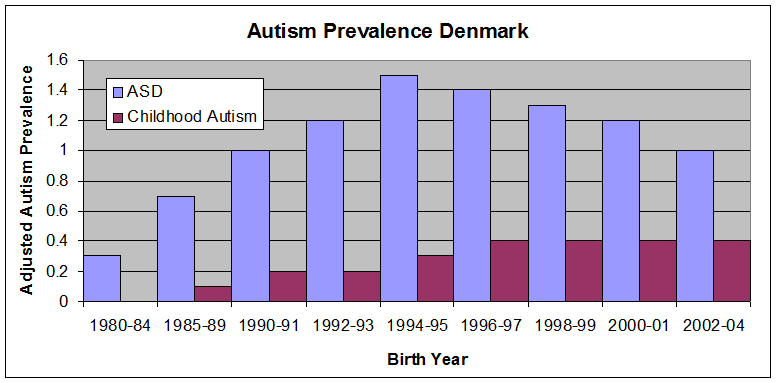
If you dive into more details, it gets even worse for the vaccines and/or thimerosal cause autism argument. Let’s look at the prevalence as a function of birth year for childhood autism and ASD from the recent study:

AutismPrevalenceDenmark

Consider this statement from a previous study:

This means that children who followed the full vaccination program during the period 1961–1970 had received a total of 400 g of thimerosal or 200 g of ethyl mercury by the age of 15 months and during the period 1970–1992 they had received a total of 250 g of thimerosal or 125 g of ethyl mercury at 10 months of age. In March 1992 the last batch of thimerosalcontaining vaccine was released and distributed from Statens Serum Institut in Denmark.

The thimerosal exposure was higher prior to 1992 than after. But the prevalence of both childhood autism and ASD is higher after the removal of thimerosal. This is the same result as shown in the 2003 study. The number of vaccines seems to be constant over this time period, so number of vaccines/aluminum/too-many-too-soon or other arguments don’t work either.

How about taking just a single year. The prevalence for ASD in 1996-97 was 1.4%. What is the autism prevalence in the U.S. for that year? To answer accurately, I’d contend we need a count today, not an old one. But people promoting the idea that vaccines cause autism take the CDC reports as absolute measures of autism, comparing each report and telling us all about the epidemic. So, let’s take the CDC number for kids born in 1994: 0.8%. That study was reported in 2009.

So, we have 1.4% in Denmark and 0.8%, nearly half the Danish prevalence, in the U.S.. Denmark had no thimerosal, no Hepatitis B shot (birth or otherwise), fewer vaccines and less aluminum exposure. And much higher reported autism prevalence.

Oddly enough, even though there have been many prevalence studies out of Denmark, Tomljenovic and Shaw didn’t include Denmark in their study “Do aluminum vaccine adjuvants contribute to the rising prevalence of autism?” My guess is that Denmark didn’t fit their conclusion then, and, like Iceland, would make their analysis fall apart now. It is even more odd that Tomljenovic and Shaw didn’t use Denmark as Denmark was used in a faux-study put out by Generation Rescue. In AUTISM AND VACCINES AROUND THE WORLD: Vaccine Schedules, Autism Rates, and Under 5 Mortality Someone at Generation Rescue made the first attempt at the sleight of hand of comparing the autism prevalence in various countries vs their vaccine schedules. At that time, 2009, Generation Rescue claimed that the autism prevalence in Denmark was 1 in 2,200, misrepresenting the 2003 study discussed here. The raw prevalence in this 2008 study was 0.65% or about 1 in 153. That value didn’t fit the thesis that the Generation Rescue author wanted to convey.

One argument found on the internet is that the 2003 Denmark paper fudged the results by clipping the last years off the data presented. An email involving people involved in the study is quoted as saying, “But the incidence and prevalence are still decreasing in 2001“. Oh, my, we are told, the autism prevalence and incidence actually went down after the removal of thimerosal!

But, it didn’t. The prevalence of childhood autism (basically what was studied in the 2003 paper) in Denmark is flat from birth cohorts 1996-2004. Flat. The prevalence of ASD’s do see a decline. That must be it! Evidence that thimerosal was causing autism in Denmark! But it isn’t. The prevalence of ASD in 2003-04 is the same as that in 1990-91, before thimerosal was removed. Why does the ASD prevalence go down? We can’t say for sure, but my strong suspicion is that it’s the same reason why the authors in 2003 were seeing a decrease: too few years of follow up. Autistic kids are typically diagnosed earlier than those with other ASD’s, but the average age was about 5 in Denmark in 2003 (as I recall). ASD kids can have an average age of diagnosis of 8. Recall that the recently released study followed kids up to the end of 2010. It’s no surprise to me that the estimated prevalence for ASD kids born in 2002 is lower than that for kids born in 2000 in this study. And this is consistent with the flat prevalence for kids with childhood autism diagnoses, as they are typically diagnosed earlier and 8-9 years would be enough to find the majority of the autistics in that population.

What about the idea that there’s a “changepoint” in the autism prevalence in Denmark and California pointing to some event in the late 1980s that’s contributing to autism prevalence? For one thing, the present study notes that the recurrence risk doesn’t change with time, so that’s good evidence against such an idea. There is no changepoint in the California data in the 1980’s, as it is exponential and fitting it to two straight lines is just a mistake. What about the prevalence data just released? The data are not finely spaced in birth years, in my opinion, to give a good idea of any “changepoints” in the 1980’s. But there is a changepoint of sorts in the childhood autism data in the 1990’s. The data plateaus at about 1996. But, as already noted, this doesn’t coincide with anything related to vaccines. The ASD prevalence appears to peak at about 1994, but, again, this doesn’t coincide with vaccine events and, I suspect, results largely from lack of follow up for the kids in the later birth years.

How about the MMR vaccine? MMR uptake for young children (MMR1) was basically flat from 1987-1997. Uptake rose somewhat after that. So, during the period that the estimated prevalence was increasing, MMR uptake was basically flat. During the time that the estimated prevalence was either flat (childhood autism) or decreasing (ASD’s), the MMR uptake was increasing. So if we were to play the “correlation equals causation” game, MMR prevents autism. (two notes, preventing rubella infections most likely does prevent some autism and the link above shows a nice example of rubella infections going down after MMR was introduced in 1987. The two points are not linked because most women in Denmark who were infected with rubella before 18 weeks gestation chose abortion, resulting in a low congenital rubella syndrome prevalence).

How about the “fetal cells in vaccines cause autism” argument? It’s one without biological plausibility, but then so was the thimerosal idea. I’d be interested in seeing how the vaccines were produced in Denmark in the 1990’s, but at present, the MMR vaccine there is developed using chicken eggs, not fetal cell lines. And they don’t routinely vaccinate against chickenpox, another vaccine in the U.S. using fetal cell lines. It looks like at least as far back as 1999 they were using egg-based vaccine production for MMR.

So, it appears we have a country with no vaccines grown in fetal cell lines with an autism prevalence as high or higher than that in the U.S.. In other words, the “vaccines from fetal cell lines caused the ‘autism epidemic’ theory” also appears to be debunked by the Denmark data.

In case you are looking for correlations with the vaccine program, here’s the history in Denmark.

So, how about the rise in estimated prevalence in the 1980’s. Is it “real”, as in does it represent an actual increase in the fraction of autistics in the population? It’s a good question and one which could be answered by performing a real study of autism prevalence in adults. The sort of study I and others have called for in the U.S., but that most autism-parent advocacy groups have refused to support. Such a study would not only answer the question of the prevalence, but it would give us valuable data on what has led to success and failure among the autistic adult population.

For those promoting the idea that environmental mercury emissions are a factor in the increase of autism rates, if you have data for Denmark, I’d love to see it. In the U.S., environmental mercury emissions dropped by over 50% in the 1990’s.

Lastly, let’s discuss a comment statement one will read or hear. It goes something like “the autism prevalence was 1 in 10,000 in 1980 and it’s 1 in 1,000 today”. This involves a number of sleights of hand. First, the autism prevalence wasn’t 1 in 10,000 in 1980. It was a few in 10,000 (Wing and Gould reported about 5/10,000). Doesn’t sound like a big deal, but when people start taking ratios (it went up a gazillion percent) a factor of 2 or 3 in the denominator makes a difference. Second, this was the estimated prevalence based on the number of autistics diagnosed at the time. As shown above, the childhood autism prevalence estimate for Denmark in the 1980’s increased by 240% in the past decade. This was not a real increase, but better identification. Third, the comparison is between autism (childhood autism, DSM-III autism or some other restrictive definition) vs. autism spectrum disorders. Also shown above was that the prevalence of ASD’s in the 1980’s increased by a factor of 10, increasing only in the past 10 years.

A factor of 10 in the numerator, a factor of 3 or 4 in the denominator and pretty soon you are talking about a big part of the increases observed.

In the end, none of the above arguments are that new. Or, to put it better, none of the vaccines-cause-autism arguments had much real support. The mercury idea has lost much of the support it had 10 years ago in the parent community, but it persists. The aluminum in vaccines idea has risen to try to take the place of the mercury hypothesis, but it is based on the exact same smoke and mirrors. The idea that the increase in autism is due to the MMR has been scientifically dead for years. And, yet, these ideas persist. And they cause harm, both to the community at large and to the autism community.


Matt Carey

Jenny McCarthy, shilling for big tobacco

10 Aug

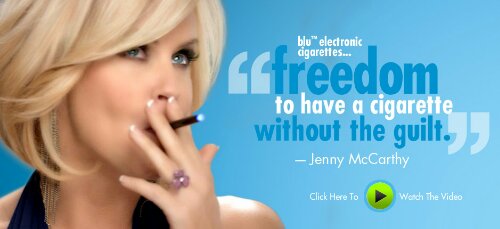
Not my usual style for an article title, I know, but I couldn’t think of any other way to say this.  Jenny McCarthy is now advertising for Blu e-cigarettes. Blu is owned by Lorillard, a major tobacco company.

“All the fun and none of the guilt of having a cigarette”, she says in one video. Yes, children, smoking is fun. And sexy.  Smoke an e-cigarette and you can get a date.

Fun and sexy.  Anyone else feel like we are watching an episode of Mad Men (a show about advertising in the 1960’s)?

image

After her stance on vaccines, Jenny McCarthy wouldn’t promote something that is toxic, right? Of course the health aspects have been tested, right?

Here’s a bit from the Blu FAQ.

Is blu better for me than traditional cigarettes?

blu liquid is made in the U.S. with domestic and imported ingredients by Johnson Creek Enterprises in Hartland Wisconsin; we maintain an organization that inspects product lines at all facilities daily. blu simulates the smoking experience without the tobacco smoke, ash and smell associated with traditional tobacco cigarettes. blu should not be used as a quit smoking device as it has not been approved by the FDA as a cessation device. blu eCigs are not a smoking cessation product and have not been evaluated by the Food and Drug Administration, nor are they intended to treat, prevent or cure any disease or condition.

Did you catch where they address the question of whether the health risks are reduced in e-cigarettes? That’s right, they didn’t. They didn’t point out that there are no safety studies.  You know, long term health outcomes of the sort that Jenny McCarthy says are lacking in vaccine research making such research in her view — yes — tobacco science.

What’s in the “smoke juice” used in Blu? I didn’t find it easily on their website, but here’s what the manufacturer of the liquid says

Johnson Creek Original Smoke Juice is happy to furnish our ingredient list! In fact, we list our ingredients right on the bottle. USP Grade Propylene Glycol (not in Red Oak Smoke Juice Recipe) USP Grade Vegetable Glycerin USP Grade Glycerol USP Grade Deionized water USP Grade Nicotine (except in Zero Nicotine recipe) Natural Flavors Artificial flavors USP Grade Citric Acid

Propylene Glycol“. That’s a form of antifreeze. A form that has been approved by the FDA for some food uses. Ms. McCarthy and her team falsely claimed that vaccines contain “antifreeze”. It’s scary in vaccines but OK in an e-cigarette. Is propylene glycol scary? No. But there is heavy irony in her promoting a product using an antifreeze after using this term (falsely) as a scare tactic about vaccines.

Edit to add: The Blu website does include the ingredients and Propylene Glycol isn’t in them.

Ingredients: blu™ flavor cartridges are propylene glycol-free with six (6) key ingredients: distilled water, nicotine (when applicable), FCC grade vegetable glycerin, natural flavors, artificial flavors, and citric acid.

I’m so glad that they use high grade (USP Grade) nicotine. Only the best, right?

Here’s the proposition 65 warning on the Blu website;

| CALIFORNIA PROPOSITION 65 – Warning: This product contains nicotine, a chemical known to the state of California to cause birth defects or other reproductive harm.

I seem to recall Jenny McCarthy telling the story of how she locked herself in a hotel room so she could quit smoking when she learned she was pregnant. She believed that tobacco ingredients were harmful then. Now she’s selling a nicotine delivery system.

Jenny MCarthy is not new to promoting toxins. Back in her vaccine campaign heyday she touted the benefits of botox. In 2008 she only got a little bit (every two months). Now she’s “Team Botox“.

I will say, her move to promote e-cigarettes was unexpected. Which is different from saying I’m surprised. If someone had said, “do you think Jenny McCarthy would accept money to promote an e-cigarette nicotine delivery system”, I’d have said yes. Jenny McCarthy may not be consistent on her stories and beliefs, but she is consistent in promoting Jenny McCarthy and taking opportunities to make money.


By Matt Carey

Note–I posted an early draft of this article which contains errors. The original paragraph is below

“Propylene Glycol”. That would be the same substance used in vaccines that Ms. McCarthy and her team mislabelled “antifreeze”. It’s scary in vaccines but OK in an e-cigarette. Which do you think contains the greater exposure? (Hint, infants don’t carry packs of vaccines every day). Is propylene glycol scary? No. But there is heavy irony in her promoting a product using it after using this substance as a scare tactic about vaccines.

The Amish may not be a great population for a vaccinated/unvaccinated study

10 Aug

The recent attempt to legislate brought back the subject of the Amish, vaccination and autism. It’s an old idea, made popular by a journalist whose work was, shall we say, less than complete.

House Resolution 1757 (still stuck in committee) states:

” Target Populations- The Secretary shall seek to include in the study under this section populations in the United States that have traditionally remained unvaccinated for religious or other reasons, which populations may include Old Order Amish…”

Whenever the Amish are brought forward as a population for vaccinated/unvaccinated studies, people present many reasons why such an idea lacks rigor.

1) The Amish do vaccinate. They have no prohibition against vaccination. (i.e. the statement that “because the Amish have a religious exemption from vaccination” is incorrect).

2) “The” Amish is a bit of a misnomer. Amish is more of a plural, as in a group of basically island populations which have been developing somewhat independently genetically for a few hundred years.

3) Talking about studying the Amish as though one has the right to just force them to submit is very disrespectful. And a bad assumption. One does not tell a community that they have to be study subjects. One asks. The Amish may very well not want the entire population screened for autism.

There are more arguments. Valid arguments. But without some cold, hard, numbers the response that usually comes up is, “Ah, you are afraid of what we will find!”

No, if one is going to do a study, one should be rigorous. One should get as close to the correct answer as possible. Studying the Amish as an “unvaccinated” population with “no” (or little) autistic subpopulation is to start out with little chance for success.

But how about some cold, hard numbers (I mean, beside from the fact that the Amish vaccinate and there are autistic Amish).

Here’s a talk presented this summer by the DDC Clinic in Ohio. This clinic is following the model of the cleverly hidden “Clinic For Special Children” that a certain journalist failed to contact before publishing his conclusions. In the description of the Clinic you will find:

A 501(c) (3) non-profit organization located in
Middlefield of Ohio, Geauga Amish settlement
• Total population ~95,000, Amish ~14,000 (15%)
• 50% of developmental disabilities are from Amish
• One hour (but a world) away from world class healthcare

Yes, they are 15% of the local population but account for about 50% of the developmentally disabled population for their community.

In other words, the prevalence of developmental disability is more than five times that of the general population.

Do you still want to compare this population for long term health outcomes and vaccination status? Do you want to say, “hey, here’s a population that doesn’t vaccinate and they have more developmental disability than the rest of the population?”

That’s what people have been pointing out for years in stating that genetically the Amish are somewhat distinct from the rest of the U.S. population. The proposed study will run into big problems.

Why does the Clinic for Special Children (and similar clinics) exist? They aren’t just there because the Amish are likely to be underserved in general since they lack insurance (which, I’ve been told, is something the Amish avoid). The Clinic’s mission statement is:

The Clinic for Special Children was established in 1989 as a non-profit medical service for Amish and Mennonite children with genetic disorders. The Clinic serves children by translating advances in genetics into timely diagnoses and accessible, comprehensive medical care, and by developing better understanding of heritable diseases.

Again, they are a small, island-like population. Many genetic conditions are more common in their communities. Many are metabolic conditions. (Dr. Morton’s talk at the conference was “Approach to Care for Patients with Metabolic Disorders”). Conditions which put people at greater risk of harm from infections, hence the reason that people have been working to increase vaccine uptake in the Amish over the past 3 decades.

The Clinic for Special Children has been an example of how focusing on genetic conditions can have major impacts on the well being of those with the conditions. Over the past 30 years, the Clinic has pioneered efforts which have resulted in better health and longer lives for their patients. Too often we hear in the autism communities that genetic conditions mean “no hope”.

I’ll leave you with the words of Dr. Holmes Morton of the Clinic for Special Children. Words from the Clinic’s main page:

“Special children are not just interesting medical problems, subjects of grants and research. Nor should they be called burdens to their families and communities. They are children who need our help, and if we allow them to, they will teach us compassion. They are children who need our help, and if we allow them to, they will teach us love. If we come to know these children as we should, they will make us better scientists, better physicians, and thoughtful people.”


By Matt Carey

Another attempt at legislating an autism-vaccine study

4 Aug

Last week someone forwarded to me an email from the SafeMinds lobbyist. SafeMinds promotes the idea that vaccines, and specifically thimerosal which was formerly in vaccines, caused the rise in autism diagnoses observed in the past decades. The email asked for support for proposed bill in the U.S. House of Representatives, HR 1757.

I am once again saddened that such a vocal minority of the autism communities are focusing their attention on vaccines. Consider that right now there are three bills before congress that come up on a search for “autism”:

Autism Understanding and Training in School Methodologies for Educators Act of 2013
(which is stalled in committee)

H.R. 1757, Vaccine Safety Study Act
(the one that prompted this article, also stalled in committee)

and a Bill introduced just this week (so recent that the text of the bill isn’t online yet)

To establish a health and education grant program related to autism spectrum disorders, and for other purposes.

Three proposed bills on autism, two attempting to improve the lives of autistics and one on vaccines. Surely as a Country, we can do better than this?

Are we hearing a call for support for the other bills from these parent advocate groups promoting autism as vaccine injury? Not that I’ve seen. Are the sponsors of the vaccine bill (Members of Congress Posey and Maloney) cosponsoring the other two bills? No.

As noted, the text of the last bill (health and education grant program) is not up, but the sponsors are Representatives Christopher Smith and Michael Doyle. These are people who were instrumental in getting the Combatting Autism Reauthorization Act passed. These are people with autism on their radar.

By contrast, the main sponsor of the vaccine related bill is not a member of the Congressional Autism Caucus. The cosponsor, Representative Maloney is.

The point I’m trying to make here is this: there are two autism related bills which are not strongly supported by the vaccine-focused parent groups, nor the Members of Congress who are sponsoring the vaccine bill.

Back to the vaccine bill. Bills like this are not new, the bill is similar to ones that have been proposed before:

Comprehensive Comparative Study of Vaccinated and Unvaccinated Populations Act of 2006
Comprehensive Comparative Study of Vaccinated and Unvaccinated Populations Act of 2007
Comprehensive Comparative Study of Vaccinated and Unvaccinated Populations Act of 2009

All were proposed by Member of Congress Maloney. In 2006, the bill had 15 cosponsors. In 2007, 21 cosponsors. In 2009, 9 cosponsors. The present proposed bill has one sponsor (Representative Posey) and 1 cosponsor (Representative Maloney). Support for this bill, while never strong, peaked 6 years ago.

To put this in historical perspective, Robert Kennedy Jr.’s “Deadly Immunity” article (now retracted by Salon.com but still on Rolling Stone) and David Kirby’s “Evidence of Harm” were published in 2005. So it isn’t surprising that the bill enjoyed some support in the early iterations.

Most proposed bills do not get out of committee. The previous incarnations of this bill did not. Fewer bills become law. For example, in her tenure in the House, Member of Congress Maloney appears to have one bill make it to a public law. That bill was a reauthorization of an existing law (changing “dollars and dates”) Some motions by Representative Maloney, such as honoring ex President Clinton have been agreed to by the House.

I already mentioned that Congressman Posey is not cosponsoring the other two autism bills presently before the House. Nor is he a member of the Congressional Autism Caucus. In fact, Representative Posey, the sponsor of the current bill, was not a cosponsor of the 2009 bill, the year he was first elected to Congress. I don’t see him as a cosponsor of CARA. For whatever it is worth, he has received donations from a wealthy Floridian who has worked in the past to get autism vaccine research legislated (Crist backer Gary Kompothecras bullies Florida health officials)

So, with all due respect to Congressman Posey (and a request that he consider a broader support for autism related issues) I’m not seeing H.R. 1757 as an autism focused bill, but a vaccine focused bill. The name says it: H.R. 1757: Vaccine Safety Study Act.

How about the text of the bill? It was rebranded as the “Vaccine Safety Study Act” rather than the previous “Comprehensive Comparative Study of Vaccinated and Unvaccinated Populations Act of 2009”. It starts with some simple findings:

(1) Securing the health of the Nation’s children is our most important concern as parents and stewards of the Nation’s future.
(2) The Nation’s vaccine program has greatly reduced human suffering from infectious disease by preventing and reducing the outbreak of vaccine-preventable diseases.

I wonder how few people currently calling for support of H.R. 1757 would support a House Resolution making only point 2. I suspect the number is small. Vanishingly small. That before we even add point 4 “(4) Childhood immunizations are an important tool in protecting children from infectious disease.”

Then we get to the proposed findings which are more to the core of the views of those promoting this bill:

(5) The number of immunizations administered to infants, pregnant women, children, teenagers, and adults has grown dramatically over recent years.

(6) The incidence of chronic, unexplained diseases such as autism, learning disabilities, and other neurological disorders appears to have increased dramatically in recent years.

You get both the “scary correlation” and the rather interesting use of the word “dramatically”. We saw a “greatly” reduced human suffering in point 2, not a “dramatically reduced” human suffering.

Here’s another interesting proposed “finding”

(9) Childhood immunizations are the only health interventions that are required by States of all citizens in order to participate in civic society.

Really? Vaccines are “required” for children and then up to the point that you can say “I don’t want to do that to my kid” in 19 states (philosophical exemption) or “it’s against my religion” in 48 states (religious exemption) or “my kid has a doctor’s note saying he/she can’t be vaccinated” (medical exemption) in all states. How much income tax would be collected if the “required” taxes had the same out as vaccines? Also, “childhood immunizations” are required by “all citizens in order to participate in civic society”? Really? So, since I didn’t get, for example, a chickenpox vaccine, the MMR (or, my guess, M, M or R vaccines), or, really most of the childhood vaccines, I am somehow barred from participating in civic society?

Let’s limit this just to kids. What is meant by “civic society”? Unvaccinated children are allowed in schools, they are allowed in public places, they can’t vote (neither can vaccinated kids…they are kids after all). That’s what exemptions mean. What restrictions are there on unvaccinated children that Representative Posey is talking about here?

Let’s go on:

(10) Public confidence in the management of public health can only be maintained if these State government-mandated, mass vaccination programs–

(A) are tested rigorously and in their entirety against all reasonable safety concerns; and

(B) are verified in their entirety to produce superior health outcomes.

Makes us accept a few unsupported assertions. Let me approach it like this: vaccine uptake has remained, on average, high for decades. This without the study proposed in this bill. Evidently, vaccines are tested rigorously and in their entirety against all reasonable safety concerns and are verified in their entirety to produce superior health outcomes. At least as far as the US public is concerned.

Then we get:

“(11) There are numerous United States populations in which a practice of no vaccination is followed and which therefore provide a natural comparison group for comparing total health outcomes.”

If you think one of the “numerous” populations considered are the Amish, you’d be correct. They are mentioned later in the bill. They’ve been mentioned in previous versions of the bill. Even though the Amish do, indeed, vaccinate. There was some very poor journalism promoting the idea that the Amish don’t vaccinate (and that their are no autistic Amish, another incorrect statement).

The bill then goes on the instruct the Secretary of Health and Human Services to initiate a study of health outcomes in vaccinated and unvaccinated populations. The bill proposes dictating how the study will be undertaken. For example, here are the proposed qualifications for the investigator (why only one?):

(c) Qualifications- With respect to each investigator carrying out the study under this section, the Secretary shall ensure that the investigator–

(1) is objective;

(2) is qualified to carry out such study, as evidenced by training experiences and demonstrated skill;

(3) is not currently employed by any Federal, State, or local public health agency;

(4) is not currently a member of a board, committee, or other entity responsible for formulating immunization policy on behalf of any Federal, State, or local public health agency or any component thereof;

(5) has no history of a strong position on the thimerosal or vaccine safety controversy; and

(6) is not currently an employee of, or otherwise directly or indirectly receiving funds from, a pharmaceutical company or the Centers for Disease Control.

OK. From now on when the vaccine/autism groups promote a study supposedly linking autism with vaccines, I’ll ask if said investigator “has no history of a strong position on the thimerosal or vaccine safety controversy”. Many such studies are by individuals or teams with clearly strong views favorable to the autism/vaccine hypothesis. I note that people funded by or members of vaccine/autism groups are not barred from the proposed study. No, just people receiving funds from pharmaceutical companies or the CDC, or public health employees, or people who are on any committee which is interested in vaccines…

Then there’s the “Amish” clause:

(d) Target Populations- The Secretary shall seek to include in the study under this section populations in the United States that have traditionally remained unvaccinated for religious or other reasons, which populations may include Old Order Amish, members of clinical practices (such as the Homefirst practice in Chicago) who choose alternative medical practices, practitioners of anthroposophic lifestyles, and others who have chosen not to be vaccinated.

Why would the named groups be any more valuable to researchers than “…others who have chosen not to be vaccinated”?

It’s a useless clause. It’s worse than useless. One would want to study populations as similar in all respects save vaccination as possible. In their press release SafeMinds stated, ” Every 7th grader knows you cannot do a proper experiment without a rigorous control group that can be compared with the exposed group.” Choosing a group which is specifically different from the study group in areas other than the variable of interest would be, by definition, non rigorous. I’ll leave it to the reader whether every 7th grader would understand that, as some well educated adults do not.

The bill ends with:

(f) Transparency- To facilitate further research by the Secretary or others, the Secretary shall ensure the preservation of all data, including all data sets, collected or used for purposes of the study under this section.

This is essentially the “We want an objective researcher to perform this study but if his/her results go against what we hope for, we want the chance for our own people to work with the same dataset” clause.

One site I saw put the chances of this bill becoming law at 1%. In the email that was forwarded to me one thing I don’t recall being stressed was this. “http://thomas.loc.gov/cgi-bin/bdquery/z?d113:h.r.01757:

Sponsor: Rep Posey, Bill [FL-8] (introduced 4/25/2013) Cosponsors (1)
Latest Major Action: 4/26/2013 Referred to House subcommittee. Status: Referred to the Subcommittee on Health.

Yes. The bill was introduced 3 months ago (4/25/2013) and was referred to a subcommittee (4/26) and has not moved, nor collected additional sponsors in that time. Sure, it’s summer and things move slowly in Washington in the summer. But this has the markings of another failed bill. A waste of efforts. Efforts that could go towards supporting some other legislation, or creating some new bill which has the chance to impact the well being of today’s autistic population. But we aren’t seeing a call to action for that. Nor, I suspect, will we.

edit to add:

What’s missing from HR 1757? In my view, any mention of appropriations. The bill does not mention setting aside any money for this study. Sure, HHS probably can move money around and fund another study. But it makes me wonder whether anyone is serious about this getting out of committee.

The bill is essentially the same as the previous incarnations. The “transparancy” clause is new. Also new is this:

(b) Rule of Construction- Nothing in this Act shall be construed to authorize the conduct or support of any study in which an individual or population is encouraged or incentivized to remain unvaccinated.

Yes, they are making it clear that they are not asking for a prospective double-blind study where one group would be intentionally unvaccinated. I’d love to know how that new clause was inserted. It’s probably the simple reality that such a study is unethical and would make this bill dead on arrival.


By Matt Carey

Jenny McCarthy angling for a spot on The View?

15 Jul

I don’t spend much time following celebrities. Jenny McCarthy was, for a time, an exception. She became the number one spokesperson for the idea that vaccines cause autism as well as for unproven and sometimes dangerous “therapies” for autism. She made a lot of money from autism, autism kept her name in the press and, as the money dried up, Ms. McCarthy quieted down on the topics that only a short time before she was so passionate about. Jenny McCarthy now makes news for topic like, “Jenny McCarthy ‘dating’ Donnie Wahlberg“.

New reports recently came out that Jenny McCarthy is being considered for a spot on the TV show “The View”. I saw a number of these sorts of news stories before I cancelled my news alerts. “Jenny McCarthy in talks with….for a job” They struck me as publicity and trial balloons. Attempts to get buzz going to help get the job.

If Jenny McCarthy’s publicity team are floating this as a trial balloon, they should have known the response they would get:

U.S. News and World Report: Jenny McCarthy’s Pseudoscience Has No Place on ‘The View

Slate: The View of Jenny McCarthy

Salon: Don’t put Jenny McCarthy on “The View” The “warrior mother” is dangerous for television

Atlantic: Destabilizing the Jenny McCarthy Public-Health Industrial Complex

Most discussions focus on Jenny McCarthy’s views on vaccines. She adheres to the idea that vaccines cause autism. It’s good to point out this stance but, as I’ll discuss below, I personally question why The View would be considering Jenny McCarthy given her unprofessional attitude and lack of integrity in regards to her visits on The View.

The vaccine stance has been a bit of a liability for Ms. McCarthy and her organization (Generation Rescue). They have toned down their message a great deal over recent years. Back at the time when Generation Rescue was founded, they were very upfront:

Generation Rescue believes that childhood neurological disorders such as autism, Asperger’s, ADHD/ADD, speech delay, and many other developmental delays are all misdiagnoses for mercury poisoning.

With the number 1 reason for “How was my child poisoned” being thimerosal in vaccines.

The founder of Jenny McCarthy’s autism charity famously wrote once:

With less than a half-dozen full-time activists, annual budgets of six figures or less, and umpteen thousand courageous, undaunted, and selfless volunteer parents, our community, held together with duct tape and bailing wire, is in the early to middle stages of bringing the U.S. vaccine program to its knees.

Generation Rescue both before and since Jenny McCarthy has had a focus on various “cures” for autism. They range from relatively harmless (homeopathy) to dangerous and clearly ill founded (Lupron), promoted at their parent conventions like AutismOne.

Jenny McCarthy not only promotes subjecting disabled children to dangerous therapies, she attacks those parents who don’t accept her advice in this regard.

What’s very interesting with the possible gig on The View is the fact that Jenny McCarthy has a very checkered past with that show. In her first autism book tour, the one person who had the guts to challenge Jenny McCarthy was Barbara Walters on The View. Jenny McCarthy was so angered by this that she reportedly told a rally of her supporters exactly where Barbara Walters could “stick her microphone”. (On a local autism news group, when some people proposed putting video of this event on YouTube they were discouraged from doing so. Even then people realized this was not a good move by Ms. McCarthy.)

In a later book, Jenny McCarthy told the story of her confrontation with Barbara Walters on The View, making herself into a brave “warrior” mom. Only, the story that she gave in the book was very different from the version she gave in a televised interview. In other words, at least one of the stories appears fabricated.

She also posited that Barbara Walters was jealous of Jenny McCarthy and that was the reason why Ms. Walters challenged her. Ms. McCarthy even “forgave” Ms. Walters for the incident. Barbara Walters acted like a journalist and asked Jenny McCarthy to back up her statements. Jenny McCarthy slammed Ms. Walters publicly and quite rudely. And Jenny McCarthy forgave Ms. Walters.

Seemed at the time, and still does, that Ms. McCarthy should have been apologizing, not forgiving.

In the time between the incident on The View and Ms. McCarthy offering “forgiveness”, Ms. Walters had published her biography. In it Ms. Walters disclosed that her sister was intellectually disabled. Jenny McCarthy then “understood” that Ms. Walters was jealous of the fact that she had recovered her son, while Ms. Walters’s sister did not have that opportunity. Forgiveness with a side order of condescension.

An interesting point in the “forgiveness” story. Jenny McCarthy didn’t offer forgiveness when Ms. Walters made the disclosure in her biography. No, Ms. McCarthy waited four months until her own book tour to make the statement. It doesn’t strike this observer as anything beyond a cheap publicity stunt by Ms. McCarthy.

Another interesting point is that it has since been reported that Jenny McCarthy’s “recovered” son needs a $100,000 per year school. So, tales of “forgiveness” because she had recovered her kid while Ms. Walters’s sister remained disabled her whole life fall rather flat.

I did find it interesting that when Jenny McCarthy returned years later to The View for another book tour, it was on a day when Barbara Walters was not present.

Barbara Walters is still active onscreen and behind the scenes at The View. Ms. Walters is a true pioneer of journalism. She didn’t last this long without a very thick skin, so I doubt any of the childish antics from Jenny McCarthy bother her personally. On the other hand, Ms. Walters has been able to see first hand how Jenny McCarthy puts integrity aside in favor of self promotion.

The View is not the sort of hard journalism that is the backbone of Ms. Walters’ legacy. But, one does wonder why Ms. Walters (co-producer and co-owner of The View) would take on Ms. McCarthy. Jenny McCarthy is not and never will be on par with Barbara Walters. Few of us are. But bringing Jenny McCarthy into The View would cheapen, just a bit, a lifetime of hard work and excellence by Ms. Walters.


By Matt Carey

A fishing expedition at Vaccine Court

14 Jul

The U.S. Court of Federal Claims has a section devoted to adjudicating claims of vaccine injury. This is often referred to as the “Vaccine Court”. Individuals or their families can file a claim (petition) the court for alleged vaccine injury.

Information on individuals who are vaccinated are kept by ten Managed Care Organizations (MCO’s) and the Centers for Disease Control as the Vaccine Safety Datalink (VSD) Project. Researchers working as expert witnesses for families in the Vaccine Court have accessed the VSD in the past, and in one case misused their access. Possibly as a result of this, the MCO’s stopped contributing their data to the CDC for a single VSD database. Hence the reason why there are now 11 separate databases, with each MCO retaining control over their data.

One can see how groups who want to argue vaccine injury in court might want access to the VSD. Mark and David Geier have in the past attempted to use the VSD and they were the ones caught misusing the database. They, together with Heather Young, used an older VSD dataset to produce a paper for the Petitioners Steering Committee (the attorneys arguing for the families in the Omnibus Autism Proceeding). A paper for which the PSC was charged $250,000. A paper which was of such poor quality that it was not used by the PSC in the Omnibus.

In a recent decision, the Court heard arguments that the information in the Vaccine Safety Datalink Project should be turned over to their expert, Theresa Deisher, for analysis:

Petitioners seek access to data from the Vaccine Safety Datalink Project (hereafter the VSD Project) to allow their expert, Theresa A. Deisher, Ph.D., to conduct an original study comparing the rate of autism disorder incidence among children who received a particular vaccine, with the rate among children who did not receive that vaccine. As discussed more fully below, petitioners’ expert does not seek to study the MMR vaccine at issue in this matter, but rather the varicella vaccine.

That last sentence is important. The Special Master points out the decision to research whether the varicella vaccine (chickenpox) is associated with autism for good reason. The petitioners are not arguing that the varicella vaccine caused their child’s autism. No, they argue that the child reacted to DNA in the MMR vaccine resulting in autism. So, how a study on the chickenpox vaccine would further their case is somewhat unclear. Why they are not asking for data on chickenpox is even less clear.

The petitioners asked for $260,000 up front to fund the study. To my knowledge, the Court does not fund expert witnesses for efforts not yet performed. Aside from that fact, the Special Master noted that Theresa Deisher’s studies on the subject done to date were already funded.

Dr. Deisher notes that this work was funded by the MJ Murdock Charitable Trust, Pet’rs’ Ex. 26 at 18, which according to information on Deisher’s CV, provided her with a $500,000 grant to study “Population, Bioinformatics and In Vitro Studies into the Relationship between Residual Human DNA Vaccine Contaminants and Autism.” Deisher’s CV at 3. Dr. Deisher’s inability to produce a paper of publishable quality, after receiving a substantial grant, does not lend support to petitioners’ claim that she is capable of competently leading a study.

Yes, half a million dollars so far with no papers published. A manuscript was submitted to Autism Research and rejected. My guess is that the manuscript will soon be submitted to a journal (there are those which will welcome this). Or, one of these journals will seek out Ms. Deisher for her work (I could easily see this being published in a certain Polish journal, for example).

One can apply to gain access to the VSD databases. However, Ms. Deisher has not attempted to access the data in this way, opting instead to gain access through a court order.

As discussed in more detail later in this Order, petitioners acknowledge that Dr. Deisher has not followed the CDC’s usual Data Sharing application process and that she has no intention of doing so.

She did, however, apply for an NIH grant to perform this research. The petitioners claim that the controversial nature of the study resulted in it not being funded. The referee reports, however, were clear that the planned study was weak and Ms. Deisher’s skills were not strong in epidemiology and statistics (among other weak points).

Although petitioners make assertions to the contrary, the evidentiary record before the undersigned contains a withering assessment of Dr. Deisher’s ability to competently lead the proposed study. Petitioners here seek extraordinary relief, and the undersigned is reluctant to substitute her scientific judgment for that of the NIH reviewers—a panel of Dr. Deisher’s peers—who have found her proposed study to be critically deficient. In the undersigned’s view, the NIH reviewers’ comments merit weighted consideration.

“Withering assessment”.

The special master also notes that the request for data from the VSD exceeds the data needed to do the proposed study.

The petitioners do not limit their data request to information that is needed for the study they propose:

Despite the stated limits of her study, petitioners’ request for production from respondent and the MCOs lacks correlative limits for patient age and injury. Instead: petitioners seek authority to issue subpoenae to compel [respondent and the MCOs] to grant the petitioners full and unrestricted access to all data collected by the respondent within the VSD related to the administration of vaccines, and the occurrence of neurodevelopment and other disorders from the inception of the VSD to date.

Which, in my opinion, points to this as a fishing expedition. An attempt to gather any and all data and test multiple questions later–with the probability of a chance “hit” going up with the number of questions tested.

Since the Special Master did not grant access to the VSD, the funding request was also denied.

The petitioners asked that the expert witness fees for Theresa Because petitioners’ discovery request is denied, petitioners’ motion for authorization of interim expert expenses is deemed moot.

The decision also includes much discussion of a large, broad request for information from the FDA on the vaccine approval process. Again, this appears as a “fishing expedition”

Petitioners’ motion does not appear to be a well-considered effort to meet their evidentiary burden under the Vaccine Program; but rather appears to be a brazen attempt to gain access to respondent’s comments on the various vaccine licensing applications in the hope that something therein might be of relevance. As presented, there is nothing in petitioners’ briefing or the record showing that the documents under FDA’s control are necessary to a determination of the issues in this matter

Ms. Deisher’s previous research has focused on “changepoint” analysis of autism prevalence data. She follows the method set forth by two people at the FDA who presented such a changepoint analysis previously. I found that analysis lacking and submitted a comment to the journal on it. I find Ms. Deisher’s analysis lacking as well.

In the end, the petitioners shot themselves in the foot, repeatedly. They made an overly broad request for data (essentially the entire VSD database). They requested the funding for the analysis in advance. Their expert witness’ track record was lacking. The proposed a search of FDA documents without providing a good reason why this was important for their case.

They went fishing and they got skunked.


By Matt Carey

Wakefield dodges debate – again

9 Jun

The following comment was submitted to the Age of Autism blog but not approved:

Dr Wakefield is being disingenuous. In an earlier video posted on Age of Autism, he offered to debate the MMR-autism link ‘with any serious contender’. In an article published in the online magazine Spiked on 16 April, readily accessible through a link on AoA, I indicated that, as both the parent of an autistic son and as a doctor who has been engaged in this controversy for 15 years, I was prepared to engage in such a debate:

http://www.spiked-online.com/site/article/13532/

On 17 April Matt Carey published an article on the Left Brain, Right Brain blog, entitled ‘Mike Fitzpatrick calls Andrew Wakefield’s Bluff. Wakefield moves the goalposts’, drawing attention to Dr Wakefield’s apparent switch from being ready to debate ‘any serious contender’ to proposing that he was only prepared to debate with British immunisation chief, Dr David Salisbury: https://leftbrainrightbrain.co.uk/2013/04/

As Dr Wakefield is well aware, this is a very safe offer because Dr Salisbury has publicly indicated that he will not engage in any debate with Dr Wakefield.

Still receiving no response from Dr Wakefield, I publicly repeated this challenge in a posting on the Left Brain, Right Brain blog on 30 April, under the title ‘Andrew Wakefield: Now What About That Debate?’: https://leftbrainrightbrain.co.uk/2013/04/

Given the findings of the General Medical Council inquiry that removed Dr Wakefield’s name from the medical register on the grounds of ‘dishonesty’ and ‘irresponsibility’ in the conduct of his research, doctors and scientists are reluctant to engage in any public discussion with him. Many have advised me against accepting his challenge on these grounds. Yet I recognise that he continues to exert some influence among parents of autistic children. Hence I am prepared to engage in a debate that can only expose his failure, after 15 years, to produce any evidence in support of a link between the MMR vaccine and autism.

Michael Fitzpatrick 6 June 2013

Studies ‘supporting’ Andrew Wakefield

7 May

It is 15 years since Andrew Wakefield first hypothesised a link between the MMR vaccine and autism in children, mediated by an inflammatory bowel condition (subsequently labelled ‘autistic entercolitis’). Over this period Dr Wakefield and his supporters have cited a range of studies which are claimed to ‘verify’, ‘replicate’ or ‘support’ his MMR-autism theory. Here is the most recent list:

‘Here is a list of 28 studies from around the world that support Dr. Wakefield’s research:
1.The Journal of Pediatrics November 1999; 135(5):559-63
2.The Journal of Pediatrics 2000; 138(3): 366-372
3.Journal of Clinical Immunology November 2003; 23(6): 504-517
4.Journal of Neuroimmunology 2005
5.Brain, Behavior and Immunity 1993; 7: 97-103
6.Pediatric Neurology 2003; 28(4): 1-3
7.Neuropsychobiology 2005; 51:77-85
8.The Journal of Pediatrics May 2005;146(5):605-10
9.Autism Insights 2009; 1: 1-11
10.Canadian Journal of Gastroenterology February 2009; 23(2): 95-98
11.Annals of Clinical Psychiatry 2009:21(3): 148-161
12.Journal of Child Neurology June 29, 2009; 000:1-6
13.Journal of Autism and Developmental Disorders March 2009;39(3):405-13
14.Medical Hypotheses August 1998;51:133-144.
15.Journal of Child Neurology July 2000; ;15(7):429-35
16.Lancet. 1972;2:883–884.
17.Journal of Autism and Childhood Schizophrenia January-March 1971;1:48-62
18.Journal of Pediatrics March 2001;138:366-372.
19.Molecular Psychiatry 2002;7:375-382.
20.American Journal of Gastroenterolgy April 2004;598-605.
21.Journal of Clinical Immunology November 2003;23:504-517.
22.Neuroimmunology April 2006;173(1-2):126-34.
23.Prog. Neuropsychopharmacol Biol. Psychiatry December 30 2006;30:1472-1477.
24.Clinical Infectious Diseases September 1 2002;35(Suppl 1):S6-S16
25.Applied and Environmental Microbiology, 2004;70(11):6459-6465
26.Journal of Medical Microbiology October 2005;54:987-991
27.Archivosvenezolanos de puericultura y pediatría 2006; Vol 69 (1): 19-25.
28.Gastroenterology. 2005:128 (Suppl 2);Abstract-303

http://healthimpactnews.com/2013/new-published-study-verifies-andrew-wakefields-research-on-autism-again/

Which of these studies supports a link between MMR and autism? None of them. Which studies support a link between MMR and inflammatory bowel disease? None. In fact, none of these studies focuses on MMR: the term ‘MMR’ is not included in any of the titles.

One study (no 6) by Vijendra Singh, published in 2003, claims a link between measles virus and autism. According to virologists in London, Singh’s methodology was suspect and the evidence for the specific ‘anti-MMR’ antibody he identified was ‘not credible’(see Michael Fitzpatrick, MMR and Autism: What Parents Need To Know, p90).

Several studies claim to show an association between ‘autistic enterocolitis’ and autism. Of these (nos2, 3, 4, 9, 18, 19, 28) all but two feature Dr Wakefield as a co-author. Study no 9 is the work of Wakefield collaborators Arthur Krigsman and Carol Stott, published in a journal whose editors include Wakefield and Stott. Study no 28 is the work of Wakefield’s former Royal Free colleague Federico Balzola. The study by Dr Lenny Gonzalez, (no 27) a former collaborator with Wakefield at his Thoughtful House clinic in Texas, published in Venezuela, reports the extraordinary findings of autistic enterocolitis in 100% of 45 children with autism, and in 66.66% of 57 ‘developmentally normal’ controls. Apart from Wakefield and his former or current colleagues, no other researchers in the world have confirmed the existence of ‘autistic enterocolitis’ in children with autism.

Some studies suggest the presence of gastrointestinal disorders other than ‘enterocolitis’ in association with autism. These include upper gastrointestinal conditions, such as gastritis and oesophagitis (no 1, Horvath;no 10, Galiatsatos; no 20, Torrente); coeliac disease or malabsorption (no 12, Genuis;no 16, Walker-Smith;no 17, Goodwin); microbial factors other than measles (nos14, 15, 24, 25 – the Finegold, Bolte, Sandler team; and no 26 –Parracho and colleagues at Reading). Most of these studies feature small numbers of cases and two (nos 16,17) were published more than 40 years ago.In study no 10, Polymnia Galiatsatos and colleagues in Montreal, Canada report the cases of two young adults, one with colonic inflammation, the other with gastritis. Nikolov and colleagues at Yale(no 13) simply report on ‘gastrointestinal symptoms’ in association with autism.

Other studies suggest immune or autoimmune dysfunction in association with autism: Jyonuchi (nos7,8) and Singh (nos5,11). One study (no 23, Shinohe) focuses on abnormal glutamate metabolism in adults with autistic spectrum disorders. These studies do nothing to advance the vaccine-autism hypothesis.

Given that supporters of Dr Wakefield often claim that his work has been ‘independently’ replicated, it is worth pointing out that Wakefield himself is a co-author on a quarter of the studies listed here (2,3,4, 18,19, 21,22). Others (9, 20, 27,28) feature former Royal Free team members(Ashwood, Torrente, Furlano, Balzola), or subsequent collaborators (Krigsman, Stott, Gonzalez).
Those who, like me, have been following this sad story over the past 15 years, will have noticed that several authorities formerly cited in support of Wakefield’s theory seem to have fallen by the wayside.

In the early days of the MMR controversy, Wakefield often cited the studies of Rosemary Waring and Patricia D’Eufemia in support of his notion of a ‘leaky bowel’. His colleague John Walker-Smith claimed that a letter from Aderbal Sabra published in the Lancet in 1998 (about children with food allergies and ADHD) provided a ‘great public vindication’ of the work of the Royal Free team (see MMR and Autism, p143-4). Tokyo physician Hishashi Kawashima’s claims to have identified measles virus in children with autism were widely promoted – but soon discredited. In Sunderland, retired pharmacy lecturer Paul Shattock, an ardent Wakefield supporter, attracted widespread publicity for his claims to have identified distinctive urinary peptides linking MMR and autism, but his research was never published.

The most widely cited research supposedly supporting Wakefield came from his Dublin collaborator John O’Leary (published in 2002 in separate papers with Uhlmann and Shiels). This was discredited by the evidence of Stephen Bustin in the Omnibus Autism Proceedings in the USA in 2009 (see Stephen A Bustin, Why There Is no Link Between Measles Virus and Autism, DOI: 10.5772/52844).
Another study by Balzola, based on the use of the technique of ‘capsule endoscopy’ in a single (adult) case has also been dropped. It was rapidly followed by a report from another member of his team of ‘acute small bowel perforation secondary to capsule endoscopy’.

Other forgotten Wakefield supporters are the South Carolina immunologist Hugh Fudenberg, and the Florida preacher and vitamin salesman Jeffrey Bradstreet, whose dubious practices were exposed in Brian Deer’s Channel Four documentary in 2004. The father and son team of Mark and David Geier, notorious for their promotion of the ‘Lupron protocol’ of chemical castration and heavy metal chelation as a treatment for autism as well as for their shoddy researches, have also been dropped from the list of supportive researchers.

Another widely quoted ‘study’ supposedly supporting Wakefield was a poster presentation by Stephen Walker (working in collaboration with long-standing Wakefield ally Arthur Krigsman) at the IMFAR meeting in Montreal in 2006.These preliminary, provisional, unconfirmed, non-peer-reviewed findings – of measles virus in bowel biopsy specimens – in an uncontrolled study (which does not mention MMR) were widely reported – and enthusiastically acclaimed by Dr Wakefield. Walker himself disclaimed the interpretation that his work supported any link between measles and autism. This study has never been published.

In conclusion, after 15 years, we are offered 28 studies, none of which supports the MMR-enterocolitis-autism hypothesis. It is not surprising that over this period Wakefield has failed to win the support of a single paediatrician, paediatric gastroenterologist, child psychiatrist or autism specialist in England. Surely it is time to call a halt?


By Michael Fitzpatrick