Archive | Vaccines RSS feed for this section

Mark Geier: under scrutiny in more states

29 Jul

In Home Autism doctor here under scrutiny, The St. Louis Post Dispatch discusses investigations ongoing in Illinois:

A autism doctor who operates clinics in St. Peters and Springfield, Ill., has been suspended in two states for alleged mistreatment of children.

Dr. Mark Geier has been accused of misdiagnosing children with early puberty and treating them with high doses of Lupron, a drug used to suppress the hormone testosterone.

A hearing will be held on August 22nd to consider Dr. Geier’s license in the state of Illinois.

The Post Dispatch notes that Dr. Geier’s hypotheses and methods are far from generally accepted:

Dr. John Constantino, a psychiatry professor and leading autism researcher at Washington University, said Geier “understands the tools of science but has applied them in questionable ways” to justify specific treatments.

“There is currently no scientific evidence to support the clinical use of Lupron to treat autism in anything other than carefully conducted research trials,” Constantino said.

Autism News Beat in Castration doctor’s license now suspended in four states notes:

Dr. Mark Geier, the Maryland physician who chemically castrates disabled children, is still licensed to practice medicine in seven states, down from eleven. Four states have suspended or revoked his privileges since April 27, when his home state took action against him. Washington followed on May 26, then Virginia on June 9. On June 29, Indiana issued an emergency 90-day suspension, citing the Maryland action.

Another manufactured controversy

26 Jul

People are mad at Brian Deer. Really mad. His work uncovered a number of facts behind Andrew Wakefield’s research and business interests. These facts, these actions by Mr. Wakefield, led to many of the problems Mr. Wakefield has suffered in recent years. It is understandable that people are mad at Brian Deer. Andrew Wakefield is rather important to the groups who believe that vaccines caused an epidemic of autism. Mr. Wakefield is the researcher who took the parent’s hypothesis and put it into a prestigious medical journal. Mr. Wakefield has good credentials, and demeanor which makes for excellent TV footage. It is difficult to listen to him and think, “here is a man who lied to the world, caused a fear of the MMR vaccine and vaccines in general, and hid not only his faulty research, but other ethical lapses and shortcuts taken along the way”.

Difficult, but not impossible. The U.K.’s General Medical Council decided that contrary to what Mr. Wakefield had to say in his defense, he had misrepresented his work, he had taken many ethical shortcuts. While the GMC wasn’t interested in the vaccine fears promoted by the faulty, even fraudulent research, the GMC did find Mr. Wakefield guilty of ethics violations, research misconduct and dishonesty and had him struck off the U.K.’s medical register.

And, yes, it was the facts that led to the downfall of Mr. Wakefield. But, that doesn’t shield the messenger. In this case, Mr. Deer. Well, he was more than the messenger. He uncovered the facts as well as presented them.

One thing Mr. Wakefield’s supporters are mad about is the fact that Mr. Deer interviewed one parent using a pseudonym. He presented himself as “Brian Lawrence”, not “Brian Deer”. This is not news, having been in the press for at least 7 years. Much more to the point, it isn’t even a controversy, as I’ll show below. But, it is blog fodder. Apparently enough for Dan Olmsted of the Age of Autism to put out 3, count them 3, articles on the subject.

Since AoA have discussed Mr. Wakefield and Mr. Deer on their blog, it is not surprising that people came here looking to see if there would be a response to Mr. Olmsted’s pieces. There was a time when I read the Age of Autism blog, so perhaps, just perhaps, I was aware of the articles. In a comment on my piece, My comment to the IACC, I got the following

Jim Thompson, frequent commenter here, wrote:

Sullivan:

It seems that your interests parallel those on AoA with a major exception. Have you read this?

See “I was visited yesterday, Friday 28th November 2003 by Brian Lawrence…” at http://www.ageofautism.com/201…..dical.html

I used to get a lot of comments like that. Thread-jacking comments pointing me to one blog or another where some heated discussion was supposedly going on. I pulled the comment this time. In this case I felt it justified. The article it was attached to had nothing to do with the subject of the comment. In fact, to be blunt, I found it both ironic and insulting that the comment was attached to that piece.

Yes, my piece asking for research into better medical care for autistics is so like rehashing the “Brian Deer used a pseudonym” argument. If anything, this serves to show the differences between the Age of Autism and Left Brain/Right Brain. Differences which are becoming more pronounced with time. I’m pushing for a better future. They are rehashing their failures of the past.

Believe me, when I first heard that Brian Deer used a pseudonym in order to obtain an interview, I looked into the question. I asked a simple question: can a journalist lie to a source and if so, when?

The answer is, yes, a journalist can lie. As to when: there are two criteria that must be met. First, there must be a pressing need for the public to obtain the information. Second, the information is not expected to be obtainable by straightforward means.

Let’s consider the news investigation into Mr. Wakefield’s research. It is clear that there was a pressing need for the public to know whether the details were being accurately presented. Mr. Wakefield’s research was creating a fear of vaccines in general, and the MMR in specific. The vaccination rates were dropping to dangerously low levels, presenting a public health hazard. An investigation into the research, even if it required suberterfuge, was warranted, as long as the second criterion was met: there must be a valid expectation that the information would be obtainable by straightforward means.

OK, so point one is met. Let’s look at point two. Mr. Olmsted gives us insight into that question himself:

Deer had written a number of critical articles about parents’ claims of vaccine injury, and if he gave his real name, he doubtless feared, Child 2’s mother would not agree to talk to him. Once she checked his blog, she would be more likely to kick him out of the family home than sit still for what turned into a six-hour inquisition.

Mr. Deer is also described by Mr. Olmsted as being considered at the time of the interview as “a journalist notoriously hostile to people who claimed that vaccines had injured their children. ”

Clearly, the second point is met as well: the information was not expected to be obtainable by straightforward means

Mr. Olmsted is, no doubt, quite aware of the ethics of such methods. The Society of Professional Journalists have the following rules (emphasis added):

Journalists should:
— Test the accuracy of information from all sources and exercise care to avoid inadvertent error. Deliberate distortion is never permissible.
— Diligently seek out subjects of news stories to give them the opportunity to respond to allegations of wrongdoing.
— Identify sources whenever feasible. The public is entitled to as much information as possible on sources’ reliability.
— Always question sources’ motives before promising anonymity. Clarify conditions attached to any promise made in exchange for information. Keep promises.
— Make certain that headlines, news teases and promotional material, photos, video, audio, graphics, sound bites and quotations do not misrepresent. They should not oversimplify or highlight incidents out of context.
— Never distort the content of news photos or video. Image enhancement for technical clarity is always permissible. Label montages and photo illustrations.
— Avoid misleading re-enactments or staged news events. If re-enactment is necessary to tell a story, label it.
— Avoid undercover or other surreptitious methods of gathering information except when traditional open methods will not yield information vital to the public. Use of such methods should be explained as part of the story
— Never plagiarize.
— Tell the story of the diversity and magnitude of the human experience boldly, even when it is unpopular to do so.
— Examine their own cultural values and avoid imposing those values on others.
— Avoid stereotyping by race, gender, age, religion, ethnicity, geography, sexual orientation, disability, physical appearance or social status.
— Support the open exchange of views, even views they find repugnant.
— Give voice to the voiceless; official and unofficial sources of information can be equally valid.
— Distinguish between advocacy and news reporting. Analysis and commentary should be labeled and not misrepresent fact or context.
— Distinguish news from advertising and shun hybrids that blur the lines between the two.
— Recognize a special obligation to ensure that the public’s business is conducted in the open and that government records are open to inspection.

As an aside: consider the rules above and Mr. Olmsted’s reporting on autism. “Distinguish between advocacy and news reporting”. “Test the accuracy of information from all sources and exercise care to avoid inadvertent error. Deliberate distortion is never permissible.” and more…

Back to the question of whether it is permissible to use “surreptitious methods of gathering information” in obtaining a story. Aside from these being the published rules of the Society of Professional Journalists, Mr. Olmsted is likely well aware of the method. Back when he was at UPE, Mr. Olmted’s journalism partner on what may have been his real intro into medical news reporting (a series on Lariam) was a gentleman named Mark Benjamin. Mr. Olmsted included Mr. Benjamin in the dedication of his book, “The Age of Autism”.

I believe that this is the same Mark Benjamin who went on to write a series for Salon.com called “Getting straight with God“, a “four-part investigation into the Christian netherworld of “reparative therapy,” a disputed practice to convert gays and lesbians into heterosexuals. ”

How did Mark Benjamin, a straight man, obtain the information he needed for the story? ” I told Harley I was gay, although I am straight and married. I used a fake name. ”

He flat out admits, he lied:

When I arrived in Levy’s office, I was asked to fill out roughly 15 pages of questions about myself and my family. Mostly the questions centered on how I got along with my folks. In a section about my problems, I wrote “possible homosexuality.” The fact is, I’m straight, I’m married to a woman, and I have a 3-year-old daughter and a son due in October. I wrote on the form that that I was married with a kid. But I lied and said I was also living a secret life, that I harbored homosexual urges.

This is why I’m calling this out as a manufactured controversy. Brian Deer interviewed someone using a pseudonym. He misrepresented himself. It happens in journalism. It not only happens, it is clearly allowed under specific circumstances. As a journalist, a journalist whose colleagues have used the same techniques, Mr. Olmsted should be quite aware of this.

et

Generation Rescue: taking another small step away from the brink?

14 Jul

Generation Rescue has over the years been one of the more vocal promoters of the vaccines-cause-autism notion. Like any organization, they have changed over the years and their website reflects that. Their website started out with the title “Autism Mercury Chelation” and a very simple (and wrong) statement:

Generation Rescue believes that childhood neurological disorders such as autism, Asperger’s, ADHD/ADD, speech delay, sensory integration disorder, and many other developmental delays are all misdiagnoses for mercury poisoning.

Of course, later during the early years of Jenny McCarthy, when Generation Rescue became “Jenny McCarthy’s autism organization. By this point, GR had a prominent link on the main page to “vaccines”. This included a page with Generation Rescue recommended vaccine schedules. Their “favorite” being a schedule that offered no protection against many diseases, including measles, mumps, rubella, pertussis, diptheria and tetanus.

They had a page of “science”, including statements claiming that Andrew Wakefield’s 1998 paper linked MMR to autism (a position Mr. Wakefield has tried to distance himself from in the past few years):

“This study demonstrates that the MMR vaccine triggered autistic behaviors and inflammatory bowel disease in autistic children.”

They had a science advisory board, which included S. Jill James, Ph.D., Richard Deth, Ph.D., Woody R. McGinnis, M.D. and Jerry Kartzinel, M.D.. Not exactly heavy hitters, but at least a couple of people who actually publish in journals.

Times have changed again. The website is revamped. And vaccines seem to be much less prominent. For example, in the current version of the Generation Rescue website, I can’t find “recommended” vaccine schedules (they refer people to Dr. Bob Sears). A search for Wakefield shows he is only mentioned once “Studies by researchers: Horvath, Wakefield, Levy, and Kushak highlight a myriad of gut problems present in children with autism, including abnormal stool (diarrhea, constipation), intestinal inflammation, and reduced enzyme function”. The science advisory board is down to one person (Jerry Kartzinel) and an unnamed “cohesive group of professionals committed to healing and preventing autism”.

Sure, it’s still not a place I would recommend to anyone, especially a parent who just found out their kid is autistic. But just a few short years ago the trajectory was increasing with the vaccine discussion, not decreasing.

Heavy Metal in Children’s Tooth Enamel: Related to Autism and Disruptive Behaviors?

11 Jul

The idea that mercury causes autism has been around for over 10 years now. The data have been overwhelmingly against the hypothesis. The risk of autism doesn’t increase with thimerosal exposure from vaccines (e.g. Prenatal and infant exposure to thimerosal from vaccines and immunoglobulins and risk of autism and a number of other studies.) There are still groups which promote the idea, and there are still studies being performed. Case in point, a new study: Heavy Metal in Children’s Tooth Enamel: Related to Autism and Disruptive Behaviors?

The idea is straightforward and one that has been used to promote the idea of vaccine/thimerosal causation. If baby teeth have a different level of mercury, that might say something about whether the child was (a) exposed to high levels of mercury and/or (b) whether the child was more or less able to excrete mercury.

Here is the abstract of the study:

To examine possible links between neurotoxicant exposure and neuropsychological disorders and child behavior, relative concentrations of lead, mercury, and manganese were examined in prenatal and postnatal enamel regions of deciduous teeth from children with Autism Spectrum Disorders (ASDs), high levels of disruptive behavior (HDB), and typically developing (TD) children. Using laser ablation inductively coupled plasma mass spectrometry, we found no significant differences in levels of these neurotoxicants for children with ASDs compared with TD children, but there was marginal significance indicating that children with ASDs have lower manganese levels. No significant differences emerged between children with HDB and TD children. The current findings challenge the notion that perinatal heavy metal exposure is a major contributor to the development of ASDs and HDB.

Basically, the levels of mercury and lead were the same for autistic kids as for non-autistic kids. There may be lower levels of manganese.

This isn’t the strongest, nor is it the last, study on mercury and autism. But, yet again, the evidence comes in against the idea that autism is caused by mercury.

The Measles Initiative and the myth of mild measles

9 Jul

Advance warning: this post has basically nothing to do with autism. It is about a group called the Measles Initiative. I found the site for the Initiative while looking for information about the effects of measles in the non-developing world. There have been outbreaks in France, for example, in recent years. Large enough outbreaks that people have died.

Here is a figure from a presentation given by Daniel Floret of the Claude Bernard University Lyon and Chairman of the French NITAG and of the French Working group on measles elimination.

Yes, even in modern times, in developed countries like France, measles can kill. Unfortunately, segments of the autism communities play an active role in disseminating the misinformation about measles (downplaying the risk) and the vaccine (inflating the risk).

One thought: you’ve probably seen groups and people on the net claiming that the developing world doesn’t need vaccines. Clean water and/or improved sanitation they say, will suffice. Of course, we would all like to see better water and sanitation worldwide. But next time you see that argument posed, ask yourself, “Has this group ever advocated for or raised money to improve the water or sanitation anywhere?”

In the past 10 years there has been a major initiative to increase vaccination rates in Africa. This has had a major impact, with measles deaths dropping by 90%. The World Health Organization announced the success of this effort in a press release, Measles deaths in Africa plunge by 91%.

Measles deaths in Africa fell by 91% between 2000 and 2006, from an estimated 396 000 to 36 000, reaching the United Nations 2010 goal to cut measles deaths by 90% four years early. The spectacular gains achieved in Africa helped generate a strong decline in global measles deaths, which fell 68% worldwide – from an estimated 757 000 to 242 000 – during this period.

Unfortunately there hasn’t been a strong focus on measles reduction in South Asia, and measles deaths have not changed. The following image shows that as the number of deaths have dropped in Africa, they have not dropped in south Asia.

It really bothers me that so much of the bad information about vaccination comes from a segment of the autism communities. It bothers me that this misinformation puts people at risk. There is a real risk of injury and death, even in the developed world as we can see from the data from France. Measles vaccines work. They prevent deaths. And, while I haven’t gone into it in this discussion, the MMR-causes-autism notion has been tested carefully and it is wrong.

A Positive Association found between Autism Prevalence and Childhood Vaccination uptake across the U.S. Population

8 Jul

The title for this article should have a question mark, “A Positive Association found between Autism Prevalence and Childhood Vaccination uptake across the U.S. Population?”. The paper’s faults have already been discussed, but I was unable to sleep earlier this week and I decided to graph some of the data. For some reason, even this didn’t help me to sleep.

A Positive Association found between Autism Prevalence and Childhood Vaccination uptake across the U.S. Population

here is the abstract:

The reason for the rapid rise of autism in the United States that began in the 1990s is a mystery. Although individuals probably have a genetic predisposition to develop autism, researchers suspect that one or more environmental triggers are also needed. One of those triggers might be the battery of vaccinations that young children receive. Using regression analysis and controlling for family income and ethnicity, the relationship between the proportion of children who received the recommended vaccines by age 2 years and the prevalence of autism (AUT) or speech or language impairment (SLI) in each U.S. state from 2001 and 2007 was determined. A positive and statistically significant relationship was found: The higher the proportion of children receiving recommended vaccinations, the higher was the prevalence of AUT or SLI. A 1% increase in vaccination was associated with an additional 680 children having AUT or SLI. Neither parental behavior nor access to care affected the results, since vaccination proportions were not significantly related (statistically) to any other disability or to the number of pediatricians in a U.S. state. The results suggest that although mercury has been removed from many vaccines, other culprits may link vaccines to autism. Further study into the relationship between vaccines and autism is warranted

The author made a number of strange decisions in this paper, as already discussed (and here, here, and here). First, she chose “autism prevalence” for her title when what she discussed was a combination of autism and speech or language impairment. So, I will put quotes around “autism” in “autism” prevalence, as this isn’t a real autism prevalence. Second, she chose a vaccination rate that is based on 100% completion of the 1995 vaccine schedule. This rate was changing notably, as she starts the study period when the schedule was introduced. So, as states and pediatricians and parents adopted the schedule, the “vaccination rate” as defined by the author increases notably. Again, I will use quotes around “vaccination rate” as this is an odd definition of the term.

Here is the main result of the paper:

The results suggest that if a given U.S. state has a 1% higher vaccination rate than another U.S. state, then the state with the higher vaccination rate might have, on average, a 1.7% higher prevalence of autism or speech disorder

With more than 4 × 10^6 babies born in the United States each year, this finding translates into an additional 680 children (= number of children [4 × 10^6] × coefficient [0.017] × 1% [0.01]) exhibiting autism or speech disorders for every 1% rise in children receiving the 4:3:1:3:3 series of vaccinations by age 2 years.

To put all this simply, the author is claiming that if there is some baseline prevalence of “autism” if the “vaccination rate” is 0, say 5%, then the prevalence rate of “autism” would be 5+1.7=6.7% if the “vaccination rate” were 100%.

One would expect that as “vaccination rates” go up or down, the “autism rate” would go up or down with this proportionality factor. It doesn’t happen that way, though.

The author used household income and ethnicity (%Hispanic, % African America, %Other) as variables in the model. Let’s assume that those numbers don’t change significantly during the time period considered for each state (the author appears to make this assumption, so let’s go with it.)

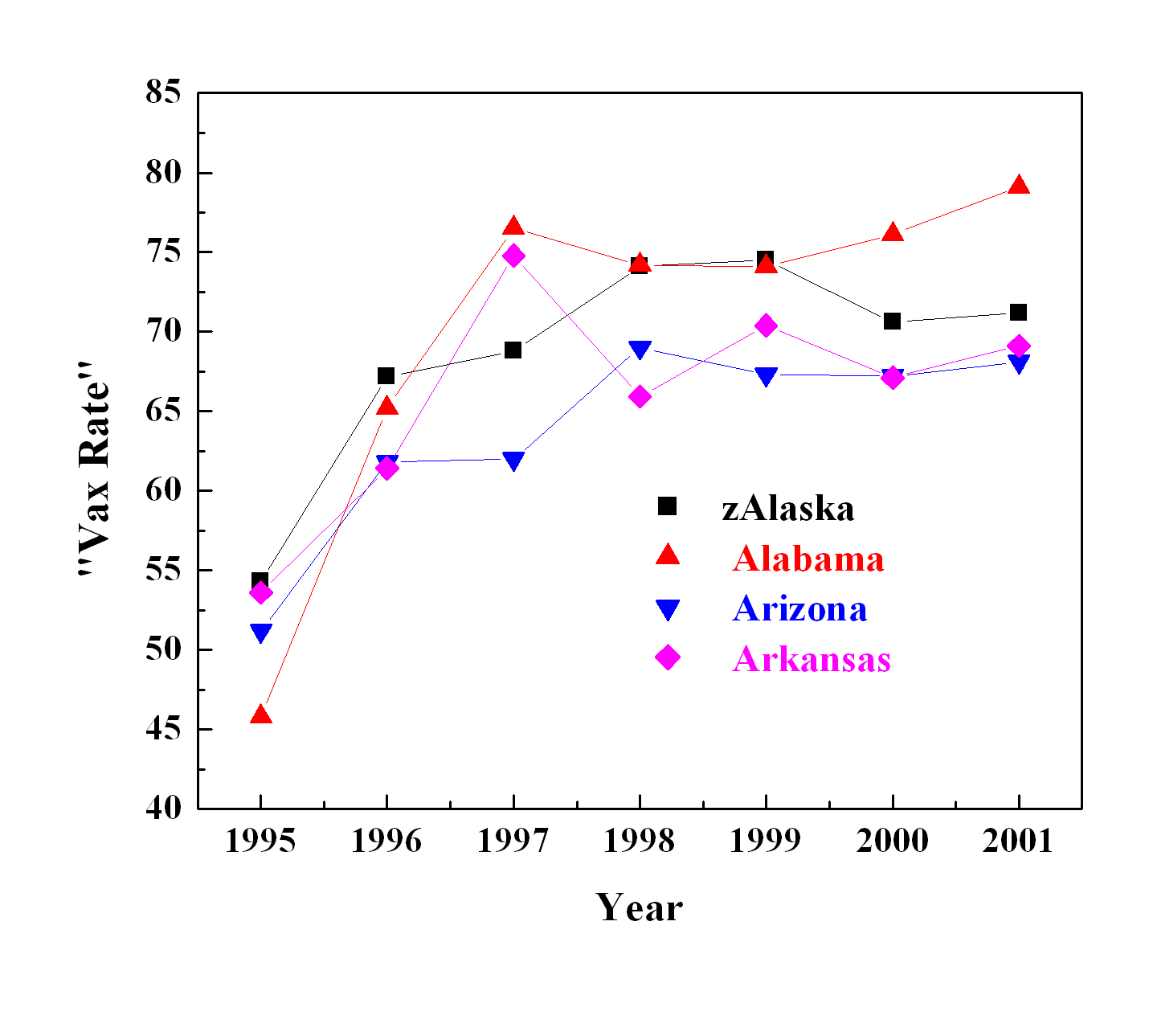
I took a look at the first 4 states in the table (listed alphabetically): Alabama, Alaska, Arizona and Arkansas. If anyone has a particular interest in any given state, I’ll graph them up (or you can do it yourself).

Here is the “vaccination rate” as a function of study year:

As Prometheus has noted, this rate shows the biggest change in the first two years. Given the result of the study, we should see the biggest changes in “autism rate” in these two years. But we don’t. I took the data for the “vaccine rates” as a function of time and applied the 1.7% increase in “autism” prevalence the author states as a result. Let’s look at these states and what the model predicts and what the actual data showed (click any graph to make bigger):

Alaska:

Alabama:

Arizona:

Arkansas:

The data not follow the predicted trends. Not even close. Not only that, but for two states, the predicted values are higher than the reported values (red curves higher than black) while for the other two states the opposite is seen.

This isn’t a case of “I don’t know how the analysis came to the conclusion but I don’t think it is right” type of paper. This is a case of “how did this get past an editor and referee” type of paper. It is just that clearly wrong.

Underimmunization in Ohio’s Amish: Parental Fears Are a Greater Obstacle Than Access to Care

29 Jun

With apologies for opening the subject of the Amish and autism once again, a recent paper in the journal Pediatrics explores vaccination and the Amish: Underimmunization in Ohio’s Amish: Parental Fears Are a Greater Obstacle Than Access to Care. Seth Mnookin has already discussed this at The Panic Virus at PLoS blogs in Anecdotal Amish-don’t-vaccinate claims disproved by fact-based study.

What is worrisome here is the fact that the nderimmunization amongst the Amish is resulting from parental fears. In a very different study from 2001, Haemophilus influenzae Type b Disease Among Amish Children in Pennsylvania: Reasons for Persistent Disease, most Amish parents who chose to not vaccinate were citing availability and convenience rather than fear as the reason.

To repeat–in 10 years the reasons for non-vaccinating amongst the Amish have changed from convenience to fear. We can’t say exactly why, but it seems quite plausible that the focus on autism, vaccines and the Amish could have played a role.

Given that the “Amish Anomaly” notion seems destined to linger on, I have written up another summary of the history and the facts of the story.

Dan Olmsted, now the owner of the Age of Autism, was once an editor for UPI. It was during his UPI time that he took on the autism/vaccine question that has since dominated his professional life. Back in 2005 he ran a series of stories which investigated the proposed link between autism and vaccines and, in specific, mercury. It was right around the time that the David Kirby/Lyn Redwood book “Evidence of Harm, Mercury in Vaccines and the Autism Epidemic: A Medical Controversy.” was published. This was likely the high water mark for the public’s acceptance of the vaccines-causation idea.

One of the ideas that Mr. Olmsted explored was that of the Amish. He started with the belief that they don’t vaccinate and set out to investigate whether this correlated with a lower autism prevalence. The idea of the Amish being a largely unvaccinated population was set out years earlier. David Kirby describes in Evidence of Harm how Lyn Redwood of SafeMinds discussed this in a presentation she made to congress in the year 2000.

Mr. Olmsted described his investigation starting in a piece, The Age of Autism: Mercury and the Amish . There was plenty of data even then which Mr. Olmsted could have considered which went against his hypothesis. Since then even more data has mounted against the idea.

And, yet, it persists. Often the “Amish don’t vaccinate and they don’t have autism” story pops up in internet discussions following news stories. Books have incorporated the idea. Of course it ends up in alternative medicine books on autism such as Kenneth Bock’s “Healing the New Childhood Epidemics: Autism, ADHD, Asthma, and Allergies”. The idea can be found in other boos as well, including “Timeless Secrets of Health and Rejuvenation” (2007) and “Cry for Health: Health: the Casualty of Modern Times” (2010). Again, this is a reason to revisit the debunking of this myth. The myth lives on, even in the face of facts.

In his 2005 UPI article, Mr. Olmsted started out with the assumption that the Amish don’t vaccinate. He set out to see if he could find autistics amongst the Amish, but didn’t look into the vaccination question with any depth:

So I turned to the 22,000 Amish in Lancaster County, Pa. I didn’t expect to find many, if any, vaccinated Amish: they have a religious exemption from the otherwise mandatory U.S. vaccination schedule.

As is well known now, the Amish do not have a religious exemption from the vaccine schedule. They do not have a religious prohibition against vaccination.

This was something Mr. Olmsted could easily have confirmed at the time. He might have checked the 1993 book Amish Society by John Andrew Hostetler (1993), in which he would have found the following statements about medicine:

“Some are more reluctant than others to accept immunization, but it is rare that an Amish person will cite a biblical text to object to a demonstrated medical need…” ….””If the Amish are slow to accept preventive measures, it doesn’t mean they religiously opposed to them…”

He might have made more than a cursory effort to contact people at the Clinic for Special Children in Strasburg, Pennsylvania. The Clinic, aside from serving special needs children (including autistics) runs vaccine clinics and has for some many years. In a piece explaining Mr. Olmsted’s failures, Mark Blaxill (also of the Age of Autism) explained that the Clinic did not return Mr. Olmsted’s phone call. No mention is given why Mr. Olmsted didn’t go to the clinic in his visits to Lancaster County

Had Mr. Olmsted done so, he would have known that this statement, again from his 2005 piece, was incorrect when he relied on a source who claimed a very low immunization rate:

That mother said a minority of younger Amish have begun getting their children vaccinated, though a local doctor who has treated thousands of Amish said the rate is still less than 1 percent.

He also made a misleading statement:

When German measles broke out among Amish in Pennsylvania in 1991, the CDC reported that just one of 51 pregnant women they studied had ever been vaccinated against it.

What is left vague in this statement was the fact that the 51 pregnant women were those who contracted German measles. Not surprising that those infected were largely unvaccinated. This doesn’t tell us what fraction of the whole population were vaccinated though, and is quite misleading.

One might wonder why Mr. Olmsted was not aware that the Amish participated in the eradication of Polio. Conversely, he might have questioned how polio was eradicated if the Amish did not vaccinate. Here is a March of Dimes photo from a 1959 vaccine clinic:


(from March of Dimes By David W. Rose, 2003)

An article available to Mr. Olmsted at the time of his 2005 article, Haemophilus influenzae Type b Disease Among Amish Children in Pennsylvania: Reasons for Persistent Disease, discussed the reasons why Amish parents did not vaccinate their children. While some did cite “religious or philosophical objections”, the majority said they would vaccinate if “vaccination were offered locally”:

Among Amish parents who did not vaccinate their children, only 25% (13 of 51) identified either religious or philosophical objections as a factor; 51% (26 of 51) reported that vaccinating was not a priority compared with other activities of daily life. Seventy-three percent (36 of 49) would vaccinate their children if vaccination were offered locally.

Since Mr. Olmsted’s original series, more data has come in refuting the “Amish Anomaly”. In 2006, a paper was published: Vaccination usage among an old-order Amish community in Illinois. Here is the abstract:

The Old-Order Amish have low rates of vaccination and are at increased risk for vaccine-preventable diseases. A written survey was mailed to all Amish households in the largest Amish community in Illinois inquiring about their vaccination status and that of their children. In this survey, the Amish do not universally reject vaccines, adequate vaccination coverage in Amish communities can be achieved, and Amish objections to vaccines might not be for religious reasons.

It is clear that the Amish do vaccinate and that it would have been simple for Mr. Olmsted to find accurate information about this at the time. It was certainly more difficult for Mr. Olmsted to ascertain what the prevalence of autism might be amongst the Amish. He made the assertion: ““there are only a few of them [autistic Amish] in the United States”.

Of the “few” Amish autistics Mr. Olmsted could find, six were being treated by Lawrence Leichtman. The children were unvaccinated but the doctor who reported them to Mr. Olmsted attributed their autism to high mercury levels. This is not surprising as Dr. Leichtman was one of the early alt-med practitioners working in autism, being part of the secretin fad of the 1990’s. One wonders if the “elevated mercury” levels in these children would stand up to tests performed by qualified medical toxicologists.

Another six autistic Amish, nearly under Mr. Olmsted’s nose at the time of his article, were being treated by the Clinic for Special Children in Lancaster, PA. Six children who had PDD or Autism were at that time being treated and written up for a study in the New England Journal of Medicine. They were missed by Mr. Olmsted. He has since argued that these children are syndromic and, thus, somehow not as relevant to his story. Those arguments aside, this was a clear miss for Mr. Olmsted.

In 2010, a study was presented at IMFAR: Prevalence Rates of Autism Spectrum Disorders Among the Old Order Amish

Preliminary data have identified the presence of ASD in the Amish community at a rate of approximately 1 in 271 children using standard ASD screening and diagnostic tools although some modifications may be in order. Further studies are underway to address the cultural norms and customs that may be playing a role in the reporting style of caregivers, as observed by the ADI. Accurate determination of the ASD phenotype in the Amish is a first step in the design of genetic studies of ASD in this population.

A preliminary number of 1 in 271 is a far cry from “little” or no autism amongst the Amish. Given the limitations of working within a community like the Amish, it is surprisingly close to the 1 in 100 often cited as the autism prevalence estimate for the general U.S. population. The study was being prepared for submission when I checked with the lead author last fall. It will be interesting to see what the final number is obtained for the prevalence.

The IMFAR abstract was available, I believe, before Dan Olmsted’s book, The Age of Autism, went to press. Instead of including this information, he chose to paint autism as rare amongst the Amish using quotes he obtained in 2005 and unsupported statements like, “the most aggressive possible count of autistic Amish comes to fewer than 20 cases, which would give us a rate of no more than 1 in 10,000.” It seems unlikely, given the low sales figures, that The Age of Autism will be reprinted. If that should happen, I wonder if Mr. Olmsted will correct this misinformation. The facts are clearly against him. Certainly, his review of internet sources and cursory tour of Lancaster County hardly counts as “aggressive”.

The “Amish don’t vaccinate and don’t have autism” idea was never very well supported. Now, with more data in, it is just plain wrong. It would be a good and honorable thing for Mr. Olmsted himself to make this clear. Good. Honorable. And not going to happen.

Mark Geier: My therapy is unconventional, but it works

17 Jun

Dr. Mark Geier is appealing the suspension of his medical license. The license suspension order includes (as summarized by Kathleen Seidel at Neurodiversity.com):

• In six out of nine of these cases, the board determined that the children were misdiagnosed with precocious puberty. Children were diagnosed with precocious puberty without the benefit of a physical examination; some were too old to qualify for the diagnosis.

• Medical records and medical necessity letters prepared by Dr. and Mr. Geier indicated that children were diagnosed not only with precocious puberty, but also with pituitary dysfunction, insomnia, aggression, mitochondrial disorder, metabolic dysfunction, and “heavy metal toxicity” when neither test results nor parent reports suggested anything of the sort.

• In one case, the only record of the diagnosis of precocious puberty was a code number entered onto a standing order for lab tests. In another, no note was made in the medical records of the date the child began treatment with Lupron. Yet another patient’s file contained no indication that Dr. Geier reviewed any of the results of the numerous, burdensome diagnostic tests he had ordered.

• The order describes claims submitted to at least one insurance company for a psychiatric interview and “prolonged evaluation and management” services that were never rendered.

• The order further describes an occasion when David Geier, who is not licensed to practice medicine, conducted a medical evaluation and diagnostic tests, made diagnoses, and recommended treatments for an autistic boy in Dr. Geier’s absence.

• Additionally, the Board determined that Dr. Geier misrepresented his qualifications as a geneticist, and misrepresented the ability of his Institutional Review Board to conduct oversight of his research.

Dr. Geier has taken his case to the public in an opinion piece in the Baltimore Sun: Autism doctor: My therapy is unconventional, but it works. He certainly has the right to present his case to the Sun, and while I would not have published the letter were I editor, the Sun is within its rights to host the letter. I am within my rights to comment on the letter, and I took that opportunity in the comments as you will see (complete with typos) if you follow the link.

Dr. Geeir opens with a simple statment “If there’s a single statement that everyone who works in the field of autism can agree on, it’s that there is so much that we still don’t know.” This is incomplete: there is much we do know. We know that the theories Dr. Geier has proposed are wrong. We know that the rise in autism is not due to mercury. Certain tests should be performed before a child is diagnosed with precocious puberty. Tests which the charges indicate Dr. Geier failed to do on many occasions. We know that treatment for precocious puberty should stop at an age when puberty is expected. Dr. Geier is charged with initiating and/or continuing treatment in children too old to be diagnosed with precocious puberty.

Dr. Geier has published many papers in the literature, this is true. These papers have been widely criticized by researchers. Not because the ideas are unconventional, but because the ideas are ill founded and the experimental methods are poor. Dr. Geier has been described as “intellectually dishonest” for his work as an expert witness. The Institute of Medicine has referred to Dr. Geier’s papers as suffering from “serious methodological flaws and their analytic methods were nontransparent, making their results uninterpretable”

There is much we do not know. On thing we do know: we deserve better than Mark Geier

Perhaps it is the frustration of having read the recent article by the Geiers in the new “autism science digest”. Perhaps it is the fact that I listened to a podcast interview with the Geiers in preparing my recent response to the article. Perhaps it is just the years of reading bad science and waiting for someone to act against these people, but my patience is worn rather thin, as you will see in the comments.

AutismOne throws their support behind the Geiers in “Autism Science Digest”

16 Jun

When news came out about the legal troubles Mark and David Geier are facing, there was some hope expressed that maybe, just maybe, some of the groups that have supported the father/son team would take the chance to distance themselves. The Generation Rescue/Autism One conference was at that time still in the future, and the Geiers were scheduled to speak. Dr. Mark Geier had his license suspended for the “therapy” he was planning to tout at AutismOne, and that David Geier was facing the charge of practicing medicine without a license.

As we have seen, the optimism was ill founded. The Geiers presented their talk at AutismOne. And, as it turns out, AutismOne had already in-press their new magazine, the “Autism Science Digest”, which included an article by the Geiers. Someone forwarded it to me and it is frankly painful to read.

It is a nice glossy advertisement for the Geiers and their testosterone/autism theory. I don’t throw that out lightly. It is pseudo-science generated to promote an idea. and idea which really doesn’t stand up to real science.

For example, they present the article like a science study, complete with references. It makes it seem as though what they say is backed up by legitimate science. But citations do not make a study. Especially when they are misused.

It is difficult to describe the Geier hypothesis. This is for two reasons. First, it is hard to accept that they actually believe their own work, it is so bad. Second, it has morphed dramatically over the few years of its existence.

Let me explain. When they first proposed their idea that testosterone was somehow important, they claimed that testosterone was binding mercury in the brain, rendering it difficult to remove through chelation. If you listen to Lisa Sykes talk about the Geiers (the Rev. Sykes being a major spokesperson for the Geiers over the years), she tells how David Geier told her, “We figured something new out…..we think we can get rid of the mercury by lowering the testosterone”.

By the way, the Rev. Sykes mentions that she tested her child for testosterone. The range was 0 to 25 and her kid was “at the top of the range”. Not above it. At the top. As in, high but within normal.

If you listen to the Geiers speak now (and, again, I find this painful to do), they are still pushing the idea that mercury is the main causation factor in autism. But, here’s the shift with Lupron, they are downplaying the idea that is part of a chelation protocol. It’s all about reducing testosterone.

Is anyone surprised that if you change the testosterone levels in a person you will see changes in behavior? Does this have anything to do with autism? Does it have anything to do with mercury?

The Geier article relies heavily on the work of Dr. Simon Baron-Cohen’s group. They cite Dr. Baron-Cohen’s group 5 times in their article. It makes the article look legitimate. The first paragraph states, “In fact, ASD’s have even been described as the result of an “extreme male brain” by psychologist Dr. Simon Baron-Cohen”.

At this point, it is worth recalling what Dr. Baron-Cohen had to say about the work the Geiers are doing:

Simon Baron-Cohen, a professor of developmental psychopathology at the University of Cambridge in England and director of the Autism Research Center in Cambridge, said it is irresponsible to treat autistic children with Lupron.

“The idea of using it with vulnerable children with autism, who do not have a life-threatening disease and pose no danger to anyone, without a careful trial to determine the unwanted side effects or indeed any benefits, fills me with horror,” he said.

Some how “fills me with horror” was not included in the Geier article.

Dr. Baron-Cohen’s theories include the idea that fetal testosterone levels affect the development of the brain. This is a prenatal process. The Geier notion is that autistics have high testosterone levels (even though they have documented cases of children they treated who do not have high levels). It is intellectually (and otherwise) very dishonest to claim that the work of Dr. Baron-Cohen in any way supports the Geier’s application of the drug Lupron to autistic children.

It isn’t just Dr. Baron-Cohen’s work that is misused to sell this therapy. The Geier’s write, “”Also, some investigators have found that leuprolide acetate administration resulted in improvements in cognition” ( Bryan et al. , 2010)”

Here is the abstract for Bryan, et al.:

Down-regulation of serum gonadotropins is as effective as estrogen replacement at improving menopause-associated cognitive deficits.
Bryan KJ, Mudd JC, Richardson SL, Chang J, Lee HG, Zhu X, Smith MA, Casadesus G.
Source

Department of Neurosciences, Case Western Reserve University, Cleveland, Ohio, USA.
Abstract

Declining levels of estrogen in women result in increases in gonadotropins such as luteinizing hormone (LH) through loss of feedback inhibition. LH, like estrogen, is modulated by hormone replacement therapy. However, the role of post-menopausal gonadotropin increases on cognition has not been evaluated. Here, we demonstrate that the down-regulation of ovariectomy-driven LH elevations using the gonadotropin releasing hormone super-analogue, leuprolide acetate, improves cognitive function in the Morris water maze and Y-maze tests in the absence of E2. Furthermore, our data suggest that these effects are independent of the modulation of estrogen receptors alpha and beta, or activation of CYP19 and StAR, associated with the production of endogenous E2. Importantly, pathways associated with improved cognition such as CaMKII and GluR1-Ser831 are up-regulated by leuprolide treatment but not by chronic long-term E2 replacement suggesting independent cognition-modulating properties. Our findings suggest that down-regulation of gonadotropins is as effective as E2 in modulating cognition but likely acts through different molecular mechanisms. These findings provide a potential novel protective strategy to treat menopause/age-related cognitive decline and/or prevent the development of AD.

The short version: the authors removed the ovaries from mice, putting them into a menopause state. They found that these mice decline cognitively, but that they can treat this with a leuprolide acetate (a drug similar to lupron).

Yes, somehow the animal model for autism to the Geiers are post-menopausal mice.

This study has nothing to do with improving cognition in children, or autistic children in particular. Don’t take my word for it. I contacted one of the researchers who wrote the paper:

Well… The principle of gonadotropins working on cognition in menopausal women or patients with AD has nothing to do with autism nor with improving cognition via the depletion of gonadal steroids such as testosterone or estrogen. For example, we know that when women that are in reproductive age (and men to a lesser extend) are given leuprolide their cognition is impaired, indicating that gonadal steroids are important for cognition. However, we have shown that after menopause, gonadal steroids can be by-passed by downregulating gonadotropins to improve cognition.

If you want the message in a single sentence:

The beneficial effects of leuprolide on cognition in ovariectomized (menopausal) female mice has nothing to do with the treatment of autism in children.

Another study the Geiers cite: “Increased marble-burying behavior in ethanol-withdrawal state: Modulation by gonadotropin-releasing hormone agonist”

No, I am not kidding. It is a study about alcoholic mice burying marbles. Here’s the abstract:

A characteristic behavior in alcohol abstinence state indicates the possibility of obsessive–compulsive behavior in alcoholics. Ethanol is known to reduce hypothalamic synthesis, release, and mRNA expression of gonadotropin-releasing hormone (GnRH) that modulates serotonergic, dopaminergic, and glutamatergic systems, which experience adaptive changes on chronic exposure to ethanol. Such changes are also evident in obsessive–compulsive disorder. Therefore, it was proposed to investigate the effect of ethanol-withdrawal on marble-burying behavior in mice, particularly because it simulates some aspects of obsessive–compulsive behavior; further, the influence of GnRH agonist was studied on the same. Ethanol-withdrawal state was induced after its chronic administration, and marble-burying behavior was observed at 0, 6, 24, 48, and 96 h interval. Further, the influence of leuprolide—a GnRH agonist (50–600 ?g/kg, s.c.) or fluoxetine (5–30 mg/kg, i.p.) was investigated on ethanol-withdrawal-induced changes in marble-burying behavior. The results indicated that ethanol-withdrawal led to a gradual increase in marble-burying behavior upto 48 h with peak at 24 h interval. Administration of leuprolide (100–600 ?g/kg, s.c.), 30 min prior to 24 h interval, dose dependently reduced ethanol-withdrawal-induced increase in marble-burying behavior, and this effect was comparable to that of fluoxetine (15 and 30 mg/kg, i.p.). Further, twice daily administration of leuprolide (50 ?g/kg, s.c), concomitant with ethanol, prevented the gradual increase in marble-burying behavior after ethanol-withdrawal and this effect was comparable to fluoxetine (5 mg/kg, i.p.). In conclusion, ethanol-withdrawal on chronic administration increases marble-burying behavior in mice; its development and expression is attenuated by leuprolide.

The researchers gave mice alcohol over a long period. When they made the mice stop, cold turkey, they exhibited behaviors such as burying marbles. While the mice are going through the first stages of withdrawl, the researchers gave them a lupron like drug and found that the mice didn’t bury marbles as much.

Once again, who finds this to be a valid animal model for autism? Is your child an alcoholic, marble-burying mouse?

But you don’t see this if you just read the article. What you read is, “similarly, other investigators have used an anti-androgen medication called leuprolide acetate, which reduces the production of male hormones, in the treatment of anxiety, hyperexcitability, depression, impaired social interaction, and obsessive compulsive behaviors in laboratory animal species”.

The Geiers have obviously felt the need to respond to the criticism that they are using a drug used for chemical castration. They write

Finally, the administration of anti-androgen medications to individuals diagnosed with an ASD is not intended to deprive the individual of their sexuality nor to alter their normal developmental trajectory, but rather to regularize a process that was proceeding in an abnormal fashion and producing adverse effects and, thereby, improve the health of the patient and reduce the clinical symptoms associated with abnormally elevated androgen levels.

Here is an example patient from the patent application the Geiers submitted (US20070254314A1: Methods of treating autism and autism spectrum disorders):

Laboratory analyses did not reveal elevated levels of mercury or elevated levels of at least one androgen. Specifically, undetectable levels of mercury were present in Child D’s urine and minimal levels of mercury were in Child D’s blood (1.5 ?g/L, reference range=0.0-14.9 ?g/L). Additionally, analyses of Child D’s blood androgen metabolites revealed a serum testosterone=153 ng/dL (age- and sex-adjusted LabCorp reference range=0-350 ng/dL) and serum/plasma DHEA=291 ng/dL (age- and sex-adjusted LabCorp reference range=183-383 ng/dL) within their respective reference ranges.
After extensive discussions with his parents concerning the risks, benefits, and alternative treatments available, a decision was made to place Child D on a course of LUPRON® therapy.

Yes, Child D has testosterone well within the normal level. And, yet, the child was treated with Lupron. How, exactly, does this fit with improving “…the health of the patient and reduce the clinical symptoms associated with abnormally elevated androgen levels”?

Also, in the Autism Science Digest article itself, the authors note:

The child underwent antiandrogen therapy until the age of 13, when he entered puberty at an age typical of his sibling

Age 13 is within the normal range to start puberty. So is 9. Why did they delay this child 4 years? As of age 9, the child was not in central precocious puberty.

The Geiers make this comment in their recent article:

Two months prior to his 9th birthday, he was given a test dose of leuprolide acetate. After administration, he went outside and began to swing on a tire swing using his feet to push – a neurotypical behavior never seen before.

Dramatic, isn’t it? First shot, and the kid goes outside and uses the swing for the first time. This caught my eye, because they mention swinging in their patent. In the patent they note, “Within a few days of the second shot of LUPRON DEPOT®, Child X learned to swing by himself using leg timing for propulsion”

I’m betting that this is the same kid. If so, did the kid get his first shot and go outside and start swinging, or did he go a few days after his second shot?

One issue the Geiers (and others) have faced is inflation of credentials. David Geier, for example, listed himself as a “diagnostician” to get on the Maryland Autism Commission. The Autism Science Digest article is no different. Mr. Geier gives as his credentials that he “Has been a research scientist at the National Institutes of Health in the laboratory of Biochemical Genetics.”

Take a moment, if you will, and think what that statement means to you, ” research scientist at the National Institutes of Health in the laboratory of Biochemical Genetics”. I ask you to do this before we see what his job really was.

We can read Mr. Geier’s resume here, which lists his experience including:

I. T. R. A. Summer Fellow Appointment at The National Institutes of Mental Health (under Laboratory Chief [Redacted] of The Laboratory of Biochemical Genetics)
Projects:
(1) Protein Gel and Phage Research

That was in the summer of 1998. That’s the summer before he entered college, if I read the rest of his resume correctly. At this point I have to do something I rarely do, point out my own credentials. I’ve been a summer intern. I’ve been a research scientist. I’ve been a research scientist supervising summer interns. While I find the work of my summer interns has been valuable and of high quality, they weren’t “research scientists” in the way that is clearly implied in the article. Sure, it would have taken more space to write, “He was an intern the summer of his freshman year at the NIH”, but it would have made his position much more clear.

Dr. Mark Geier lists as part of his credentials, “His extensive research has resulted in him being invited to address the Institute of Medicine at the U.S. National Academy of Sciences on six occasions.” I find it remarkable that he uses this to build credibility, given the fact that the IOM clearly was not impressed by his work.

Let’s look at what the Institutes of Medicine had to say about the Geiers’ research:

The first was an ecological study (Geier and Geier, 2004a) that reported a potential positive correlation between the number of doses of measles-containing vaccine and the cases of autism reported to the special education system in the 1980s. The second was a study of passive reporting data by the same authors (Geier and Geier, 2003c) that reported a positive correlation between autism reports in the Vaccine Adverse Events Reporting System (VAERS) and estimated administered doses of MMR. However, these two studies are characterized by serious methodological flaws and their analytic methods were nontransparent, making their results uninterpretable, and therefore noncontributory with respect to causality (see text for full discussion).

It isn’t news that the Geiers are poor scientists. It isn’t news that the Geiers have been called out for their ethical lapses multiple times over the years. It is fairly recent news that the Geiers have actually faced charges. And, yet, AutismOne and Generation Rescue continue to support this team by inviting them to speak at conferences and giving them space in their magazines to promote the same bad medicine that has cost Dr. Geier his license.

Dr. Geier has lost his license to practice medicine. To which I can only say, what took so long? What do they have to do to lose the support of the alternative medical community?

Autism and vaccines, 911 truths and fluoridation

9 Jun

Yes, I’m ramping down on discussing Andrew Wakefield. Let this stand as an example why. He’s joined in with 911 truthers and anti-fluoridation advocates in a series of talks in Ireland. The talk is billed as “The Master Plan” and “The Hidden Agenda for Global Scientific Dictatorship”.

If Andrew Wakefield feels like he has any credibility left, why is he lending it to these groups?

For more information, check Seth Mnookin’s post. He’s pulled in some of the 911 truthers who want to discuss their points. I see parallels between the truthers on the net and the vaccine “skeptics” in how they respond.