There have been a few papers in the recent past on oxytocin and autism. Oxytocin is a hormone and is considered to have a rule in social cognition. Fragile-X is a syndrome which results in autism or autistic-like symptoms. As such, it isn’t surprising that someone has looked into oxytocin and Fragile-X.
This study comes out of Stanford University. Effects of intranasal oxytocin on social anxiety in males with fragile X syndrome. It is very small with only 10 subjects starting the study (only 8 completed the study). Eye contact is tracked. This is not what I would consider a great parameter to track, but it is measurable. In addition, heart rate and salivary cortisol were monitored. These are measures of excitability/anxiety. They found no effect on heart rate and some other measures. Cortisol levels went down and eye contact went up.
Again, it is small study so it is difficult to
Here is the abstract:
Fragile X syndrome (FXS) is a rare inherited genetic disorder causing severe intellectual disability and autistic-like symptoms. Individuals with FXS, males in particular, often exhibit extreme eye gaze avoidance and hyperarousal when they encounter stressful social situations. We investigated whether oxytocin (OT), a hormone with prosocial and anxiolytic effects, could alleviate symptoms of social anxiety in this population. A randomized double-blind placebo-controlled single-dose trial was performed with intranasal administration of placebo, 24IU OT and 48IU OT. Measures of eye gaze frequency, heart rate, respiratory sinus arrhythmia (RSA), heart rate variability (HRV) and salivary cortisol were obtained during a structured social challenge conducted 50min following OT administration. Ten low-functioning males with FXS (aged 13-28 years) traveled to Stanford for the initial visit: 8 completed the study. Eye gaze frequency improved significantly in response to the 24IU OT dose and salivary cortisol levels decreased significantly in response to the 48IU OT dose. There was no effect of OT on heart rate, RSA or HRV although individual plots of the heart rate data suggested that OT increased heart rate in some participants and decreased heart rate in others. These findings suggest that intranasal administration of OT may ameliorate some symptoms of social anxiety in patients with FXS. Further double-blind placebo-controlled studies of OT, conducted in combination with behavioral treatment programs, may be warranted
I want to like Autism Speaks. I really do. I know some very good people working with Autism Speaks. From a very practical standpoint, they are one of the biggest autism organizations and I need them to be doing good.
Unfortunately, sometimes Autism Speaks does things which I really find difficult to support. Recently, I pointed out that Autism Speaks is sponsoring a conference by the National Autism Association. This conference will be hosting Andrew Wakefield to speak. In my view, Mr. Wakefield is a person whose damage to the autism communities can not (and should not) be minimized. Even though Autism Speaks isn’t directly hosting Mr. Wakefield, I feel that it would be good and appropriate to withhold sponsorship of such an event.
During the discussion of that article I decided to search for how Autism Speaks discusses Mr. Wakefield on their website. The Autism Speaks website is a resource for many families looking for information. I found that Autism Speaks has a book list in their Resource Library (Family Services » Resource Library » Books) and this list includes “Callous Disregard: Autism and Vaccines – The Truth Behind a Tragedy”, Mr. Wakefield’s account of the events surrounding the loss of his medical license.
Frankly, I find this a poor resource for autistics, families, well anyone looking for accurate and useful information. Shannon Rosa did what I should have done and contacted Autism Speaks for comment and reported the response the comments here.
Kim, you are awesome. And I agree, working towards real change is hard; it requires a lot of processing power, a lot of reflection, a lot of synthesis, a lot of perseverance—and an eye on long-term as well as short-term goals.
Re: listing Callous Disregard, Autism Speaks pointed me to their resources section’s legal disclaimer:
“Autism Speaks maintains the Family Services Resource Guide as a service to families as a reference tool. Every effort is made to ensure listings are up-to-date. Autism Speaks does not endorse or claim to have personal knowledge of the abilities of those listed. The resources listed on this page are not intended as a recommendation, referral, or endorsement of any resource or as a tool for verifying the credentials, qualifications, or abilities of any organization, product or professional. Users are urged to use independent judgment and request references when considering any resource associated with diagnosis or treatment of autism, or the provision of services related to autism.”
But I still think including Callous Disregard reflects badly upon them, and have said so. The conversation continues.
Since that time two small changes have occurred to that page. First, a disclaimer was added (it wasn’t there before, as the Google cache version confirms). The disclaimer:
Autism Speaks does not provide medical or legal advice or services. Rather, Autism Speaks provides general information about autism as a service to the community. The information provided on this website is not a recommendation, referral, or endorsement of any resource, therapeutic method, or service provider and does not replace the advice of medical, legal, or educational professionals. Autism Speaks has not validated and is not responsible for any information or services provided by third parties. You are urged to use independent judgment and request references when considering any resource associated with the provision of services related to autism.
I agree…to a point. Autism Speaks can’t be responsible for everything said in every resource. However, Mr. Wakefield was found guilty of dishonesty and unethical behavior in his research activities involving autistics. Even if one believes Mr. Wakefield’s account (which is clearly contradicted by the facts), it doesn’t give any real information of value to, say, a family with a new diagnosis. Autism Speaks can and does make a distinction of what books to host. You won’t find “The Empty Fortress” by Bruno Bettleheim on the list (surprisingly enough, it is still in print).
The second change to the Autism Speaks books resource page? The link has been removed to “Callous Disregard”. The book is still listed, but there is no link to the publisher’s site any longer.
The vaccine-autism notion has caused a great deal of harm to the autism communities. So much time and money has been thrown at researching the supposed epidemic of vaccine-induced autism. Much more to the point for an organization like Autism Speaks: this idea has caused a great deal of harm to families, a great deal of pain and, most importantly, a great deal of unwarranted and sometimes dangerous medicine to be practiced on autistics. This is why I would go further than to question why Autism Speaks lists a book by someone proven dishonest and unethical. I would ask why continue to give support to ideas whose time has clearly passed.
For example:
Evidence of Harm: Mercury in Vaccines and the Autism Epidemic: A Medical Controversy
by David Kirby
David Kirby’s book was speculative at best when written. It is now very clearly false. Thimerosal did not cause an autism epidemic. And why list this under the subheading “Medical, Biomedical, Diet Interventions”? Mr. Kirby isn’t anything close to a medical professional and the book is more of a speculative thiller involving conspiracies which didn’t occur to cover up a mercury-induced epidemic that didn’t happen. Here’s the blurb for Evidence of harm:
Evidence of Harm explores the heated controversy over what many parents, physicians, public officials, and educators have called an “epidemic” of afflicted children. Following several families, David Kirby traces their struggle to understand how and why their once-healthy kids rapidly descended into silence or disturbed behavior, often accompanied by severe physical illness. Alarmed by the levels of mercury in the vaccine schedule, these families sought answers from their doctors, from science, from pharmaceutical companies that manufacture vaccines, and finally from the Center for Disease Control and the Food and Drug Administration-to no avail. But as they dug deeper, the families also found powerful allies in Congress and in the small community of physicians and researchers who believe that the rise of autism and other disorders is linked to toxic levels of mercury that accumulate in the systems of some children.
An important and troubling book, Evidence of Harm reveals both the public and unsung obstacles faced by desperate families who have been opposed by the combined power of the federal government, health agencies, and pharmaceutical giants. From closed meetings of the FDA, CDC, and drug companies, to the mysterious rider inserted into the 2002 Homeland Security Bill that would bar thimerosal litigation, to open hearings held by Congress, this book shows a medical establishment determined to deny “evidence of harm” that might be connected with thimerosal and mercury in vaccines. In the end, as research is beginning to demonstrate, the questions raised by these families have significant implications for all children, and for those entrusted to oversee our national health.
Other books of a questionable nature:
What Your Doctor May Not Tell You About(TM) Children’s Vaccinations
by Stephanie Cave
This is a book which links vaccines to autism using, for example, the incorrect comparison of mercury poisoning symptoms to autism, and gives the Wakefield (called “One of the most prominent researchers in MMR vaccine research) hypothesis for MMR causing autism.
Another example from the Autism Speaks book list:
The Age of Autism: Mercury, Medicine, and a Man-Made Epidemic
by Dan Olmsted, Mark Blaxill
This is another in the series of books making the link between autism and mercury. On the one hand, it is nice for Autism Speaks to host a link to a book by people who are such harsh critics of Autism Speaks. But, why be polite when the book is a failed hypothesis wrapped in a bad understanding of science?
Another book:
Vaccine Epidemic: How Corporate Greed, Biased Science, and Coercive Government Threaten Our Human Rights, Our Health, and Our Children
edited by Louise Kuo Habakus, MA, and Mary Holland, JD
Amongst other topics discussed, this book includes a chapter which is basically a summary of “Callous Disregard”. I know this is getting repetitive, but Autism Speaks could do families a service by steering them away from this.
The book list is long. No one will agree with all the books listed as being accurate and valuable. I have no problem with that. I do feel that some level of screening is being done and more should be done. A new family deserves better than to waste their time, money and emotions on the failed ideologies of the past decade. They are, after all, trying to perform a service with this book list. I am only asking that they follow through on the spirit of this. Perform a service. Pointing them at sources of misinformation is no service. Disclaimers don’t change that.
I am both encouraged and saddened by this recent paper. Encouraged that someone is taking up the topic of aging and autism. Saddened because there is very little work out there so far. The paper is from the MRC Social, Genetic and Developmental Psychiatry Centre, Institute of Psychiatry, King’s College London, London, UK.
This article addresses an important and barely researched topic: what happens to children with autism spectrum disorders when they grow old. We review the small published literature on aging in autism. We then consider the relevance of research on ‘neurotypical’ aging in core domains of autistic impairment: social cognition, executive function, cognitive style and memory. Research themes from the study of normal aging, including cognitive reserve, compensation, quality of life, loneliness and physical health are of relevance for future research on autism. Studies of aging in autism will be important not only to plan appropriate services, but also to shed light on the full developmental trajectory of this neurodevelopmental condition, and perhaps provide clues to neuropathology and etiology.
“barely researched topic”
I hope that (and lobby for) a change in this. I will not be here to support my child through old age. Even if I were, I could really use some help in understanding what is going on.
The short summary, via Reuters, is: “the big take-home message is that we found only a few cases in which vaccines can cause adverse side effects, and the vast majority of those are short-term and self-limiting.”
As to autism? There are two main theories of autism and vaccines: MMR and Thimerosal. The autism and MMR theory is one of the most studied and most clear. The committee found that the research “Favors Rejection”. As in,
The committee concluded the evidence favors rejection of five vaccine-adverse event relationships. These include MMR vaccine and type 1 diabetes, DTaP vaccine and type 1 diabetes, MMR vaccine and autism, inactivated influenza vaccine and asthma exacerbation or reactive airway disease episodes, and inactivated influenza vaccine and Bell’s palsy. The evidence base for these conclusions consisted of epidemiologic studies reporting no increased risk; this evidence was not countered by mechanistic evidence
The epidemiological evidence says there is no increased risk. There is no good mechanism known or postulated whereby MMR could cause autism.
I expect much criticism to be focused on the IOM from some circles. The arguments will likely focus on “look at all the vaccines which have not been specifically studied in relation to autism”. It is a semi valid point. The problems with the argument are many, but include: what mechanism is there for these vaccines to cause autism? (Too many too soon is a slogan, not a scientific argument). Without a mechanism, and without some sort of data showing a possible link, there is such a low possibility of finding anything that resources are best spent elsewhere. In addition, the studies to date give a reasonable proxy for vaccine exposure: the more thimerosal an infant was exposed to, the more vaccines. Thimerosal exposure becomes a proxy for the number of vaccines. It has been shown (multiple times) that there isn’t an increased risk for autism with thimerosal.
Lastly, if you read the criticisms claiming “but they’ve only studied one vaccine and one ingredient”, watch for the intellectual honesty. That’s the part where the critic admits that “they’ve only studied one vaccine and one ingredient, and they found that those don’t increase the risk of autism“. Most critics in this field are cake-eaters. They want their cake (the argument that the studies have only looked in depth at MMR and thimerosal) and they want to eat it too (by denying the results of those studies). It’s predictable.
I have yet to hear a good explanation why supposedly autism organizations have such a fixation on the HPV vaccine. Seriously, has anyone made the claim that vaccines given to 12 year olds cause autism?
Here’s what ACHAMP has to say about this law:
If a twelve-year old child requests a vaccines for a sexually transmitted disease, what conclusion could a rational person come to other than a sexual crime has either occurred or will occur in the near future, which is exactly the standard required by California law for mandated reporters. How can a physician or nurse give a vaccine for a sexually transmitted disease, or other professionals counsel a child on getting such a vaccine, without the child’s parents’ involvement, and obey the mandated reporter laws? We don’t know either, which is why we consider this bill to the California Pedophile Protection Act of 2011.
The “California Pedophile Protection Act of 2011”?!? Wow, ACHAMP. Besides the fact that the logic is completely off, what’s the need for this language?
An act to amend Section 6926 of the Family Code, relating to minors.
LEGISLATIVE COUNSEL’S DIGEST
AB 499, as introduced, Atkins. Minors: medical care: consent.
Existing law allows minors to consent to specified forms of medical or dental treatment.
This bill would, in addition, allow a minor who is 12 years of age or older to consent to medical care related to the prevention of a sexually transmitted disease.
THE PEOPLE OF THE STATE OF CALIFORNIA DO ENACT AS FOLLOWS:
SECTION 1. Section 6926 of the Family Code is amended to read:
6926. (a) A minor who is 12 years of age or older and who may have come into contact with an infectious, contagious, or communicable disease may consent to medical care related to the diagnosis or treatment of the disease, if the disease or condition is one that is required by law or regulation adopted pursuant to law to be reported to the local health officer, or is a related sexually transmitted disease, as may be determined by the State Director of Health Services Public Health Officer
.
(b) A minor who is 12 years of age or older may consent to medical care related to the prevention of a sexually transmitted disease.
(b)
(c) The minor’s parents or guardian are not liable for payment for medical care provided pursuant to this section.
(a) A minor who is 12 years of age or older and who may have come into contact with an infectious, contagious, or communicable disease may consent to medical care related to the diagnosis or treatment of the disease, if the disease or condition is one that is required by law or regulation adopted pursuant to law to be reported to the local health officer, or is a related sexually transmitted disease, as may be determined by the State Director of Health Services.
(b) The minor’s parents or guardian are not liable for payment for medical care provided pursuant to this section.
Aside from the blatant fear mongering and inflammatory language, ACHAMP is wrong on many counts. California already allows for minors to be treated without parent consent for sexually transmitted diseases, pregnancy, abortion, HIV testing and birth control.
Yes, California minors can seek treatment for STD’s, but if we try to amend the law to allow for prevention, it is a “pedophile protection act”.
I wonder how many members of ACHAMP waited until age 18 before participating in sexual activity with their peers? Or, do they allow former pedophiles (by their own definition) into their ranks? (see how your twisted logic works, ACHAMP?)
I’d like to say I’m surprised by ACHAMP. Unfortunately, I’m not. I do have hopes that someday these groups will abandon the cheap shots, inflammatory language and fear mongering. Heck, I have hope that they might focus the majority of their attention on making a better life for autistics.
This is an article written by EpiRen. Since his blog has gone offline, I am republishing these articles since I find that they contain some good descriptive information. Here is “Epidemiology Night School: Descriptive Epidemiology”:
Let’s say that you have been told by several of your neighbors that they became ill after the neighborhood mixer over at the fire hall the other day. You’ve heard from enough people to make you a little worried that the food at the mixer (some of which you made yourself) may be involved. Descriptive epidemiology helps us form theories about what, if anything, is going on. What is descriptive epidemiology? Simply stated, it’s looking at the location and characteristics of the cases (and non-cases) and letting the evidence guide your decisions.
Let’s discuss descriptive epidemiology and see if something is going on in the neighborhood, all after the jump…
Who? What? When? Where? How? All lead to Why?!
PERSON
When someone calls in an outbreak to the health department where I work, one of the first things we ask for is for a line-list of cases. The line-list is basically a list of people who are sick that includes their name, age, gender, occupation, and other factors of interest. (The traditional first step in an outbreak investigation is to confirm that you indeed have an outbreak going on, but that’s for the outbreak lesson later.) The line-list explains who is being affected by the disease or condition.
From that information we can take a quick look for clues. Are they all males or females? If not, what is the breakdown? What are their ages? Are they all young, old, in between? You might think that this information is trivial, but it isn’t. Suppose you’re investigating cervical cancer. Gender and age surely play a role in the distribution of the disease based on biology alone. (Very few men, if any, have uterine cervices.) I seem to remember a food outbreak where the men in the party were far more likely to be ill than the females. We would later find out that the party attendees were of an ethnic background where men and women celebrated and ate separately.
PLACE
Another big characteristic of cases that we look at is place. Suppose we’re looking at deaths in car accidents. Are the deaths mostly occurring on a particular road, a particular brand of vehicle, or in one particular State (one without seat belt laws, for example)? In the neighborhood outbreak, we might want to know if the cases are from one particular street or section of your neighborhood.
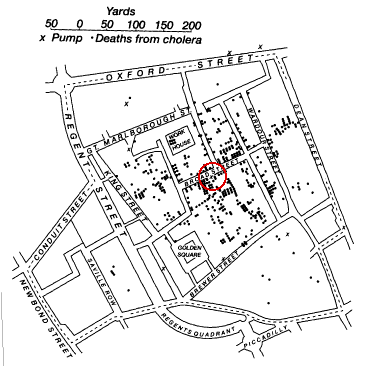
One of the classic examples of the use of “place” in a public health investigation is John Snow’s mapping of cholera cases in London. John Snow was a physician who was in London during a huge outbreak of cholera. He went from house to house, asking for the characteristics of people in the household who were ill. When he plotted the number and location of those who were ill, he came to the conclusion that one water pump was causing the great majority of cases. He removed the pump handle from the pump in question, and the number of cholera cases dropped precipitously.
Person and place gave Dr. Snow a lot of clues
TIME
The third, yet equally important part of descriptive epidemiology is time. In the line-list, we would ideally want to know when the cases had their onset of symptoms, when they were diagnosed, and when their symptoms resolved. Ideally, the exact time when this happened would be included. This is because different diseases have different incubation times (the time from infection to the onset of symptoms). For example, norovirus has a 12-24 hour incubation time. Influenza takes up to 72 hours to appear. Legionnaires’ Disease may appear up to two weeks post-exposure. Likewise, different diseases last for different periods of time. Norovirus clears up in a few hours or couple of days. The flu lasts for days or even a week. Pneumonia can go on for a long time if not treated.
Your symptoms lasted how long?
Time is also important in knowing because it may give us a clue as to what kind of exposure is going on. That part is for our section on outbreaks later in the “course,” so maybe just keep this in mind.
CASE DEFINITION
One other thing we can do with person, place, and time is to form a case definition. Case definitions will come in handy when we talk about outbreak investigations and case-control studies. But I’ll tell you right now that case definitions include person, place, and time.
HOW TO GET THE DATA
You could do like Dr. Snow and go from house to house asking if anyone in the household had diarrhea and getting their details. You could also just mail out a survey to all your neighbors. Then again, you could just wait for your neighbors to tell you about their illness. These are all examples of surveillance.
We’ll discuss poor survey techniques later.
Actively going to your neighbors and asking about disease is a form of active surveillance. Waiting for them to tell you, or for someone to tell you, is a form of passive surveillance. We’ll discuss surveillance in a later “lesson,” so make a note of this too.
PRESENTING THE DATA
So you have the scoop on who has diarrhea and who doesn’t. It is essential that you present the data properly in order for your local health department (or you, budding epidemiologist) to do what is needed. There are many ways to present the data, however, and it may take some practice to get it right. So let’s just use some parameters for examples and show you the right and wrong ways to present them.
AGE
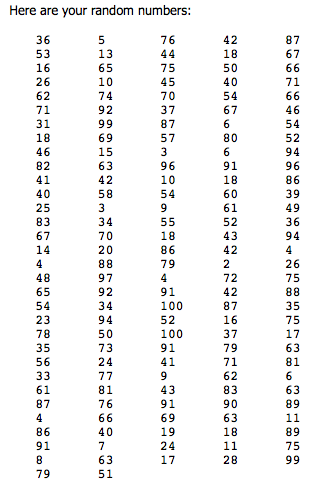
Let’s say you interviewed or received information from 157 people in your neighborhood. I used a random number generator from random.org to get this dataset of ages:
Totally random, I swear.
Because I used a random number generator, the distribution of ages should be a bell curve (called a “normal distribution”). That is, there will be about an equal number of people in each age group, more or less. Your results will vary. Tip: When averages and medians are about the same, as is the case here, there is a good chance that the data are normally distributed.
With regards to age, I would describe this group in the following way: “The group consisted of 157 people, ages 2 to 100, with an average age of 54 and a median age of 53.” There is a common mistake that a lot of member of the media make, and I think it has more to do with lack of time to present findings than to be malicious. They will usually say or write, “The average person is 54 years old,” or “Most people were 54 years old,” or “Middle-aged people were more likely to get the diease.” Well, no, because you have half of your group older than that, and half of your group will be younger than that. This leads us to describing gender.
GENDER
Again using a random number generator, I came up with 84 males and 73 females. That is, 54% of the people in your neighborhood are male, and 46% are female. Some will say or write, “Most of the people are men.” While that is true, it doesn’t give the full picture. Giving the percentages is better, and, in my opinion, more honest.
He’s mostly male, 54% or so.
ONSETS
You probably know where I am going with this. Instead of saying, “Most people had an onset of about 12 hours,” you want to say that the onset of symptoms ranges from 6 to 36 hours, with an average incubation of 12 hours.
I could bore you to death even more by showing all the other mistakes done when presenting data gained from descriptive epidemiology. But I won’t. You’re all bright “students,” and you know how all these things can be mixed up to confuse you.
YOUR NEIGHBORHOOD
Just some questions for you to ponder about what is going on in your neighborhood:
• What was the average incubation period? How would you change your ideas on what happened if the incubation period was shorter or longer?
• What is the average age of a sick person? How would you change your ideas on what the implicated food would be based on that age value?
• Where do most of the cases live? How would you change your ideas on what happened if, for example, they all lived on one single street?
SUMMARY FOR TONIGHT
So tonight we learned that descriptive epidemiology gives us the basic information we need to make educated guesses (hypotheses) of what is going on. We learned that descriptive epidemiology must include details on person, place, and time. And we also learned that there are different ways to get at those data. Hopefully, you now have a better idea of what descriptive epidemiology is. When we talk about public health surveillance, we’ll see how easy or difficult it can be to get those data.
LAST BUT NOT LEAST
“Michael” asked for some tips on what would make a good MPH student. The best answer is that it depends. A lot of my fellow students at George Washington University were not on the Epidemiology/Biostatistics track like I was. They were on the International Health, Community Health, or even the MD/MPH track. They came from a variety of backgrounds, however. Not all of them came form a health background. (Frankly, I don’t remember meeting a fellow medical technologist.)
If your interest is epidemiology, the study of everything and anything that comes upon the people, then you’ll impress the admissions department if you have a good background in biology, mathematics, or any of the sciences that require serious research skills. The biology will come in handy when you have to understand why and how vaccines work, or why and how coffee can’t possibly cause pancreatic cancer. (The former will be discussed in our future “lesson” on clinical trials, and the latter will be discussed in our future “lesson” on confounding and bias.) The math, as you can see, will be handy with biostatistics.
Of course, there are other factors that go into getting admitted to any master’s degree program. I didn’t get admitted when I first submitted an application because my undergrad GPA was awful. I had to talk to the dean of admissions and explain to her that years had passed since I was “just a kid” in college, that I was incredibly interested in understanding how and why things like outbreaks happen, and that my background in the lab would boost my critical thinking skills (not to mention biology). I had to take some courses under “probation,” but even those courses helped me decide that the MPH was the degree for me before diving in completely. I suggest the same… Taking a couple of courses to see if being an epidemiologist (or an MPH in other disciplines) is your cup of tea.
I’ve said it before: I really like David Mandell’s work. He and his team take on some very important and tough questions. I am very concerned about the lack of information on autistic adults. We don’t know an accurate prevalence. Without study ongoing into the needs of autistic adults, those of us with autistic children will face a
This study estimated the ASD prevalence in a psychiatric hospital and evaluated the Social Responsiveness Scale (SRS) combined with other information for differential diagnosis. Chart review, SRS and clinical interviews were collected for 141 patients at one hospital. Diagnosis was determined at case conference. Receiver operating characteristic (ROC) curves were used to evaluate the SRS as a screening instrument. Chi-squared Automatic Interaction Detector (CHAID) analysis estimated the role of other variables, in combination with the SRS, in separating cases and non-cases. Ten percent of the sample had ASD. More than other patients, their onset was prior to 12 years of age, they had gait problems and intellectual disability, and were less likely to have a history of criminal involvement or substance abuse. Sensitivity (0.86) and specificity (0.60) of the SRS were maximized at a score of 84. Adding age of onset <12 years and cigarette use among those with SRS 80 increased specificity to 0.90 but dropped sensitivity to 0.79. Undiagnosed ASD may be common in psychiatric hospitals. The SRS, combined with other information, may discriminate well between ASD and other disorders.
Sensitivity relates to the test’s ability to identify positive results.
Specificity relates to the ability of the test to identify negative results.
Identifying autistic adults is not easy. Prevalence studies are far more difficult than when working with students. But Prof. Mandell is out there, trying to find autistic adults. In this case, he found that in a given psychiatric hospital, about 10% of the patients were autistic. He is calibrating instruments (the SRS together with correlates like smoking, age-of-onset, ID) to provide for a fairly direct screening tool.
This is one type of work that needs to be done. I’m glad that Prof. Mandell’s group is out there doing it, but I hope that more groups pick this up in the future.
Here is an introductory post by EpiRen on his Epidemiology Night School Project:
I’m seriously thinking of writing a series of posts about epidemiology, making the most complex concepts as clear as I can. I would call this project “Epidemiology Night School.” I would offer no college credit for it, though. And I would not say that it would replace any class you can get in a formal, accredited pubic health program. But I will say that it might make it a little easier to understand the myriad of studies and health-related news that you see in the media. After the series of posts, I hope that you will be able to answer the following:
What is epidemiology?
What tables, graphs, and measures are used to describe disease trends? And what rules do you need to follow to present the data in the most honest and open way?
When do you use an “average”? When do you use a “median”? And how do you interpret these?
What is public health surveillance? And what are its limitations?
How do you investigate an outbreak?
I’ll be using a lot of my own experience in addressing these and other questions. If you need some text to follow along, I recommend CDC’s Principles of Epidemiology (PDF).
Of course, there are some prerequisites. You can’t just walk in off the street and understand epidemiology, though I will aim to do that. The main prerequisite will be an understanding of mathematics (adding, dividing, multiplying, and subtracting) and an open mind (because some stuff will blow your mind).
I plan on starting this project this coming weekend, maybe sooner than that or maybe later than that. We’ll see how it goes.
With EpiRen offline, I feel a bit of a void. In his blogging he was taking on an educational project: using current topics to discuss important topics in epidemiology. EpiWonk is also offline, but his body of work remains. EpiWonk also took on describing topics and terminology in epidemiology. Since I find these efforts valuable, I’ve decided to lift some of EpiRen’s “Epidemiology Night School” posts to preserve here. Below is one from March 25, 2011. I picked this somewhat at random, so don’t read too much into the selection.
From here on out, it is in EpiRen’s voice. As he is offline, don’t expect him to respond to comments directed at him.
If you’ve been reading me for a while, you know that I absolutely detest having to attack someone personally. Sure, I may point out the stupidity in some statements by people like Christina England, some homeopath here and there, and even Ms. Jennings was a subject of several postings. But I try not to inject my personal opinions about a person (much) because discussions of science should leave personal feelings out of it. (Sorry it was too late for you, Galileo.) Doing this avoids all that background noise. Know what I mean?
Still, there are those times when someone just somehow manages to get under my skin with comments so outrageous (in my opinion) that I am forced to think ill of them. (Not wish them ill, though. Even I am not that big of a bastard so as to wish others ill.) So I’m going to weave in some comments from the twitter feed of one Dr. Jay Gordon, just to show you how someone who doesn’t understand epidemiology can come off as crass and uncaring (in the opinion of many). All, of course, after the jump…
WHAT IS AN OUTBREAK?
Traditionally, an outbreak has been defined as “one case over the expected rate (or number) of cases for a given location in a period of time.” In Minnesota, they have seen 22 cases over the last 14 years (22/14=1.6 cases per year in all Minnesota). Rounding up, we can say that two cases per year is what is expected. Three cases in 2011 would mean an outbreak. What was that in 2010, you ask? Well, 19 cases in 13 years give us a rate of 1.5 cases per year. It would also be an outbreak situation, especially if the three cases were epidemiologically linked. That information is not yet available from the MDH, but it will be interesting to read later on.
YES. YES, IT'S AN OUTBREAK. IT'S A FRIGGIN' OUTBREAK!!!
YES. YES, IT’S AN OUTBREAK. IT’S A FRIGGIN’ OUTBREAK!!!
EPIDEMIOLOGICALLY LINKED?
When two or more people develop a disease or condition, and they have similar exposures, they are said to be epidemiologically linked. For example, if two people ate at the same place in the hours before their onset of the same illness, then they are epidemiologically linked regardless of whether or not the food they shared is found to be the culprit. Some links are stronger than others, but this concept is not lost in outbreak investigations. During the outbreak of what is now known as Legionnaires’ Disease in Philadelphia in 1976, the fact that all those men were coming down with pneumonia raised some flags… The fact that they were all staying at the same hotel AND were all members of the American Legion was a cause for alarm. (It would be a while before the bacteria that caused the outbreak was discovered, but their epidemiological link proved to be an enormous clue.)
BACK TO MINNESOTA
So, eleven cases, all epidemiologically linked, is that an outbreak?
You Lost Me at Porn
YOU LOST ME AT PORN.
I learned in grade school that 11 cases (to date) in the current outbreak is 9 cases over the expected 2. I also learned that it’s over 5 times the expected rate. I then learned in epidemiology school (a master’s level degree) that the fact that all these cases are somehow related to each other pretty much makes this an outbreak. Am I – or anyone working on that outbreak – being obsessive about “a few extra cases of measles”?
If it means stopping a disease that can do this to a child, then YES, YES I AM OBSESSED.
I want to emphasize the fact that they are all related to each other. If they had absolutely nothing to do with each other and were found in different corners of planet Earth, I wouldn’t obsess. But they’re all in one region of Minnesota. There’s nothing random about that, is there?
You can lead the horse to the water, but… RANDOM, I DO NOT THINK YOU UNDERSTAND WHAT THAT WORD MEANS
As I’ve stated before, there are clearly defined guidelines on what constitutes an outbreak and what doesn’t. If you look at the definition, there are factors of person, place, and time. How many people, where, and when? As I’m writing this, the answer is 11 people, in one region of Minnesota, in the last two to three weeks. That’s an outbreak, my friends. It’s a clean and clear situation.
What the hell does Noro have to do with measles? REMEMBER YOUR TRAINING
Pop quiz. What is the definition of incidence? Yep. You got it. It’s the number of new cases divided by the population at risk. Vaccine coverage for measles is estimated at 85% in Minnesota (maybe lower or higher, but certainly not enough for herd immunity now). That means that about 780,000 people in Minnesota are at risk for measles because they’re not considered immune. (Others who have been immunized, but whose immune system didn’t “take” the vaccine are too low in number to make an impact. The vaccine is really quite good, giving immunity to 99.7% of those who get their two doses and to 95% of those who get at least one dose.) That little quip about 15% norovirus? It’s a GUIDELINE on when to call an elevated number of cases of norovirus symptoms on a cruiseship an outbreak. (It appears that Dr. Gordon wants to go with one guideline but not another.)
Not a dangerous epidemic? Would he say that to the mothers of those sick children?
TELEVISION AND REALITY
I don’t know about you folks, but I have never based an epidemiological decision or observation on a television show. I am yet to hear anything on television (or in any other media) and take it as gospel. What I have done is look at books about epidemiology that build upon a couple of centuries of knowledge and scientific experimentation. Maybe the Brady Bunch didn’t succumb to measles because – and I’m only taking a wild guess here – THEY WERE A FICTIONAL FAMILY! Moreover, they were a fictional family that caught measles in 1969 and then mumps in 1973. I would NEVER take my medical or epidemiological advice from such a careless bunch.
The guy isn’t even wearing gloves!
I’d never use them as an example for such a serious situation. Heck, if I used stuff on television to justify my thinking on epidemiological matters, I would be laughed out of a profession… I mean, imagine if I advocated to call in the US Army to wipe out a town because they had an outbreak of hemorrhagic fever? (“Outbreak“, 1995)
RECAP
Alright, so we learned that an outbreak is defined by person, place, and time. (If you remember one of the first lessons of the nightschool was descriptive epidemiology, and the example there was learning to recognize an outbreak.) There are certain situations where you have a group of people who are sick at the same time, but they were never in the same place. We call that a cluster in time.
Not to be confused with a cluster OF time.
There are other situations when a group of people who live in the same area get sick from the same pathogen (or condition) but at different times. We call that a cluster in space.
We call this “Lost in Space”
To be an outbreak, you need to establish associations between person, place, and time. Sure, the cluster in time may turn out to be an outbreak once you find out through questionnaires and interviews that they all bought the same brand of milk, albeit from different retailers. Or the cluster in space may turn out to be an outbreak once you notice that something has been leaking into the environment over a long period of time.
So, when trying to determine if something is an outbreak, consider how many cases you’re looking at compared to previous years (or other periods of time), consider their geographic spread, consider common exposures of attributes (like gender, race, ethnicity, social status, grade in school, etc.), and consider them all human beings worthy of your caring and best honest effort to bring the outbreak under control and prevent it from ever happening again – like with vaccines and stuff.
DrugMonkey over at Science blogs reports that the new owners of Science Blogs will not allow for anonymous/pseudonymous blogging in the future. In Pseudonymous blogging at Science Blogs is over he/she writes:
I have just been informed that ScienceBlogs will no longer be hosting anonymous or pseudonymous bloggers. In case you are interested, despite extensive communication from many of us as to why we blog under pseudonyms, I have not been given any rationale or reason for this move. Particularly, no rationale or reason that responds to the many valid points raised by the pseudonymous folks.
This is very problematic for me. The ability to speak freely and without fear of reprisal is the foundation and necessity of pseudonymous blogging. These bloggers work long and hard to establish the credibility and reliability of their online identities and shouldn’t be punished or banished because of it.
Science Blogs is now owned by the National Geographic Society. They have hosted anonymous articles on their own site (e.g. WHAT’S THE WORLD’S DEEPEST, DARKEST, DENSEST JUNGLE?). ScienceBlogs is now their property, and they can set the rules. I would hope that they would reconsider this, though. I prefer quality over non-anonymous information, frankly. The worst information I can find on the net, especially blogs, has names attached. Some excellent work has been produced under a pseudonym.
Yes, this is a different topic than typical for this blog. But, let’s consider a simple and obvious lie by our president: the As is typical for this president, this project involves multiple lies. Here are but two. First, the White House would not be changed itself. Just added to. As noted in a recent […]
How does one recapture trust in the public health system? I can tell you one way to make it worse. Put Mark Baxill to work at the CDC. Mr. Blaxill is a long time anti-vaccine activist who has done a lot of harm promoting the “vaccines cause autism” lie. We on this blog have been […]
The same people who might value your efforts with Operation Warp Speed will also be able to do the simple math in their heads that says Mr. Kennedy’s approach is going to kill people. Mr. Trump, there is a lot of chatter about you wanting the Nobel Peace Prize. OK, I know you’ve publicly stated […]
We pay for the CDC. It isn’t there to support Mr. Kennedy’s agenda. It’s there to generate good information that Mr. Kennedy can use or, sadly, not use. He can’t ask them to sign off on dangerous vaccine policy and then cry “restore trust” to excuse firing the trusted experts who are, in his own […]
I will state this straight out–I believe the anti vaccine movement has put good people at risk for decades with their rhetoric. And I also believe Mr. Kennedy has contributed a great deal to this climate of hate. How much or how directly he may have influenced the gunman who opened fire at the CDC […]




 Left Brain Right Brain
Recent Comments