Listen to Andrew Wakefield talk for a while and he will tell you his work has been replicated. Usually claiming replicated multiple times and around the world. Since he says it, it gets repeated by his supporters in online discussions.
For those who get dragged into those discussions, here is another paper to reference. This one takes on the idea that there is a bowel disease specific to autism. Wakefield’s “autistic enterocolitis”
People have looked and, guess what, it isn’t there. Yes, autistics get bowel disease. Being autistic doesn’t prevent bowel disease. The fact that some do, indeed, get bowel disease isn’t what Wakefield claimed. He claimed a “new syndrome”.
It doesn’t exist.
Here’s the abstract. The group is reputable and, in fact, has expressed sympathetic views towards Wakefield.
OBJECTIVE:
Alterations in intestinal function, often characterized as a “leaky gut,” have been attributed to children who are on the autism spectrum. Disaccharidase activity, intestinal inflammation, and permeability were analyzed in 61 children with autism and 50 nonautistic individuals with gastrointestinal symptoms.
METHODS:
All patients had duodenal biopsies assayed for lactase, sucrase, maltase, and palatinase activity. Intestinal permeability was evaluated by rhamnose/lactulose test and measured by high-performance liquid chromatography-mass spectrometry. Intestinal inflammation was evaluated by fecal calprotectin and lactoferrin levels using enzyme-linked immunosorbent assay and histology.
RESULTS:
Some children with autism had mild levels of mucosal inflammation on intestinal biopsy. Disaccharidase activity was not different in autistic and nonautistic individuals. Fecal calprotectin and lactoferrin were similar in both groups. Differences between lactulose and rhamnose recovery and lactulose/rhamnose ratio in urine were not statistically different in patients with and without autism.
CONCLUSIONS:
The present study supports the observation that children with autism who have symptoms of gastrointestinal disorders have objective findings similar to children without autism. Neither noninvasive testing nor endoscopic findings identify gastrointestinal pathology specific to autism, but may be of benefit in identifying children with autism who have atypical symptoms.
If you are getting ready to write, “but they might not have seen enough kids to find one with autistic enterocolitis”, according to Wakefield, most of the kids his team tested had his “new syndrome”. If that were true, this team would have found it.
Add this to “MMR causes autism” as one of the failed ideas of Andrew Wakefield. Not that he will ever admit it.
The title a modified version of a line from a recent study: A Case Study of Paternal Filicide-Suicide: Personality Disorder, Motives, and Victim Choice. This is a topic that many of us, autistics and parents, have been aware of and trying to prevent for years. Parents and caregivers are killing people with disabilities. Not frequently, but far too often. Once is too often.
This study, this story, reminds us of why we speak out. Why when someone downplays the value of an autistic life, we speak out. Why when someone tries to downplay the seriousness of a murder, we speak out.
The study discusses the case of a father who murdered his autistic son. The researchers were able to speak at length with the murderer and report the details behind the murder. This sort of view into a murder is rare.
There were three major factors that fed into the murder. First, the father is mentally ill. He had an undiagnosed schizoid personality disorder.
Some people will jump on this and say, “aha, here’s the reason. It isn’t what we say that caused the murder, it’s because the father was mentally ill.”
For any of you reading this: you are completely missing the point. We don’t downplay murder, we don’t downplay the value of autistic lives specifically to not feed into a murder such as this. You can say, “I won’t judge parents who commit murder and almost every parent out there will not be encouraged to commit murder.
Key word: almost. There are people like this father out there.
And if you don’t understand that statements like this ares harmful and damaging to autistics, that they tell autistics they are less valued than the rest of us in society, please step back and rethink that.
The second factor that played into this father’s decision to commit murder was revenge. He was separated from his wife and felt that she had moved on to new relationships, and he wanted to hurt her.
Instead of hurting her directly, he chose to murder his son. He didn’t consider murdering either of his typical daughters, but only his autistic son.
Oh, and there’s a fourth reason. The second part of the motive (first being revenge). This exemplifies the reason why we don’t feed the narrative that autistic lives are worth less, that their struggles mean they would be somehow better off not alive. This is that the father felt a sense of altruism in murdering is son.
Yes, altruism. We hear that again and again. That somehow the parent is helping the child by ending his or her life.
The authors begin the section on altruism with this discussion:
The offender was convinced that his wife’s effusive preoccupation with their son’s impairment and her support of the educational inclusion project would be detrimental to their son. With his and his son’s death, both of them would be liberated from what he experienced as the mother’s intrusive and overbearing interference. Also, the offender had long been preoccupied with what would become of his son when he reached adulthood. He thought of his child as a nice boy and he believed that his son would be far too good to survive in what the offender considered to be a dog-eat-dog world. He was convinced that, by killing him, he would in fact spare him from a cruel destiny: “He wouldn’t have a future and would only get in trouble, anyway.”
Some people don’t understand why so many of us promote acceptance. Let’s leave aside the obvious (accepting people for who they are is the right thing to do), the message of “non-acceptance” is damaging. It is hurtful. Beyond that, yes, it feeds the murder narrative. Consider this from the study, the discussion of how the father saw his son as “different” and was “not very happy with him”.
Concerning his son, though, there was also another side to his attachment. Although he loved him, the offender admitted that, in fact, he was not very happy with him. He did not like having a son who was “different” and impaired. Although he admitted being ambivalent towards his son, he nevertheless stressed that this would not have been a sufficient reason to kill him.
Also note that the father saw that his son “lived on another planet” and didn’t respond as expected.
To him it appeared that his son “lived on another planet.” Discussing the offence, he emphasized that, contrary to human behavior, mathematically-based computer systems are regarded as “intelligent and reliable.” As the offender explained, the output of a computer is determined by the input: “a computer can only produce a stupid answer if the initial question is stupid.” “Hence intelligent input ineluctably leads to intelligent output.” Although he did his best to feed his son with what he considered to be intelligent input, the output was not as he expected. As has been observed with individuals with schizoid personality disorder, the offender saw the world as being out of line rather than himself not being attuned with the world around him (Esterberg et al., 2010).
If I am somehow not getting the message across–
There are messages that are not only damaging, they lower the bar for those considering murdering autistics (and other people with disabilities).
“My kid is different and I can’t accept that.”
“My kid’s life is harder, so it is less worth living.”
“My life is hard/my family’s life is hard because of my kid.”
“That parent murdered his/her child. I can’t judge that parent because I haven’t walked in his/her shoes.”
Of course this discssion comes shortly after I have spoken out against Polly Tommey for using exactly this language. Language that downplays the seriousness of murders (here and here). She says she “won’t judge” parents who murder their autistic children. Further she says this is because she “hasn’t walked in their shoes”. Saying that means that there may be some reason, some experience from “walking in their shoes”, that could mitigate murder.
There isn’t.
In the past I have also criticized Ms. Tommey’s colleague Andrew Wakefield. He has not just downplayed murder, but has portrayed the murder of autistics by parents as an act of love.
I don’t want to make this discussion about Tommey and Wakefield. They just serve as examples of people who are doing the harm I speak against.
Although evidence with respect to its prevalence is mixed, it is clear that fathers perpetrate a serious proportion of filicide. There also seems to be a consensus that paternal filicide has attracted less research attention than its maternal counterpart and is therefore less well understood. National registries are a very rich source of data, but they generally provide limited information about the perpetrator as psychiatric, psychological and behavioral data are often lacking. This paper presents a fully documented case of a paternal filicide. Noteworthy is that two motives were present: spousal revenge as well as altruism. The choice of the victim was in line with emerging evidence indicating that children with disabilities in general and with autism in particular are frequent victims of filicide-suicide. Finally, a schizoid personality disorder was diagnosed. Although research is quite scarce on that matter, some research outcomes have showed an association between schizoid personality disorder and homicide and violence.
I feel bad for grabbing one line from the story, as the whole story is quite good. But for now, let’s just take a look at this one paragraph:
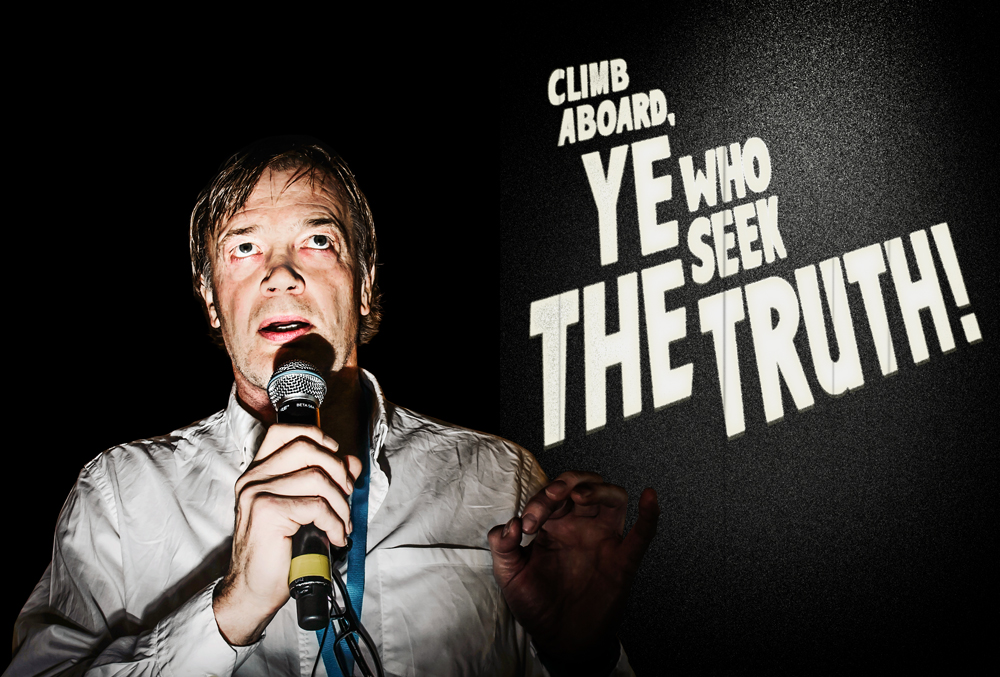
“Your bodies are owned by Big Pharma,” he said. “It’s turning into a science-fiction movie.” The audience gasped and shook their heads in disbelief. “This will be the end of the United States of America.” During the Q&A portion, Wakefield added, “This is a deliberate eugenics program, a deliberate population-control program.”
“This is a deliberate eugenics program, a deliberate population-control program.”
I’ve been told this was in response to a question about vaccines possibly being a part of a eugenics program.
This is the sort of statement Mr. Wakefield typically has avoided making public. It’s the sort of statement that plays well on the “ConspiraSea Cruise”, but in more reasoned company is clearly wrong and irresponsible. It’s the sort of statement that goes against the image of Wakefield as the “legitimate scientist who is wronged for ‘just asking questions'”.
I have no idea how Mr. Wakefield defines “anti-vaccine”. Readers here will recognize that I rarely use the term. So, let’s continue in that mode. Let’s not refer to him as “anti-vaccine”. He is strongly, and irresponsibly, and using misinformation, “anti-vaccine-program”. How can someone who believes that vaccines are “a deliberate eugenics program, a deliberate population-control program” be anything else?
The IACC (Interagency Autism Coordinating Committee) is revising the Strategic Plan for autism research. This is THE document that they produce that can influence how autism research money is allocated.
Do you need something from autism research (almost certainly the answer is yes). Let the Committee know what specifically you want. Do you want better services and educational plans for minimally verbal students? Better job supports for adults (adults who have high support needs or “just” significant support needs)? Let them know.
Here is the post I wrote about this a few weeks ago:
As many readers here may recall, I spent a few years as a public member to the Interagency Autism Coordinating Committee (IACC). The IACC is mandated by the same law that commits the government to funding autism research. The most important thing the IACC does is draft the Strategic Plan. This is the how the autism communities tell the government and other funding agencies what research projects we want performed. That Plan is up for a major revision. Something that hasn’t happened since before I was on the IACC. Now is when the real work of the IACC is going to happen.
And they want your feedback. They need your feedback. There is a website open now to submit feedback: Request for Public Comments – 2016 IACC Strategic Plan. I list the questions below so you can prepare–but go to that website and give feedback. Do it now. Don’t put it off and possibly miss the chance to give feedback.
Maybe you want to give feedback on only one topic. Great. Maybe you want to give a lot of feedback. Great. But do it. Do it now.
Why?
Do you want a major focus on, say, supporting high support adults? Early intervention? Better education supports and strategies for older students?
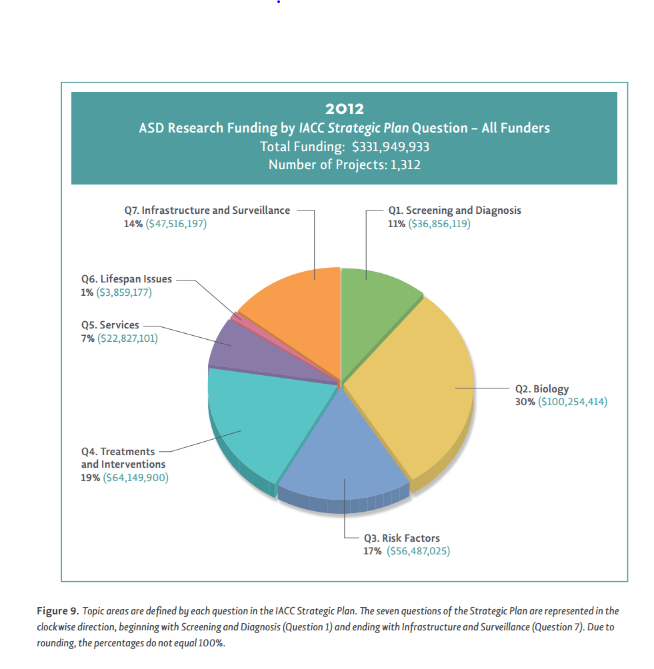
We aren’t talking small amounts of money. Here’s a figure from the IACC’s Portfolio Analysis from 2012. That’s over $300,000,000.00 spent in one year. Three hundred million plus dollars.
Is that the breakdown you want to see? Is that what will make a difference in your life, or the life of someone you care about?
It isn’t what I want or need. Research takes time to impact real life. I want autistic adults–especially those with high support needs–to have a better life. I’d like it NOW, but I need it by the time my kid ages out of school. In the pie chart above, “lifespan issues” account for 1% of the total funding. Lifespan issues is the term for issues involving adults.
1%.
That has to change. And I’ll give that feedback, and more.
Here are the questions you will see on the website.
Question 1: When Should I Be Concerned? (Diagnosis and Screening)
Please identify what you consider the most important priorities and gaps in research, services and policy for Question 1. Topics include: diagnosis and screening tools, early signs, symptoms, and biomarkers, identification of subgroups, disparities in diagnosis
Question 2: How can I understand what is happening? (Biology of ASD)
Please identify what you consider the most important priorities and gaps in research, services and policy for Question 2. Topics include: molecular biology and neuroscience, developmental biology, cognitive and behavioral biology, genetic syndromes related to ASD, sex differences, immune and metabolic aspects, and co-occurring conditions in ASD
Question 3: What Caused This to Happen and Can it be Prevented? (Risk Factors)
Please identify what you cosnider the most important priorities and gaps in research, services and policy for Question 3. Topics include: genetic and environmental risk factors, gene-environment interactions, and the potential role of epigentics and the microbiome
Question 4: How can I understand what is happeing? (Treatments and Interventions)
Please identify what you consider the most important priorities and gaps in research, services and policy for Question 4. Topics include: behavioral, medical/pharmacologic, educational, techonology-based, and complementary/integrative interventions.
Question 5. Where can I turn for services? (Services)
Please identify what you consider the most important priorities and gaps in research, services and policy for Question 5. Topics include: service access and utilization, service systems, education, family well-being, efficacious and cost-effective service delivery, health and safety issues affecting children, and community inclusion.
Question 6. What does the future hold, especially for adults? (Lifespan Issues).
Please identify what you consider the most important priorities and gaps in research, services and policy for Question 6. Topics include: health and quality of life across the lifespan, aging, transition, and adult services, including eduction, vocational training, employment, housing, financial planning and community integration.
Question 7. What other infrastructure and surveillance needs must be met? (Lifespan Issues)
Please identify what you consider the most important priorities and gaps in research, services and policy for Question 7. Topics include: research infrastructure needs, ASD surveillance research, research workforce development, dissemination of research information, and strengthening collaboration.
As I wrote about yesterday, Andrew Wakefield’s “Vaxxed” team, led by distributor Philipe Diaz of Cinema Libre Studio, threatened Fiona O’Leary (an autistic adult who is also the parent of autistic children). Well, it looks like the story has been picked up by the Irish Examiner.
The article starts:
A US film studio has threatened to sue an Irish autism-rights advocate if she continues to speak out against its controversial anti-vaccine documentary, Vaxxed: From Cover-Up to Catastrophe,.
West Cork-based mother, Fiona O’Leary, who wants to block the film’s release in Ireland and Britain, said she was outraged to receive a legal letter from California-based Cinema Libre Studios over the weekend.
I am hesitant to write this. Not hesitant because I have any doubts that the actions of Cinema Libre Studios and Andrew Wakefield’s team are wrong. No, hesitant because it has all the hallmarks of people trolling for attention and free publicity. I do not like giving people like Andrew Wakefield or Cinema Libre Studio attention.
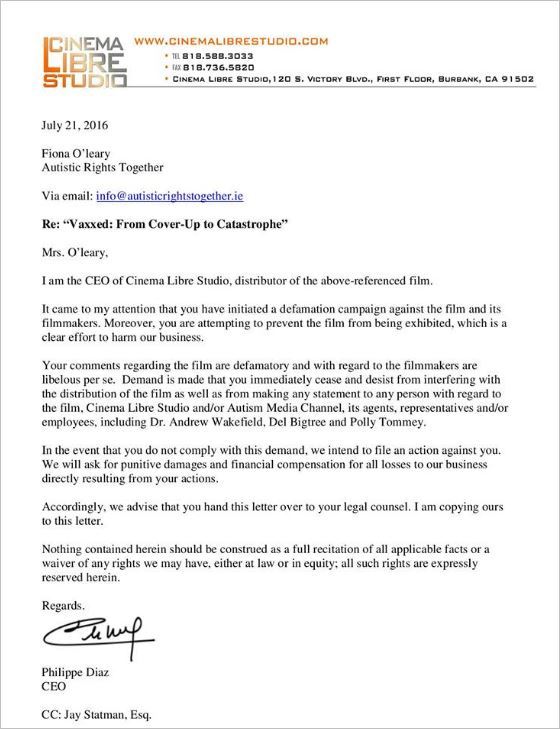
That said, I can’t let that stop me from speaking out. In this case Cinema Libre Studios, who are distributing the faux documentary “Vaxxed”, have sent a letter to Fiona O’Leary threatening legal action:
As you can read, the letter is not just on behalf of Cinema Libre, it is also on behalf of Andrew Wakefield, Polly Tommey and Del Bigtree (the main voices promoting “Vaxxed” and it’s misinformation).
Philipe Diaz (Cinema Libre Studios CEO) demands that Fiona not only “cease and desist from interfering with distribution of the film” (while giving no examples of actions of her interfering), but also demands that she “cease and desist…from making any statement to any person with regard to the film, Cinema Libre Studio and/or Autism Media Channel, its agents, representatives and/or employees, including Dr. Andrew Wakefield, Del Bigtree and Polly Tommey.”
Apparently Philipe Diaz is not above hypocrisy. Recall that the marketing campaign for Vaxxed relied heavily upon their ouster from the Tribeca Film Festival. They erroneously claimed that Tribeca “censored” Vaxxed and that Vaxxed is “the film they don’t want you to see”.
So, a film festival chooses which films to give laurels to (and which to not give laurels to) and this is “censorship” and bad. But someone criticizes the film and the film makers and this is grounds for legal action.
In case you weren’t aware, Fiona O’Leary is an autistic adult. She is the parent of 5, two of whom are autistic.
What is the most common theme you will hear from Andrew Wakefield? That’s right, “listen to the parents. The parents are right.”
Well, except for the majority of us who disagree with Wakefield. Then we parents are ignored or even threatened, right Andy?
When Vaxxed was rightfully removed from the Tribeca Film Festival and other festivals, Philipe Diaz erroneously called those actions “… a slap in the face to the First Amendment.” But when faced with criticism, Diaz demands silence.
Since you apparently don’t understand free speech, let’s explain this one to you, Mr. Diaz. Tribeca didn’t try to stop you showing your film everywhere. They just said that your film would not get shown at Tribeca and get Tribeca Laurels. Just as if you were responsible enough to have not picked up Vaxxed and not put Cinema Libre’s name on it, that wouldn’t be an infringement of free speech.
Telling someone they can’t even talk about you, your company or your clients…that’s a clear attempt to quash free speech.
There’s an example of someone who has their priorities mixed up.
Del Bigtree, song-and-dance man turned pitch-man for bad advocacy and science. You are basically branding “Be Brave” within your little community. Pat yourself on the back, Del, you are so brave. Threatening legal action against an autistic parent of autistic children. Don’t respond to criticism, use lawyers to try to quash it.
OK, Del, be brave. Start discovery now. Send Fiona the financial records for Vaxxed to show her how she could be harming your business. Send her all your group’s communications about Vaxxed and about Fiona so she can see that this isn’t just retaliation. That would be brave.
I don’t think you have the guts. You stand behind your studio and lawyers and send threats and demands. Hell, you didn’t even have the guts to apologize for telling people “now’s the time” for guns.
And to both of you–Bigtree and Tommey–at the end of your nonpology video you thank your followers for stopping an article in the Sunday Times. Really? So the whole “pot calling the kettle black” thing you have going here with faux censorship is a pattern?
You want “be brave”? How about standing up to an unreasonable threat? Because that’s exactly what Fiona did:
“Anyone who believes in the right to bear arms. To stand up against your government. I don’t know what you were saving that gun for then. I don’t know when you planned on using it if they were going to take control of your own body away.
It’s now. Now’s the time.”
emphasis added.
The statement is clearly bad. And I criticized Del Bigtree for it. Rightly so.
Mr. Bigtree has responded. Full version on his facebook page. As you will see he starts to do the right thing, then he fails. He admits the message is bad, but then tries to defend himself by stating that apparently he was trying to show solidarity for people fighting for gun rights (the statement above has nothing to do with that). He then claims that he was taken out of context and edited (no edits, and one can watch the full video and see the context changes nothing).
Just say it’s a wrong statement and apologize, Mr. Bigtree. It takes courage in being able to admit mistakes and apologize. I greatly appreciate that you distanced yourself from your irresponsible statement, but do it honestly and completely. When people hear you equivocating and making up excuses, it weakens your clarification. It makes it all about you, rather than correcting the message. It makes it easier for people to ignore your clarification.
Let’s address some of the accusation Mr. Bigtree uses to defend himself. Is the Q&A video I took or the statement above taken out of context? Is it edited? No. Mr. Bigtree is just trying to deflect criticism. Want the context? Watch the full video on his Facebook page. Please do–because this is just the worst of a number of really bad statements he made that night. By claiming it is “taken out of context” he is simply attempting to avoid staring his own mistakes head on. As I’ve already said, besides demonstrating a lack of moral fiber there, it weakens Mr. Bigtree’s attempt to distance himself from the message he gave.
And we need his response to be clear and concise.
Since Polly Tommey has difficulty understanding the point I’m making, let’s spell it out. What I did was saying, “I’m judging you Del Bigtree so that people know this isn’t acceptable behavior.”
Which, you have to admit, is far more effective than, “I will sit in the audience and laugh nervously and hope no one takes Mr. Bigtree seriously.” Or, “I will sit next to Mr. Bigtree and look as though I am not even paying attention.” Mr. Bigtree was criticized and he has tried, however poorly, to distance himself from his statement.
As the old saying goes, the first step in getting out of the hole you’ve dug is to stop digging. Del Bigtree just digs and digs. Having rewritten history to make him stand in solidarity with guns rights activists, he then goes on the attack: I am a “troll”.
Del, I’m an autism parent and you know it. I am a scientist and you know it. I have spent more time looking at the facts behind your film than you have. I’m either better at understanding them or more honest than you. I obtained the William Thompson documents from Bill Posey. I gave my analysis–and I gave the documents so that my analysis would be put in context. If context is so important to you now, why hasn’t your team ever released the documents you hold? People can check what I say. You manipulate the situation so that your message can not be challenged.
More to the point, Del, you are being criticized not trolled. This is an important discussion and given the damage you are doing, you should damned well act like an adult. Because right now you are not.
Polly Tommey shows a similar lack of moral fiber by refusing to face head on the criticism levied against her in a different post (Polly Tommey won’t judge parents who murder their disabled children. That’s part of the problem). She defends herself with the statement, “I had a clip of me that made it look like I endorsed murdering children with autism”. It’s a classic straw man argument.
Let’s break this down simply:
There is the act of murder.
There is encouraging the murder.
There is refusing to murderers that they are wrong.
Ms. Tommey, you are in the third category. Let me remind you of your own, unedited, words:
Parents are taking the lives of their children already because they will not leave them in the world as it is today. And I for one will never judge them for what they do.
Why is this statement wrong? Let’s put this in language Mr. Bigtree just used in his attempted defense. A famous poem:
First they came for the Socialists, and I did not speak out—
Because I was not a Socialist.
Then they came for the Trade Unionists, and I did not speak out—
Because I was not a Trade Unionist.
Then they came for the Jews, and I did not speak out—
Because I was not a Jew.
Then they came for me—and there was no one left to speak for me.
People are “coming” for our own. As you say, parents are murdering their autistic children. It isn’t a matter of stopping this before “they come for me”. They are already coming for us as these children (and adults) are our own.
If you will not speak out, your use of that poem is just empty rhetoric.
Del Bigtree helped Andrew Wakefield produce a faux documentary called Vaxxed. Vaxxed has been discussed here and elsewhere a great deal, but here is a review from Science Based Medicine if you are looking for more details (Andrew Wakefield’s VAXXED: Antivaccine propaganda at its most pernicious).
The team that made Vaxxed has been using the screenings as a platform to give personal appearances. Below is a clip from one of those personal appearances. I would encourage you to watch for yourself:
In case you couldn’t watch or skipped the video, here are the concluding statements of this particular speech by Mr. Bigtree:
“Anyone who believes in the right to bear arms. To stand up against your government. I don’t know what you were saving that gun for then. I don’t know when you planned on using it if they were going to take control of your own body away.
It’s now. Now’s the time.”
We need to stop here and do what neither Polly Tommey nor anyone in that audience had the guts to do: stand up to Del Bigtree and say No! No, this is not the time to use guns.
This is no joking matter. Bigtree’s comments are at best beyond irresponsible and at worst a call for armed violence.
Whatever was in Bigtree’s mind, why didn’t anyone speak out against this? There was nervous laughter when Bigtree made his call to arms so people can’t claim they didn’t hear or didn’t understand what he was suggesting. Here’s the Facebook post with the full video. There are over 1500 comments. And I can’t find one that says, “No, Del, we reject a call to violence.”
I want to keep this short, but I will repeat myself for emphasis: Del Bigtree crossed the line in a big way with his comments. His comments are reprehensible.
But standing by silent while he makes these reprehensible statements is also wrong.
Ironically Del Bigtree’s facebook page has this as the top saved image:
You fans of Del Bigtree, you need to walk the walk. Stop patting yourselves on the back for being “brave” and show that you are indeed brave individuals. Disavow these statements.
Del Bigtree, you need to dial this back. You need to apologize and take back these statements.
Let’s just jump right to the video clip. Because it needs no introduction, it is just so wrong:
The speaker is Polly Tommey. Polly Tommey has a long history of bad autism advocacy. When people think of the autism parents who just do advocacy wrong, they are thinking of people like Polly Tommey. She’s been a voice in the “vaccines-cause-autism” movement for a long time. She’s worked with Andrew Wakefield (whose unethical actions in relation to disabled patients at his hospital lost him his medical license. To name one of his many failures). This in itself demonstrates bad judgement and poor reasoning. Recall that Andrew Wakfield fictionalized an account of a parent murdering her autistic child, framing it as an act of love.
But the low point of Polly Tommey’s advocacy career came when she and Andrew Wakefield “helped” a family in crisis. They were working on a reality TV show (that failed to get off the ground) called the Autism Team. The idea was simple: find a family with an autistic child who is in need of help. Swoop in with Team Wakefield, blame vaccines, claim it’s all about gastrointestinal issues, claim to have helped the family and move on to the next. But it all fell apart with one family–that of Alex Spourdalakis. In the autism community, a community were people have extraordinary needs, Alex had extraordinary needs. What he didn’t need was for his mother to be fed false hopes and bad advice, which is what Team Wakefield did. What he didn’t need was for Team Wakefield to walk away to their next project, leaving his mother with nothing when the hope they were sold proved false.
Alex was murdered. Brutally murdered. By his mother and another caregiver. Alex was poisoned. When that failed to kill him, he was stabbed. Repeatedly. His wrist was slit to the bone. By his mother and caregiver. Alex bled to death, leaving a grisly scene for when his father, estranged from the mother, found him.
The fact that Polly Tommey won’t face up to her abject failure with Alex Spourdalakis is not surprising. It is also not surprising that Polly Tommey won’t judge the people who committed that brutal murder, or any other murder by a parent of an autistic child. Not surprising, but an example of the failure of Polly Tommey and other faux autism advocates to actually stand up and lead. How hard is it to say, “No! Murder is wrong”?
Polly Tommey met Alex Spourdalakis. But she “won’t judge” the person who plunged a knife into his chest. She won’t judge the person who poisoned him. She won’t judge the person who slit his wrist.
Ms. Tommey tells us to check the web for stories. I searched for: autism parent murder child. First hit was this article: “Please Don’t Murder Us” Shouldn’t Be Controversial. Autistic people don’t share your views, Ms. Tommey. Autistic people don’t think we should stand back and “not judge” murderers.
Katie was murdered by a mother who wanted a non disabled child. Katie, suffocated in a plastic bag by one of the people she most loved. Katie, who should be a beautiful young teenager today. Katie, whose mother felt that vaccinating her child made her responsible for Katie’s autism. Yes, the vaccination myth you, Polly Tommey, promote played into Katie’s murder. While Katie’s mother was suffocating her with a plastic bag, Katie struggled to get free, leaving teeth marks on the bag. She suffered. She feared.
Katie’s family (not counting her mother) loved her. She was valued. Her father stated, “If the measure of a person’s life could be quantified by the number of people that loved them, then Katie, in her brief 3 1/2 years, achieved well beyond all of us.”
Polly Tommey why won’t you judge Katie’s mother? Why won’t you stand up and say, “this is wrong”? Why not stand with Katie’s father?
Keep searching the web, Ms. Tommey and you will find London McCabe.
He loved hats. More importantly, he was loved. Valued. His father is quoted as saying that London was his whole world. That he will miss London forever.
London McCabe’s mother took him to a bridge and pushed him over the rail. He fell over 100 feet, landing in a river. He not only had the fall to know that his own mother had pushed him over, he survived the fall, suffering multiple broken bones. He died from drowning. London McCabe suffered. He suffered fear. He suffered pain. He suffered betrayal. His mother had planned the murder, researched how to get off with an insanity defense (which thankfully failed).
But outright premeditated murder isn’t something you can judge, Ms. Tommey?
When you say, “I won’t judge”, you are saying, “autistics have such hard lives that killing them can be justified in some cases”. You were probably thinking of people like Alex, whose challenges were great. But you were wrong. Alex deserved his chance. He deserved his life. But even in your twisted logic, why can’t you bring yourself to judge Katie’s mother? London’s mother?
You and your new friend Del Bigtree are trying to make a name for yourselves with all your talk of freedom we Americans value so strongly. Let me remind you of the Declaration of Independence.
We hold these truths to be self-evident, that all men are created equal, that they are endowed by their Creator with certain unalienable Rights, that among these are Life, Liberty and the pursuit of Happiness
All men are created equal. And the first of the “unalienable rights” is life.
Alex Spourdalakis was created equal. He had a right to life.
Katie McCarron was created equal. She had a right to life.
London McCabe was created equal. He had a right to life.
All people with disabilities are created equal. All have a right to life. A many are murdered. Why don’t you stand with them? Why do you stand with those who murder?
The phrase “parental rights” doesn’t exist in the Constitution. As a parent I am not endowed with the right to chose life or death for my child. Until you understand that, all your “freedom” rhetoric is, frankly, just a bullshit public relations effort.
When you refuse to judge, you enable. You make it just that little bit easier for parents and other caregivers to murder.
My kid faces an uncertain future. A future where abuse and murder are real possibilities. My kid needs advocates who will stand up for him and his rights. If I do wrong by my son, damned right someone should judge me. Because if we refuse to judge parents, we say it’s acceptable to commit murder. It’s acceptable to treat autistics as less valuable, less human, less deserving of basic human rights.
It is perfectly acceptable, even important, to judge others when they fail. Ms. Tommey, in case it isn’t clear, I’m judging you right now.
Yes, this is a different topic than typical for this blog. But, let’s consider a simple and obvious lie by our president: the As is typical for this president, this project involves multiple lies. Here are but two. First, the White House would not be changed itself. Just added to. As noted in a recent […]
How does one recapture trust in the public health system? I can tell you one way to make it worse. Put Mark Baxill to work at the CDC. Mr. Blaxill is a long time anti-vaccine activist who has done a lot of harm promoting the “vaccines cause autism” lie. We on this blog have been […]
The same people who might value your efforts with Operation Warp Speed will also be able to do the simple math in their heads that says Mr. Kennedy’s approach is going to kill people. Mr. Trump, there is a lot of chatter about you wanting the Nobel Peace Prize. OK, I know you’ve publicly stated […]
We pay for the CDC. It isn’t there to support Mr. Kennedy’s agenda. It’s there to generate good information that Mr. Kennedy can use or, sadly, not use. He can’t ask them to sign off on dangerous vaccine policy and then cry “restore trust” to excuse firing the trusted experts who are, in his own […]
I will state this straight out–I believe the anti vaccine movement has put good people at risk for decades with their rhetoric. And I also believe Mr. Kennedy has contributed a great deal to this climate of hate. How much or how directly he may have influenced the gunman who opened fire at the CDC […]


 Left Brain Right Brain
Recent Comments