Archive | Autism RSS feed for this section

U.S. announces 2% autism rate. Again. And it’s dependent on a change in the way a survey is worded. Again.

17 Nov

Last week a study was released showing an autism “rate” in the U.S. of about 2% (an estimated prevalence of 2.24% to be exact). Luckily one of the best science journalists out there focuses a lot of her attention on autism and covered this story. I’m writing of course about Emily Willingham and her article Increase In Autism Diagnoses Not An Increase In Autism.

The study in question is Estimated Prevalence of Autism and Other Developmental Disabilities Following Questionnaire Changes in the 2014 National Health Interview Survey. The abstract is at the bottom for those interested.

While other articles are discussing the large “increase in autism”. Or, as in this Reuters article, US autism numbers soar in which we read what must be a confusing message to many:

The results reflect a near doubling in autism rates over the past three years, but the US Centers for Disease Control, which released the data last week, says the shift is largely due to a change in the way the survey was worded.

Here’s the thing, before I saw what the study was, I actually thought that the discussion was about this study: Changes in Prevalence of Parent-reported Autism Spectrum Disorder in School-aged U.S. Children: 2007 to 2011–2012. In that study, released in 2013, a 2% autism “rate” was announced. And that was a significant change from the previous survey data (using the National Survey of Children’s Health). And like previous estimates based on survey’s the change is at least due in large part to a change in the way the survey was presented to parents (I’m looking for a link to the discussion of the change in survey questions that affected the 2013 estimate, but there was a shift and it had a big impact).

Thankfully much of the media, and even Autism Speaks, are pointing out how this 2% figure doesn’t represent a “real” change in autism prevalence, but is largely dependent on the study methods. Others can be counted on to shout “epidemic” and ignore some of the key reasons why this doesn’t reflect a real increase.

Number 1 reason–the autism prevalence is basically the same for kids who were 3-10 and kids who were 11-17:
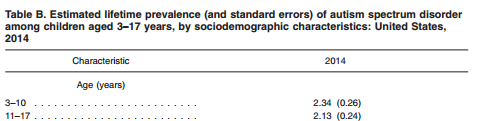
AutPrevalence

A real increase would show up as a higher prevalence for younger kids.

One thing we see is a decrease in disparity for autism prevalence by race/ethnicity. African Americans have a slightly lower autism prevalence (it’s unclear whether this is statistically significant or not), and Hispanics have a decidedly lower autism prevalence (1.49% vs. 2.55% for Caucasians). Which means we still have far to go to identify and bring services to all autistics. And it also means that the autism prevalence estimates will continue to rise as we do identify more in under diagnosed populations.

AutPrevalence race-ethnicity

But let’s focus on the important part of that–we still have a large under-diagnosed/under-served population and it is largely among Hispanics. We really need to be focusing more attention on remedying that situation.

Here is the abstract for the current study:

Objectives—The developmental disabilities questions in the 2014 National Health Interview Survey (NHIS) were changed from previous years, including
question reordering and a new approach to asking about autism spectrum disorder (ASD). This report examines survey-based estimates of the lifetime
prevalence of ASD, intellectual disability (ID), and any other developmental delay (other DD) following the inclusion of a standalone ASD question, the
inclusion of specific diagnoses in the ASD question, and the ASD question preceding the other DD question, and compares them with estimates from
previous years.

Methods—In NHIS, one child is randomly selected from each family to be the subject of detailed questions on health conditions, functional limitations, and
health care utilization. Parents are asked if a doctor or health professional had ever told them that their child had each of a series of developmental disabilities.
Prevalence estimates of ASD, ID, and other DD for children aged 3–17 years were calculated using data collected in 2011–2014.

Results—The estimated prevalence of ASD based on 2014 data was 2.24%, a significant increase from the estimated annualized prevalence of 1.25% based on
2011–2013 data. In contrast, the prevalence of other DD declined significantly from 4.84% based on 2011–2013 data to 3.57% based on 2014 data. The prevalence of ID did not significantly change from 2011–2013 (1.27%) to 2014 (1.10%). The prevalence of having any of the three conditions was constant across survey years.

Conclusions—The revised question ordering and new approach to asking about developmental disabilities in the 2014 NHIS likely affected the prevalence estimates of these conditions. In previous years, it is likely that some parents of children diagnosed with ASD reported this developmental disability as other DD instead of, or in addition to, ASD. Following these changes, the 2014 ASD estimate was more similar to ASD prevalence estimates from other sources.


By Matt Carey

Mr. Kennedy, if you know the science, why did you claim that the MMR vaccine contains mercury?

16 Nov

Robert Kennedy (son of Robert F. Kennedy) has been focused on reducing mercury exposure for some time. His advocacy against mercury led him to focus on vaccines (infant vaccines used to contain a mercury compound as a preservative). And, the main argument against mercury in vaccines is the (now totally failed) idea that mercury in vaccines causes autism.

It’s important to keep that autism is not his priority. It’s his tool to allege dangers of vaccines. He’s not out to help us out, but instead to use us to help him.

Add to this that he’s a lawyer, not a scientist and he’s from a very political family. Three are lawyers and politicians actually understand science. Mr Kennedy claims he is in that number (he’s “rabidly pro-science”), but in reality he either doesn’t understand the science or the facts are just be a political tool for him.

That Mr. Kennedy feels the need to instill in us the message that he understands science may stem from the fact that his first attempt at discussing autism and vaccines met with disaster. He published an article “deadly immunity” (because, you know, very pro-vaccine people use terms like “deadly immunity” to discuss vaccines, right?). This article was published both in Rolling Stone and Salon.com. In Salon’s Correcting our record, We’ve removed an explosive 2005 report by Robert F. Kennedy Jr. about autism and vaccines. Here’s why we read:

In 2005, Salon published online an exclusive story by Robert F. Kennedy Jr. that offered an explosive premise: that the mercury-based thimerosal compound present in vaccines until 2001 was dangerous, and that he was “convinced that the link between thimerosal and the epidemic of childhood neurological disorders is real.”

The piece was co-published with Rolling Stone magazine — they fact-checked it and published it in print; we posted it online. In the days after running “Deadly Immunity,” we amended the story with five corrections (which can still be found logged here) that went far in undermining Kennedy’s exposé. At the time, we felt that correcting the piece — and keeping it on the site, in the spirit of transparency — was the best way to operate. But subsequent critics, including most recently, Seth Mnookin in his book “The Panic Virus,” further eroded any faith we had in the story’s value. We’ve grown to believe the best reader service is to delete the piece entirely.

“I regret we didn’t move on this more quickly, as evidence continued to emerge debunking the vaccines and autism link,” says former Salon editor in chief Joan Walsh, now editor at large. “But continued revelations of the flaws and even fraud tainting the science behind the connection make taking down the story the right thing to do.” The story’s original URL now links to our autism topics page, which we believe now offers a strong record of clear thinking and skeptical coverage we’re proud of — including the critical pursuit of others who continue to propagate the debunked, and dangerous, autism-vaccine link.

“…critical pursuit of others who continue to propagate the debunked, and dangerous, autism-vaccine link”. Not exactly a ringing endorsement of Mr. Kennedy’s approach nor the “science” he still promotes.

One take a moment here to discuss Mr. Kennedy’s strong record of advocating for real changes that would benefit autistics. Or we could if there were such a record. Again, we aren’t his focus. We are his tool.

So, given this long introduction, what about the claim that that the MMR vaccine contains mercury? It is in this video Mr. Kennedy produced recently. And while it may seem like a small thing, it is a clear example of misunderstanding or ignoring simple facts in order to support his argument that mercury in vaccines cause autism. Mr. Kennedy is jumping on the controversy that Brian Hooker and Andrew Wakefield tried to make last year about the MMR vaccine.

Now for those who have a basic understanding of the science, one will immediately wonder, “why is Kennedy latching on to this MMR story when there is no mercury in the MMR vaccine?” Not only does the MMR vaccine not contain mercury, it can’t contain mercury. The MMR vaccine is a live virus vaccine. Mercury is a preservative; it’s specific purpose is to kill bacteria (mostly) and viruses.

Let’s leave out the other huge warning flags here–such as the current MMR controversy Wakefield and Hooker tried to create is based on a huge amount of misrepresentations. Let’s ignore that and ask, surely Mr. Kennedy wouldn’t claim that the MMR vaccine contains mercury, right? Because that would mean either he doesn’t care about the facts or doesn’t understand the facts. It would suggest that sticking to very simple facts is taking back seat to political advocacy.

Why care, one might ask? Politicians have been ignoring facts for millennia. I care beause of the harm Mr. Kennedy brings to my community. I care because he is be scaring parents, especially African American parents, needlessly and convincing them to avoid a vaccine which prevents three very serious diseases. But more, he’s instilling in a new community the guilt and shame that comes with belief in the vaccines-cause-autism idea.

Given that long intro, here’s the video where Mr. Kennedy sends out his message to the African American community:

You can jump right to the point I’m discussing (6:45 into the video).

“…it proved that these vaccines, these mercury containing vaccines particularly, were causing autism”

When he’s talking about the William Thompson story, he’s talking about this study, Age at first measles-mumps-rubella vaccination in children with autism and school-matched control subjects: a population-based study in metropolitan atlanta. He’s talking about the MMR vaccine.

Again, the MMR doesn’t contain mercury. Never has. In fact, it can’t. And there’s no good reason why after all these years why Mr. Kennedy would not know this. In his book “Thimerosal, let the science speak”, Mr. Kennedy on two occasions (Kennedy MMR-not thimerosal 1 and Kennedy MMR-not thimerosal 1) notes that the MMR vaccine does not contain mercury.

Again, this may seem like a small thing–he got this fact wrong. So what?

There was a time when I thought that the leaders of the movements that promote the idea that vaccines cause autism were just misguided. Probably good, decent people who somehow got themselves to believe wrong ideas. It’s not that hard to believe in something false, and just because you are wrong doesn’t mean you are lying.

Well, in my opinion, that doesn’t describe Mr. Kennedy. And as I’ve noted, the consequences for my community are huge. And I don’t appreciate Mr. Kennedy what appears to be Mr. Kennedy using us as his tool.


By Matt Carey

With a new IACC meeting, there’s a chance to be heard. Send your comments now.

11 Nov

The Secretary of Health and Human Services has seated a new Interagency Autism Coordinating Committee (IACC). The committee is in place to coordinate Federal and private research efforts and to provide policy advice to the Secretary and Congress.

The Committee takes public comment in both oral (be present at the meeting) and written. This is from the meeting announcement:

Notification of intent to present oral comments: Monday, November 9, 2015 by 5:00 p.m. Eastern

Submission of written/electronic statement for oral comments: Tuesday, November 10, 2015 by 5:00 p.m. Eastern

Submission of written comments: Tuesday, November 10, 2015 by 5:00 p.m. Eastern

Please note: Written public comments and statements accompanying oral public comments should be sent to IACCPublicInquiries@mail.nih.gov. The NIMH Office of Autism Research Coordination (OARC) anticipates that written public comments received by 5:00 p.m. ET, Tuesday, November 10, 2015 will be presented to the Committee prior to the November 17th meeting for the Committee’s consideration. Any written comments received after the 5:00 p.m. EST, November 10, 2015 deadline through November 16, 2015 will be provided to the Committee either before or after the meeting, depending on the volume of comments received and the time required to process them in accordance with privacy regulations and other applicable Federal policies. Please read the IACC Public Comment guidelines.

While on the last IACC, I pointed out that while oral comments were available on the website (through video), written comments were not. OARC responded and now written comments are posted to the IACC website. This was no small effort as Federal rules are different like privacy are different for comments that are made available on request vs. those that are posted like this.

All that aside, take a look at the comments. Ask yourself, do these represent your views? More, do they actually push for a better life for yourself or your loved one? I ask this because the groups that push the failed idea that vaccines are causing an autism epidemic are actually very good at getting comments submitted to the IACC.

I was a public member to the last IACC. I can tell you, we read all the comments. We took them seriously and I’m sure this Committee will as well.

This Committee has a lot of very important work to do. The Strategic Plan for autism research needs a full overhaul. The old one has basically expired–the goals were written with timelines that have already passed. There is also a requirement in the new law for a report on autistics transitioning from school to adulthood. Do you want that to include a strong emphasis on autistics who need high levels of support? Send comments. Do you want an emphasis on support in higher education? Send comments. If it’s important to you, it’s worth putting in a comment.

And, yes, I will be reminding you for future meetings as well.

But for now, put what you want the IACC to read into a message and email it to IACCPublicInquiries@mail.nih.gov.

The Committee members can’t represent the entire diversity that is in the autism communities. They need your input on what is important to you. And this is how you can do it.


By Matt Carey

Was the murder of Dustin Hicks committed by a biomed mom?

10 Nov

Let me start with some resources. Shannon Rosa of the Thinking Person’s Guide to Autism have done a good job in writing about resources for families. In particular, Parenting Kids With Disabilities: How to Get Through Tough Times. There are other resources out there as well. As Shannon wrote in a recent Facebook comment

Again: The solution **for this situation** is to spread the message that killing disabled people is unacceptable, and that parents have other choices. Here are some of those choices: http://www.blogher.com/parenting-kids-disabilities-through-toughest-times -SR

Also, the Autistic Self Advocacy Network (ASAN) has an effort to stop such murders. One can find information about that at their Anti-Filicide Toolkit page.

With that long introduction, here’s the main article:

Recently I posted news here about another murder/suicide. The autistic youth, the victim, was Dustin Hicks. Usually when I write these stories I leave out the name of the mother. I do because many news stories focus on the mother, even to the point of not naming the victim. Consider yesterday’s news where they asked if this was a mercy killing. A possible mercy killing?

Dustin Hicks’ mother was named Nina Hicks. They lived in Georgia.

As it turns out, there was a mom in Georgia named Nina Hicks who also listed herself as “Dustin’s Mom” in online discussions. As one can see in the signature in this post left to the “open Georgia Autism Group”. On this list, we see that she is a proponent of so-called “biomedical” intervention approach. Here we see her promoting the Amy Yasko “protocol” (which, by the way, is nonsense):

I would also highly recommend your looking into the genetic testing offered by Dr. Amy Yasko. It takes a lot of the guess work out of biomedical interventions and addresses the underlying reasons why your kiddo cannot excrete toxins like his typically developing peers can. You can find info regarding the Yasko protocol on the two sites I’ve listed above. It’s a little extra $$ up front, but it will save lots of (precious) time and $$$ overall.

She appears to have petitioned on behalf of her son for compensation in the vaccine court (Court of Federal Claims). The decision states that the mother did not provide any medical opinion or medical record that autism was a vaccine injury. Simply put, she didn’t really put forth a case.

One might ask why bring all this up?

Because the culture that goes with the alternative-to-medicine approach and the vaccines-cause-autism movement is toxic. Yes, I know these groups feel some sort of ownership over the word “toxic” and will feel that it’s ironic that I use it here. But their culture has very toxic elements. Let me explain. Because this is exactly what many of us have been fighting against. And the murder of Dustin Hicks is exactly the sort of event we have tried to prevent.

First we have the toxic message, “your child is damaged. You did this by vaccinating him/her. Now it’s your job to fix him/her.” Think I’m exaggerating? Take a look at the introduction to Jenny McCarthy’s first autism book, “louder than words”. The introduction was written by DAN (Defeat Autism Now!) doctor Jerry Kartzinel:

“You broke him, now you fix him!” was the mandate given to me by my wife as we watched our fourth boy slip into the world of autism after receiving his first measles, mumps, andrubella (MMR) vaccine.

Further in the introduction, we read:

Autism, as I see it, steals the soul from the child; then, if allowed, relentlessly sucks life’s marrow out of the family members, one by one.

Let’s break this down. First we get the message that autistics are less than they should be. They are damaged. And not only are they damaged, but autism also destroys their loved ones. Allow autism to go unchecked and you are allowing this damage into your family.

So, “fix him!”. The goal of a parent is to try anything, tested or untested (mostly untested), with a demonstrated safety or (more often) not.

And while not in the above quote, “the clock is ticking”. You as a parent have only a short time before your child will forever be this source of sucking life’s marrow out of everyone around him/her.

Yes, that’s a toxic message. And yes, that plays into pushing some people over the edge. Did it push Dustin Hicks’ mother over? We can’t tell for sure. Did it push others? Yes. Consider Katie McCarron’s mother. She killed Katie because Katie was autistic and wasn’t on a path to being non-autistic. Who cared that Katie was a beautiful child with a future? Well, a lot of people. Her father. Her grandparents, just to name a few. But that wasn’t enough for her mother.

Let’s look for another source of the toxic message of the autism-is-vaccine-injury community. Here’s part of the introduction to Dr. Bob Sears’ “The Autism Book”, titled ironically “an encouraging word”. It begins:

Autism has become one of the most widespread childhoold epidemics in recorded history. Except for some infectious disease epidemics of the past, no other serious condition has ever affected so many of our children.”

He goes on later in that paragraph,

“What makes it so devastating for parents is that autism can strike unexpectedly, seemingly out of nowhere; a healthy and neurologically normal infant can suddenly regress into autism, between ages one and two.”

Where’s the encouraging message? We get the “devastating” and “epidemic” messages. What’s encouraging about that? Well, having sewn despair and fear, Dr. Bob offers encouragement in his book of untested (for either efficacy or safety) treatments based on either disproved or just bad ideas of what autism is.

And, again, having instilled the fear in the parents, what happens as the fake medicine doesn’t really render the child non-autistic? Not only the autism remains, but the fear and despair.

And that’s classic for the Dr. Bob’s and the Dr. Jerry’s of the world–use despair and fear and then sell hope. False hope. Tell them all will be better with fake treatments like chelation. Years back, JB Handley, founder of Generation Rescue, told the world that if you chelate your autistic kid, you “get them back”.

Boyd Haley, long proponent of the autism as mercury poisoning idea tried to coin the phrase “mad child disease” (because autism is just like mad cow disease, right?) for autism. He went on to try to sell an untested industrial chemical, a chelation compound, as a “supplement”.

Then you have people like Andrew Wakefield. Mr. Wakefield has been at the forefront of the vaccines-cause-autism movement for about 20 years now. He introduced one of his first books with a glorification of a murder/suicide. He gives a fictionalized account of a real incident in which a mother jumped to her death, taking her autistic child with her. With no apparent sense of irony, he ends his intro with

She knew. She was ready. Falling ever faster, she pulled him to her, love and instinct keeping him safe.

Because pulling/pushing your child to his death is “love” and “keeping him safe”.

Andrew Wakefield also famously took on a family in a very desperate situation–the Spourdalakis family. Alex Spourdalakis was an autistic teen with very extraordinary needs. Mr. Wakefield was trying to launch a reality show where he would show that his “autism team” could swoop in and save people like Alex, blame vaccines and move on to the next family.

Only after collecting his tape, after taking him to his colleague for the diagnosis of the non-existent diagnosis of “autistic enterocolitis”, Alex’s mother brutally murdered him.

But don’t look to the people who spread the message of despair to take responsibility. No. They will tell you, as Dr. Bob does, that they are giving “encouraging messages”.

In the days when Yahoo Groups were flourishing and many were focused on giving autism parents a venue to discuss autism as vaccine injury and ways to “heal” that supposed injury, one could often read parents write, “what have I got to lose”. Because the lives of their autistic children where already so devalued by the process of selling fake cures that parents actually came to believe, “what have I got to lose”.

Is this what drove Dustin Hick’s mother to the edge? We don’t know yet. Maybe in the past few years she came to separate herself from the ideas of autism as vaccine injury and autistics as being less and “devastating” to the family and all that goes with that message.

While writing this article, the Age of Autism blog came out with their own article on the murder/suicide. Kim Stagliano left this as the conclusion to her comment.

I do understand that some families will be so overwhelmed, so set adrift, so exhausted and facing such despair that murder and/or suicide seems the only solution. There but for the grace of God.

Kim

No, Kim, you don’t understand. You are and have been part of the problem. You are just using this tragedy to continue to spread your message of despair. You offer no help, instead you just throw an anchor to those who are already having trouble staying afloat.

Not “there for the grace of God”, Kim. How about, “if you get to that point, STOP. Find resources. If you have reached the end of your abilities, pass on the responsibility to someone else. Because even though it may seem the only solution, it isn’t.”

How about trying to stop this instead of claiming it’s some “new normal”. Not on my watch, Kim. Perhaps on yours, but not on mine.

I won’t close with that. Instead I’ll end as I started, with Shannon Rosa’s Parenting Kids With Disabilities: How to Get Through Tough Times.

To Dustin’s father, I can only imagine what you are going through.

Dustin, you should be alive today.


By Matt Carey

Associated Press: Woman who held disabled people captive gets life in prison

6 Nov

Sometimes people who misunderstand the disability rights movement, the neurodiversity movement or ideas like disability acceptance will try to characterize these movements as denialist.  They deny disability.  They deny challenges.  They “whitewash” disability.

It’s all bogus, but it’s a common theme.

Why bring that up, given the title of this article?  Well, here’s the news story: Woman who held disabled people captive gets life in prison.  Here’s the start of that story:

PHILADELPHIA (AP) A woman who kept mentally disabled adults captive in the basement of a Philadelphia home and in other states for their disability checks was sentenced Thursday to life in prison.

Linda Weston, 55, apologized during the hearing, saying: “I believe in God and God knows what happened.”

U.S. District Judge Cynthia Rufe replied that: “There are a lot of people in this courtroom who know what happened too,” according to Philly.com.

Thank you Judge Cynthia Rufe.  Thank you the strong sentence.  Thank you for the message that there is no excuse for what Linda Weston did.

Often I will post such stories here and leave it at that–here’s the horrible thing and damned right this person deserves to be put away for life.

But the conversation elsewhere will often focus on “this is why disability is so bad”.  Sure, they don’t write it in exactly those words, but the message is basically that.  It’s used to justify alternative (aka fake) medicine or promoting vaccine fears (ostensibly to keep others from facing the fate of being abused like the people in the story above).  All with sly attacks on “well, the neurodiverse just accept this”.

Hell no, we don’t.

Acceptance isn’t denial.  It isn’t giving up. It isn’t walking away from fights.  Acceptance is hard.  For a parent acceptance means facing reality head on and saying, “I will do what I can to change today’s reality to make a better place for my kid”.

No amount of bleach, chelation, vitamins, hyperbaric oxygen, energy medicine, homeopathy or any of those alternatives to medicine will make the evil people in the world go away.  Nor will they cure autism, but let’s move on.

We need a society that will make the bad people look elsewhere than at people with disabilities.  We need laws, law enforcement and courts that work to protect disabled people.  We need regular citizens who see it as their duty to help in these efforts.

And if history tells us anything–heck, if just looking around the world today tells us anything–it’s that making societies that will stand up for the rights of the disabled is hard.  Not impossible, but hard.  Because in the very recent past, many would have looked the other way or downplayed the actions of this horrible woman.   They would have said, yeah, but they were “only” disabled people.

Because in the past society didn’t respect the disabled.  It still doesn’t really, but it was much worse before.

This is why I advocate acceptance. I will need society to one day support my kid. And I don’t want society to do this out of pity. Because pity doesn’t come with respect. The institutions of the past are how my society “helped” those they didn’t respect in the past. No.

Linda Weston is an example of someone who did not understand acceptance. Clearly. She didn’t accept people as valuable. As human. Had the judge not understood acceptance, Weston might have gotten a lesser punishment.

For those who say that acceptance is for the so-called “high functioning” in the disability community, you have no idea what you are talking about. Those who need the most support are the ones who need acceptance the most. Because without it, crimes like the one above will be common.

As I said above, acceptance means looking reality head on. Anyone who thinks that’s easy or denial has never done it.


Matt Carey

HHS Announces Appointment of New Membership and New Chair for the Interagency Autism Coordinating Committee

28 Oct

The Secretary of Health and Human Services has selected and seated a new Interagency Autism Coordinating Committee. The press release is below.

HHS Announces Appointment of New Membership and New Chair for the Interagency Autism
Coordinating Committee

The U.S. Department of Health and Human Services (HHS) today announced the appointments of new
and returning members to the Interagency Autism Coordinating Committee (IACC), reauthorized under
the Autism CARES Act. After an open call for nominations for members of the public to serve on the
committee, Secretary of Health and Human Services, Sylvia M. Burwell, appointed this group of
individuals to provide her with advice to advance research, strengthen services, and increase
opportunities for people on the autism spectrum. The public member appointees include three adults
on the autism spectrum, several family members of children and adults on the autism spectrum,
clinicians, researchers, and leaders of national autism research, services, and advocacy organizations.
Many of the appointed individuals serve dual roles, dedicating their professional careers to helping
people on the autism spectrum because of their personal experiences with autism spectrum disorder
(ASD). The first meeting of the new committee will take place on November 17, 2015 in Rockville,
Maryland.

In addition to the new public members, the IACC will have a new chair when it reconvenes. Dr. Thomas
Insel, who served as the Director of the National Institute of Mental Health (NIMH) and as Chair of the
committee for more than a decade, announced his planned departure for Google Life Sciences in at the
end of October 2015. Dr. Bruce Cuthbert, who will become Acting Director of NIMH on November 1,
has been appointed to serve as the IACC Chair over the next year.

Autism research, services, and advocacy organizations represented by new and returning appointees to
the committee include: Association of University Centers on Disabilities, Arc of the United States, Autism
Science Foundation, Autism Speaks, Autism Society, Simons Foundation, and Autistic Self Advocacy
Network. Federal departments and agencies represented on the committee include several agencies
within HHS: Administration for Children and Families, Administration for Community Living, Agency for
Healthcare Research and Quality, Centers for Disease Control and Prevention, Centers for Medicare &
Medicaid Services, Food and Drug Administration, Health Resources and Services Administration, and
National Institutes of Health; as well as Department of Education, Environmental Protection Agency, and
Department of Defense .

The responsibilities of the committee include annually updating the IACC Strategic Plan for ASD,
preparing an annual summary of advances in ASD research, monitoring federal ASD activities, and
providing guidance to the HHS Secretary on matters related to ASD.
The public members appointed by the Secretary to serve on the renewed IACC are:

David Amaral, Ph.D.
Dr. David Amaral is a new public member of the IACC. He is a Professor of Psychiatry, Behavioral
Sciences and Neuroscience at the University of California, Davis. He is also Chair of the Beneto
Foundation, Founding Research Director of the UC Davis MIND (Medical Investigation of
Neurodevelopmental Disorders) Institute, and Director of the Autism BrainNet. Dr. Amaral conducts
research on the neurobiology of ASD. He received a joint Ph.D. in psychology and neurobiology from the
University of Rochester and carried out postdoctoral work at Washington University in neuroanatomy.

James Ball, Ed.D., B.C.B.A.-D.
Dr. Jim Ball has served on the IACC as a public member since 2012. He is a Board Certified Behavior
Analyst (BCBA-D) and President and CEO of JB Autism Consulting. He has worked in the autism field for
more than 25 years, providing educational, employment, and residential services to children and adults
affected with autism. He is the Executive Director of the Autism Society’s (AS) Board of Directors. He
received his Doctor of Education degree from Nova Southeastern University in Fort Lauderdale, Florida.

Samantha Crane, J.D.
Ms. Samantha Crane is a new public member of the IACC. She is Legal Director and Director of Public
Policy at the Autistic Self Advocacy Network (ASAN) and an autistic self-advocate. Ms. Crane previously
served as staff attorney at the Bazelon Center of Mental Health Law, focusing on enforcing the right to
community integration as established by the Supreme Court in Olmstead v. L.C.. Ms. Crane holds a B.A.
from Swarthmore College, with high honors, in Psychology, and she received her J.D. degree from
Harvard Law School.

Geraldine Dawson, Ph.D.
Dr. Geraldine Dawson has served on the IACC as a public member since 2012. She is a Professor of
Psychiatry and Behavioral Sciences in the Duke School of Medicine and a faculty member of the Duke
Institute for Brain Sciences. Dr. Dawson also is Director of the Duke Center for Autism and Brain
Development and President of the International Society for Autism Research. Dr. Dawson is a licensed
clinical psychologist and researcher who has published extensively on ASD, focusing on early detection,
intervention, and early brain development. She received her Ph.D. in Developmental Psychology with a
minor in Child Clinical Psychology from the University of Washington and was a postdoctoral fellow at
the University of California at Los Angeles.

Amy Goodman, M.A.
Ms. Amy Goodman is a new public member of the IACC. She is the Director of the Arc of the United
States’ Autism NOW Resource and Information Center, which serves the needs of individuals with
autism and their families. She is a self-advocate for individuals on the autism spectrum and holds a
master’s degree in special education from Marshall University in West Virginia.

Shannon Haworth, M.A.
Ms. Shannon Haworth is a new public member of the IACC. She is the Public Health Program Manager
for the Public Health team at Association of University Centers on Disabilities (AUCD) and a parent of a
child on the autism spectrum. She has a master’s degree in Applied Behavior Analysis and a graduate
certificate in Autism from Ball State University. She has also earned a Post Baccalaureate Graduate
Certificate in Disability Leadership from Virginia Commonwealth University, is currently a doctoral
candidate (DrPH) studying Public Health at Walden University, and is a certified Early Intervention
Specialist for the state of Virginia.

David Mandell, Sc.D.
Dr. David Mandell has served on the IACC as a public member since 2012. He is an Associate Professor of
Psychiatry and Pediatrics at the University of Pennsylvania’s School of Medicine. He is a health services
researcher and psychiatric epidemiologist whose work focuses on identifying the best ways to organize,
finance and deliver services to children with autism and other psychiatric and developmental disabilities.
Dr. Mandell holds a Bachelor of Arts in psychology from Columbia University and a Doctor of Science
from the Johns Hopkins School of Hygiene and Public Health.

Brian Parnell, M.S.W., C.S.W.
Mr. Brian Parnell is a new public member of the IACC. He has led a distinguished career in child welfare
and disabilities services and as an administrator of public and nonprofit agencies, having supervised and
managed social service programs for more than 20 years. Mr. Parnell currently works at the Utah
Division of Services for People with Disabilities, Department of Human Services, and helped develop
Utah’s Medicaid Autism Waiver program. Mr. Parnell is a parent of seven children, three of whom are
on the autism spectrum.

Kevin Pelphrey, Ph.D.
Dr. Kevin Pelphrey is a new public member of the IACC. He is the Harris Professor in the Child Study
Center and Professor of Psychology at Yale University and Director of the Yale Center for Translational
Developmental Neuroscience. He also is the father of two children on the autism spectrum. Dr.
Pelphrey’s research focuses on the development of brain mechanisms for social cognition in children
with and without ASD. He also is the Principal Investigator for a federally-funded multisite Autism Center
for Excellence, “Multimodal Developmental Neurogenetics of Females with ASD.” Dr. Pelphrey received
his Ph.D. in Psychology from the University of North Carolina at Chapel Hill.

Edlyn Peña, Ph.D.
Dr. Edlyn Peña is a new public member of the IACC. She is an Assistant Professor of Higher Education
Leadership at California Lutheran University (CLU) and is a parent of a child on the autism spectrum. Dr.
Peña’s research focuses on social justice issues for ethnic/racial minorities and students with autism and
other developmental disabilities in higher education. She earned her Ph.D. in Education with a
concentration in Higher Education from the University of Southern California.

Louis Reichardt, Ph.D.
Dr. Louis Reichardt is a new member of the IACC. He is the Director of the Simons Foundation Autism
Research Initiative (SFARI), whose goal is to improve the understanding, diagnosis, and treatment of ASD
by funding innovative, high quality research. Prior to this, he was a Professor of Biochemistry and
Biophysics at the University of California, San Francisco, where he directed its neuroscience graduate
program and Herbert W. Boyer Program in Biological Sciences. His research has focused on
neurotrophins, a family of proteins that play a key role in brain development and function. Dr. Reichardt
was a Fulbright scholar and earned his undergraduate degree from Harvard University and a Ph.D. in
Biochemistry from Stanford University.

Robert Ring, Ph.D.
Dr. Robert Ring has served on the IACC as a public member since 2014. He is the Chief Science Officer
(CSO) for Autism Speaks, the largest autism science and advocacy organization in the U.S. Dr. Ring is
responsible for leading the science program at Autism Speaks, which features a diverse portfolio of
research investments targeting medical research on the underlying biology of ASD, diagnosis, treatment,
etiology, public health, and innovative technologies. Dr. Ring holds adjunct faculty appointments in the
Department of Psychiatry at Mount Sinai School of Medicine (New York) and the Department of
Pharmacology and Physiology at Drexel University College of Medicine (Philadelphia). He holds a Ph.D. in
Molecular Neurobiology from City of Hope National Medical Center in Southern California.

John Elder Robison
Mr. John Elder Robison has served on the IACC as a public member since 2012. He is the Neurodiversity
Scholar in Residence at the College of William & Mary in Williamsburg, Virginia, where he teaches
courses on neurodiversity and living with autism. He is an autistic adult who is best known for working
to increase public understanding of autism, and he is the author of several popular books about living
life with autism, including Look Me in the Eye, My Life with Asperger’s, Be Different: Adventures of a
Free-Range Aspergian, and Raising Cubby.

Alison Singer, M.B.A.
Ms. Alison Singer has served on the IACC as a public member since 2007. She is Co-Founder and
President of the Autism Science Foundation, a not-for-profit organization launched in April 2009 to
support autism research by providing funding and other assistance to scientists and organizations
conducting, facilitating, publicizing, and disseminating autism research. Ms. Singer is the mother of a
daughter with autism and legal guardian of her adult brother with autism. Ms. Singer graduated magna
cum laude from Yale University with a B.A. in Economics and has an M.B.A. from Harvard Business
School.

Julie Lounds Taylor, Ph.D.
Dr. Julie Lounds Taylor is a new public member of the IACC. Dr. Taylor is an assistant professor of
Pediatrics and Special Education at Vanderbilt University and an Investigator at the Vanderbilt Kennedy
Center. Her research focuses on factors that promote a positive transition to adulthood for individuals
with ASD and their families, as well as the impact of having a sibling with an intellectual or
developmental disability. She has published research on a variety of autism and disability servicesrelated
issues, including sex and gender differences, peer victimization, transition planning, secondary
education and vocational training, employment, and daily life skills for people on the autism spectrum.
Dr. Taylor earned her Ph.D. in developmental psychology at the University of Notre Dame.

***

The IACC is a Federal advisory committee that was created by Congress in an effort to accelerate
progress in ASD research and services. The IACC works to improve coordination and communication
across the Federal government and work in partnership with the autism community. The Committee is
composed of officials from many different Federal agencies involved in autism research and services, as
well as adults on the autism spectrum, parents and family members of individuals on the autism
spectrum, advocates, researchers, providers, and other members of the autism community. The
documents and recommendations produced by the IACC reflect the views of the Committee as an
independent advisory body and the expertise of the members of the Committee, but do not represent
the views, official statements, policies or positions of the Federal government. For more information on
the IACC, please visit: www.iacc.hhs.gov.

Secretary Burwell it is beyond unacceptable that there is no seated IACC

24 Oct

In the U.S. we have a promise from our government to focus attention on autism and to include community participation in that effort. There is a law in fact (Public Law No: 113-157) although you may think of it as the Autism CARES Act or the previous bills (the Combating Autism Act and the Combating Autism Reauthorization Act).

That law stipulates that the Secretary of Health and Human Services shall appoint a committee:

Establishment.–The Secretary shall establish a committee, to be known as the `Interagency Autism Coordinating Committee’ (in this section referred to as the `Committee’), to coordinate all efforts within the Department of Health and Human Services concerning autism spectrum disorder.

This Committee, the IACC, has specific annual deliverables such as a Strategic Plan for autism research and an update of advances in autism research. The Committee is required to include non Federal Government members including autistics, parents and members of large non-government autism organizations. Regular meetings are to be held and public input solicited.

And none of this is happening.

With the new law required more from the government. For example, a report on autistics transitioning out of school. While the law doesn’t require direct IACC input in this, that would be the natural way to bring public input into that report (and to make sure that report is, indeed, being produced). Would you like to see that the report includes the needs of students transitioning to high support living placements? Or those who are in need of job support? Would you like to know that medical issues are being addressed? Would you like to have your voice heard at all in this process?

Well, as of now, it isn’t happening.

And there is no reason for that.

Let me repeat this: there is NO REASON that an IACC isn’t in place right now. And it was not Congress’ intent that there be a gap in IACC activity when they drafted this law. Consider this paragraph from the House report that was produced with the bill. The Congressional Committee that drafted the bill stated:

The Committee appreciates the diverse makeup of IACC, and would like the panel to continue to represent the diversity within the autism community and remain a place where all viewpoints can be heard. Current members include parents and legal guardians, individuals with an autism diagnosis, advocacy organizations, and medical researchers. The Committee believes that these groups should continue to be represented. After previous reauthorizations of the Combating Autism Act, IACC has been dissolved and reconstituted. The Committee believes that this is unproductive and disruptive, and would like IACC to remain active, as the changes in this bill are instituted to ensure continuity.

Let’s get a little into the details here. The previous IACC was dissolved at the end of September, 2014. This is the date stipulated in the law as enacted in the Combating Autism Reauthorization Act (CARA). All well and good except for one very important point: the provisions under CARA were superseded by Autism CARES Act before the sunset of the IACC.

In other words, the law as in place in September 2014 did not call for the IACC to be disbanded. I will state that I was the only member of the IACC to voice opposition to being disbanded. The intent and the wording of the law was clear to me: there was no reason for us to disband.

Even if I am completely wrong about that, there is no reason why a new Committee has not been formed. Consider the last time an IACC was dissolved and reformed.

Committee dissolved in September of 2011. The law in place at the time stipulated this. The reauthorization was signed into law the next day.

The new committee (of which I was a member) was announced at the end of March 2012. Yes, six months passed without a committee being in place.

The new committee did not meet until July of 2012. Yes, over eight months after the previous IACC was dissolved. Consider that the previous full meeting was in July of 2011 and you see that a year had passed without a meeting.

That was unacceptable.

And that was nothing compared to the situation we have today. The last IACC was dissolved at the end of September 2014. Over a year ago. And the last full committee meeting was in July of 2014. If a new IACC were announced today, given the time that it takes to organize meetings, we wouldn’t likely see a new Committee meet until February of 2016 at the earliest.

At best, we’ve lost about 2 years. At best.

The Strategic Plan that is in place today is outdated. The goals and strategies outlined in it have deadlines that have already passed. No annual autism research updates have been provided to Congress for 2014 or 2015. No advice has been provided to the Secretary.

Public input has not been heard by decision makers who are members of the IACC. And that is one of the greatest losses.

And now consider this: Autism CARES is an example of a “single disease” bill. Leaving aside the term disease, it’s worth noting that this sort of legislation is quite unpopular now in Congress. As a community we are lucky that we have this in place to focus federal attention and funding on autism. Congress promised funding and asked for some small things in return: a committee and annual reports from that committee.

I worry that by not seating a new committee we endanger the chances for a future re-authorization. If the Secretary (and we as a community) don’t seem to care about the existence of the Committee, what message is being sent to Congress?

In case you are wondering how valuable the IACC is–the IACC has acted as a model for other advocacy communities in terms of providing for public/federal partnership in crafting Federal strategies. There a many groups that would gladly take on an IACC type committee for themselves.

The IACC is a part of the framework that Congress promised to our communities. Promised and legislated. As I say above, it is beyond unacceptable that no Committee is currently in place.


By Matt Carey

Tom Insel to leave NIMH

4 Oct

Tom Insel has been the director of the U.S. National Institute of Mental Health for 13 years. He chaired three incarnations of the Interagency Autism Coordinating Committee (IACC), taking that chair shortly after the first IACC was seated.

He will be joining Alphabet (Google) in the Google Life Sciences team.

As chair of the IACC, Insel has shown that he kept a very close watch on autism research and an interest in the autism community. More than one could normally expect from the chair. And this isn’t just my observation. I’ve had others who watch the IACC and NIH closely tell me this.

I wish him well in his next effort.

Here is Tom Insel’s statement from the NIH website:

Dr. Tom Insel to Step Down as NIMH Director

After 13 years as NIMH Director, I have decided to move on. I will be leaving NIMH at the beginning of November. These years serving as director have been inspiring, at times challenging, and ultimately gratifying beyond anything I might have imagined when I arrived in 2002. I was fortunate to serve under two visionary NIH directors, Elias Zerhouni and Francis Collins, and to work with extraordinary Institute and Center Directors. I will be leaving a team of gifted and dedicated colleagues within NIMH. The NIMH has accomplished so much during this past decade — progress in neuroscience, progress in diagnostics and therapeutics, and, most of all, progress toward a focus on the needs of people with serious mental illness. To be able to work on such important problems with such talented people has been the high point of my professional career.

Why am I leaving? I had always planned to depart after 10 years. I stayed longer because of the fun of first launching a new Institute, the National Center for Advancing Translational Sciences (NCATS), and then the BRAIN Initiative, as well as my passion for what we have been doing at NIMH. I am not leaving because of a problem or crisis. Indeed, I chose this moment because I wanted to leave at a high point: for the first time in many years we have a complete and completely outstanding leadership team at NIMH, we have excellent engagement from the advocacy community, we have unprecedented support from Congress, and we have an inspiring strategic plan. I want to step away at the best of times with all signs pointing to a bright future.

In terms of my own future, I am certainly not planning to retire. I am currently working out the final details for a move to the life sciences team at Google (or rather, Alphabet, now!). The Google Life Sciences (GLS) team is developing new technologies to transform healthcare, such as a contact lens with an embedded glucose monitor. The GLS mission is about creating technology that can help with earlier detection, better prevention, and more effective management of serious health conditions. I am joining the team to explore how this mission can be applied to mental illness. That the life sciences team at Google would establish a major exploration into mental health is by itself a significant statement — recognizing the burden of illness from psychosis, mood disorders, and autism as well as the opportunity for technology to make a major impact to change the world for the millions affected. The Google philosophy has been to seek a 10x impact on hard problems. I am looking forward to a 10x challenge in mental health.

A national search for a new NIMH Director will be launched, but in the meanwhile Dr. Collins has issued an official statement appointing Dr. Bruce Cuthbert as Acting Director. Bruce has held a number of leadership positions at NIMH, including leading our RDoC initiative as well as the NIMH Division of Adult Translational Research. He is an internationally recognized researcher. I greatly appreciate his willingness to lead the Institute during this transition period. I know with Bruce at the helm and the leadership team in place at NIMH, I leave the Institute in strong, capable hands.


By Matt Carey

Newsweek: Anti-Vaxxers Accidentally Fund a Study Showing No Link Between Autism and Vaccines

3 Oct

Newsweek has an article up at Newsweek about the recent vaccine study–the one discussed in the press release here. The title of the article pulls no punches: Anti-Vaxxers Accidentally Fund a Study Showing No Link Between Autism and Vaccines

Here’s how it starts:

Most experts today agree that the belief that childhood vaccines cause autism is based on bunk science. Even still, some advocacy groups claim immunizations are responsible for raising the risk for this neurodevelopmental condition, despite a growing body of research that shows there isn’t a link. (The study that most anti-vaccination groups point to was retracted after it was found to be based on falsified data.)

If the title didn’t tip you off that there would be no false balance here, this first paragraph is very clear.

Here’s the second paragraph, where they discuss how SafeMinds, called an organization in the anti-vaccine movement:

Despite the science, organizations involved in the anti-vaccine movement still hope to find some evidence that vaccines threaten children’s health. For example, the autism advocacy organization SafeMinds recently funded research it hoped would prove vaccines cause autism in children. But this effort appears to have backfired for the organization—whose mission is to raise awareness about how certain environmental exposures may be linked to autism—since the study SafeMinds supported showed a link between autism and vaccines does not exist.

SafeMinds, even though they funded the study and were kept aware of the progress, even though they knew the methods and approved of them, wants to do their own analysis.

But Sallie Bernard, president of SafeMinds, says she would at least like to see a re-analysis of the newest data. “We feel that embedded within these data sets there are animals that have potentially an adverse reaction to this vaccine schedule that would mirror what happens in human infants,” she says. “The majority who get vaccines are fine, but we believe there is a subset that have an adverse reaction to their vaccines. By looking at the raw data, not data in aggregate, we may be able to identify the subgroup that had that reaction.”

And who at SafeMinds would be better qualified than the authors to do this analysis? (who would even be remotely qualified?)

No one.

Has SafeMinds shown excellence in research methods and integrity in the past?

No.

Does anyone doubt that SafeMinds would torture the data to the point of getting the answer they want?

Integrity would be accepting the results of the study they sponsored. SafeMinds lacks that integrity.


Matt Carey

Press Release: New Research Finds No Evidence That Thimerosal-Containing Vaccines Affect Behavior or Neuroanatomy in Infant Primates

30 Sep

Below is a press release from the Johnson Center for Child Health and Development (formerly Thoughtful House). The press release discusses a recent study which investigated the safety of vaccine schedules (present and past) using monkeys as test subjects.

The study is a follow on study to a previous series of pilot studies involving some of the same authors. The pilot studies were considered by many to be an indication of evidence that vaccines cause autism and other neurological conditions. This larger study shows no evidence of adverse effects from vaccines.

Here is the press release:

New Research Finds No Evidence That Thimerosal-Containing Vaccines Affect Behavior or Neuroanatomy in Infant Primates

(Austin, Texas) – September 28, 2015 – New research finds no evidence that thimerosal- containing vaccines cause negative behaviors or result in neuropathology in infant primates, according to a study that will be published today in the Proceedings of the National Academy of Sciences. In this study, conducted by Dr. Dwight German of the University of Texas Southwestern School of Medicine, and colleagues, infant rhesus macaques received several pediatric vaccines containing thimerosal (a mercury-based preservative) in a schedule similar to that given to infants in the 1990s. Other animals received just the measles-mumps- rubella (MMR) vaccine, which does not contain thimerosal, or an expanded vaccine schedule similar to that recommended for US infants today. Control animals received a saline injection.

Regardless of vaccination status, all animals developed normal social behaviors. Cellular analysis of three brain regions, the cerebellum, amygdala and hippocampus (all known to be altered in autism), was similar in vaccinated and unvaccinated animals.

“This comprehensive analysis of social behavior and neuropathology in 12-18 month old rhesus macaques indicated that vaccinated primates were not negatively affected by thimerosal; the same was true for animals receiving an expanded 2008 vaccine schedule, which is similar to that recommended for US infants today” explained Dr. Laura Hewitson of The Johnson Center for Child Health and Development, one of the principle investigators working on the study. Hewitson was part of a team of researchers from The Johnson Center; the University of Texas Southwestern; the Center on Human Development and Disability Infant Primate Research Laboratory; the Washington National Primate Research Center (WaNPRC) at the University of Washington, Seattle WA; and Texas A&M Health Science Center & Central Texas Veterans Health Care System.

According to Hewitson, the study was designed to compare the safety of different vaccination schedules, including the schedule from the 1990s, when thimerosal was used as a preservative in multi-dose vaccine preparations. The data from this study indicate that administration of TCVs and/or the MMR vaccine to rhesus macaques did not result in neuropathological abnormalities,or aberrant behaviors, like those often observed in autism.


Citation
Administration of thimerosal-containing vaccines to infant rhesus macaques does not result in autism-like behavior or neuropathology. Bharathi S. Gadad, Wenhao Li, Umar Yazdani, Stephen Grady, Trevor Johnson, Jacob Hammond, Howard Gunn, Britni Curtis, Chris English, Vernon Yutuc, Clayton Ferrier, Gene P. Sackett, C. Nathan Marti, Keith Young, Laura Hewitson and Dwight C. German. PNAS

This article can be downloaded for free here.

This study was supported by The Ted Lindsay Foundation, SafeMinds, National Autism Association, and the Johnson and Vernick families. This work was also supported by WaNPRC Core Grant RR00166 and CHDD Core Grant HD02274.

About The Johnson Center
The mission of The Johnson Center for Child Health and Development is to advance the understanding of childhood development through clinical care, research, and education.

Previous Press Releases
For Immediate Release
Contact: media@johnson-center.org
512-732-8400


By Matt Carey
