Archive | MMR RSS feed for this section

Andrew Wakefield and Lance Armstrong: two unethical people exposed by the Sunday Times

30 Jun

The Sunday Times has a series of films (Unquiet Films, www.foreverunquiet.co.uk) has a series of short films about the impact of The Times has had over the years.

Newspapers are all about stories – but sometimes the best stories are the ones we don’t tell.

Let’s not forget that news is often something that someone, somewhere, doesn’t want you to know. The real-life tales of how world-changing exclusives – whether from foreign reporters under fire, or determined hacks banging against stone-walling bureaucracy – are brought out into the open can be just as extraordinary as the articles that end up in the newspaper. Sometimes the story behind our amazing photo-journalism, campaign to change the law on adoption, to make cities safe for cycling, to reveal the corruption at the heart of FIFA, or the lies of a champion like Lance Armstrong are as exciting as a thriller, as tense as an episode of House of Cards.

We decided it was time to showcase just what the best journalists do… the real lives, real struggles, real bravery behind the newspaper stories that change the course of history. It’s all very well to boast that The Times and the Sunday Times strive to speak truth to power, without fear or favour and to report the truth, whatever the cost. But too often exactly what that takes – the death threats to reporters, the legal battles, the toughness and integrity it takes to get the article on the page – gets lost in the telling.

So here, in a series of extraordinary and independently made short films are some of the amazing, true-life stories behind the stories – we hope you find them as moving and inspiring as we do.

As an example of the “best journalists do”, they have a segment entitled “question everything“. It focuses on Brian Deer (whose work exposed the unethical actions of Andrew Wakefield, later found proved by the GMC) and David Walsh (who pursued and uncovered the Lance Armstrong doping scandal).

From BAFTA-winning filmmaker Will Clark: We now live in a world where more often than not, only the surface facts of a story are reported. Real investigative journalism seems to be a dying art and I feel this is something we should all be deeply concerned about. I wanted to create a film that focused on two Sunday Times journalists whose pursuit for the truth turned into an obsession. From Lance Armstrong’s doping revelations to Andrew Wakefield’s fraudulent MMR claims, both were lengthy investigations that were published at risk by the newspaper. Both investigations also managed to reveal large scandals that would most likely have remained hidden were it not for the perseverance and tenacity of the journalists covering the stories. I’m sure every reporter has secretly wished for his or her very own All The President’s Men moment. This is the tale of two journalists who got their wish.

Here’s the video:


By Matt Carey

UK families suing MMR litigators for pursuing “hopeless” claims

27 Jun

The saga of the U.K. MMR litigation continues. In this case a family is suing a law firm involved for mishandling the case. Per one story, one of the original MMR litigants (McCafferty) is now suing:

McCafferty, 23, from Falkirk, central Scotland, is seeking damages to “include compensation, distress, expense and inconvenience of engaging in hopeless litigation”.

I’m not sure how sound this case is, but here we have a family arguing that they suffered by being sucked into the MMR litigation. The effort and expense they put into the case was not only wasted, but the case was “hopeless” and, thus, the attorneys were at fault for dragging them through this.

The story at The Times is behind a paywall, but it starts:

MMR families sue their legal aid lawyers

Families who failed to win compensation cases driven by flawed research into the MMR vaccine are suing their lawyers for pursuing “hopeless” claims and enriching themselves on legal aid.

Matthew McCafferty, 23, who received the vaccine and three years later developed autism, is taking action against his former legal team over a claim that he says had no chance of succeeding, was issued out of time and raised false hopes

MMR vaccine: lawyers sued for pursuing claim based on link to autism
Man claims Hodge Jones & Allen was negligent in litigating a hopeless claim while profiting from part of £15m legal aid funding

A man is suing his former legal team for pursuing “hopeless claims” based on flawed research into the MMR vaccine, it has emerged.

Matthew McCafferty, who was diagnosed with autism three years after receiving the vaccine, is taking legal action over a legal claim that he says had no chance of succeeding, according to a report in the Times.

The law firm is Hodge Jones & Allen. In MMR and Autism: What Parents Need to Know, Michael Fitzpatrick discusses how Richard Barr, the attorney who worked closely with Andrew Wakefield, started at Dawbarns, moved to Hodge Jones & Allen and then moved on to Alexander Harris, “always taking his burgeoning portfolio of MMR cases with him.”


By Matt Carey

Andrew Wakefield, apparently he’s making films to convince you that doctors think vaccines cause autism and are covering it up.

28 May

It can be very interesting to hear what people say when they are in their home element. Ken Reibel showed this when he reported back from an AutismOne parent convention six years ago. More recently, we heard Jenny McCarthy accuse parents who don’t take her advice on alternative medicine of being victim moms who love the attention they get from having a disabled child. So much so that they won’t treat their children. So, with that in mind, I took the time to listen to a talk from this year’s AutismOne convention. The talk by Andrew Wakefield.

Andrew Wakefield, the doctor behind the MMR/autism scare of the 1990’s, spoke at the AutismOne parent convention last week. His talk at AutismOne was The Legacy of Vaccine Injury. It’s much of the same non-autism talk about vaccines one reads online. But one minute of the talk stood out for me. A minute where he describes why he is making films.

Yes, in case you weren’t aware, Mr. Wakefield has a new career as a film maker. He has a documentary on the death of an autistic young man, Alex Spourdalakis. Mr. Spourdalakis was brutally murdered by his mother and caregiver. Mr. Wakefield, as it turns out, had been “helping” the family and was filming their story. That film is finished. Mr. Wakefield tells us why he makes his films in his AutismOne talk. One might ask: is it to demonstrate the needs of autistics? The challenges parents of autistics face? The lack of supports for autistics?

No. It’s best to get it straight from him (although I admit the title of this article gives it away). With that in mind, here’s my best effort at transcribing what he says. For context: he’s speaking to an audience of autism parents at AutismOne, and he’s been talking about how surveys/studies show a sizable minority of the U.S. population believes that vaccines cause autism:

“And there is no mention in these studies of the uncertain or the undecided. There was another poll* that came out, I think from the University of Chicago, in fact. Where they asked the question: ‘Do you believe doctors think that vaccines cause autism and are covering it up?’ 20% of the respondents said yes. The important number is that 36% didn’t know. And it’s that 36% that I am targeting in the films that I am making. They are not for you. You already know. I’d be honored if you watched them but they are not for you. They are for the agnostic. And for that reason they must get out into the mainstream.”

For that reason they must get out into the mainstream

“That reason”: convincing the agnostic that doctors think that vaccines cause autism and they are covering it up. Alex Spourdalakis died a horrific death, and that can be used in this campaign, by inserting him into one of Mr. Wakefield’s films.

Go ahead and listen. It’s about 9 minutes in this video (for some reason the embed code isn’t working so you have to follow the link).

And some people wonder why I am critical of Mr. Wakefield. Yeah, I know that criticizing Mr. Wakefield plays directly into the persona he has created, where he has given everything for the children. But in this case the time as well as the criticism is well deserved.


By Matt Carey

*In case you are wondering: he appears to be referring to Medical Conspiracy Theories and Health Behaviors in the United States.

On Andrew Wakefield and the use of the term “fraud” in the press

6 May

Andrew Wakefield has sent a threatening letter to Forbes and Emily Willingham claiming harm over their use of the word “fraud” in a recent article. I wrote about this recently but then thought, “I wonder how often the term ‘fraud’ shows up in the press. Here are some examples from a recent Google News search.

Vail Daily column: Vaccine: Not a 4-letter word

But before I continue, realize that a few years later Wakefield was found guilty of falsifying data in order to fit a desired conclusion and was stripped of his license to practice medicine. The hypothesis that MMR caused autism was declared fraudulent, and Wakefield is now living in Texas pushing homeopathic medicine (read: watered-down to the point it needs no FDA approval) to the gullible.

STONE: Vaccines save lives

First, let’s put to bed one of the more outlandish conspiracy theories brought on by the anti-vaccine movements that vaccines cause autism. Jenny McCarthy, fueled by a biased and fraudulent study in 1998 by Dr. Andrew Wakefield claiming autism was linked to the combined measles, mumps, rubella (MMR) vaccine, used her celebrity stature to “raise awareness” for parents to reconsider vaccines for their children.


LETHBRIDGE: The victory of reason over my vaccination fears

In retrospect, it was the correct decision. Wakefield’s work was later found to be fraudulent. His research practices were ethically dubious, he falsified data and failed to declare certain vested interests.

The vaccine and its controversy

The MMR vaccine became the centre of a controversy following claims (which were subsequently established as fraudulent) that the vaccine was responsible for causing Autism-spectrum disorders in children. The controversy was kicked off in 1998 by the publication of a paper by British surgeon Andrew Wakefield in the medical journal The Lancet. Investigations later revealed that Wakefield had multiple undeclared conflicts of interest, had manipulated evidence, and had broken other ethical codes. The Lancet paper was partially retracted in 2004 and fully retracted in 2010, and Wakefield was found guilty by the General Medical Council of serious professional misconduct in May 2010 and was struck off the Medical Register.

Collin Boots | Immune to reason
The Devil’s Advocate | The anti-vaccine movement, whether religious or secular, needs a dose of reality

Not only have countless follow-up studies directly contradicted this result, but The Lancet actually retracted the original article in 2010 when it was revealed to be fraudulent. Wakefield was also stripped of his medical license

Richard Feldman: Vaccines and autism: Numerous studies indicate no connection

British researcher Dr. Andrew Wakefield authored completely bogus research in 1998 that linked the measles-mumps-rubella vaccine to autism. His fraudulent research was finally exposed; he was completely discredited and lost his British medical license.

Don’t let parents opt out of ‘mandatory’ vaccinations

In 2011, the British Medical Journal published an investigative piece by Sunday Times reporter Brian Deer, debunking Dr. Andrew Wakefield’s vaccine/autism study as “an elaborate fraud.”

Only 12 children were studied. Doubts were raised about the manner in which they were recruited and the science with which the study was conducted.

As well, it was discovered Wakefield was on the payroll of a group that had launched a lawsuit against manufacturers of the MMR vaccine — and their claim would be based on his evidence.

What’s most shocking about this is that well-meaning, concerned parents around the world stopped vaccinating their children on the basis of this fraudulent study and Wakefield became the darling of the anti-vaccine activists movement.

Even though it’s been shown to be a giant fraud, there are those who still persist in parroting the untruths.

EDITORIAL: Vaccinate your children

Reasons vary. Some parents prefer a “natural immunity” to vaccine-acquired immunity; others believe vaccines overload a child’s immune system; others say we shouldn’t worry about diseases that have “disappeared.” Then there’s the Jenny McCarthy phenomenon. The former Playboy model has convinced some parents that vaccines cause autism. The one study that linked the measles-mumps-rubella vaccine to autism, by British doctor Andrew Wakefield in 1998, has been discredited as fraudulent, and the published paper was retracted. Autism rates are the same in vaccinated and unvaccinated children.

My position on immunization – Dr. Mark Fishaut

Editors of BMJ, the British medical journal, have even called the study “an elaborate fraud,” accusing author Andrew Wakefield of deliberately falsifying medical data.

Prevention is better than cure

It was also reported that his research methodology was questionable as patient data was manipulated to create the appearance of a link to autism. This conflict of interest plus the fraudulent research resulted in the withdrawal of Wakefield’s paper from The Lancet and revocation of his medical licence.

That’s, what, 10 examples in only the past few weeks?

None have any notation that Mr. Wakefield has contacted them. I have not heard of any such letters being sent other than the one to Forbes and the lawsuit instigated against Brian Deer and the BMJ.

Odd, isn’t it, that all of a sudden Mr. Wakefield decides to threaten one of the Age of Autism’s favorite targets and no one else?


By Matt Carey

Andrew Wakefield threatens another libel suit

6 May

One of the advantages of taking some time off writing and the internet autism discussions is not hearing about Andrew Wakefield. Otherwise it seems a day can’t go by without some news article or blog post going up where the same 4-5 people will descend and tell us, once again, about how Andrew Wakefield isn’t an unethical guy but a combination of Nelson Mandela and Jesus Christ rolled up into one.

If you don’t recall and think I’ve gone way over the top with that phrase: it’s a quote. Yeah, really. J.B Handley, co-founder of Generation Rescue actually said that to a reporter at the New York Times for his article The Crash and Burn of an Autism Guru.

A decade ago Brian Deer exposed the first of the ethical lapses to come to light involving the MMR/Autism research Mr. Wakefield had undertaken. That’s when it became clear that Mr. Wakefield had financial conflicts of interest, hidden from the public and even his own colleagues. While this ground has been gone over many times in the past 10 years, it’s worth reading about it again if only to hear Mr. Wakefield’s colleague, Simon Murch, chime in on what it was like to discover that Mr. Wakefield had hidden financial interests:

Simon Murch, one of the leading doctors involved with Wakefield’s research at the Royal Free, said yesterday that news of the £55,000 legal funding was “a very unpleasant surprise”. “We didn’t know. We were pretty taken aback. The timing of it before the paper is something we have all been shocked by. If you have a colleague who has not told you, if you have not been informed you are going to be taken aback.”

He went on: “I am not going to join the queue of people rushing up to kick Andy. But it is right that this has come out: there has been a complete conflict of interest.”

Murch said it was never made clear that the payment was in place before the report was published. “We never knew anything about the £55,000 — he had his own separate research fund,” said Murch. “All of us were surprised . . . We are pretty angry.”

In response for his 2004 reporting of such stories, Mr. Deer was served with a lawsuit. A lawsuit that Mr. Wakefield eventually dropped, paying Mr. Deer’s legal fees. But before it was dropped, a judge made the following statements in a judgment and those comments are worth reading again (at least I think so):

It thus appears that the Claimant wishes to use the existence of the libel proceedings for public relations purposes, and to deter other critics, while at the same time isolating himself from the “downside” of such litigation, in having to answer a substantial defence of justification.

The Claimant in the above being Mr. Wakefield. Who appears to have been facing a rather strong rebuke for “us[ing] the existence of the libel proceedings for public relations purposes..” etc..

Before we get to the matter at hand, here’s one more paragraph of background. Readers of Left Brain Right Brain may be aware that Mr. Wakefield has again sued Mr. Deer, this time for articles which appeared in the BMJ. Mr. Wakefield lost the first round of this lawsuit against the BMJ and Brian Deer and is appealing (docket here). Mr. Wakefield took exception to his work being called fraudulent and himself being called a fraud. Well, he took exception to the word fraud in the BMJ and spoken by Mr. Deer, but as Todd W notes at Harpocratese Speaks, Mr. Wakefield has since let a lot of other mentions of the word “fraud” go by unchallenged. Most notably, to me, a Time magazine article: Great Science Frauds.

Mr. Wakefield has now taken offense at an article written by Emily Willingham, Ph.D., a researcher and science writer whose work appears, among other places, on Forbes.com. Emily Willingham wrote an article, Blame Wakefield For Missed Autism-Gut Connection in which she used the “f” word (fraud):

So why is it that no one attends to this clear (to me) link when it come to autistic children? Well, the Pediatrics review by McElhanon et al. happens to cite that reason several times: Wakefield’s MMR/autism/gut red herring and the subsequent noxious cloud that his fraud (link added 5/2/14) left over any research examining autism and the gut. So we don’t know anything about the real underlying causes of these digestive problems among autistic children. The Pediatrics authors state it unequivocally, as they have done before (link added 05/02/14):

It is clear that greater clinical and research scrutiny is needed to increase awareness on this topic and thus support development of the best standards of care. Previous controversy surrounding the MMR vaccine and proposed causal link between ASD and infection of the GI tract probably deterred investigators from dedicating resources to examine GI functioning in this population while fostering uncertainty in the ASD community regarding the validity of this line of inquiry.

Mr. Wakefield responded with a letter (linked at Forbes) in which he has informed Willingham and Forbes that while he isn’t bringing a suit forward now but he intends to bring suit. He also sent a copy of the letter sent to the Age of Autism blog which posted it.

Let’s go to the heart of Mr. Wakefield’s assertion, where he pulls a line out of the Forbes article and comes to a conclusion of malicious intent (he starts with a quote from the Forbes article):

Well, the Pediatrics review by McElhanon et al. happens to cite that reason several times: Wakefield’s MMR/autism/gut red herring and the subsequent noxious cloud that his fraud… The Pediatrics authors state it unequivocally:

On any ordinary reading, the intent of your statement is clear: to imply that the authors of the Pediatrics paper cite fraud on my part. What McElhanon et al actually say is substantially different from your false and defamatory allegation i.e.,

Well, I guess by Mr. Wakefield’s standards I did not give the article an “ordinary reading” as I did not see that purported intent. I stand apart from Mr. Wakefield on many standards. Why didn’t I make the association Mr. Wakefield claims?. Because I know without reading the Pediatrics article that no where in it does it have the phrase “noxious cloud that his fraud”. I know this because I read scientific journals, write for scientific journals, have edited an issue of a journal and more. Perhaps Mr. Wakefield missed the obvious conclusion that the phrase he focuses upon is clearly in Emily Willingham’s voice and that is obvious “on any ordinary reading”.

Mr. Wakefield asserts that the Forbes article was written “maliciously” and that “[Emily Willingham’s] defamatory statements about me will undoubtedly cause me to suffer significant personal and financial damage.” Now, I can’t speak for Emily Willingham, but I can speak for myself–when I write my opinions of Mr. Wakefield and his work, I don’t think about it in terms of causing him damage. Frankly, if forced to consider it, I’d guess that when I write I likely enhance his stature among his supporters and donors, by supporting the image of Mr. Wakefield as some wronged maverick with myself as cast in the role as part of the machine which is grinding him down.

When I saw that Mr. Wakefield had threatened Forbes and Emily Willingham I thought, has he never heard of the Streisand Effect? I mean, here was a blog post at Forbes that had a couple of thousand views and was quickly on its way to the archives. Then I thought, yep, I bet he has heard of the Streisand Effect. I wouldn’t be surprised if he’s counting on me and others writing about him. What was it that judge said 10 years ago in a different suit? It thus appears that the Claimant wishes to use the existence of the libel proceedings for public relations purposes. I could be wrong. Probably am. I can no more read minds than can Andrew Wakefield, who projects malicious intent where I see none.

Consider a very recent interview he gave for a podcast. He’s introduced as “one of those dudes… [who] won’t back down” who has been “through living hell”. That group, by the way, is helping raise money for Mr. Wakefield.

So, here I am, playing into the mythos that is Andrew Wakefield, a man bravely facing critics like me in order to do what he does best: listen to the mothers of autistic children with GI disease. Except when those mothers disagree with him, apparently. Oh, did you miss that? Emily Willingham *is* the mother of an autistic child. And *two* of her kids have dealt with GI diseases. It’s in the comments of the article on Forbes.

In case it is not clear in the above, this is far from a trivial matter. Threats of legal action are never minor. I recall when Kathleen Seidel (autism parent and writer) was subpoenaed by Cliff Shoemaker, a vaccine attorney (Mr. Shoemaker was sanctioned). I recall when J.B. Handley threatened Kev Leitch (disabled adult, father of an autistic child and founder of Left Brain Right Brain). Even when you know you are in the right, lawsuits create a lot of uncertainty and distress.


By Matt Carey

Yep, measles is still a killing disease

21 Mar

Vaccines are a side show to the autism discussion, I know. And, yes, I know I spend a lot of time on this side show. One reason is that the autism parent community has a segment which does a lot to harm public health by creating fear of vaccines. With the resurgence of measles in the U.S., we are seeing the discussion rise again. For example, Dr. Robert “Bob” Sears has chimed in on facebook (see a discussion at Respectful Insolence here) as has Dr. Jay Gordon on twitter (see a discussion at The Poxes).

Inevitably these discussions include statements about how people suffer injuries or even death from measles. This is then countered by claims that with good nutrition, sanitation and vitamin A, no one will suffer lasting consequences. The CDC makes this very clear:

Even in previously healthy children, measles can be a serious illness requiring hospitalization. As many as 1 out of every 20 children with measles gets pneumonia, and about 1 child in every 1,000 who get measles will develop encephalitis. (This is an inflammation of the brain that can lead to convulsions, and can leave the child deaf or mentally retarded.) For every 1,000 children who get measles, 1 or 2 will die from it. Measles also can make a pregnant woman have a miscarriage, give birth prematurely, or have a low-birth-weight baby.

But people think this is an acceptable risk, or downplay this risk. One way they do this is to estimate risk of harm by the fraction of the total population, not the fraction of the population infected. That made some sense in the old days when a sizable fraction of the population was infected each year and everyone would be infected at some point in their lives.

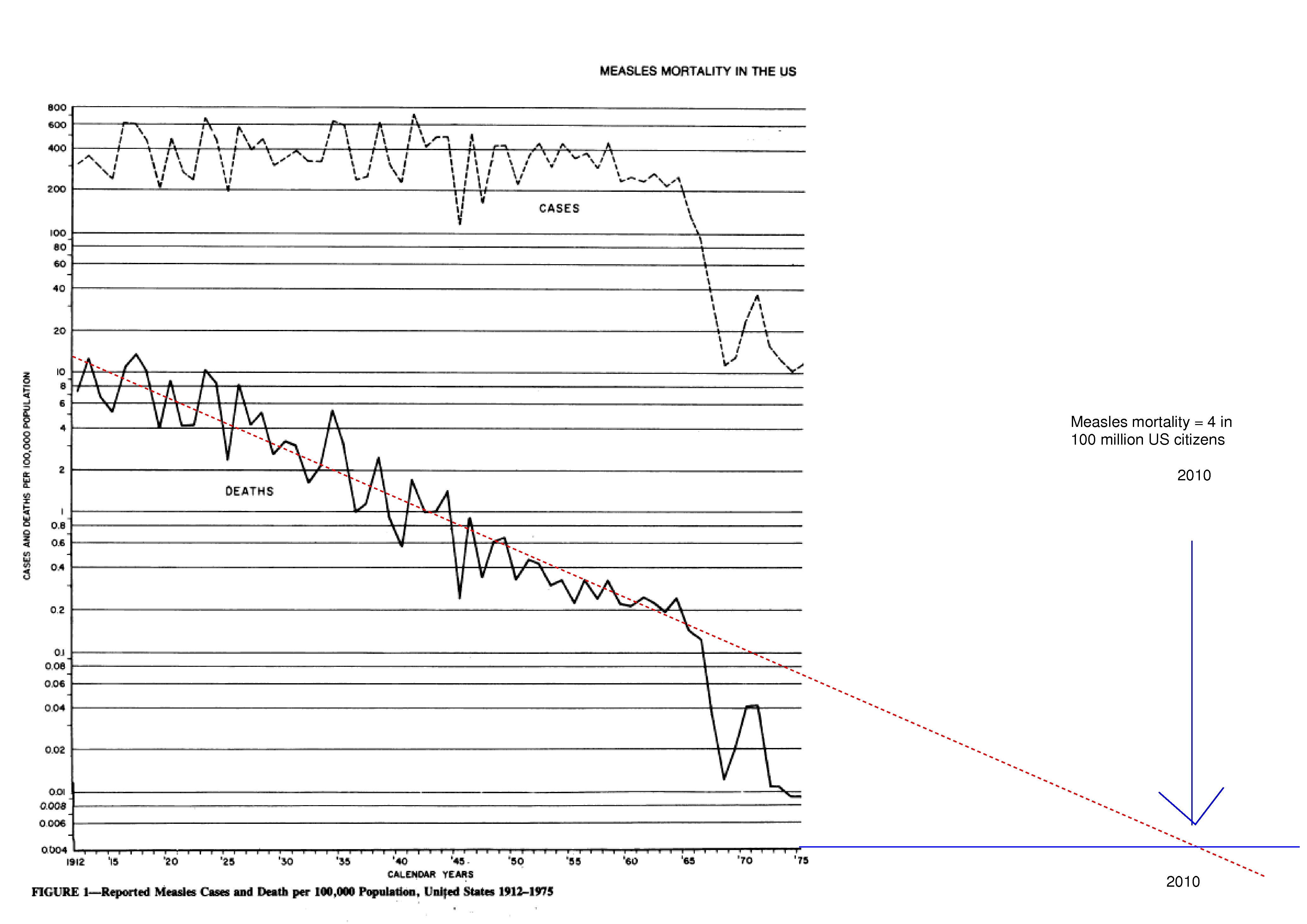
Consider this old graph. In a bit we will get to the edit that was done and how deceptive that is (click figure to enlarge):

measlesmortalityusa1971-75_1

The rate of measles infection dropped by about 30x between 1964 (before the introduction of the vaccine) and 1971. With that came a drop in deaths from measles. A factor that is very interesting, and very much misused, is the fact that the death rate from measles was steadily dropping before the introduction of the vaccine. Hence the “vaccines didn’t save us” myth. Had we just waited, the death rate would have dropped to the same level anyway. There’s a line extrapolating from the data that “shows” that.

First off–hooray for medical advances. They have improved the survival rate from measles. Damned glad they did. But, what about that line? Well, you can draw a line through pretty much anything if you try hard enough. It doesn’t mean anything if you don’t understand the mechanism causing the trend. Why should we expect the trend before 1965 to continue for the next 45 years?

While engaging in online discussions about measles outbreaks, I ran across this website from the U.K.. The table is “Measles notifications and deaths in England and Wales, 1940-2013”. The public health officials in the UK are supposed to be “notified” of every person infected with measles, so “notifications” are “cases”. Let’s consider the notifications. (click figure to enlarge)

Measles Notifications UK

This isn’t normalized to the total population, it’s just the raw number of cases in any given year. I’ve taken the liberty to point out some events which happen to coincide with changepoints in the graph. First is the introduction of the measles vaccine, after which the number of cases per year dropped dramatically. Second is the introduction of the MMR vaccine which, again, was followed by drops in the number of cases. Lastly we see the publication of Andrew Wakefield’s now-retracted Lancet study. Shortly after which, the number of cases started to rise again. Yes, correlation is not causation, but time after time, with vaccine after vaccine we see the same thing: introduce a vaccine and the incidence of that disease decreases.

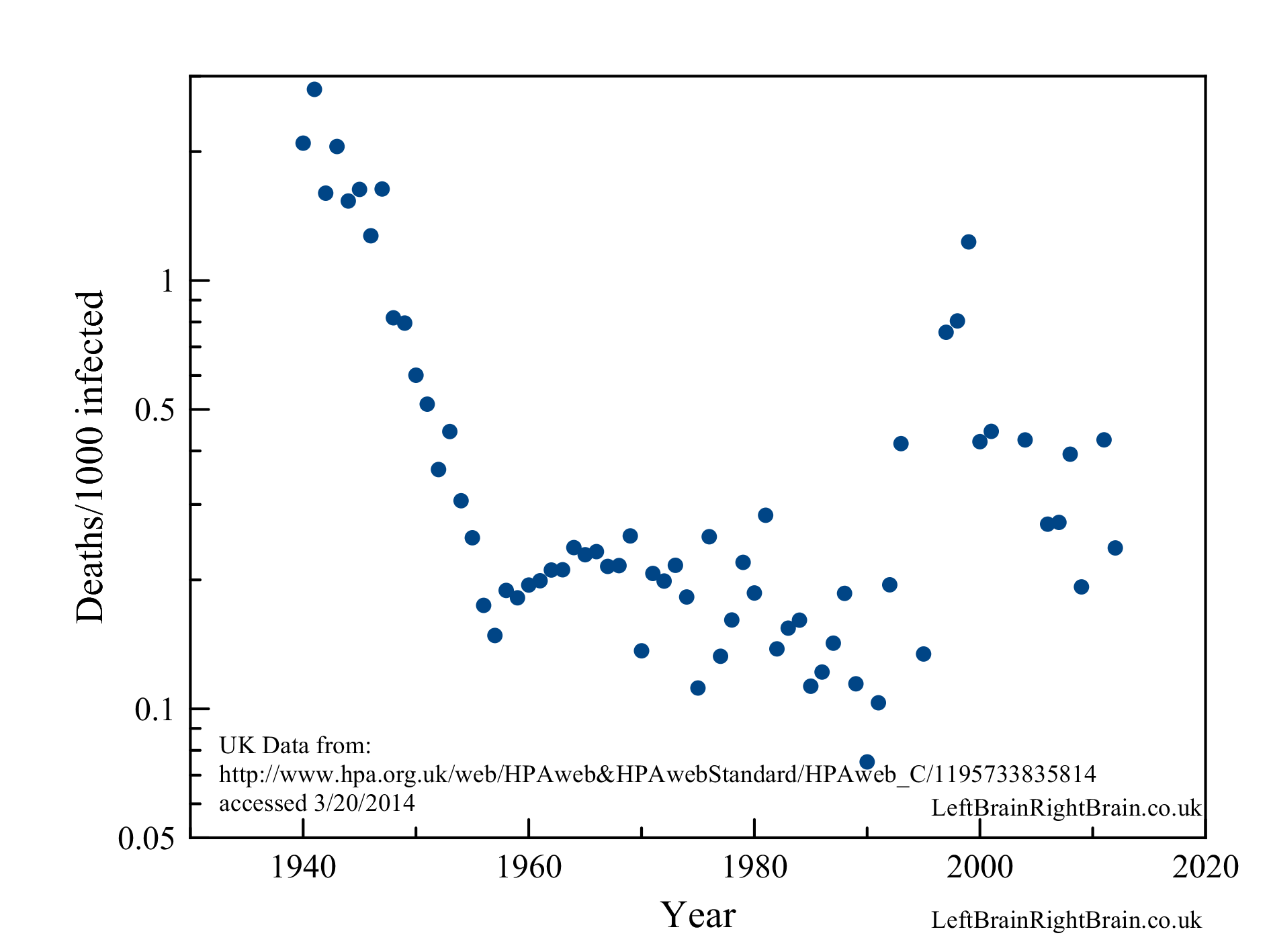
OK, we’ve looked at notifications. What about deaths? Let’s take the number of deaths and normalize by the number of notifications. In other words, let’s look at what fraction of those infected died.

Measles Deaths UK

Pre 1960 there was a steady drop in the fraction who died. Again, yay medicine. And, yes, yay nutrition and sanitation. After 1960, though, the fraction who died leveled off. 2-3 people per 1000 infected died. (it averages to about 2.6/1000 from 1960 onward).

None of this is news. In Measles Elimination in the United States, a team from the CDC writes:

By the late 1950s, even before the introduction of measles vaccine, measles-related deaths and case fatality rates in the United States had decreased markedly, presumably as a result of improvement in health care and nutrition. From 1956 to 1960, an average of 450 measles-related deaths were reported each year (∼1 death/ 1000 reported cases), compared with an average of 5300 measles-related deaths during 1912–1916 (26 deaths/ 1000 reported cases)

Catch that–that’s people from the CDC saying “yay healthcare! Yay nutrition!” and “yay vaccines!”.

Did nutrition, sanitation and improved medical care reduce the fraction of people who died from measles infection? Absolutely. Was it enough? No. Can we draw lines from old data and claim that the number who would die today would be 4 in 100 million today? Well, sure, you can draw the line. It’s dishonest, but given the source that’s not surprising. As I wrote above, you can draw a line through anything. Doesn’t make it true. If you don’t know the reason why a trend is happening, or the limitations on that trend, it’s meaningless. In this case there was a “hard floor”. There are deaths from measles that sanitation, nutrition and modern medicine can’t prevent. People still die from measles. Measles deaths in France (modern sanitation, nutrition and medicine) were seen at a rate of 3/1000 in recent years. Pregnant women, fetuses, small children and the infirm are more likely to suffer. Which is why when people like “Dr. Bob” Sears and “Dr. Jay” Gordon downplay the risks of measles–in effect telling their readers to keep relying on the rest of us to provide herd immunity–people like me speak up. Yes it’s a diversion from autism, but it’s a diversion fed by some of my fellow autism parents. And it’s an important diversion.


By Matt Carey

A cause célèbre for those claiming vaccines cause autism

1 Mar

If you participate in online discussions about autism and vaccines (and I’d advise you to spend your time more productively), you will often hear about how the U.S. Court of Federal Claims (the “Vaccine Court”) has compensated numerous cases of autism, the government just doesn’t admit it. These are often referred to as “secret” compensations, even though the decisions are in the public record. And, quite frankly, the families were not compensated for autism claims.

One family whose story has become a cause célèbre thanks to David Kirby is now the topic of a new Court decision. In this new decision, the court responds to the parents request to have past court documents redacted. They would like to stop being approached by members of the media.

Before we get to the new decision, consider Mr. Kirby’s story:

The parents, who did not want to be interviewed, specifically asserted that [child] “suffered a Vaccine Table Injury, namely, an encephalopathy” as a result of his MMR vaccination on December 19, 2003.” (“Table injuries” are known, compensable adverse reactions to immunizations.)

Alternatively, they claim that “as a cumulative result of his receipt of each and every vaccination between March 25, 2003 and February 22, 2005, [child] has suffered . . . neuroimmunologically mediated dysfunctions in the form of asthma and ASD.”

(child’s name redacted by me)

The parents didn’t want to be interviewed. They also presented two claims, one encephalopathy and one autism. Mr. Kirby focused on the autism claim, even though it wasn’t compensated. Mr. Kirby states:

Whether HHS agreed with [child]’s parents that his vaccine-induced brain disease led to ASD is unknown. The concession document is under seal.

Actually, it was known. The proffer of an award was titled “Proffer on Award of Compensation; Measles-Mumps-Rubella (MMR); Table Injury; Encephalitis.”

The child was being compensated for a table injury: encephalitis. Within that document, it is clearly stated:

On June 9, 2011, respondent filed a supplemental report pursuant to Vaccine Rule 4(c) stating it was respondent’s view that Ryan suffered a Table injury under the Vaccine Act – namely, an encephalitis within five to fifteen days following receipt of the December 19, 2003 MMR vaccine, see 42 C.F.R. § 100.3(a)(III)(B), and that this case is appropriate for compensation under the terms of the Vaccine Program

Emphasis mine.

Even with this information showing the family were not compensating autism clearly in the public domain Mr. Kirby tells us it’s “unknown”. Then, true to Mr. Kirby’s style, he leads his readers to the evidence supporting the possibility that it was ASD while never coming right out and saying it.

Perhaps the feds were loath to concede yet another vaccine case involving autism. Four cases in the Autism Omnibus Proceedings were recently compensated. Three of those cases are marked with asterisks, indicating the government did not conclude that autism can be caused by vaccines. But the fourth autism case that was paid out in 2013 ([child]’s case? We don’t know) has no such caveat.

Mr. Kirby was referring to the HRSA statistics page that lists vaccine court petitions filed and compensated. At the time Mr. Kirby wrote his piece, the statistics report did include autism cases. They no longer do, so you have to check archived pages to see what he’s referring to.

At the time of Mr. Kirby’s article, there appear to have been two cases where someone in the Omnibus Autism Proceeding did receive compensation (I don’t have reason to believe Mr. Kirby was in error, but the archived page doesn’t show four cases). Both of those cases had asterisks.

*May include case(s) that were originally filed and processed as an OAP cases but in which the final adjudication does not include a finding of vaccine-related autism

Mr. Kirby concluded with:

Meanwhile, as HHS says it “has never concluded in any case that autism was caused by vaccination,” it is still underwriting autism treatments such as ABA for children in its vaccine-injury program.

Which basically reads as “the government is making a distinction without a difference”. I.e. the reader comes away with the impression that the government really are compensating autism.

We knew then that these parents didn’t want to talk to the media. They didn’t want to speak with Mr. Kirby, to become his latest cause célèbre. And now we know that they still do not want this attention and we read once again that the case was not compensated for autism. From a recent decision:

“Petitioners have made these requests because they have had the misfortune of being frequently contacted by members of the media who mistakenly believe they were compensated for their alternative autism allegation when Petitioners were actually compensated for a Table Injury encephalopathy.”

Given the family’s clear intent to get out of the public’s eye, I am hesitant to put this article out. But perhaps, just perhaps, some of those using this family as part of their constant fight to keep the autism/vaccine idea alive might reconsider.


By Matt Carey

Comment on: Wrong About Vaccine Safety: A Review of Andrew Wakefield’s “Callous Disregard”

23 Jan

Andrew Wakefield has been discussed here and elsewhere a great deal. Thankfully his presence in the autism communities seems to have retreated to a small core of supporters and the occasional parent convention where he can, yet again, defend himself. Yes, his supporters are vocal. And, yes, he continues to cause harm. But his heyday is long past.

Mr. Wakfield was stripped of his medical license after an extremely lengthy hearing. Mr. Wakefield chose to not present evidence at the hearing, chose not to appeal the decision and has, instead, offered up his defense in a book: “Callous Disregard”. Callous Disregard has been discussed online multiple times.

Mr. Wakefield and his supporters tend to make sciency appearing defenses of him. For example, there are claims that his work has multiple independent replications in various countries. If one checks the references used to make that claim, one finds the claim is, well, false. Citations in “Callous Disregard” often do not support the arguments Mr. Wakefield is making. But few people have the time to go through his prose, much less his references.

One gentleman has taken on that task. Joel A. Harrison, PhD, MPH, has published a paper: Wrong About Vaccine Safety: A Review of Andrew Wakefield’s “Callous Disregard” in which he debunks the main claims in “Callous Disregard”. Here is the abstract:

Abstract: On February 28, 1998, Dr. Andrew Wakefield published an article in the Lancet on 12 children “with a history of pervasive developmental disorder and intestinal symptoms. Onset of behavioral symptoms was associated, by the parents, with measles, mumps, and rubella vaccination in eight of the 12 children.” Though not claiming the MMR vaccine caused the symptoms, adding what parents thought certainly raised the possibility. Statements and articles by Wakefield suggested he believed such a link probable. Vaccination rates plummeted in the UK and outbreaks of vaccine preventable diseases followed. Investigative journalist Brian Deer uncovered dishonest and unethical medical practices by Wakefield, resulting in Wakefield losing his medical license. Rather than appeal the decision, Wakefield wrote a book, “Callous Disregard: Autism and Vaccines – The Truth Behind a Tragedy,” wherein he claims loss of his license was a political attempt to silence his criticism of vaccine safety. This paper examines the validity of Wakefield’s claims. A careful review of publicly available information makes it clear that Wakefield’s claims regarding vaccine safety are wrong. It is hoped that this review will be used by doctors and public health personnel to encourage parents hesitating to have their children vaccinated to question anti-vaccination claims in general, given that many proponents often refer to Wakefield as an authority and display in their own writings and pronouncements similar erroneous claims.

The paper is 17 pages as published and includes 142 references. His conclusion is quite strong, and includes this paragraph:

I have shown that every major claim Wakefield makes in his book concerning vaccine safety is wrong. I have given accurate quotes from both Wakefield’s book and sources that contradict his claims, including those he misquotes. Based on the old adage, “trust but verify,” where possible I have given the URLs to many of the documents and articles referred to in this paper. My hope is that those who take the time to check will realize that Wakefield’s claims regarding vaccine safety are not only wrong but also harmful, and that once this is realized, people will read Deer’s articles [3] and the British Medical Council’s findings [1,2] with an open mind.

How does he back up such a strong conclusion? Consider this point he makes in his summary (which is discussed at length in the paper)

Wakefield claims that a leading Swedish vaccine researcher, Dr. Christenson, told him that vaccine safety studies had not been carried out in Sweden; yet, gives references to two Swedish papers that extensively report on vaccine safety studies in Sweden, one of them coauthored by Dr. Christenson.

Yes, once again, we see Mr. Wakefield claiming something which the very references he uses show the opposite.

Consider Mr. Wakefield’s stance on the Urabe-strain containing mumps vaccine (a component of the MMR used for some time in the UK). Mr. Wakefield ignored the Urabe vaccine during his time as an expert for the MMR litigation in the UK but has more recently taken the story up as some sort of defense of himself. If that sounds confusing, it really isn’t. Mr. Wakefield thinks we all will just forget that he pushed his own pet theory 15 years ago and just listen to the fearful message he gives now.

Dr. Harrison states:

“Wakefield claims that the Urabe mumps strain contained in the MMR vaccine used in the UK starting in 1988 had been approved after the Canadians withdrew it. Not True.”

Yes, the UK didn’t approve the Urabe Strain vaccine after Canada withdrew it.

Canada licensed Trivirix in May 1986 [57]. The starting date for the UK for MMR vaccinations was October 1, 1988 [58,59]. The license for Trivirix was withdrawn in Canada in May 1990 stating: “Recent laboratory findings from the United Kingdom, Canada and Japan have provided sound evidence. . . In addition, the report states: “The infection follows the course of benign aseptic meningitis” [60]. The UK withdrew the Urabe-containing vaccine on September 14, 1992 [61].

Dr. Harrison also goes to great length to discuss how Mr. Wakefield’s characterization of the Urabe strain vaccine is inaccurate–painting a story of a dangerous vaccine where the evidence does not support this argument.

So Wakefield carried out an incorrect statistical analysis, claimed the authors combined the data when they did not, and incorrectly gave a shorter follow-up time. All of these inaccuracies move evidence from showing safety to showing possible harm.

Dr. Harrison concludes the paper with:

The only conclusion that can be reached from this review is that the title of Wakefield’s book is incomplete. It should read: “Andrew Wakefield’s Callous Disregard for the Facts.”

A rather bold statement given Mr. Wakefield’s litigious nature, having brought suit against the BMJ and Brian Deer and threatening an autism charity with legal action.

Mr. Wakefield’s supporters will likely ignore this lengthy takedown. Mr. Wakefield is dishonest. He lies. And the sad thing is that people believe him.


By Matt Carey

note: minor edits were made after this article was published

Autism, Denmark and again no link with vaccines.

25 Aug

For a while now, I’ve been hoping that someone would publish data on the current state autism prevalence by birth year in Denmark. Denmark has been used for epidemiological studies for autism since their is a national database for health care. Thus, one can obtain a count of all people in Denmark who have been diagnosed with autism. Which is not the same thing as saying they have a count of all people in the country who are autistic. One can be autistic and not be diagnosed, as we will see.

A recent study using the Danish database is Recurrence of Autism Spectrum Disorders in Full- and Half-Siblings and Trends Over Time: A Population-Based Cohort Study. It’s an interesting study and I feel somewhat guilty for pulling the time-trend data out for my own discussion. In short, the study found that if a family has one child who is autistic, the chance for a subsequent child to be autistic is about 7 times higher than for families without an autistic child. This is fairly consistent with many other sibling studies over the years, but much lower than found in the recent baby siblings study out of the MIND Institute. That might be due to the active surveillance used by the team at MIND. I.e. they were actively monitoring and testing baby siblings.

Much more, they conclude:

Although the results from our comparison of recurrence in full- and half-siblings support the role of genetics in ASDs, the significant recurrence in maternal half-siblings may support the idea of a contributing role of factors associated with pregnancy and the maternal intrauterine environment. Finally, the lack of a time trend in the relative recurrence risk in our data suggests that the likely combination of genetic and environmental factors contributes to the risk for ASD recurrence in siblings or that the risk for recurrence because of such factors has not been affected by the rise in the ASD prevalence.

Very interesting–whatever is behind the higher prevalence among younger siblings, it seems to be the same today as 30 years ago.

What’s the overall prevalence of autism in Denmark according to this study? For childhood autism, they report 0.3%. For all ASD’s, 1.2%.

Autism, we are told by those promoting the autism/vaccine link, is unmistakable. Each autism prevalence report is not an estimate, but an accurate count of every autsitic because there is no way to miss an autistic. Back in the day, Rick Rollens was a constant fixture in the news on autism. He was a strong proponent of the idea that one could not miss autism:

WATSON:
Like many parents, Rick is convinced that Russell was damaged by a series of vaccinations. He strongly rejects the idea that the epidemic of autism can be entirely explained by poor diagnosis in the past because numbers have rose over the last few years.

ROLLENS:
Missing child with autism is like missing a train wreck. For us now to now think that somehow we have better identified a child who can’t talk, who has repetitive behaviour. Who makes no eye contact. Who is self- involved and in many cases self-abusive just defies logic.

Mr. Rollens was wrong on two counts (leaving aside his inflammatory and derogatory language). First, autism is not just the child who can not talk, self-involved and self-abusive. Second, yes, a lot of autistics have been missed. We’ve seen that time and time again. Look at the same population at different times and the later study will have found more autistics. An this goes for autistics with intellectual disability, as shown in the recent UCLA/Utah autism followup: “Today’s diagnostic criteria applied to participants ascertained in the 1980s identified more cases of autism with intellectual disability. ”

But, what about Denmark? A study from 10 years ago looked at autism incidence following the removal of thimerosal in Denmark in 1992. Thimerosal and the occurrence of autism: negative ecological evidence from Danish population-based data

In that study they found 956 children born in their study period who were diagnosed with autism by 2000:

A total of 956 children with a male to female ratio of 3.5:1 had been diagnosed with autism during the period 1971–2000.

The current Denmark study included individuals diagnosed until the end of 2010. I.e. there were 10 more years of followup. In those 10 years a lot more people were diagnosed. Where there were 956 diagnosed with autism by 2000 (for birth years 1971 to 2000), 2321 were diagnosed by 2010. That’s an increase of 240%. And the new study focused on birth years 1980 to 1999. I.e. the entire 1970’s birth cohort is not included in this count, and they still found over twice as many autistics. Where were they in 2000, when the previous study was performed? Living in Denmark, not identified as autistic.

There are a few factors which are likely behind this increase, but here we have a great example of “increased awareness” affecting autism prevalence.

And, those numbers were for childhood autism. For ASD, the increase is even larger. 10,377 Danes had an autism spectrum disorder diagnosis (for birth years 1980-1999) in the new study (the previous study included none). That’s a whopping 1080% increase. Again, there are a few reasons for this (including the increased awareness above), but here’s what “expanding the definition” does to autism.

Those increases would be an “epidemic” to some if it weren’t for the fact that those autistic Danes were there all along. They just weren’t diagnosed in 2000.

For many years, groups touting the idea that vaccines cause autism have pointed to Denmark as part of their argument. Denmark uses fewer vaccines than the U.S.. Generation Rescue used to have this on their website discussion of vaccines:

Comment: Denmark is a first world country based in Western Europe. Their schedule appears far more reasonable than ours. They have also been reported to have a much lower rate of autism than the U.S. Do they know something we don’t?

What was that Danish vaccine schedule that Generation Rescue recommended?

DTaP at 3, 5 and 12 months
Hib at 3, 5 and 12 months
IPV at 3, 5 and 12 months, plus 5 years
MMR at 15 months and 12 years

No mercury (Denmark phased that out in 1992). No birth dose of Hepatitis B. Fewer vaccines overall than in the U.S.. And the same autism prevalence of about 1%.

If you dive into more details, it gets even worse for the vaccines and/or thimerosal cause autism argument. Let’s look at the prevalence as a function of birth year for childhood autism and ASD from the recent study:
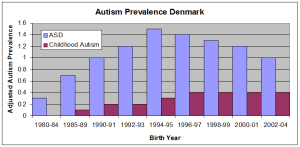
AutismPrevalenceDenmark

Consider this statement from a previous study:

This means that children who followed the full vaccination program during the period 1961–1970 had received a total of 400 g of thimerosal or 200 g of ethyl mercury by the age of 15 months and during the period 1970–1992 they had received a total of 250 g of thimerosal or 125 g of ethyl mercury at 10 months of age. In March 1992 the last batch of thimerosalcontaining vaccine was released and distributed from Statens Serum Institut in Denmark.

The thimerosal exposure was higher prior to 1992 than after. But the prevalence of both childhood autism and ASD is higher after the removal of thimerosal. This is the same result as shown in the 2003 study. The number of vaccines seems to be constant over this time period, so number of vaccines/aluminum/too-many-too-soon or other arguments don’t work either.

How about taking just a single year. The prevalence for ASD in 1996-97 was 1.4%. What is the autism prevalence in the U.S. for that year? To answer accurately, I’d contend we need a count today, not an old one. But people promoting the idea that vaccines cause autism take the CDC reports as absolute measures of autism, comparing each report and telling us all about the epidemic. So, let’s take the CDC number for kids born in 1994: 0.8%. That study was reported in 2009.

So, we have 1.4% in Denmark and 0.8%, nearly half the Danish prevalence, in the U.S.. Denmark had no thimerosal, no Hepatitis B shot (birth or otherwise), fewer vaccines and less aluminum exposure. And much higher reported autism prevalence.

Oddly enough, even though there have been many prevalence studies out of Denmark, Tomljenovic and Shaw didn’t include Denmark in their study “Do aluminum vaccine adjuvants contribute to the rising prevalence of autism?” My guess is that Denmark didn’t fit their conclusion then, and, like Iceland, would make their analysis fall apart now. It is even more odd that Tomljenovic and Shaw didn’t use Denmark as Denmark was used in a faux-study put out by Generation Rescue. In AUTISM AND VACCINES AROUND THE WORLD: Vaccine Schedules, Autism Rates, and Under 5 Mortality Someone at Generation Rescue made the first attempt at the sleight of hand of comparing the autism prevalence in various countries vs their vaccine schedules. At that time, 2009, Generation Rescue claimed that the autism prevalence in Denmark was 1 in 2,200, misrepresenting the 2003 study discussed here. The raw prevalence in this 2008 study was 0.65% or about 1 in 153. That value didn’t fit the thesis that the Generation Rescue author wanted to convey.

One argument found on the internet is that the 2003 Denmark paper fudged the results by clipping the last years off the data presented. An email involving people involved in the study is quoted as saying, “But the incidence and prevalence are still decreasing in 2001“. Oh, my, we are told, the autism prevalence and incidence actually went down after the removal of thimerosal!

But, it didn’t. The prevalence of childhood autism (basically what was studied in the 2003 paper) in Denmark is flat from birth cohorts 1996-2004. Flat. The prevalence of ASD’s do see a decline. That must be it! Evidence that thimerosal was causing autism in Denmark! But it isn’t. The prevalence of ASD in 2003-04 is the same as that in 1990-91, before thimerosal was removed. Why does the ASD prevalence go down? We can’t say for sure, but my strong suspicion is that it’s the same reason why the authors in 2003 were seeing a decrease: too few years of follow up. Autistic kids are typically diagnosed earlier than those with other ASD’s, but the average age was about 5 in Denmark in 2003 (as I recall). ASD kids can have an average age of diagnosis of 8. Recall that the recently released study followed kids up to the end of 2010. It’s no surprise to me that the estimated prevalence for ASD kids born in 2002 is lower than that for kids born in 2000 in this study. And this is consistent with the flat prevalence for kids with childhood autism diagnoses, as they are typically diagnosed earlier and 8-9 years would be enough to find the majority of the autistics in that population.

What about the idea that there’s a “changepoint” in the autism prevalence in Denmark and California pointing to some event in the late 1980s that’s contributing to autism prevalence? For one thing, the present study notes that the recurrence risk doesn’t change with time, so that’s good evidence against such an idea. There is no changepoint in the California data in the 1980’s, as it is exponential and fitting it to two straight lines is just a mistake. What about the prevalence data just released? The data are not finely spaced in birth years, in my opinion, to give a good idea of any “changepoints” in the 1980’s. But there is a changepoint of sorts in the childhood autism data in the 1990’s. The data plateaus at about 1996. But, as already noted, this doesn’t coincide with anything related to vaccines. The ASD prevalence appears to peak at about 1994, but, again, this doesn’t coincide with vaccine events and, I suspect, results largely from lack of follow up for the kids in the later birth years.

How about the MMR vaccine? MMR uptake for young children (MMR1) was basically flat from 1987-1997. Uptake rose somewhat after that. So, during the period that the estimated prevalence was increasing, MMR uptake was basically flat. During the time that the estimated prevalence was either flat (childhood autism) or decreasing (ASD’s), the MMR uptake was increasing. So if we were to play the “correlation equals causation” game, MMR prevents autism. (two notes, preventing rubella infections most likely does prevent some autism and the link above shows a nice example of rubella infections going down after MMR was introduced in 1987. The two points are not linked because most women in Denmark who were infected with rubella before 18 weeks gestation chose abortion, resulting in a low congenital rubella syndrome prevalence).

How about the “fetal cells in vaccines cause autism” argument? It’s one without biological plausibility, but then so was the thimerosal idea. I’d be interested in seeing how the vaccines were produced in Denmark in the 1990’s, but at present, the MMR vaccine there is developed using chicken eggs, not fetal cell lines. And they don’t routinely vaccinate against chickenpox, another vaccine in the U.S. using fetal cell lines. It looks like at least as far back as 1999 they were using egg-based vaccine production for MMR.

So, it appears we have a country with no vaccines grown in fetal cell lines with an autism prevalence as high or higher than that in the U.S.. In other words, the “vaccines from fetal cell lines caused the ‘autism epidemic’ theory” also appears to be debunked by the Denmark data.

In case you are looking for correlations with the vaccine program, here’s the history in Denmark.

So, how about the rise in estimated prevalence in the 1980’s. Is it “real”, as in does it represent an actual increase in the fraction of autistics in the population? It’s a good question and one which could be answered by performing a real study of autism prevalence in adults. The sort of study I and others have called for in the U.S., but that most autism-parent advocacy groups have refused to support. Such a study would not only answer the question of the prevalence, but it would give us valuable data on what has led to success and failure among the autistic adult population.

For those promoting the idea that environmental mercury emissions are a factor in the increase of autism rates, if you have data for Denmark, I’d love to see it. In the U.S., environmental mercury emissions dropped by over 50% in the 1990’s.

Lastly, let’s discuss a comment statement one will read or hear. It goes something like “the autism prevalence was 1 in 10,000 in 1980 and it’s 1 in 1,000 today”. This involves a number of sleights of hand. First, the autism prevalence wasn’t 1 in 10,000 in 1980. It was a few in 10,000 (Wing and Gould reported about 5/10,000). Doesn’t sound like a big deal, but when people start taking ratios (it went up a gazillion percent) a factor of 2 or 3 in the denominator makes a difference. Second, this was the estimated prevalence based on the number of autistics diagnosed at the time. As shown above, the childhood autism prevalence estimate for Denmark in the 1980’s increased by 240% in the past decade. This was not a real increase, but better identification. Third, the comparison is between autism (childhood autism, DSM-III autism or some other restrictive definition) vs. autism spectrum disorders. Also shown above was that the prevalence of ASD’s in the 1980’s increased by a factor of 10, increasing only in the past 10 years.

A factor of 10 in the numerator, a factor of 3 or 4 in the denominator and pretty soon you are talking about a big part of the increases observed.

In the end, none of the above arguments are that new. Or, to put it better, none of the vaccines-cause-autism arguments had much real support. The mercury idea has lost much of the support it had 10 years ago in the parent community, but it persists. The aluminum in vaccines idea has risen to try to take the place of the mercury hypothesis, but it is based on the exact same smoke and mirrors. The idea that the increase in autism is due to the MMR has been scientifically dead for years. And, yet, these ideas persist. And they cause harm, both to the community at large and to the autism community.


Matt Carey

A fishing expedition at Vaccine Court

14 Jul

The U.S. Court of Federal Claims has a section devoted to adjudicating claims of vaccine injury. This is often referred to as the “Vaccine Court”. Individuals or their families can file a claim (petition) the court for alleged vaccine injury.

Information on individuals who are vaccinated are kept by ten Managed Care Organizations (MCO’s) and the Centers for Disease Control as the Vaccine Safety Datalink (VSD) Project. Researchers working as expert witnesses for families in the Vaccine Court have accessed the VSD in the past, and in one case misused their access. Possibly as a result of this, the MCO’s stopped contributing their data to the CDC for a single VSD database. Hence the reason why there are now 11 separate databases, with each MCO retaining control over their data.

One can see how groups who want to argue vaccine injury in court might want access to the VSD. Mark and David Geier have in the past attempted to use the VSD and they were the ones caught misusing the database. They, together with Heather Young, used an older VSD dataset to produce a paper for the Petitioners Steering Committee (the attorneys arguing for the families in the Omnibus Autism Proceeding). A paper for which the PSC was charged $250,000. A paper which was of such poor quality that it was not used by the PSC in the Omnibus.

In a recent decision, the Court heard arguments that the information in the Vaccine Safety Datalink Project should be turned over to their expert, Theresa Deisher, for analysis:

Petitioners seek access to data from the Vaccine Safety Datalink Project (hereafter the VSD Project) to allow their expert, Theresa A. Deisher, Ph.D., to conduct an original study comparing the rate of autism disorder incidence among children who received a particular vaccine, with the rate among children who did not receive that vaccine. As discussed more fully below, petitioners’ expert does not seek to study the MMR vaccine at issue in this matter, but rather the varicella vaccine.

That last sentence is important. The Special Master points out the decision to research whether the varicella vaccine (chickenpox) is associated with autism for good reason. The petitioners are not arguing that the varicella vaccine caused their child’s autism. No, they argue that the child reacted to DNA in the MMR vaccine resulting in autism. So, how a study on the chickenpox vaccine would further their case is somewhat unclear. Why they are not asking for data on chickenpox is even less clear.

The petitioners asked for $260,000 up front to fund the study. To my knowledge, the Court does not fund expert witnesses for efforts not yet performed. Aside from that fact, the Special Master noted that Theresa Deisher’s studies on the subject done to date were already funded.

Dr. Deisher notes that this work was funded by the MJ Murdock Charitable Trust, Pet’rs’ Ex. 26 at 18, which according to information on Deisher’s CV, provided her with a $500,000 grant to study “Population, Bioinformatics and In Vitro Studies into the Relationship between Residual Human DNA Vaccine Contaminants and Autism.” Deisher’s CV at 3. Dr. Deisher’s inability to produce a paper of publishable quality, after receiving a substantial grant, does not lend support to petitioners’ claim that she is capable of competently leading a study.

Yes, half a million dollars so far with no papers published. A manuscript was submitted to Autism Research and rejected. My guess is that the manuscript will soon be submitted to a journal (there are those which will welcome this). Or, one of these journals will seek out Ms. Deisher for her work (I could easily see this being published in a certain Polish journal, for example).

One can apply to gain access to the VSD databases. However, Ms. Deisher has not attempted to access the data in this way, opting instead to gain access through a court order.

As discussed in more detail later in this Order, petitioners acknowledge that Dr. Deisher has not followed the CDC’s usual Data Sharing application process and that she has no intention of doing so.

She did, however, apply for an NIH grant to perform this research. The petitioners claim that the controversial nature of the study resulted in it not being funded. The referee reports, however, were clear that the planned study was weak and Ms. Deisher’s skills were not strong in epidemiology and statistics (among other weak points).

Although petitioners make assertions to the contrary, the evidentiary record before the undersigned contains a withering assessment of Dr. Deisher’s ability to competently lead the proposed study. Petitioners here seek extraordinary relief, and the undersigned is reluctant to substitute her scientific judgment for that of the NIH reviewers—a panel of Dr. Deisher’s peers—who have found her proposed study to be critically deficient. In the undersigned’s view, the NIH reviewers’ comments merit weighted consideration.

“Withering assessment”.

The special master also notes that the request for data from the VSD exceeds the data needed to do the proposed study.

The petitioners do not limit their data request to information that is needed for the study they propose:

Despite the stated limits of her study, petitioners’ request for production from respondent and the MCOs lacks correlative limits for patient age and injury. Instead: petitioners seek authority to issue subpoenae to compel [respondent and the MCOs] to grant the petitioners full and unrestricted access to all data collected by the respondent within the VSD related to the administration of vaccines, and the occurrence of neurodevelopment and other disorders from the inception of the VSD to date.

Which, in my opinion, points to this as a fishing expedition. An attempt to gather any and all data and test multiple questions later–with the probability of a chance “hit” going up with the number of questions tested.

Since the Special Master did not grant access to the VSD, the funding request was also denied.

The petitioners asked that the expert witness fees for Theresa Because petitioners’ discovery request is denied, petitioners’ motion for authorization of interim expert expenses is deemed moot.

The decision also includes much discussion of a large, broad request for information from the FDA on the vaccine approval process. Again, this appears as a “fishing expedition”

Petitioners’ motion does not appear to be a well-considered effort to meet their evidentiary burden under the Vaccine Program; but rather appears to be a brazen attempt to gain access to respondent’s comments on the various vaccine licensing applications in the hope that something therein might be of relevance. As presented, there is nothing in petitioners’ briefing or the record showing that the documents under FDA’s control are necessary to a determination of the issues in this matter

Ms. Deisher’s previous research has focused on “changepoint” analysis of autism prevalence data. She follows the method set forth by two people at the FDA who presented such a changepoint analysis previously. I found that analysis lacking and submitted a comment to the journal on it. I find Ms. Deisher’s analysis lacking as well.

In the end, the petitioners shot themselves in the foot, repeatedly. They made an overly broad request for data (essentially the entire VSD database). They requested the funding for the analysis in advance. Their expert witness’ track record was lacking. The proposed a search of FDA documents without providing a good reason why this was important for their case.

They went fishing and they got skunked.


By Matt Carey