Archive | Authors RSS feed for this section

The time is NOW–please give the IACC input on the Strategic Plan

6 Jul

As many readers here may recall, I spent a few years as a public member to the Interagency Autism Coordinating Committee (IACC). The IACC is mandated by the same law that commits the government to funding autism research. The most important thing the IACC does is draft the Strategic Plan. This is the how the autism communities tell the government and other funding agencies what research projects we want performed. That Plan is up for a major revision. Something that hasn’t happened since before I was on the IACC. Now is when the real work of the IACC is going to happen.

And they want your feedback. They need your feedback. There is a website open now to submit feedback: Request for Public Comments – 2016 IACC Strategic Plan. I list the questions below so you can prepare–but go to that website and give feedback. Do it now. Don’t put it off and possibly miss the chance to give feedback.

Maybe you want to give feedback on only one topic. Great. Maybe you want to give a lot of feedback. Great. But do it. Do it now.

Why?

Do you want a major focus on, say, supporting high support adults? Early intervention? Better education supports and strategies for older students?

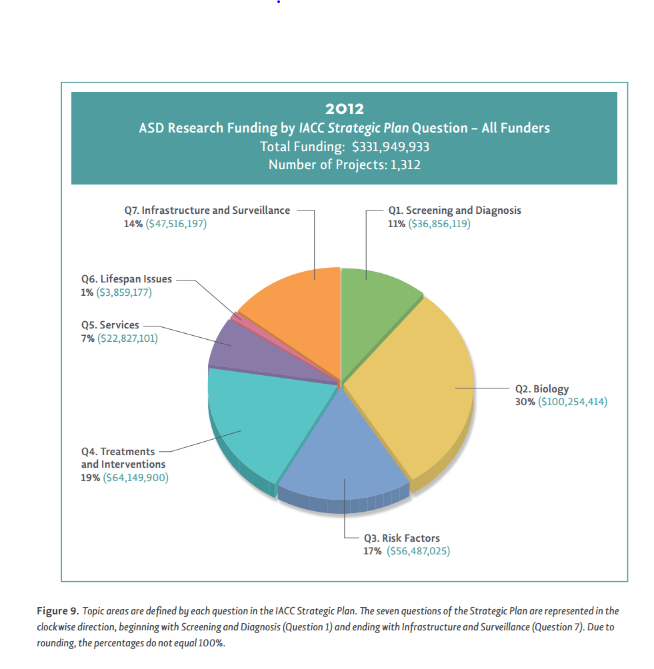
We aren’t talking small amounts of money. Here’s a figure from the IACC’s Portfolio Analysis from 2012. That’s over $300,000,000.00 spent in one year. Three hundred million plus dollars.

Autism Expenses 2012

Is that the breakdown you want to see? Is that what will make a difference in your life, or the life of someone you care about?

It isn’t what I want or need. Research takes time to impact real life. I want autistic adults–especially those with high support needs–to have a better life. I’d like it NOW, but I need it by the time my kid ages out of school. In the pie chart above, “lifespan issues” account for 1% of the total funding. Lifespan issues is the term for issues involving adults.

1%.

That has to change. And I’ll give that feedback, and more.

You may have other areas, or other specific projects you want to see advances in. Let the IACC know. Let them know NOW. Request for Public Comments – 2016 IACC Strategic Plan

Here are the questions you will see on the website.

Question 1: When Should I Be Concerned? (Diagnosis and Screening)

Please identify what you consider the most important priorities and gaps in research, services and policy for Question 1. Topics include: diagnosis and screening tools, early signs, symptoms, and biomarkers, identification of subgroups, disparities in diagnosis

Question 2: How can I understand what is happening? (Biology of ASD)

Please identify what you consider the most important priorities and gaps in research, services and policy for Question 2. Topics include: molecular biology and neuroscience, developmental biology, cognitive and behavioral biology, genetic syndromes related to ASD, sex differences, immune and metabolic aspects, and co-occurring conditions in ASD

Question 3: What Caused This to Happen and Can it be Prevented? (Risk Factors)

Please identify what you cosnider the most important priorities and gaps in research, services and policy for Question 3. Topics include: genetic and environmental risk factors, gene-environment interactions, and the potential role of epigentics and the microbiome

Question 4: How can I understand what is happeing? (Treatments and Interventions)

Please identify what you consider the most important priorities and gaps in research, services and policy for Question 4. Topics include: behavioral, medical/pharmacologic, educational, techonology-based, and complementary/integrative interventions.

Question 5. Where can I turn for services? (Services)

Please identify what you consider the most important priorities and gaps in research, services and policy for Question 5. Topics include: service access and utilization, service systems, education, family well-being, efficacious and cost-effective service delivery, health and safety issues affecting children, and community inclusion.

Question 6. What does the future hold, especially for adults? (Lifespan Issues).

Please identify what you consider the most important priorities and gaps in research, services and policy for Question 6. Topics include: health and quality of life across the lifespan, aging, transition, and adult services, including eduction, vocational training, employment, housing, financial planning and community integration.

Question 7. What other infrastructure and surveillance needs must be met? (Lifespan Issues)

Please identify what you consider the most important priorities and gaps in research, services and policy for Question 7. Topics include: research infrastructure needs, ASD surveillance research, research workforce development, dissemination of research information, and strengthening collaboration.

Go to the website. Request for Public Comments – 2016 IACC Strategic Plan. Give them feedback. Did I mention you should do it now and not wait?


By Matt Carey

The next Hannah Poling. Not vaccine injured. No mitochondrial disease.

27 Jun

One of the main talking points for the idea that autism is a “vaccine induced epidemic” is the case of Hannah Poling. Hannah Poling was chosen as one of the test cases for the Omnibus Autism Proceeding (OAP). But before the case went to hearing, the Department of Health and Human Services conceded her case on the grounds that she met the criteria for a table injury. If you want more details there are a lot of discussions online, including a lot of misinformation. But basically a table injury means that Miss Poling met certain criteria in a prescribed time frame after receiving vaccines, so she is presumed vaccine injured. One can go into length about how this isn’t “the vaccine court decided vaccines caused her autism”, but that’s another story (if you are interested, Prof. Dorit Reiss discusses it in Vaccine Injury Compensation and Mitochondrial Disorders).

At the time, the Poling concession was big news, on CNN and elsewhere. The story broke when David Kirby released some of the details of the concession (the Rule 4c report, a report written by Department of Justice attorneys on behalf of HHS describing the concession.) Kirby was journalist/PR man working with groups promoting the idea that vaccines cause autism. Much of his writing was problematic at best, much more PR than journalism. Kirby stayed with the Poling story for some time, pushing the idea that mitochondrial disorders are highly prevalent in the autistic population and suggesting that these disorders were caused by vaccines. As part of that PR effort, he wrote this article:

The Next Vaccine-Autism Newsmaker: Not Isolated, Not Unusual

Which begins:

In February, I leaked news of the Federal government’s admission that vaccines had triggered autism in a little girl named Hannah Poling. The stunning revelation, though still reverberating around the world, was roundly downplayed by US officials, who insisted that Hannah had an extremely rare, genetic case of “aggravated” mitochondrial disorder, with zero bearing on other autism cases.

Dr. Julie Gerberding, Director of the US Centers for Disease Control and Prevention (CDC), rushed to the airwaves, exhorting parents to adhere to the nation’s intensive and virtually mandatory immunization schedule, and brushing off their legitimate anxieties by saying: “We’ve got to set aside this very isolated, unusual situation.”

Well, the days of setting aside are over: Hannah Poling is neither isolated nor unusual.

In fact, the boy who was selected to replace Hannah Poling as the first-ever thimerosal “test case” in so-called Vaccine Court, has just been found with many of the same unusual metabolic markers as… you guessed it, Hannah Poling.

You see, Hannah Poling was supposed to be a test case for the OAP. One of the arguments the families and attorneys were going to argue in the OAP was that autism is a form of mercury poisoning caused by thimerosal (which used to be in infant vaccines as a preservative.) That idea (and the Wakefield inspired MMR causes autism and bowel disease) failed to even come close to the rather lenient standard of proof of the vaccine court. No one knew for sure before the OAP hearings that the thimerosal argument would fail so completely. Those involved actually had a great deal of confidence. But even with this confidence, some families decided to leave the OAP when the Poling concession was made public.  Most notably Robert Krakow (an attorney and activist in the autism-is-vaccine-injury community) pulled his son’s case from the OAP. His son was to be one of the three thimerosal test cases and is the one Mr. Kirby was discussing in his “Not Isolated, Not Rare” article quoted above.

In many ways it was a strange decision on the part of Mr. Krakow. The expert report on the Krakow boy (made public as part of the OAP and since pulled) made no mention of mitochondrial dysfunction. Also, the court hadn’t decided that the idea that vaccines aggravate mitochondrial disorders causes autism. While many deny this, as an attorney Mr. Krakow must have known this point. Miss Poling was compensated because she showed signs of an encephalopathy soon after vaccination, so it was presumed that encephalopathy was caused by the vaccines. The Krakow boy’s history did not show this.

In another recent case, a vaccine court Special Master noted,

In Poling v. HHS, the presiding special master clarified that the family was compensated because the Respondent conceded that the Poling child had suffered a Table Injury–not because the Respondent or the special master had concluded that any vaccination had contributed to causing or aggravating the child’s ASD.

So the situation for the Krakow boy (and Hannah Poling)  was very, very different than David Kirby painted (as was often true). This wasn’t another Poling case. Mr. Krakow and his attorneys and experts would have to show that (a) his son had real signs of mitochondrial dysfunction, (b) the hypothesis that vaccines vaccines contribute to causing autism was valid (recall, it hadn’t been decided by hearing), (c) this hypothesis applied to his son even though his son didn’t show signs of encephalopathy following vaccination.

As you will see, none of these points were valid.

Mr. Krakow pulled his son’s case  in 2008. The case dragged on for 7 years as the Krakows tried to put together their argument. And it appears that they did not win. Based on the facts presented, these documents appear to be the final decision and a ruling on motions in the Krakow case. These have been anonymized so it is possible that these are not a discussion of the Krakow case, but since the facts so closely match, I will write as though it is the Krakow case for brevity and clarity.

The decisions are lengthy. This case is as involved–if not more–than those in the OAP itself. It’s as if this is the test case for a third OAP argument.

Here is a key paragraph from the documents:

“Petitioners have failed to show that A.K. had an underlying mitochondrial disorder. They have also failed to show that the onset of A.K.’s ASD was in any way related to his influenza vaccinations. Indeed, respondent persuasively presented significant evidence indicating that A.K.’s ASD onset predated his vaccinations. Nor did petitioners establish by preponderant evidence that A.K. experienced any regression of skills related to his ASD or his vaccinations””

The Krakow boy’s history is in no way similar to that of Hannah Poling. Since her case was conceded, we don’t know if she showed signs of autism before vaccination. We do know now that the Krakow boy did show signs of autism. Poling regressed. Krakow didn’t. Poling has evidence of mitochondrial disease. Krakow doesn’t.

There are other interesting statements in these documents. Here are a few. First:

“The measles, mumps, and rubella [“MMR’] vaccines are ordinarily administered in a combined MMR vaccination, but A.K. received his in three separate vaccinations administered on December 1, 2000 (mumps); December 19, 2000 (measles), and January 2, 2001 (rubella), when he was between 13-14 months of age”

Yes. The Krakow family was following the Wakefield-recommended “separate the MMR into single vaccines” schedule. Didn’t prevent autism. This seems like valuable information for the autism community, but Mr. Krakow chose to hold this information back.

The Special Master took on the general idea that vaccines trigger regression in people with mitochondrial disorders. The evidence is very much lacking and “remain speculative”.

Here, petitioners’ experts strained to stretch the idea of mitochondrial regression to encompass vaccines as triggers of such regression. As described above, that extension is completely unsupported by any scientific literature; it was presented in this case almost entirely through the opinion of Dr. Kendall, supported by one case report (Poling, Res. Ex. MM, Tab 14). Doctor Kendall’s and Dr. Shafrir’s further reliance on the Shoffner and Weissman papers was misplaced and their opinions that vaccines can act as triggers of mitochondrial regression were unpersuasive. Evidence that regression in ASD, a well-described phenomenon involving the loss social communication and behavior, “looks like” mitochondrial regression was also nearly non-existent. “Mitochondrial autism” may someday be accepted as a descriptor for co-morbid autism and mitochondrial disorder diagnoses, but there is little evidence that autism itself is caused by such disorder, and no evidence that autism causes mitochondrial disorders. While Dr. Kendall is one of the few mitochondrial disorder specialists in the U.S., her opinion that vaccines can trigger either onset of a mitochondrial disorder with symptoms looking like ASD, or ASD via a mitochondrial regression are insufficiently supported and remain speculative.

We parents are often hit with testimonials about how alternative medicine works wonders on autistic kids. With the OAP cases we heard about a child who had adverse reactions to chelation. In this case we hear that these alternative therapies just didn’t work:

Doctor Boris recommended a gluten-free, casein-free diet for A.K. and began therapies such as chelation, supplements to counteract the effects of his MTHFR gene defect, and autoimmune medications. Tr. at 168-69. He testified that A.K. “did not respond very well to most of the treatments [he] administered.”

In an interesting twist, The Krakow boy’s geneticist  recommended he get vaccinations:

I [the special master] noted that the geneticist who had been seeing A.K. had specifically recommended that he continue to receive vaccinations and indicated that he was a “good candidate” to receive seasonal vaccinations, such as influenza.

Many people have been trying to characterize the “vaccine court” (the Court of Federal Claims) as highly adversarial. But Mr. Krakow writes that “The tenor of VICP proceedings is exceptionally hostile and adversarial”. The record show the Court was far from hostile and adversarial.

Consider this. The record shows that Robert Krakow (an attorney who appears in the vaccine court) and the attorney he chose to take over his son’s case were not proactive in prosecuting their case:

Other than the filing of medical records, petitioners did little to advance their claim during the period in which [A.K.’s father] was attorney of record.

and

However, the glacial pace of progress toward a causation hearing continued for many months thereafter. Mr. McHugh’s representation has been marked with missed deadlines, repeated requests for delays, late filings, and difficulties in properly designating and filing exhibits. His failure to meet deadlines nearly cost petitioners the opportunity to fully litigate their son’s claim.

That last sentence refers to the fact that after years of delays and missed deadlines, the court was finally forced to dismiss the case for inaction:

Accordingly, after petitioners missed the deadlines set forth in my August 18, 2010 order, I ordered them to show cause why their case should not be dismissed for failure to prosecute and comply with court orders. See Order to Show Cause, issued Sept. 3, 2010 (ECF No. 98). After petitioners ignored the deadline in the show cause order, I dismissed their petition on October 13, 2010.

The Court allowed the family to petition and re-enter the vaccine program. Not only that, but the Court granted the motion to redact parts of the dismissal. The dismissal was available on the vaccine court website (where I found and read it) but was pulled.

Many in the “autism is a vaccine epidemic” community call for a repeal of the vaccine act and a return to the time when vaccine manufacturers could sued directly.  How many cases in regular court are dismissed and allowed back in?

We could go on as the decisions are lengthy but instead let’s get back to the key points above.  When David Kirby wrote his article he concluded “And there are many more Hannah’s out there, waiting to be counted.”  Just not so.  First off, the real Hannah Poling case isn’t what Kirby claimed. The Court has stated that neither they nor the government  “…concluded that any vaccination had contributed to causing or aggravating the child’s ASD.”  More importantly, this new  case isn’t about a child with mitochondrial disorder, or even regression. It is a case of a child who showed signs of autism before the vaccines the parents claim caused autism.

This is a case of one of the most vocal proponents of the idea that vaccines cause autism misleading the public.  Mr. Krakow probably believes the story he tells of his child’s development.  He probably believes the story about how contentious the vaccine court is. But the facts tell a very different story.

I am often asked why I can not support the idea that vaccines cause autism.  Thousands of parents tell the same story, I’m told.  The problem is that the parents stories don’t match the facts. We saw this with Jenny McCarthy. We saw this with the Omnibus Autism Proceeding test cases.  We’ve seen this with more vaccine court cases.  We’ve seen this with parent stories shifting in online discussions. And now we’ve seen this with “the next Hannah Poling”.

By Matt Carey

If you are using California data to claim an autism epidemic, you’re doing it wrong. Or:The great anti-epidemic of intellectual disability in California.

22 May

If you’ve been reading about autism online, you have almost certainly read that autism “rates” are on the rise. But what if I told you that here in California intellectual disability has been dropping for over 20 years?

For many years the mainstay of the “autism is an epidemic” idea was the California Department of Developmental Services data. The CDDS keeps track of how many Californians are getting support under a number of specific disability categories. These data are publicly available (although not as easily available in the past), which makes them an easy source of data.

It’s easy to take a cursory look at the CDDS data and think “these are official data. Look at how much autism has increased!” Or claim “the CDDS only serves “severe” autism, there’s no way they were missed in the past.” You can even find a few publications to cite to back up these observations.

About a year ago I asked CDDS for some data. I hadn’t checked in a while and I wanted to see what trends are ongoing. Coincidentally, the Autism Society of San Francisco put out a report shortly after that: Autism Rising, A Report on the Increasing Autism Rates in California. So I was not alone in asking for data.  The Autism Society of San Francisco made the argument that the CDDS data are accurate and show an epidemic.

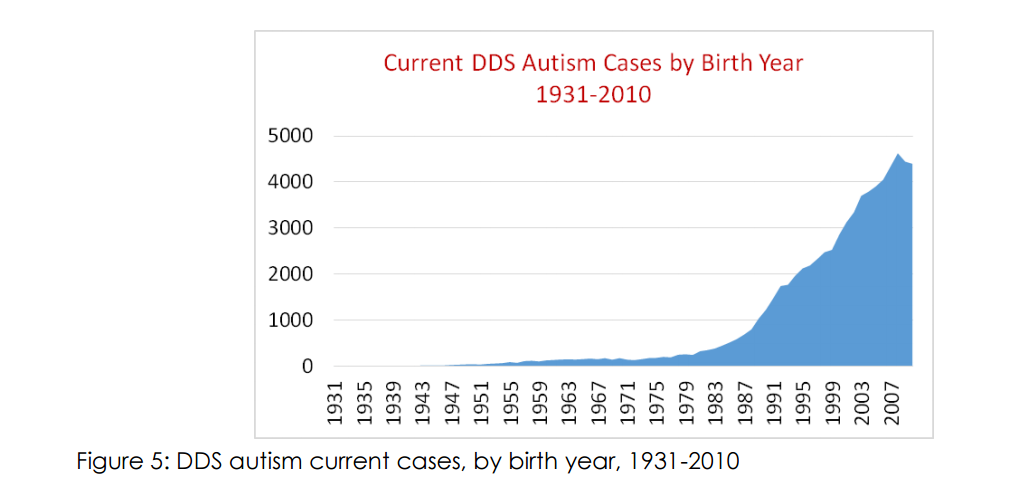
The Autism Society of San Francisco graph the data in many different ways, but the one that was closest to the way I was looking at the data was in Figure 5 (click to enlarge):

AS-SF Autism Rising Figure 5

and here is the caption for Figure 5:

Births of individuals later deemed to have DDS-eligible autism have been increasing sharply every year since the early 1980s. Typically intake into the system occurs between 2 and 7 years of age. The data reflects about 200 DDS autism births per year into the 1980s, but now the system is reflecting nearly 5,000 such births per year. The drop off in cases after birth year 2008 is likely attributable to usual delay in cases entering the system, and likely does not represent an actual decrease in DDS-eligible autism cases.

You can stop there and support your argument. And that’s just what most people do. Or you can question–how can I test if this is a “real” autism increase? For example, is the autism rate the same among different races? The answer is no. Is the autism rate the same in, say, San Francisco, Los Angeles, and Kern County? The answer is no. And there are many more questions one can ask of these data and over and over, the answer is no.

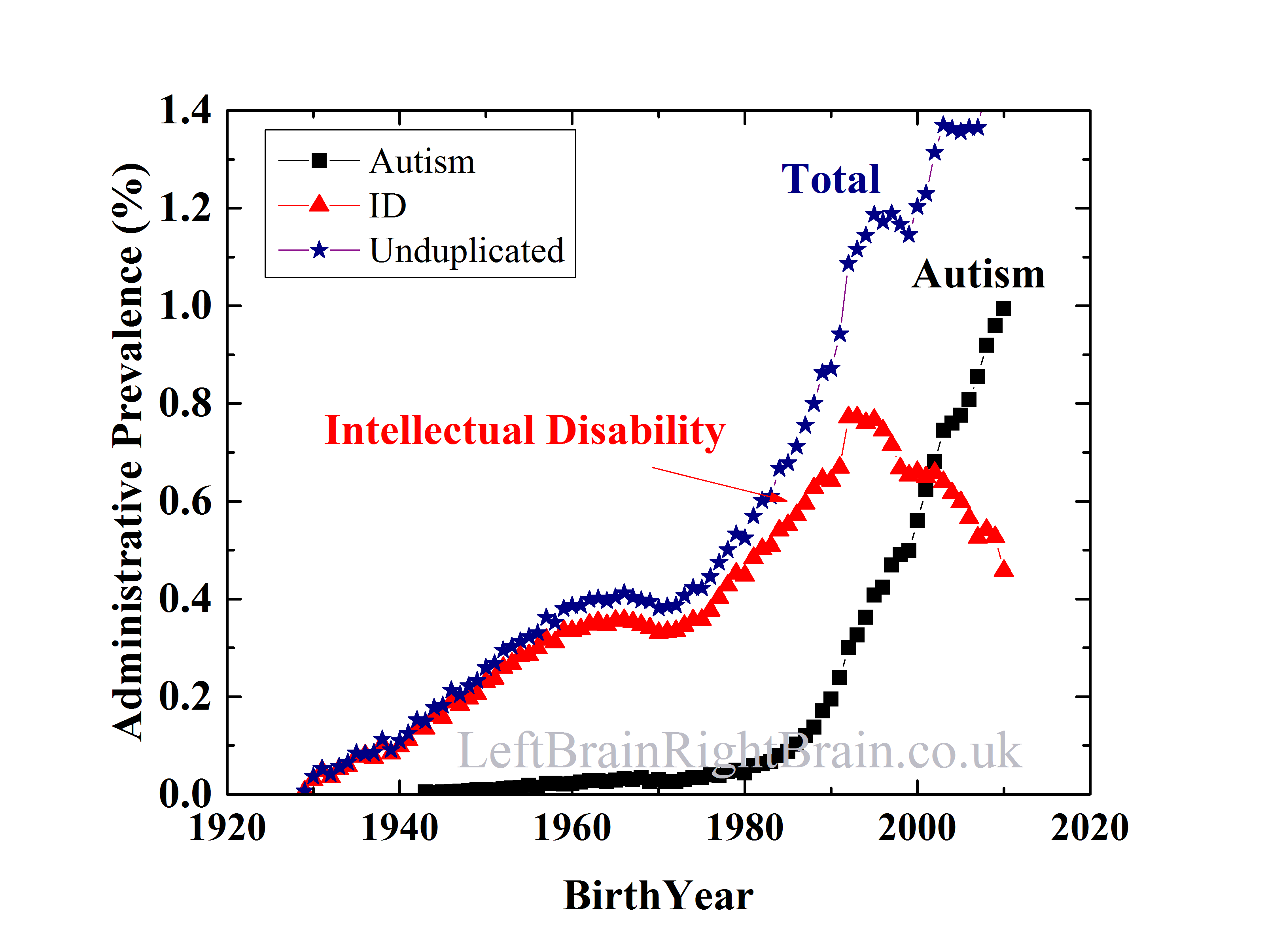
Either we aren’t counting all the autistics in our state, or there is something much more complex going on than vaccine, toxins, epigenetics, or whatever the claimed causes of the rise are. And I’ve gone through many of these discussions over the years. Let’s make this simple then. If one claims that the CDDS counts everyone within each disability category accurately and that the definitions they use aren’t changing with time, why is intellectual disability (mental retardation) dropping so fast in California?

You see I also graphed intellectual disability. I got autism counts, intellectual disability counts and “unduplicated” (total, each disabled person counted once) by birth year. I also got census data by birth year. And I graphed them. And anyone claiming CDDS data show an autism epidemic needs to do the same and to explain this graph, complete with the sharp peak for birth year 1993. (click to enlarge):

CDDS including ID

Intellectual disability has dropped. Off about 40% of the peak value.

If you think your idea for the rise in autism is correct, let’s take the failed vaccine idea as an example, you need to also explain how that resulted in far fewer people with intellectual disability. Plain and simple. And none of these claimed causes of an “epidemic” can explain the drop in ID.

Why bother challenging the people claiming an autism epidemic? Because it denies the existence of undiagnosed autistic adults. We have very little effort to identify those who were missed in past generations. And the likelihood is that these people–our people–are not being supported appropriately because of their misdiagnoses. And not only are we abandoning the misdiagnosed, we are failing to learn. What worked for past generations, the adults of today? What failed? What are the appropriate supports for the various needs of autistic adults? We don’t know today. And are unlikely to know by the time my kid is an adult, especially if we aren’t even looking at autistic adult needs today.

And then there’s the whole autism causation question. People spending their time trying to correlate CDDS data–data clearly confounded by numerous social influences–are unlikely to ever find a real answer.

But, for those who want to keep trying, include all the data. Give an explanation for this and you may be on to something.

CDDS including ID

By Matt Carey

The perils of reading history backwards: John Donvan and Caren Zucker, In a Different Key: The Story of Autism, Penguin 2016

20 May

John Donvan and Caren Zucker, In a Different Key: The Story of Autism, Penguin 2016

Hard on the heels of Steve Silberman’s award winning Neurotribes comes another grand scale history of autism, at 688 pages, even exceeding the 544 pages of its predecessor. (See http://www.spiked-online.com/review_of_books/article/why-we-shouldnt-celebrate-autism/17468#.VrST-MvcuAg)

The books have much in common: both are written by journalists with an eye for story and character. Both provide comprehensive accounts of the clinical and scientific advances of the past half century, and offer sketches of key figures on both sides of the Atlantic. They cover issues of institutionalisation and de-institutionalisation, parental campaigns (challenging professionals and bureaucrats to raise awareness, provide education and social support), and controversies (over causation, diagnostic labels, treatments, interventions and ‘cures’) and the new wave of internet-facilitated activism by adult autistics.

These histories also share common weaknesses.* Apart from their inordinate length, the narratives are often poorly organised and tend to favour description over analysis – Donvan and Zucker seem particularly reluctant to make judgements on the contribution of authorities or draw conclusions in relation to controversies. For example, in their discussion of the late Ivar Lovaas, the pioneer of ‘applied behaviour analysis’, they criticise his use of ‘aversive’ punishments to reinforce changes in behaviour – though such methods were commonplace in homes throughout the Western world up to the 1980s – and they also recycle gossip about his womanising. But they fail to provide any answers to the questions about whether modern developments of these techniques are legitimate or effective in teaching children with autism.

The authors’ proclivity for retrospective moral judgements (also a feature of Silberman’s book) gets them into murkier waters in their accounts of the work of the two authorities who first advanced the label ‘autism’ in the 1940s – Leo Kanner in the USA and Hans Asperger in Austria. From a perspective that assumes a contemporary state of enlightenment, they adopt a distinctly sanctimonious posture towards the prejudices of the past, notably in relation to issues of sexuality and race, as well as diverse forms of disability and difference, where cultural attitudes have changed dramatically over recent decades. Their criticisms of both Kanner and Asperger for their accommodations to the doctrines of eugenics fail to take account of the strength of the scientific and medical consensus supporting these theories in the first half of the twentieth century. They also seem to have little sense of the mass psychosis into which Germany and Austria in general and the medical profession in particular had descended in the period of the Third Reich. (See Robert Jay Lifton, The Nazi Doctors: Medical Killing and the Psychology of Genocide, 1986 and Saskia Baron, Science and the Swastika: The Deadly Experiment; Science and the Swastika: Hitler’s Biological Soldiers, https://vimeo.com/user6162058)

Donvan and Zucker are critical of Kanner for his approval of the sterilisation of individuals with severe learning disabilities (such procedures were carried out on a larger scale in the USA than in Germany prior to the Nazi period), even though he opposed a proposal for euthanasia, made in a leading psychiatric journal, in 1942. In relation to Asperger, In A Different Key repeats allegations made by the Austrian historian Herwig Czech in a 2010 lecture, that he made excessive compromises with the Nazi Party and was complicit in the killing of children with severe disabilities in wartime Vienna. The main problem with these allegations is that they have only the status of hearsay – though it is five years since Czech’s lecture, his evidence has not yet been published in a form which allows other authorities to scrutinise his claims and decide on their authenticity. An additional problem is that the authors fail to draw out the consequences for our evaluation of Asperger’s work, and the status of his eponymous syndrome.

Donvan and Zucker begin and end their history of autism with the story of Donald Triplett, ‘Case 1’ in Kanner’s 1943 paper that launched the diagnosis of autism into the world. Now in his early eighties, Donald is still living in his family house (though his parents are long dead) in the small town of Forest, Mississippi, where he enjoys a good quality of life in a sympathetic and supportive community. It is a heart-warming story – already told by the authors in an article in The Atlantic in 2010 (and also included in Silberman’s book) – and it reflects significant progress in the understanding and acceptance of autism over the course of Donald’s lifetime. Unfortunately, such positive outcomes are far from universal, either in the USA or in Britain, where almost every day brings new stories of people with autism suffering from mental health problems and from neglect or ill-treatment in the context of grossly inadequate therapeutic and social care services. (Meng Chuan-Lai, Simon Baron-Cohen, Identifying the lost generation of adults with autistic spectrum conditions, Lancet Psychiatry 2015; 2: 1013–27.) A recent report from Scandinavia confirms dramatically higher rates of mortality, affecting individuals across the autistic spectrum, from a wide range of medical causes, epilepsy and suicide linked to mental health problems. (Tatja Hirvikoski, et al, Premature Mortality in Autistic Spectrum Disorders, British Journal of Psychiatry, 20 November 2015, DOI: 10.1192/bjp/114.160.192).

In his thoughtful and challenging survey of the politics of identity associated with diverse forms of disability, Andrew Solomon comments on the particularly ‘polarised and fragmented’ autism community. (Andrew Solomon, Far From the Tree: parents, children and the search for identity, 2012). He contrasts this with the sphere of deafness, in which ‘medicine and activism are galloping’ – whilst in autism ‘both are trudging’. Whereas, in other forms of disability, medical advances have led to a decline in prevalence and severity, in autism, prevalence has risen apparently inexorably – in the absence of any significant advance in terms of therapeutic intervention. Though Donvan and Zucker, like Silberman, have made a valuable contribution in recording the key events in the rise of autism over the past half century, this particular chronicle still awaits rigorous historical analysis.

Michael Fitzpatrick 7 February 2016

*One is an occasional inaccuracy: Nikolas Tinbergen, associated with ‘holding therapy’, was an ethologist – not an ‘ornithologist’; Andrew Wakefield did not, in his notorious 1998 Lancet paper, report ‘traces of measles virus in the intestinal tracts’ of children with autism.


IMFAR (the International Meeting For Autism Research) starts tomorrow.

11 May

IMFAR is the world’s largest autism science conference. I don’t recall the exact statistics, but there are probably over 1000 researchers who attend. Literally hundreds of presentations on various topics. I am not attending, but I will try to write a few articles about abstracts and topics that I think of are interest.

I do know that this year Shannon Rosa (twitter: @shannonrosa) and Carol Greenburg will be attending and tweeting and probably putting some thoughts up at the Thinking Person’s Guide to Autism (twitter: @thinkingautism, Facebook and the TPGA blog.

IMFAR shows what a huge effort is going on in autism research. People are working hard to understand autism and (more importantly) make a difference in the lives of autistics.


By Matt Carey

FDA proposes a ban on electric shock devices such as used at the Judge Rotenberg Center

28 Apr

I’ll keep this simple and direct: the FDA has proposed a new rule: Banned Devices; Proposal to Ban Electrical Stimulation Devices Used to Treat Self-Injurious or Aggressive Behavior.

Here’s the summary from that document:

SUMMARY: The Food and Drug Administration (FDA or we) is proposing to ban electrical stimulation devices used to treat aggressive or self-injurious behavior. FDA has determined that these devices present an unreasonable and substantial risk of illness or injury that cannot be corrected or eliminated by labeling. FDA is proposing to include in this ban both new devices and devices already in distribution and use.

Also:

We are aware of only one manufacturer, JRC, that has recently manufactured ESDs and that currently uses ESDs, including devices that we have not previously cleared.

JRC is the Judge Rotenberg Center, a residential school in Massachusetts for disabled students, many of whom are autistic. The JRC uses the ESD’s (electrical stimulation devices) as punishments to try to control behavior for some of their students. According to the document, the JRC used their devices (called GED at the school) on 82 individuals in 2014.

The document states that a parent group from the school and 2 former students provided comments in support of keeping the shock devices. One student and

In addition to NASDDDS and a JRC parents group, referenced earlier, 15 other organizations concerned with the treatment and the rights of individuals with disabilities spoke at the Panel Meeting, all of which supported a ban. Twenty-two disability rights organizations submitted written comments to the Panel Meeting docket, one of which was signed by 23 disability rights groups. Nine of these organizations were among the 15 represented at the Panel Meeting. All of these comments support the ban. FDA also received a comment from the U.S. Department of Justice Civil Rights Division supportive of a ban, and we considered information from the National Council on Disability, the National Institutes of Health, and the United Nations Special Rapporteur on Torture.

The FDA is not just relying upon community input. They also note the scientific literature which shows significant risks of PTSD and anxiety and other adverse events following the use of shock devices.

Here is a survivor’s letter, an account from a former JRC student who was subjected to the shocks.

The JRC was in the news after a student was tied to a board for 7 hours and shocked 31 times. The original news story links are no longer valid, but I will try to find them and link to them here.

The shock devices just do not have a sound backing–scientifically or ethically. If this FDA rule goes into place, the days when disabled students in America can be subjected to electric shocks like these will come to an end.

By Matt Carey

Andrew Wakefield to Grace Hightower: “your family’s life [has] been blighted by autism”

22 Apr

One thing I have noticed over the years–those who are antagonistic towards vaccines are quite willing to use the disability community, but are rarely willing to offer us respect. Consider Andrew Wakefield, who introduced one book with a fictionalized account of a mother murdering her autistic child. He framed it as an act of love by the mother. Or his film, “who killed Alex Spourdalakis”. Alex was an autistic young man with extraordinary needs. Andrew Wakefield tried to make Alex’s life  into an episode for his (now failed) reality TV show. When Alex was brutally murdered by his mother and another caregiver, Wakefield took his footage and made a film.  It was an apology piece for the murders, using Alex as a hammer to attack mainstream medicine.

So now we have Wakefield apparently leaking his celebrity emails and showing again his misunderstanding for and contempt of autistic people. This is discussed at length by ScienceMom at JustTheVax: Paging De Niro and Hightower…Wakefield isn’t really in it to help autistics

I’ll just quote one email:

On Mar 29, 2016, at 9:18 AM, Andy Wakefield wrote:
Grace, whatever may have happened – and I guess I will never know – in truth my heart goes out to you and Bob. Not only has your family’s life been blighted by autism, but you have experienced some of the relentless and ruthless pressure that has been my life for as long as I can remember.
In truth and healing
Andy

Andy Wakefield
Director
Autism Media Channel

Just to be clear, Mr. Wakefield:

My child is not a blight. On me, my family or on anyone else.
My child is not blighted.
My life is better for my child. Challenges, struggles and all.

Just to be clear Ms. Hightower: if you didn’t respond to Mr. Wakefield in a way similar to the above, shame on you. But, while I am at it, shame on you for promoting this man and his damaging message. If you believe him, take a moment and ask yourself: if he’s lying (he is) how much harm has he caused to me, my family and mostly my son?

When you dehumanize people Mr. Wakefield, you make it easier for people to murder my child. You made it easier for people to abuse my child. You make it easier for people to disrespect my child. It is already a struggle to get adequate supports and assistance. How much will people be willing to help the “blighted”?

My child doesn’t need the charity of pity. My child needs the helping hand of respect.

And you, Mr. Wakefield, are in the way of that.

People ask me why do I spend my time countering your misinformation. This is why.


By Matt Carey

Why do people have to see Vaxxed to criticize it? Wakefield’s own description of us tells us Vaxxed is bogus.

21 Apr

Andrew Wakefield got an interview on Fox to defend his film Vaxxed (the video and transcript are at Fox Provides Platform For Discredited Doctor To Claim CDC Is Hiding Evidence That Vaccines Cause Autism). And he’s shooting back at his critics: if you haven’t seen the film you can’t criticize it. It’s doubly ironic. First Wakefield’s team didn’t send out DVD’s to the press, and, second, many critics have seen the film. But the “you can’t comment on the film because you haven’t seen it” is the same argument he used with his horrible “Who Killed Alex Spourdalakis” film. (For those who are unfamiliar with it, it’s a film where Wakefield defends a mother and caregiver for the brutal murder of an autistic young man.) That film was worse than I expected it to be. And I was expecting bad.

Wakefield describes his film in the Fox interview. And just based on Wakefield’s own words, we can see that the film is inaccurate.

Wakefield:

Dr. William Thompson comes forward and says they have known for 14 years that MMR vaccine is causally associated with autism and they have covered it up.

This is wrong. First, the study Wakefield is talking about can not show causality. This sort of epidemiology can show researcher “here’s a place to look for causality”. Anyone who has been in this field for 20 years, like Andrew Wakefield, would know that. ]

But let’s get more to the point–Thompson didn’t say that they showed a causal connection.

From a statement by William Thompson:

The fact that we found a strong statistically significant finding among black males does not mean that there was a true association between the MMR vaccine and autism-like features in this subpopulation.

no “true association” means it doesn’t show causality.

Wakefield goes on:

And so the film, it’s his words, it’s his opinion, it’s his documents that really carry the message of this film that there has been a huge cover-up which has put millions of American children in harm’s way and it was totally unnecessary.

But as we’ve just seen, the key point of the film is precisely not Thompson’s words or opinion.

Wakefield appears to be using William Thompson as a sock puppet. We are told what Wakefield seems to either believe or wants us to hear. And with the claim that it’s not Wakefield doing the telling but Thompson.

But Wakefield’s own words about Vaxxed don’t match Thompson’s own words.

But per Wakefield people can’t criticize the film.

For whatever it’s worth, it’s not just William Thompson who stated that the study doesn’t show a causal connection. Even Brian Hooker, a colleague of Wakefield, didn’t claim a causal connection in his re-analysis of the CDC data. Here’s as close as Brian Hooker gets to claiming causality in his (now retracted) paper:

Additional research is required to better understand the relationship between MMR exposure and autism in African American males

Not “we found a causal connection”, but effectively “someone should test this for causality”. Frankly I don’t think this was a moment of intellectual honesty from Brian Hooker as much as pragmatics: referees know that this study can’t show causality so they would have rejected Hooker’s paper had he tried.

Thompson’s documents don’t show a causal connection either. I’ve made them public so people can check what is in them. Wakefield hasn’t. But Wakefield asks people to “make up their own mind”. The documents don’t show a “huge cover-up”. They don’t show “millions of children in harm’s way”.

Simple check of facts here: The “huge cover-up” putting millions of American children in harm’s way”, shouldn’t we address this? Wakefield is discussing one preliminary result in the CDC study: African American boys vaccinated before age 3. In all other groups, the study (confirmed by Brian Hooker) shows what all the other MMR studies show: no indication of an MMR/autism link. This point, by the way, isn’t stressed in Vaxxed. Even when they bring in autism families, they are mostly white.

But, back to this result. Leaving aside that Vaxxed isn’t accurate, shouldn’t we be concerned? Well let’s do some checking. Brian Hooker in his paper is saying that African American boys are 3.36 times more likely to be diagnosed autistic if they get the MMR vaccine before 36 months. If that is due to a real causal connection, we should easily see that in other data. MMR uptake is generally comparable by race. So even though African Americans are a minority in the U.S., 3.36 is high enough that some indication of a risk would have shown up in one of the other autism/MMR studies. But let’s not just handwave like that. Let’s check directly: is the autism prevalence higher in African Americans? Boys are roughly 4 times more likely to be diagnosed as girls, using Hooker’s 3.36 increased risk for African American boys (and if I’ve done my math correctly) African Americans should have an autism prevalence 2.9 times higher than Caucasians.

2.9 times higher autism prevalence. That’s big. We would see that on autism prevalence studies easily.

The CDC recently released an autism prevalence estimate. And they show that African Americans are less likely to be diagnosed.

Estimated ASD prevalence was significantly higher among non-Hispanic white children aged 8 years (15.5 per 1,000) compared with non-Hispanic black children (13.2 per 1,000), and Hispanic (10.1 per 1,000) children aged 8 years.

Yes, African Americans are less likely to be diagnosed (about a factor of 0.85). Again, using the data that Wakefield claims shows a “causal” connection between the MMR and autism, we expect 2.9 times higher prevalence. The facts just don’t match up with Wakefield’s claims.

The fact that autistic people from racial/ethnic minorities or low income families are less likely to be diagnosed is a problem true autism advocates are trying to fix. Many are not receiving the appropriate services and supports. But that’s what real autism advocates are working on, not Andrew Wakefield.

So, we have a film that by comparing Andrew Wakefield’s own description with the facts is inaccurate. But per Andrew Wakefield people can’t criticize Vaxxed if they haven’t seen it. That’s a bit of a logical fail on Mr. Wakefield’s part. Not like we have a shortage of those.


By Matt Carey

Movie review: VAXXED

2 Apr

Andrew Wakefield’s film, VAXXED, opened today in a theater in New York. Mr. Wakefield somehow convinced Robert De Niro to break the rules of the Tribeca Film Festival and personally insert the film into the lineup of TFF. When this was discovered, Mr. De Niro first defended his decision and, after getting input from people whose expertise is science, pulled the film. Mr. Wakefield, with no apparent sense of irony about having avoided due process to get into the festival, cried out that he was denied due process in the removal process. But didn’t hesitate to add the tagline to his film poster, “the film they don’t want you to see”.

The opening of VAXXED had about 20 people in the audience by one account. I couldn’t attend, but someone I know did and gave me a lot of feedback. I was preparing to give summarize that feedback here when a review on indewire came out: ‘Vaxxed: From Cover-Up to Catastrophe’ is Designed to Trick You (Review) which concurs with the impressions I was about to relate here. Here’s a paragraph from that review:

In a statement leading up to the film’s release, Wakefield’s co-writer Del Bigtree claimed that “Vaxxed” is “not an anti-vaccine movie,” which is kind of like saying “Triumph of the Will” is anti-Hitler. Strung together in obvious ways to induce a constant sense of dread (look out for the slo-mo shot of a crying child!), “Vaxxed” shamelessly repeats the same non-arguments over and over again, drowning facts in murky proclamations.

VAXXED purports to be the story of a “CDC Whistleblower”, William Thompson, who contacted Brian Hooker, a vocal proponent of the idea that vaccines cause autism. The “about” page for the movie pretty much only talks about Thompson. One thing people going to see VAXXED will find is that the CDC study/William Thompson part is a very small part of the film. Most of it is filler, much of the conversation that goes on all the time online about vaccines.

But what is the Thompson story and why is it supposedly so explosive? Well, William Thompson was researcher who worked on vaccine epidemiology at the CDC. Most of that was many years ago. In fact the research discussed in VAXXED started in 2001. Thompson sought out Brian Hooker, a very vocal proponent of the idea that vaccines cause autism and led Hooker to a finding that was not reported when the paper was published in 2004.

Since this is really the heart of the film, allow me to go into some detail. The main claim was that the CDC team found in their first pass/rough analysis that autism was more common in African American boys who got the MMR vaccine than those who didn’t. Another finding was that for children without other conditions, there also appeared to be a higher autism risk. This group was called at the start of the study “isolated autism”, as in autism isolated from other conditions.

Let’s take that second one first, isolated autism. Here’s the thing–when the CDC team published their study in 2004, they did report on this. Instead of autism isolated from all other conditions, they showed autism without intellectual disability. The CDC reported that the calculated risk for this group was “statistically significant”.

In other words–what did they hide? Nothing. It’s the same result that Wakefield says was hidden. The only question I have– if this result is so important, why didn’t Wakefield or Hooker notice for the 10 years after it was published?

So, what about the other result? Thompson told Hooker that the CDC team another possible result. This result was limited to only African American boys, a fact that is largely glossed over in a film of largely white people. And this Autism/MMR/African American boys result didn’t remain statistically significant under the CDC planned, more complete, analysis. Which is to say, it’s not strong, it’s not really controversial.

But let’s ignore that for the moment. Let’s ask ourselves, if this is the smoking gun, the finding that was so explosive that a CDC researcher reached out to Brian Hooker to tell him about it, why don’t we don’t hear about that that finding until about 1/2 way through the film? And why is so little time spent on it? I’d think this would be a huge part of the film.

Let’s take another step back, a step away from the film. Here’s the thing about this from my perspective as an autism parent–if you believe this represents a real effect (that the MMR causes autism in African American males), you act very differently than Andrew Wakefield. You try to answer the question. Wakefield was at one point running a charity whose stated purpose was autism research (in the end, about half the money went to Wakefield’s salary). He is reported to have raised $400k for this film. Four hundred thousand dollars. I have seen no effort whatsoever by Mr. Wakefield to investigate this claim of a link between MMR and autism in African American boys. Instead we keep hearing about efforts on getting a congressional hearing on the subject. For those outside the autism community: there have been two autism related congressional hearings in recent years. While they have provided much YouTube footage for people pushing the idea that vaccines cause autism, they haven’t done anything to make life better for the autism communities. Nothing.

But one might argue, William Thompson tells us that this shows vaccines cause autism, right? No, he doesn’t. Here’s a public statement (one of only 2 I am aware of) that Mr. Thompson wrote:

The fact that we found a strong statistically significant finding among black males does not mean that there was a true association between the MMR vaccine and autism-like features in this subpopulation

But you won’t find that point emphasized in VAXXED. Instead you will find Wakefield and cowriter Del Bigtree claiming that Thompson says that the CDC “…knew that vaccines were actually causing autism”

There’s a huge difference between “does not mean a true association” and “knew that vaccines were actually causing autism”. I don’t know how big the difference is in film producer land, but in science, it’s night and day.

While we are exploring whether this claim of an MMR/autism link in African American boys, it’s worth noting that just yesterday the CDC came out with their latest autism report (they do this every year at the beginning of April). The CDC autism prevalence numbers show a very different story about the possibility of the MMR causing autism in African American boys. The autism prevalence in African American children is lower than that in whites. If the MMR/Autism link were real and as large as the rough analysis claimed, it would be higher.

And what about the dramatic claim of research fraud by the CDC team? This claim not only doesn’t hold up, but it’s morphed a bit over time. Originally Wakefield and Hooker claimed that the CDC changed their analysis plan after finding the “race effect”. That is–they saw a result they didn’t like and then changed the analysis plan. Let me show you. Here’s a quote from an earlier Wakefield video on the subject

“Over the ensuing months, after the data after the data had been collected and analyzed, and strictly forbidden in the proper conduct of science, the group abandoned the approved analysis plan, introducing a revised analysis plan to help them deal with their problem.”

We also see this claim in the press release that accompanied Brian Hooker’s “reanalysis” of the CDC data:

According to Dr. Thompson’s statement, “Decisions were made regarding which findings to report after the data was collected.” Thompson’s conversations with Hooker confirmed that it was only after the CDC study co-authors observed results indicating a statistical association between MMR timing and autism among African-American boys, that they introduced the Georgia birth certificate criterion as a requirement for participation in the study. This had the effect of reducing the sample size by 41% and eliminating the statistical significance of the finding, which Hooker calls “a direct deviation from the agreed upon final study protocol — a serious violation.”

Emphasis added.

The problem with that statement was that the final “revised analysis plan” was dated Sept 5, 2001 and the “race effect” wasn’t seen until late October/early November 2001. Two months later. In other words, for this version of the fraud claim to work, the CDC team would have to travel back in time. We know this timeline because the William Thompson documents are now public and we can compare the analysis plans and analysis.

If this seems confusing, it gets worse in VAXXED where we are taken into a discussion of the CDC team switching from using race data from school records to birth certificates and how this reduces the statistical power and hides an effect and all.

Rather than go into details about that, I’ll state this: this argument is a red herring. And wrong, but a red herring. Yes the CDC had data from both school and birth records. But they always planned on using the birth certificate data for their final analysis. From the analysis plan we read:

For the subset of children with Georgia birth records, sub-analyses will be performed in which potential confounding variables from the birth certificate will be used to adjust the estimated association between the MMR vaccine and autism. The variables that will be assessed as potential confounders will be birth weight, APGAR scores, gestational age, birth type, parity, maternal age, maternal race/ethnicity, and maternal education

Or to put it simply, the school records didn’t include things like APGAR scores and so much more that the CDC team planned to use from the start.

So much for “research fraud”.

We can go through the details, but let me just say that a great deal of VAXXED is not really directly the story–the story that is promised in the VAXXED web page. A lot of discussion about and by Andrew Wakefield, for example. We also get parents speaking about their beliefs that vaccines caused their child to be autistic. While very emotional and not something to be dismissed, this doesn’t address the question of whether vaccines cause autism or if there was malfeasance at the CDC.

We a significant amount of filler in the “Big Pharma is bad” sort. The industry insider they get to speak is person who worked in sales for Vioxx. No expertise on vaccines, no experience on the inside for vaccines. And more that I just won’t go into detail about.

Does that mean it won’t be convincing? Well, a large part of the audience for this is already convinced. But will they convince more people with this film? Sadly, the answer is yes. People are not afforded the chance to see the counter arguments. And the appeal to emotion that is much of the film will play. Much better than dry analysis like the above that I have provided. But do I find this movie in the least accurate? No.


By Matt Carey

Wakefield responds to his film being pulled by the Tribeca Film Festival. And it’s very classic Wakefield

28 Mar

If you don’t want to go through this whole article, and just want the most interesting bit here it is–Wakefield has responded to the Tribeca Film Festival (TFF) pulling his film. Wakefield had pulled strings somehow to get Robert De Niro (who founded TFF) to push TFF to accept the film. Immediately after it became public that Wakefield’s film was “selected” for TFF, criticism rained down from all over the world. In is defense, Wakefield brought in a sitting member of the U.S. House of Representatives to lobby to keep the film in. Now that the film has been officially pulled, Wakefield is decrying the “lack of due process” afforded him.

One wonders, doesn’t one, how legitimate film makers whose films were both accepted and rejected by TFF are swallowing that bit of irony. I mean, this is the first time in the history of the TFF that De Niro forced a film into the lineup. And, yeah, having a Member of Congress spend an hour talking to De Niro? I’m sure each and every budding film maker brought her/his own Member of Congress into the process right?

Lack of due process? Really? Wakefield had the temerity to decry a lack of due process? Wakefield would never have been in TFF if he had believed in and practiced the actual “due process” of applying, being good, being selected.

The irony is thick. As it so often is with Andrew Wakefield.

Now to what I wrote–

What are some of the classic traits we’ve come to know from Andrew Wakefield? First, he’s a martyr who suffers for the cause, but the rock of strength. He tells us he’s lost everything, his job, his career, his country…heck, there’s even a film out there where he talks to a mirror and tells us he’d gladly die for the children. I find this imagery rather difficult to accept given the size of his house from his Austin days (5900 square feet, one of four properties listed in the Austin area as owned by the Wakefields) and $270k/year base salary (my guess significantly higher than “academic gastroenterologists” make in the UK). But more to the point, why did he keep half the money from his autism research charity as his salary? But, again, it seems one can’t watch Wakefield speak without hearing about how strong he is and how much he’s given up for the cause.

Given how he frames himself, his response to having his film pulled by Tribeca was pretty much true to form:

To our dismay, we learned today about the Tribeca Film Festival’s decision to reverse the official selection of Vaxxed: From Cover-Up to Catastrophe.

Robert De Niro’s original defense of the film happened Friday after a one-hour conversation between De Niro and Bill Posey, the congressman who has interacted directly and at length with the CDC Whistleblower (William Thompson) and whose team has scrutinized the documents that prove fraud at the CDC.

It is our understanding that persons from an organization affiliated with the festival have made unspecified allegations against the film – claims that we were given no opportunity to challenge or redress. We were denied due process.

We have just witnessed yet another example of the power of corporate interests censoring free speech, art, and truth.

Tribeca’s action will not succeed in denying the world access to the truth behind the film Vaxxed.

We are grateful to the many thousands of people who have already mobilized including doctors, scientists, educators and the autistic community.

We will be pressing forward and sharing our plans in the very near future.

Onward!

– Andrew Wakefield (Director) and Del Bigtree (Producer)

We get the whole “we are the downtrodden” while at the same time “we are strong” messages. He claims wide support, including bringing to bear a sitting member of the U.S. House of Representatives while decrying “the power of corporate interests censoring free speech, art, and truth.”

As always, check every word Wakefield says.

First off, here’s a HUGE irony. Giant. He tells us he was denied “due process”. What is due process in a film festival? You submit your work and get it judged on a level playing field along with every other submission. What did Wakefield do? He pulled strings and got Robert De Niro to personally select VAXXED for the festival. He jumped the queue, possibly pushing some worthy selection out, and now he’s crying about due process?

Classic Wakefield. Absolute classic.

Was Bill Posey involved with the original push to get this film included in TFF? We don’t know, but we know that Bill Posey was involved with keeping it in, at least for a day.

How many other film makers pull that sort of pressure to get their films into Tribeca? But it’s Wakefield who was denied “due process”. But, hey, his movement is strong. They have a Member of Congress on their side. And Mr. Posey has received donations as a nice thank you for his support over the years.

Mr. Wakefield tells us about Representative Posey’s office “..whose team has scrutinized the documents that prove fraud at the CDC”. Nice phrasing there. Wakefield doesn’t come out and actually say that Posey’s office has claimed that the documents prove fraud, but the causal reader might not catch that.

By the way, the documents don’t show fraud. Everyone can read the documents now. Andrew Wakefield was given many, if not all, of the Thompson documents and never made them public. I remain grateful to Representative Posey’s office for providing those documents to me, and I did make them public. Mr. Wakefield carefully controlled information. I welcome people checking my facts.

Wakefield tells us “It is our understanding that persons from an organization affiliated with the festival have made unspecified allegations against the film”

Unless he’s been hiding behind a rock, there’s also been a media storm of very specific allegations against the film. There’s also the fact that Wakefield’s story surrounding William Thompson doesn’t hold up. There’s also the fact that Wakefield classifies his film as a “documentary” but within the first 30 seconds of the trailer he left facts behind.

What’s then interesting to read is that he moves from “an organization affiliated with the festival” to “the power of corporate interests censoring free speech, art, and truth”

So it’s either a group working with the Tribeca Film Festival, or it’s corporate interests”. And, here’s the thing, Tribeca is a private enterprise. They get to pick what is shown under their name. Declining or removing a film from their list is not censorship. Any more than it would be censorship if I asked Wakefield to host all of my writings about him on his “about” page and he declined my request.

And, if this film is like the others Mr. Wakefield has produced, “art” is not a term I would associate with it. Nor is the word “truth”.

Now, here’s a great turn of phrase:

“Tribeca’s action will not succeed in denying the world access to the truth behind the film Vaxxed”

See what he did there? He made a simple, “this isn’t a film we want to show. Go somewhere else with it” from Tribeca into a sinister act by Tribeca to keep the world from seeing this film.

Nice job, Wakefield. You are making it clear to Tribeca that they were right. Who at Tribeca even thinks they hold such power as you seem to claim? I’ll give you a hint: no one.

Wakefield closes with a claim of far reaching support. Even within the “autistic community”. The term “autistic community” usually refers to the community of actually autistic people. That is a community that has little love nor offers support to Wakefield. That aside, Wakefield never tells people that even among autism parents, the majority do not believe that vaccines might be a cause of autism. This study put vaccines well behind genetics and the “will of God”. Other have put the fraction of parents who believe vaccines could be a cause as low as 20%. And saying, “sure it could be possible” is very different from “I believe this is what caused my child’s autism”.

Wakefield’s following is far too large, but it isn’t actually that large.

But all this said, let’s bring this back to the biggest irony of Wakefield’s response–his outrage at the lack of “due process”.

Yeah, all he had was Robert De Niro picking this film for TFF. And an hour of a sitting Member of Congress lobbying Mr. De Niro. We weep for the lack of opportunity Wakefield had, don’t we?


By Matt Carey