Archive | Authors RSS feed for this section

Looking back at two decades of Geier

20 Oct

In the past Mark and (to a lesser extent) his son David Geier were frequently being discussed online. It struck me that given how far back the Geier saga goes, many may not be aware of the myriad stories of the Geiers. How often and from how many angles the news has come about just how bad the Geier legacy is. They’ve been involved in the vaccine court (and from the outset–1993–showing “intellectual dishonesty“), publishing questionable research and running a clinic whose special “therapy” is so clearly wrong.

I went back to an article I wrote in 2007 where a Special Master (the judge in the “vaccine court”) wrote that the Geiers’ work was of such poor quality that the court would no longer pay for them to act as experts. I was going to just re-run that article (and it is copied in full below) when I thought it worthwhile to list some of the more notable actions of the Geier team.

The best writing on the Geiers was done by Kathleen Seidel of Neurodiversity.com (some of the best investigative reporting ever). Unfortunately a server crash took down the site, but one can find the articles on the Wayback Machine (archive.org).

Just a few specific examples:

Maryland Authorities Charge “Lupron Protocol” Promoters With Unprofessional Conduct, Unlicensed Practice of Medicine ·

Significant Misrepresentations: Mark Geier, David Geier & the Evolution of the Lupron Protocol

A Silent Withdrawal (details behind the withdrawal of a Geier paper).

The withdrawal followed and was likely caused by Ms. Seidel’s investigations, laid out in this letter to the Journal (autoimmunity reviews) in which she noted (among other facts) that the Geiers actions were questionable from an ethics standpoint. In specific, in regard the their IRB (Institutional Review Board) approval for their study:

The Office of Human Research Protection registration of the IRB of the “Institute for Chronic Illnesses” was submitted by Mark Geier in February 2006 — fifteen months after the commencement of the research the Geiers describe in this article, which began in November 2004, the same month in which Dr. Geier testified in court that he had no prior experience in the diagnosis or treatment of autistic children. (13,14) The seven-member IRB consists of Mark and David Geier; Dr. Geier’s wife; two of Dr. Geier’s business associates; and two mothers of autistic children, one of whom has publicly acknowledged that her son is a patient/subject of Dr. Geier, and the other of whom is plaintiff in three pending vaccine-injury claims. The membership of the IRB gives rise to misgivings about the independence of ethical review of Dr. and Mr. Geiers’ research. Every member has discernible conflicts of interest, and none has any discernible expertise in endocrinology — expertise crucial to the competent oversight and conduct of research involving pharmaceutical manipulation of children’s hormones.

Yes, they got “approval” from themselves after they did the research. Just astonishingly bad. Completely circumventing the entire purpose of an IRB.

There’s so much more good work at Neurodiversity.com. But let me switch to articles here at Left Brain/Right Brain:

David Geier ordered to pay $10,000 for practicing medicine without a license

Is Mark Geier finished as an expert witness in the vaccine court? A quote from this vaccine court decision:

I will not likely be inclined to compensate attorneys in any future opinions for consultant work performed by Mark Geier after the publication date of this opinion.

Note that the question is whether to pay Mark Geier as a consultant. This was in 2011, after it was established that he was not an expert and would not be compensated for work as an expert. This didn’t stop attorneys tried to keep him on the payroll as a “consultant”.

How about the Geier theory behind using Lupron to shut down hormone production in autistic kids? It started as a way to enhance chelation. Chelation is without merit in autism treatment to begin with, but the Geiers took it a step further. One of their collaborators, and apparently the parent of one of the first kids to be subjected to the “Lupron Protocol” quoted David Geier as saying, “We figured something new out…..we think we can get rid of the mercury by lowering the testosterone”. The “science” behind the “Lupron Protocol” AutismOne throws their support behind the Geiers in Autism Science Digest is ridiculous. Even the Geiers shifted away from their original theory, leaving out the mercury angle: The Geier Story on Testosterone Shifts Again.

In their research, the Geiers cite Simon Baron-Cohen, whose has worked on the idea that exposure to testosterone in-utero could be a cause of autism. Baron-Cohen’s work had no scientific relevance to the Geier work. But, thankfully, Baron-Cohen was quoted in a news article about the Geiers:

Simon Baron-Cohen, a professor of developmental psychopathology at the University of Cambridge in England and director of the Autism Research Center in Cambridge, said it is irresponsible to treat autistic children with Lupron.

“The idea of using it with vulnerable children with autism, who do not have a life-threatening disease and pose no danger to anyone, without a careful trial to determine the unwanted side effects or indeed any benefits, fills me with horror,” he said.

Mark Geier lost his medical licenses. Yes, licenses plural. Lost in many states. He had franchised his Lupron work out. It took a cease and desist order issued to make him really stop practicing medicine.

Criticism of Mark Geier’s “expertise” was not limited to the “vaccine court”. In Boyd Haley and Mark Geier: Experts? we see how he failed to meet the standards of an expert in a civil court.

The Geiers’ have done well, financially. Charging over $50k/year, plus over $10k in tests, could do that. Here’s their home in Florida (The Geiers’ Second Home)

As part of the action to strip Mark Geier of his medical license: Maryland Board of Phyicians: Mark Geier “endangers autistic children and exploits their parents”

In Crist backer Gary Kompothecras bullies Florida health officials, we learned that political pressure was being brought to bear to give the Geiers access to Florida’s health records to perform a study.

The Geiers requested over $100,000 for work on the Hepatitis B Omnibus, including multiple trips to Europe. (almost $24k for one trip alone). Much of the request had no documentation (bills, airline tickets, etc.)

Quotes from the special master in the decision in that case:

I found that the articles authored by Dr. Geier unpersuasive and not scientifically sound, based on my prior reading of the articles and critiques of them. I am also aware that Dr. Geier is trained as a geneticist and obstetrician, not an immunologist, epidemiologist, or rheumatologist, and that my fellow special masters and several other judges have opined unfavorably on his qualifications and testimony as an expert.

and, in regards to David Geier (who holds no advanced degrees):

“In summary, the undersigned finds the costs for David Geier’s efforts to be obviously unreasonable as Mr. Geier is not qualified to address the medical issues involved in the Program and his work was duplicative of the efforts by Dr. Geier. Thus, the undersigned denies the request for costs for David Geier in its entirety.”

The egregious billing activities of the Geiers amount to treating the vaccine program as their personal piggy bank, in my opinion.

In the courts, in their research and in their clinics, the Geiers have time and again shown behavior which is just reprehensible.

Below is the article I wrote in 2007 which prompted this summary: For your own good, don’t use that study!.

____________________________________________

I just read something interesting on the web.  Someone was telling a petitioner in a Vaccine Court trial that she would have a better chance of winning if her expert witness didn’t use a research report by the Geiers.

Was this a blog?  Was this a yahoo group?  Nope, this was a decision on the Vaccine Court’s website.  This was the opinion of Special Master Vowell.

If that name sounds familiar, it’s because she is one of the three Special Masters working on the Autism Omnibus Proceedings.  What exactly did she say?

“I suggested that, in view of the criticisms leveled at Dr. Geier and his research, petitioner would be better served if her expert could opine favorably at the hearing without relying on the cited articles. “

and

“In attempting to assist this petitioner in presenting the strongest possible case for vaccine causation of her illness, I urged her counsel to caution her expert against relying on the Geier articles he cited.”

Ouch.

In case you were wondering, I wasn’t just reading the Vaccine Court decisions for fun.   I was prompted by something that Mark Geier said on NightLine.  Dr. Geier made a comment about “Wining” in vaccine court.

This struck me as a very odd statement.  Petitioners (plaintiffs) win.  Lawyers win.  Expert witnesses?  They can help someone win, but I don’t see them as “winning”.  Besides, there was something in the way he said it.  Something like when a kid says, “of course I did my homework” and you know you have to go check.  So, check I did.

I looked through the published and unpublished decisions and searched for “Geier” in each.  These go back to 1997 for published decisions.   “Decisions” include actual cases as well as pre- and post-trial actions.  The one quoted above is a good example of “pretrial”.  Post-trial Decisions are often about whether everyone should get paid what they billed.  Or, at least, this seems to be the case in more recent times.

Not all Decisions are trials.  Keep in mind, a single trial could have multiple Decisions.  I haven’t tried to group them together by case, I just made a list of all of the ones I could find involving Dr. Mark Geier.

With all that out of the way, what did I find?  There are 31 Decisions posted that involve Dr. Geier.  Of those, three are cases “won” where Dr. Geier was involved.  A further 3 may be considered “mixed” or “neutral”.  Figure that in 80% of the cases, the Petitioner and/or Dr. Geier loses.  I consider that a generous take.  It really is more like 90%.

Let’s look at those “winners”.

1999: The petitioner won the case.  “The court’s decision in this case is not based on Dr. Geier’s testimony, but neither will the court discard his testimony as unreliable.”  Not the most ringing endorsement.

2000: The petitioner won the case.  Dr. Geier submitted an affadavit which was used to “buttress” the case made by the expert witness who actually testified.

2006: Discussion of fees where Dr. Geier’s fees and use is found to be reasonable. ” In the instant case, $1562.50 in expert witness fees for Dr. Mark Geier’s services is reasonable.”

Yes, in the last 10 years, those are the “good ones”.   Not impressive.

I have seen people post that somehow the Special Masters are trying to discredit Dr. Geier because he is so effective.  People seem to imply that his recent stances on mercury and autism caused the Government to try to neutralize Dr. Geier. 

With that in mind I looked to see if the tone of the rejections has changed with time.  I didn’t really see that.  Keep in mind that some of the well known comments about Dr. Geier predate all these decisions.  For example, he was called “intellectually dishonest” way back in 1993!

Here is a sampling of quotes from other decisions through the past 10 years:

1997: Dr. Geier’s opinion, which is in an area outside his expertise, was not persuasive to the court.

1998: The court is unpersuaded by the opinions of Drs. Kinsbourne and Geier.

1999: This conclusion itself effectively renders the rest of Dr. Geier’s theory useless to petitioner in this case.

2002: “First of all, Dr. Geier is wholly unqualified to testify concerning the two major issues in this case”

2003: “Intellectual rigor is missing from Dr. Tornatore’s testimony and the stealth witness Dr. Geier’s submission after trial. ”

2004: “He is however a professional witness in areas for which he has no training, expertise, and experience”

2005: “The Special Master also noted that Dr. Geier’s opinions have been increasingly criticized in other vaccine cases. See Decision at 5. The Special Master identified seven cases in which Special Masters had rejected the expert opinion offered by Dr. Geier because the opinion related to areas outside Dr. Geier’s areas of education, training and experience.”

2006: This was a question of charges.  Dr. Geier charged $29,350.  In the end, they found $8,520 was reasonable.  It was  found that he was (1) not qualified as an expert, (2) charging for work on his own publications and (3) charging for time spent working in a related civil case.

“Since Dr. Geier did not possess the necessary expertise to testify in this case, the Court will reduce his hourly rate from $250.00/hour to $200.00/hour. Petitioner will not be compensated for costs that can be directly attributed to Dr. Geier’s original publications, attorney/lawyer consultations, and physician consultations. Additionally, the work billed for petitioner’s civil cases is not compensable.”

2007: Again Dr. Geier’s payment is cut. 

“For the reasons stated above, the undersigned finds 13.5 hours to be excessive. Dr. Geier  will be compensated for only those hours that are reasonable. Based on the undersigned’s experience with the Vaccine Program, Dr. Geier will be awarded compensation for five hours of  his time which is a reasonable, indeed generous, number of hours for a literature search and review of articles. ”

Again, that is just a sampling,  No attempt was made to be random.  The tone has been increasing against Dr. Geier, though.  As noted in 2005, “The Special Master also noted that Dr. Geier’s opinions have been increasingly criticized in other vaccine cases”.  So it is increasing.  But that is only increasing by going from Bad to Worse. 

You are welcome to go through the decisions and see if I have been quote mining.  One thing you will see is the possible reason why the Special Master has started warning petitioners to avoid Dr. Geier’s studies.  There are statements to the effect of, “If I had known Dr. Geier was useless as an expert witness, I would have hired someone else”.

Sounds like good advice. 
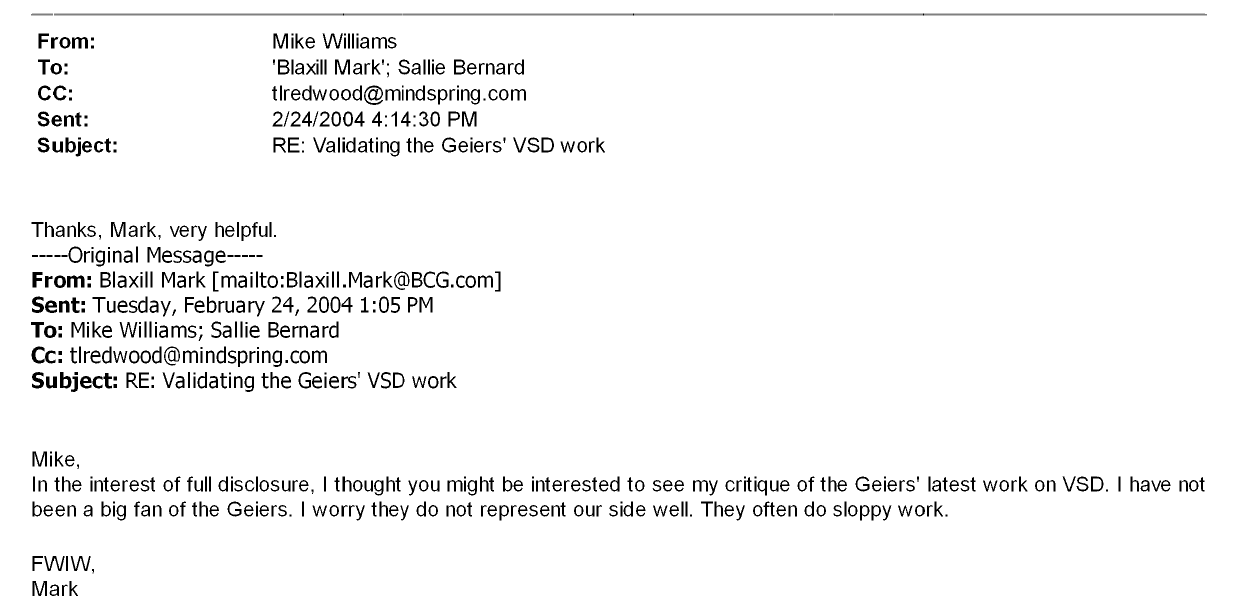
Mark Blaxill on the Geiers: they do sloppy work

13 Oct

Mark Geier and, more recently, his son David have been active promoting autism as vaccine injury for over 10 years (Mark Geier has been active as an expert in, and been criticized for his lack of quality work, the vaccine court on non-autism issues for about 20 years). They have written multiple papers, ranging from bad to worse, attempting to argue the case that vaccines (and especially thimerosal) are a primary cause of autism.

There are multiple discussions over the years of the Geiers here on Left Brain/Right Brain, Respectful Insolence as well as many other places. The best work was done by Kathleen Seidel at Neurodiversity.com, but due to a server crash much of that content is not readily available. (although it is worth searching for the cached versions or the versions on the Wayback Machine).

The work of the Geiers is so poor that it has always been a wonder to me that no criticism has come from anyone promoting the idea that vaccines caused an epidemic of autism. It isn’t that those promoting the vaccine-epidemic idea are not bright, leaving me wondering if they are too biased by their beliefs or just unwilling to speak publicly against an ally. But, recall, these are the same people who closed ranks around Andrew Wakefield in the face of clear and proved ethical violations.

If we are to believe Jake Crosby, former writer for the Age of Autism blog, it appears that the tacit approval of the Geiers has, at least in part, been a case of “circle the wagons”. I.e. people defending an ally over speak their opinions. Mr. Crosby has blaxillwilliams and quotes more emails where Mark Blaxill (former board member of SafeMinds and a long-time proponent of the idea that mercury in vaccines are a primary cause of autism) expresses his views about the Geiers to Mike Williams (attorney involved representing the families in the Omnibus Autism Proceeding).

In an email image on Mr. Crosby’s blog, Mr. Blaxill is reported to have stated:

In the interest of full disclosure. I thought you might like to see my critique of the Geiers’ latest work on VSD. I have not been a big fan of the Geiers. I worry they do not represent our side well. They do sloppy work.

In another email (quoted by Mr. Crosby, the link to the original is nonfunctioning) quotes Mr. Blaxill as stating:

“As to the Geiers, I may be a bit of a minority voice here, but I worry very much that they can do our cause more harm than good. They are not very good scientists, write bad papers (both writing badly and reporting in sloppy fashion) and attract too much attention to themselves as individuals. In this last regard, they don’t show nearly as well as Andy Wakefield but they’re trying to play the same role. Frankly, if I were on the other side and were asked to critique their work, I could rip it to shreds. I’m surprised they haven’t been hit harder. So I think you are wise to diversify.”

Mr. Crosby’s stance is that this constitutes “interference” in the Omnibus Autism Proceeding. I.e. Mr. Crosby seems to imply that the Geiers are not sloppy scientists whose work is poor, but that the Geiers should have been allowed a more active role in the Omnibus.

In this case I find myself agreeing, in part at least, with Mr. Blaxill. The work by the Geiers is poor. Where I don’t agree is Mr. Blaxill’s decision to hold back on making those statement public. Not just because it’s hard to take the stance that one is a only “…interested in the quest for the truth” when one holds back on key information like an entire critique of the Geiers’ VSD paper. No. It goes deeper than that. The Geiers’ junk science went beyond promotion of the idea that thimerosal is a primary cause of autism. The Geiers ran a clinic for many years. Mark Geier was a licensed physician, David Geier worked in the clinic (and has been accused of practicing medicine without a license). Through their papers and their talks at autism parent conventions like AutismOne, the Geiers became well known. One of the “brand name” autism clinics. They reached this level of respect within their community because no one within that community dared to speak out.

I’ve noted on Left Brain/Right Brain many times before that these parent conventions differ markedly from real science conferences in that no one ever seriously challenges the speakers. They can present almost any theory or idea, especially if they tie it to autism as vaccine injury, without anyone standing up and saying, “that makes zero sense”. These aren’t science presentations, they are advertisements. It would be interesting to see how many of these conventions Mr. Blaxill attended and yet remained silent on the “sloppy” work that could be “ripp[ed] to shreds” that the Geiers presented. Instead, parents were presented a view that the Geiers were good scientists who suffered unjust criticism for their “brave” stance on vaccines.

The Geiers were promoters of chelation as a treatment for autism. Not only does chelation have no scientific basis to be an autism treatment, a study just out this week using rodents states that chelation could be harmful if there is no real heavy metal toxicity:

Finally, we also found that succimer treatment produced lasting adverse neurobehavioral effects when administered to non-lead-exposed rodents, highlighting the potential risks of administering succimer or other metal-chelating agents to children who do not have elevated tissue lead levels. It is of significant concern that this type of therapy has been advocated for treating autism.

It is highly likely that Mr. Blaxill would disagree with the statement that chelation has no good scientific basis as a treatment for autism. He’d be wrong, but that’s been covered over and over before. The Geiers moved on from standard chelation to stranger, more dangerous therapies. As an aside, if chelation was a successful treatment one has to wonder why the Geiers were prompted to move on to using Lupron as an autism treatment. Lupron is very serious medicine and it shuts down sex hormone production in the body. Why Lupron, one might ask? The Geiers convinced themselves (or convinced themselves that they could pass off this explanation) that mercury bound itself to testosterone in the brain, making it hard to chelate. They cited a paper showing that if one heats testosterone and mercury salts in benzene, one could form these mercury/testosterone complexes. They actually claim (yes, they tried to patent this idea to make money off it) that this paper shows that “It is known in the art that mercuric chloride binds arid forms a complex with testosterone in subjects”. The “subjects” are beakers of benzene, not animals and not people. Add to that the lack of an explanation of how shutting down hormone production would break up these complexes. The Geier “science” supporting Lupron would be laughably bad if it wasn’t used to subject disabled children to Lupron injections.

Lupron clearly has no basis as an autism therapy. In fact, the “lupron protocol” played a major part in Mark Geier losing his medical licenses. One has to ask, how did the get such traction for such an obviously bad idea? For one thing, the Geiers were considered respected scientists in the vaccine injury/alternative medicine autism community due to their previous and ongoing work trying to link thimerosal and autism. Work which Mark Blaxill considered “sloppy” and worthy of being ripped to shreds. But instead of sharing his views on the Geier papers with the public, Mr. Blaxill shared them privately within his own circle.

It’s worth noting that the email quoted above was written before the “Lupron Protocol” was developed. We don’t know if Mr. Blaxill was alarmed by the emergence of the “Lupron Protocol”. I can’t find where he spoke out against it. We can see that his blog (under a different writer) promoted the idea as “MERCURY, TESTOSTERONE AND AUTISM – A REALLY BIG IDEA!“. Mr. Blaxill doesn’t seem to have commented there. For all the papers the Geiers have published, Mr. Blaxill only mentions them once in his book “Age of Autism. But as we’ve seen, tacit approval (silence) may not be the same thing as real approval.

Mr. Blaxill had the courage to testify before a congressional hearing last year. A hearing where the politicians had been lobbied in advance to be favorable to his cause. When it came to disagreeing with one of his allies, that courage was lacking. He allowed “sloppy” science from an ally to go unchallenged. An example of the fallout of such a decision, in my opinion had he stood up he could have slowed or even stopped the “Lupron Protocol”, a therapy which in my opinion amounts to the abusive treatment of disabled children in an uncontrolled and unapproved experiment.


By Matt Carey

Demonstration tomorrow at DisneyLand

9 Oct

Late notice, I know, but I just got an email that a demonstration is scheduled for DisneyLand tomorrow to protest the fact that they are discontinuing the special needs passes.

This from Facebook:

Demonstration and Petition Delivery

Tommorrow, Wed, Oct. 9th at Disney 7-11
10:00 am

611 W Katella Ave
Anaheim, CA 92802

Meet up with your signs, your shirts and your children (only if it will not be upsetting, disruptive or dangerous to them.

I just spoke with ABC News and they intend to show up.
Anaheim Petition is being printed now (we still dont have a Fl person to delivery other copy :/)
SHARE

Per the facebook page, they have 4,000 pages of signatures for the petition. Here is box 1:

box one of the petition

I wish I could be there. Back in the day I worked at DisneyLand. Spent many a day and night in the park. It’s been great for our family to be able to make use of the special needs passes. Without them we just couldn’t do DisneyLand. It’s $400 minimum to go and we only get a few hours. The new system they’ve proposed wouldn’t work for us.

By Matt Carey

No, the thimerosal in the flu vaccine does not explain why autism rates did not go down

6 Oct

Surprisingly enough, there are still people promoting the idea that the rise in autism diagnoses observed over the last decades was caused by thimerosal in vaccines. The original argument was this–vaccines were added to the vaccine schedule in the 1990’s and with them the infant exposure to thimerosal increased. Concurrent with this rise in infant thimerosal exposure was a rise in autism diagnoses. Add to this a poorly concocted argument that autism resembles mercury intoxication and you have the basis for the mercury hypothesis.

Thimerosal was phased out of infant vaccines over 10 years ago. Thus, if the thimerosal hypothesis were true, reported autism rates should be declining by now. As far back as 2005 David Kirby (whose book “Evidence of Harm” played a major role in promoting the mercury hypothesis) acknowledged this point in a statement

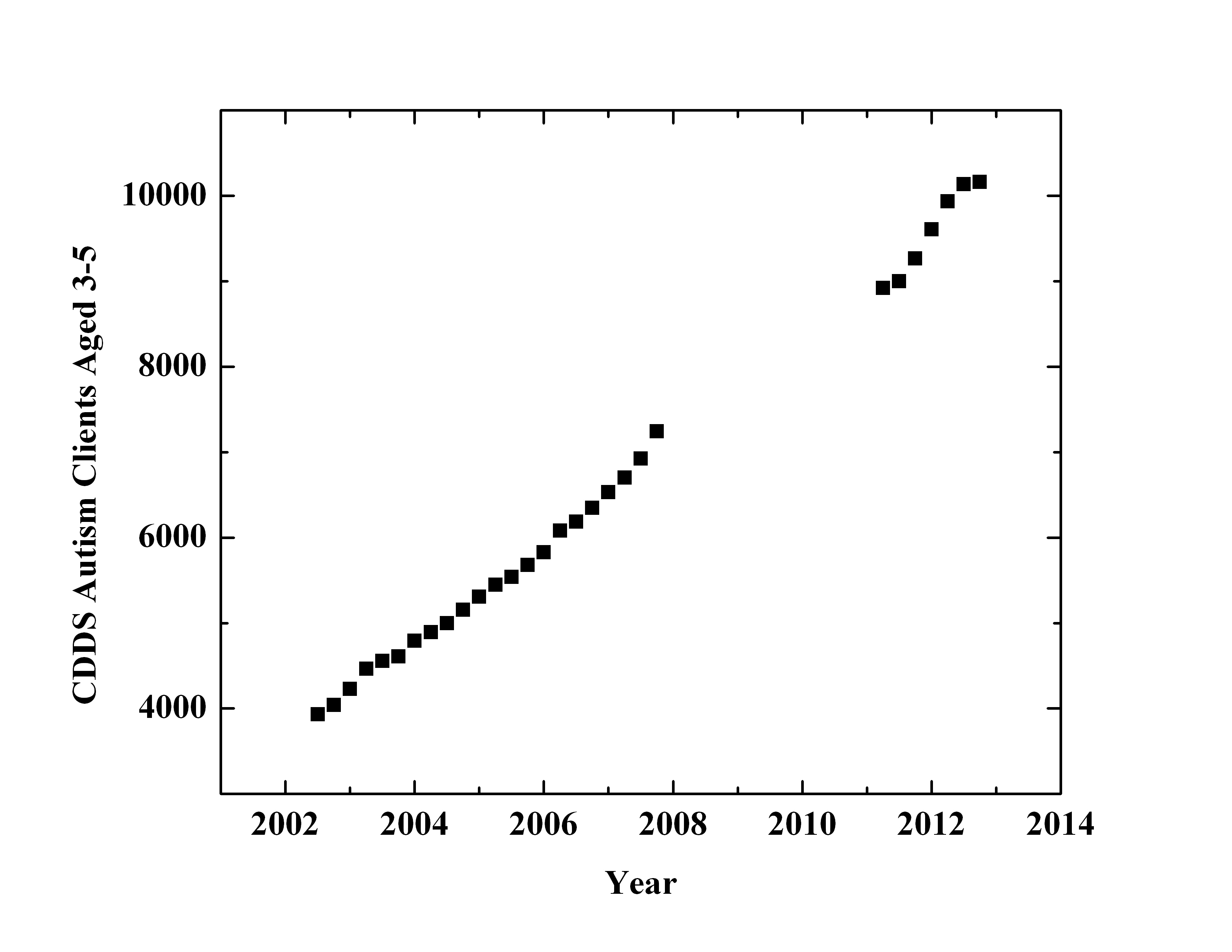
If the total number of 3-5 year olds in the California DDS system has not declined by 2007, that would deal a severe blow to the autism-thimerosal hypothesis.

It’s 2013. Autism rates in California have not declined. Not in Special Education. Not in the CDDS roles. And, yes, we are six years past the 2007 deadline that David Kirby gave us.

To be specific, let’s use the same method that David Kirby and others used to claim a thimerosal induced autism epidemic in the 1990’s (namely the California DDS client count–which not a good method, by the way). Autism “rates” have gone up by over 150% since thimerosal was phased out of infant vaccines. The age 3-5 bracket had about 4000 children in 2003 and is currently over 10,000.

CDDS 3-5

So we have more kids in California receiving services under the autism label than when thimerosal was in vaccines.

This is but one in a huge list of reasons why the thimerosal hypothesis doesn’t work.

But let’s go back in time a bit. Not so long ago one would hear proposals that we go back to the vaccine schedule of the early 1980’s when, it is claimed, the autism rate was 1 in 10,000. Fewer vaccines, less thimerosal, less autism. So goes the logic.

Generation Rescue, in fact, used to recommend the 1983 schedule as one of their alternative schedules

Turn back the clock
Comment: This is the schedule from 1983. If it worked for kids then, why doesn’t it work for kids now?”

Does it make sense to go back to the 1983 schedule? No. Why? OK a lot of reasons, but let’s focus on the fact that infants were exposed to more thimerosal in the 1980’s than today. Infant vaccines have no or only trace amounts of thimerosal.  So if thimerosal were the (or even a single) primary cause of autism risk, we would see autism rates lower today. To not only 1990’s levels, but to something like 1980’s reported levels. Assuming that the reported rates in the 1980’s were an accurate count of how many autistics there were then (a bad assumption but it’s the one they use).

To recap–Infant thimerosal exposure from vaccines peaked at nearly 200 micrograms in the 1990’s, up from about 100 micrograms in the 1980’s and is now less than 10 micrograms. And autism rates have not declined at all. Much less to 1980’s levels.

Once anyone says this the instant answer is that there is still thimerosal in some influenza vaccines. This, they say, is why autism rates have not declined. (note that thimerosal containing vaccines, including influenza vaccines, are banned in California for infants and pregnant women…and autism “rates” have continued to climb here).  

For completeness sake, let’s consider a kid who gets the maximum exposure to thimerosal from vaccines. I.e. a non California kid.  A kid who turns 6 months (the earliest age they will give a flu vaccine to a kid) during the flu season.  That kid will get 2 vaccines in the first year (6 and 7 months) then another influenza vaccine each year thereafter. Each with 25 micrograms of mercury from thimerosal. How does the thimerosal exposure compare to the 1983 schedule?  Take a look for yourself (exposures in micrograms of mercury from thimerosal):

1983 schedule 2013 schedule
DPT Inluenza
2 months 25
4 months 25
6 months 25 25
7 months 25
Total by 1 year 75 50
18 months 25 25
Total by 2 years 100 75
30 Months 25
Total by 3 years 100 100

So by age 3, the exposures are the same.  Except that the kid of today gets the thimerosal later and more spread out over time.  As an aside–most people who talk about the rise in thimerosal exposure during the 1990’s neglect to point out that the cumulative exposure in the 1980’s was already 100 micrograms. I.e. the “safe” level was significant.

If thimerosal were the driving force behind the rise in autism diagnoses, we should be back to 1983 levels, misrepresented by those claiming an epidemic as 1 in 10,000.  Instead we are at 1-2%.  The “rates” didn’t go down.

By this point the proponents of thimerosal are basically screaming, “you are forgetting the vaccines recommended to pregnant women!” No, I just put that off until now.  Sure, the influenza vaccine is recommended for pregnant women, but as the CDC notes:

Prior to 2009, influenza vaccination levels among pregnant women were generally low (~15%) (5,9).

So, from about 2000 to 2009 there wasn’t a big increase (or even a large part of the population) getting influenza vaccines while pregnant, nor were their children getting exposures higher than those in the 1983 schedule.

Take a look at that graph for California administrative autism prevalence again. Between 2002 (after the drawdown of thimerosal in vaccines) and 2012 the autism count doubled. Thimerosal exposure was down. A lot. Below 1990’s “epidemic” levels. Back to the 1983 “worked for kids then” levels. But autism “rates” continue to climb.

The people still pushing the idea that thimerosal is a (or even the) primary cause of autism are not unintelligent. We are talking about college educated people. Ivy league schools. A former journalist, an intellectual property expert and more. There is no math above. It’s all quite simple and straightforward. It uses the exact same logic and methodology they used to promote the idea that mercury causes autism. This is where intellectual honesty and basic integrity should kick in and get people to suck it up, admit their mistakes and start repairing the harm they have caused.

I’m not holding my breath.

By Matt Carey

Notes from the Field: Electronic Cigarette Use Among Middle and High School Students — United States, 2011–2012

25 Sep

A while back I wrote about the hypocrisy of Jenny McCarthy, formerly anti-toxin, touting smoking through her paid gig with an e-cigarette company. “All the fun and none of the guilt of having a cigarette” she says in one ad. Smoking=fun. And sexy.

I wasn’t aware of the e-cigarette defenders out there when I wrote the article. But when the site got a lot of traffic I did something I almost never do, I checked the links that were drawing people to the site. I found discussions like “go fill up the comments” and more from e-cigarette defenders.

And fill up the comments they did.

One theme came up again and again: there’s no evidence that American youth are being drawn to e-cigarettes. There were more themes, including clear lying by e-cigarette defenders.

Now there is. A CDC MMWR came out recently Notes from the Field: Electronic Cigarette Use Among Middle and High School Students — United States, 2011–2012. My guess is that the e-cig defenders will conveniently leave this out of their faux-knowledgeable online defenses of their passion.

E-cigarette experimentation and recent use doubled among U.S. middle and high school students during 2011–2012, resulting in an estimated 1.78 million students having ever used e-cigarettes as of 2012. Moreover, in 2012, an estimated 160,000 students who reported ever using e-cigarettes had never used conventional cigarettes. This is a serious concern because the overall impact of e-cigarette use on public health remains uncertain. In youths, concerns include the potential negative impact of nicotine on adolescent brain development (4), as well as the risk for nicotine addiction and initiation of the use of conventional cigarettes or other tobacco products.


By Matt Carey

Yes, that $29,800 donation is going to Congressman Issa too

15 Sep

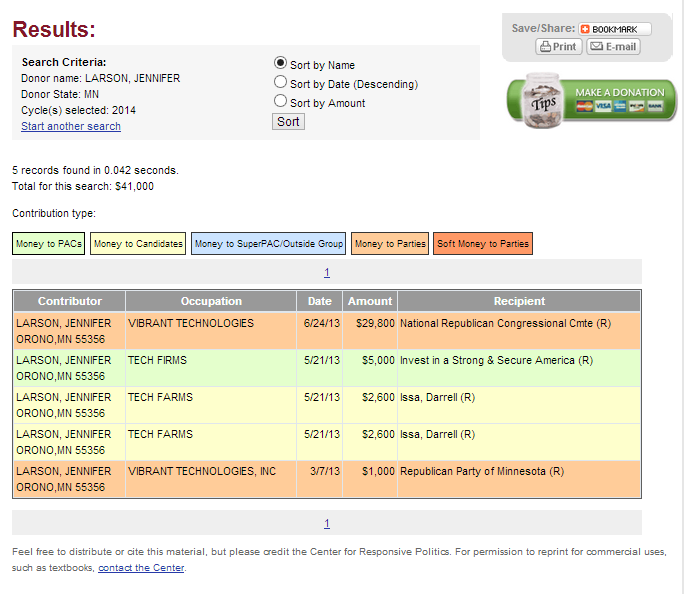
I recently wrote about what appears to be another hearing by the U.S. congress’ Committee on Oversight & Government Reform. If the internet chatter is to be believed, this hearing will be on the National Vaccine Injury Compensation Program. I also noted that internet chatter was pointing to $40,000 in donations made by one Jennifer Larson to the chair of the Oversight Committee. I could find $40,000 in donations from Ms. Larson this year, but I didn’t see the direct connection of the bulk of that amount ($29,800) to Congressman Issa. As I stated in One year and $40,000 later and another hearing:

I found a total of $40,000 donations to Congressman Issa, his PAC and the Republican National Committee though Ms. Larson and her company Vibrant Technologies (click to enlarge):

Larson-OpenSecrets

The bulk went to the Republican National Committee. I’d love to see what, if any, arrangements the RNC has to support Issa with those funds.

Well, I found out about the donation to the Republican National Committee. The Federal Elections Commission shows that that $29,800 donation was earmarked: JFC ATTRIB: DARRELL ISSA VICTORY FUND

larson RNC

Looks to this observer like those funds are going to support Congressman Issa through the “Darrell Issa Victory Fund“.

So we have funds donated to

Invest in a Strong and Secure America ($5,000) Darryll Issa’s political action committee.

Two donations of $2,600 to Darryll Issa directly

and $29,800 to the Republican National Committee, apparently to be used by the Darryll Issa Victory Fund.

As noted by frequent commenter lilady, Congressman Issa appeared at the AutismOne parent convention this year.

By Matt Carey

One year and $40,000 later and another hearing

14 Sep

Last year the U.S. Congress’ Committee on Oversight & Government Reform held a hearing. The buzz on the web was that this prompted by lobbying by people and groups who promote the idea that vaccines have caused the rise in autism diagnoses. In other words, the hearing was supposed to be a hearkening back to the “good old days” when the Committee under Dan Burton held hearings promoting the idea that vaccines cause autism. Instead, the hearing became “1 in 88 Children: A Look Into the Federal Response to Rising Rates of Autism“. The hearing originally did not include autistic representation but, after a phone/fax/email campaign, that changed. Ari Ne’eman of the Autistic Self Advocacy Network and Michael John Carley of GRASP were invited to speak. The Committee then were presented with the false dichotomy of “Parents who believe in the vaccine epidemic” vs. “Autistics who don’t and want a focus on improving the lives of autistics”. Also a long session where Members of Congress berated government public health employees.

All in all a waste of my tax dollars, if you ask me.

The people who lobbied for the hearing apparently were not pleased with various aspects of the hearing.

The buzz has been building that another hearing is in the works. We were told that $40,000 had been donated the Political Action Committee (PAC) for the chair of the Oversight committee, Darryl Issa. The original source for that information (Patrick “Tim” Bolen) is far (far, far, far) from reliable. Also, there are limits on campaign donations and it seemed unlikely to me that $40k could be donated to his PAC. But, with the chatter rising on the hearing to the point that people are claiming it is scheduled for November, I thought I’d check.

The donations were reported to have been made from Jennifer Larson, who is with the tiny “Canary Party”. Tax documents indicate that Ms. Larson is a large financial backer of the Canary Party. Searching for what donations Ms. Larson has made (using OpenSecrets.org, the Center for Responsive Politics) I found a total of $40,000 donations to Congressman Issa, his PAC and the Republican National Committee though Ms. Larson and her company Vibrant Technologies (click to enlarge):

Larson-OpenSecrets

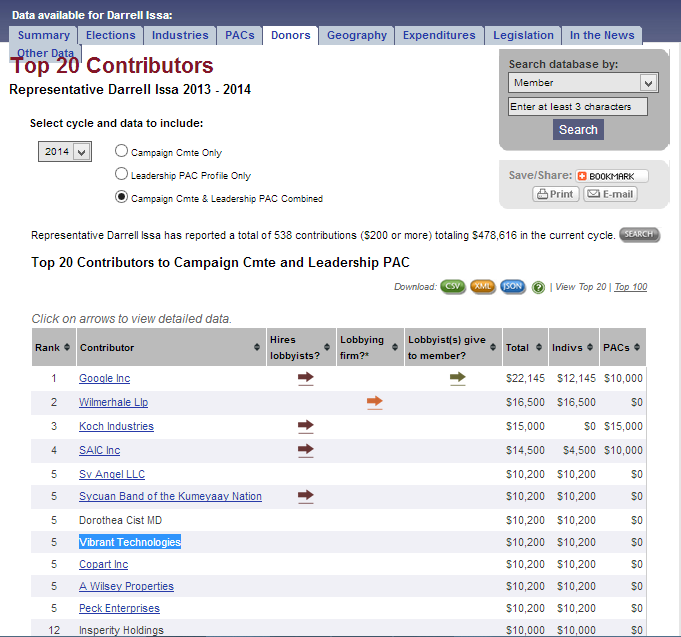
The bulk went to the Republican National Committee. I’d love to see what, if any, arrangements the RNC has to support Issa with those funds. If you think that the $10,200 given directly to ISSA and his PAC is not enough to get noticed, keep in mind that this is the 5th highest amount given to the Congressman this year (click to enlarge):

vibrant

Ms. Larson is quoted in a press release:

“We are thrilled that Rep. Darrell Issa will be holding a second round of vaccine hearings this fall in the Committee on Oversight and Government Reform, to examine just what is happening in the VICP,” said Canary Party President Jennifer Larson. “We are eager for Congress and the American people to see just how far the program has strayed from what it was intended to be when Congress put it in place in the 1980s. It has failed families and become nothing more than a tool to protect vaccine makers and cover government malfeasance in the vaccine program, to the detriment of countless children.”

Notice that the first hearing has been redefined. It wan’t about autism. I suspect in her view it never was. And that is sad. Last year’s hearing and the proposed hearing this year are about vaccines.

Last year’s hearing was preceded by donations from Gary Kompothecras (a Florida chiropractor) to Congressman Issa. Mr. Kompothecras was pictured at the hearing. If internet reports are to be believed, it appears that Mr. Kompothecras is part of the groups that split after the hearing last year. He has not donated this year to Congressman Issa or others on the committee. He and his wife did donate last year, about the time that it was reported that Congressman Issa agreed to hold the hearing.

If the buzz is correct, a hearing will be held soon. It won’t be about autism (and, thus, parents can be in the spotlight without sharing it with those inconvenient autistics). But, as we’ve seen, last year’s hearing wasn’t about autism either, right?

Did last year’s hearing have any impact on the lives of autistics? Can I say that my kid will have a better future because of that hearing? No. Absolutely not. Has congressman Issa joined the Congresional Autism Caucus? No. Has he sponsored or supported autism-relevant legislation? No. We have three bills, stalled in committee, one of which is a vaccine-study bill. None have his support.

And this year’s hearing will be even less relevant.

By Matt Carey

Autism Group Petitions CBS News: Take Down Dangerous Video

6 Sep

The Thinking Person’s Guide to Autism started a change.org petition: CBS News: Take down the video Behind the Tragedy: Mother Murders Autistic Son

The petition has over 1500 signatures as of today. Please read and consider signing. If you disagree with the way CBS portrayed the murder and the murderers of Alex Spourdalakis, please consider sending an email to CBS at cbsaudiencenews@cbs.com.

REDWOOD CITY, Calif. — Autistics and caregivers want CBS to remove a news video which frames autism as an excuse for the murder of a child.

The CBS News video, Behind the Tragedy: Mother Murders Autistic Son, frames autism as an excuse for the murder of a child, Alex Spourdalakis, by his mother & caregiver. CBS should not be promoting what The Autistic Self-Advocacy Network’s Ari Ne’eman described as “a dangerous ideology that preaches that people are better off dead than disabled.”

Even though Mr. Ne’eman and his quote were included at the end of the video, the bulk of the video tries to justify the unjustifiable — Alex’s murder — and curries sympathy for his killers. Specifically, CBS reporter Sharyl Attkisson says, “His murder might be just another unexplained tragedy, if it were not for a documentary following his family in the months leading up to his death.” This is unacceptable.

The petition can be found at cbs-news-take-down-the-video-behind-the-tragedy-mother-murders-autistic-son-2

CBS News can be reached at cbsaudiencenews@cbs.com.

The Thinking Person’s Guide to Autism is a book, website, and Facebook community run by Shannon Des Roches Rosa, Jennifer Byde Myers, Emily Willingham, and Carol Greenburg. Each woman writes, educates, and advocates within the autism communities.


By Matt Carey

Whitewashing the brutal murder of Alex Spourdalakis

31 Aug

Alex Spourdalakis was a 14 year old autistic who was brutally murdered by his mother and another caregiver. Among those with extraordinary needs, Mr. Spourdalikis had extraordinary needs. Shortly before his spent a considerable amount of time in a hospital, reportedly restrained the whole time. So far the only real details from that time have come from his mother and caregiver who were the perpetrators of the murder. The family was offered help. When someone from the local Autism Society asked the mother what she needed “[Ms.] Spourdalakis said all she wanted was an attorney” and one was found for the family. Another news report states that “Department of Children and Family Services spokesperson says that Dorothy Spourdalakis was offered services, but she refused.” Mr. Spourdalakis’ case became well known, especially within the online autism communities. The family received the services of Andrew Wakefield, whose career has taken him into reality TV film making. Mr. Wakefield’s team helped to publicize the situation and followed the family to New York from Chicago as they sought help from Mr. Wakefield’s former colleague, the gastroenterologist Arthur Krigsman. It is not clear what treatment Krigsman prescribed. Sometime after this, the mother and caregiver began to conspire in a plan to murder Mr. Spourdalakis. When the carried out their plan, they poisoned Mr. Spourdalakis with sleeping pills. When this did not work quickly enough, the mother and caregiver stabbed him. Not once, not twice, but four times, including two stabs to the heart. When even this proved not fast enough, the mother and caregiver slit his wrist. Slit so deeply that reportedly his hand was nearly severed from his arm. When Mr. Spourdalakis finally passed, the mother and caregiver turned the knife on the family cat. After cleaning the knife, they returned it to it’s place in the kitchen. The mother and caregiver then took large doses of sleeping pills, the method they had just found to be ineffective in the murder of Mr. Spourdalakis. The father (who was divorced from the mother and living elsewhere) and an uncle tried to reach the mother that day and, finding that they could not reach her, came to the apartment. When the door was not answered, the uncle reportedly kicked it down. This action, in my view, indicates that the danger posed to the young Mr. Spourdalakis by his mother (who was reported to have started planning the murder a week in advance) was known to his extended family and they were monitoring the mother in an attempt to prevent harm.

As noted above, Andrew Wakefield inserted himself into the story. His joint venture with Polly Tommey, the Autism Media Channel, started collecting film of Mr. Spourdalakis and his mother during the hospital stay. Mr. Wakefield’s intent certainly wasn’t to document the final days of Mr. Spourdalakis. Most likely he was planning a vide similar to that for the trailer he prepared for his proposed reality Show “The Autism Team”. That video shows autistic children in meltdowns, being self-injurious. One specific child is flown from the U.K. to New York to see Arthur Krigsman (just as Mr. Spourdalakis was taken from Chicago to New York to see Krigsman). In the trailer, after visiting Krigsman the child was shown happy, playing, and the parents were shown grateful. As we know, this was not the conclusion of the Alex Spourdalakis story. Whatever Mr. Wakefield and Ms. Tommey had planned for the video they had taken, the “treat bowel disease and everyone is happy” story was not to be. Instead, he has produced a video of the “medical establishment fails family, leading to tragedy” theme. I do wonder how he managed to work that theme around the facts that the tragedy (aka brutal murder at the hands of his mother) came to pass after Mr. Spourdalakis was seen by Mr. Krigsman.

CBS News journalist Sharyl Attkisson picked up the story and aired some of the video Mr. Wakefield’s team collected in Film provides glimpse into life of autistic teen killed by his mother. What is the subject of her story? The victim? The murderers? No. It’s the film. Likely the title of the online article was not chosen by Ms. Attkisson. Whoever did chose it acted poorly.

The written piece starts out with, yes, the mother:

Chicago mom Dorothy Spourdalakis was ordered to be held without bond early this week, on the charge that she and her 14-year-old son’s caretaker, Jolanta Agata Skordzka, murdered her severely autistic son. Alex Spourdalakis was found dead in June in his bed in the River Grove, Ill., apartment he shared with his mother and Skrodzka.

When Ms. Attkisson presents the discovery of the crime scene, she again presents the murderers first, then the victim. The mother and caretaker were “barely alive themselves”. The key point–they were (and still are) alive.

When police found Alex dead at home in June, his mother and caretaker were barely alive themselves after allegedly overdosing him on medicine and stabbing him in the heart before attempting to commit suicide.

The story presents the “balance” of which group failed. Was it the medical establishment or was (as she presents in a brief clip at the end) society’s attitudes about disability and the disabled? She chose this approach rather than checking facts in depth. What options were open to the family? What is the father’s and uncle’s view, as they were apparently worried about the safety of the young Mr. Spourdalakis? What evidence is there that the diagnosis made by Krigsman is accurate. While Krigsman is well thought of in some circles, he is not without his critics nor his own history of possible ethics lapses. Did she search out what supports had been offered to the family? What they had asked for (an attorney, for example, which was provided).

The written article states, “But some in the autism advocacy community take issue with the idea that lack of help is an excuse for murder.”

Really? Only some? And is this somehow limited to the autism community? Ms. Attkisson, what is your position? Is a lack of support an excuse for murder?

But there it is, in black and white, the crux of the story: is lack of help an excuse for murder? The answer is clearly no, it is not an excuse. When did we get to the point that U.S. journalists can be discussing an “excuse” for murder?

What about the lack of help? We have to take Ms. Attkisson’s word that there was a lack of help. Because Ms. Attkisson, investigative journalist, didn’t investigate that question. Instead she presented Andrew Wakefield’s depiction of the story from the murderers. Mr. Wakefield’s word is, well, not good enough for me. People who murder their children and are trying to build a defense are not reliable sources in my opinion. But the word of the accused murderers was enough for Ms. Attkisson. She took the time to investigate the hospital where Mr. Spourdalakis was kept for 2 weeks, but she didn’t bother to look into what resources were available to the family. Was insurance coverage really denied? More importantly, if so, why?

And, yes, she takes Mr. Wakefield’s word for it. She introduces her video segment with the statement that this would be “another unexplained tragedy” if it weren’t for the video he collected.

The story notes:

Dorothy’s suicide note read, in part: Alex will no longer be “treated like an animal” or “subjected to restraints.”

He will no longer be treated like an animal. He met the same fate as the family cat. Even the cat deserved better.

As a human being, I am appalled by this story. I am appalled by the way Ms. Attkisson and CBS have given us a commercial for Andrew Wakefield’s company and failed miserably to do the basic investigative journalism needed.

Much more, as the parent of a child not so unlike Alex Spourdalakis, I am disgusted. A common phrase we hear from parents is “what will happen after I am gone?” What will happen in a world where “caregivers” are excused from murder of their charges? And I know I am not alone in my views, having discussed this with other parents of disabled children. I won’t presume to present the autistic perspective on this, but here is one account:CBS Provides Glimpse into “Documentary” Defending Autistic Teen Alex Spourdalakis’ Killers .


by Matt Carey

Autism, Denmark and again no link with vaccines.

25 Aug

For a while now, I’ve been hoping that someone would publish data on the current state autism prevalence by birth year in Denmark. Denmark has been used for epidemiological studies for autism since their is a national database for health care. Thus, one can obtain a count of all people in Denmark who have been diagnosed with autism. Which is not the same thing as saying they have a count of all people in the country who are autistic. One can be autistic and not be diagnosed, as we will see.

A recent study using the Danish database is Recurrence of Autism Spectrum Disorders in Full- and Half-Siblings and Trends Over Time: A Population-Based Cohort Study. It’s an interesting study and I feel somewhat guilty for pulling the time-trend data out for my own discussion. In short, the study found that if a family has one child who is autistic, the chance for a subsequent child to be autistic is about 7 times higher than for families without an autistic child. This is fairly consistent with many other sibling studies over the years, but much lower than found in the recent baby siblings study out of the MIND Institute. That might be due to the active surveillance used by the team at MIND. I.e. they were actively monitoring and testing baby siblings.

Much more, they conclude:

Although the results from our comparison of recurrence in full- and half-siblings support the role of genetics in ASDs, the significant recurrence in maternal half-siblings may support the idea of a contributing role of factors associated with pregnancy and the maternal intrauterine environment. Finally, the lack of a time trend in the relative recurrence risk in our data suggests that the likely combination of genetic and environmental factors contributes to the risk for ASD recurrence in siblings or that the risk for recurrence because of such factors has not been affected by the rise in the ASD prevalence.

Very interesting–whatever is behind the higher prevalence among younger siblings, it seems to be the same today as 30 years ago.

What’s the overall prevalence of autism in Denmark according to this study? For childhood autism, they report 0.3%. For all ASD’s, 1.2%.

Autism, we are told by those promoting the autism/vaccine link, is unmistakable. Each autism prevalence report is not an estimate, but an accurate count of every autsitic because there is no way to miss an autistic. Back in the day, Rick Rollens was a constant fixture in the news on autism. He was a strong proponent of the idea that one could not miss autism:

WATSON:
Like many parents, Rick is convinced that Russell was damaged by a series of vaccinations. He strongly rejects the idea that the epidemic of autism can be entirely explained by poor diagnosis in the past because numbers have rose over the last few years.

ROLLENS:
Missing child with autism is like missing a train wreck. For us now to now think that somehow we have better identified a child who can’t talk, who has repetitive behaviour. Who makes no eye contact. Who is self- involved and in many cases self-abusive just defies logic.

Mr. Rollens was wrong on two counts (leaving aside his inflammatory and derogatory language). First, autism is not just the child who can not talk, self-involved and self-abusive. Second, yes, a lot of autistics have been missed. We’ve seen that time and time again. Look at the same population at different times and the later study will have found more autistics. An this goes for autistics with intellectual disability, as shown in the recent UCLA/Utah autism followup: “Today’s diagnostic criteria applied to participants ascertained in the 1980s identified more cases of autism with intellectual disability. ”

But, what about Denmark? A study from 10 years ago looked at autism incidence following the removal of thimerosal in Denmark in 1992. Thimerosal and the occurrence of autism: negative ecological evidence from Danish population-based data

In that study they found 956 children born in their study period who were diagnosed with autism by 2000:

A total of 956 children with a male to female ratio of 3.5:1 had been diagnosed with autism during the period 1971–2000.

The current Denmark study included individuals diagnosed until the end of 2010. I.e. there were 10 more years of followup. In those 10 years a lot more people were diagnosed. Where there were 956 diagnosed with autism by 2000 (for birth years 1971 to 2000), 2321 were diagnosed by 2010. That’s an increase of 240%. And the new study focused on birth years 1980 to 1999. I.e. the entire 1970’s birth cohort is not included in this count, and they still found over twice as many autistics. Where were they in 2000, when the previous study was performed? Living in Denmark, not identified as autistic.

There are a few factors which are likely behind this increase, but here we have a great example of “increased awareness” affecting autism prevalence.

And, those numbers were for childhood autism. For ASD, the increase is even larger. 10,377 Danes had an autism spectrum disorder diagnosis (for birth years 1980-1999) in the new study (the previous study included none). That’s a whopping 1080% increase. Again, there are a few reasons for this (including the increased awareness above), but here’s what “expanding the definition” does to autism.

Those increases would be an “epidemic” to some if it weren’t for the fact that those autistic Danes were there all along. They just weren’t diagnosed in 2000.

For many years, groups touting the idea that vaccines cause autism have pointed to Denmark as part of their argument. Denmark uses fewer vaccines than the U.S.. Generation Rescue used to have this on their website discussion of vaccines:

Comment: Denmark is a first world country based in Western Europe. Their schedule appears far more reasonable than ours. They have also been reported to have a much lower rate of autism than the U.S. Do they know something we don’t?

What was that Danish vaccine schedule that Generation Rescue recommended?

DTaP at 3, 5 and 12 months
Hib at 3, 5 and 12 months
IPV at 3, 5 and 12 months, plus 5 years
MMR at 15 months and 12 years

No mercury (Denmark phased that out in 1992). No birth dose of Hepatitis B. Fewer vaccines overall than in the U.S.. And the same autism prevalence of about 1%.

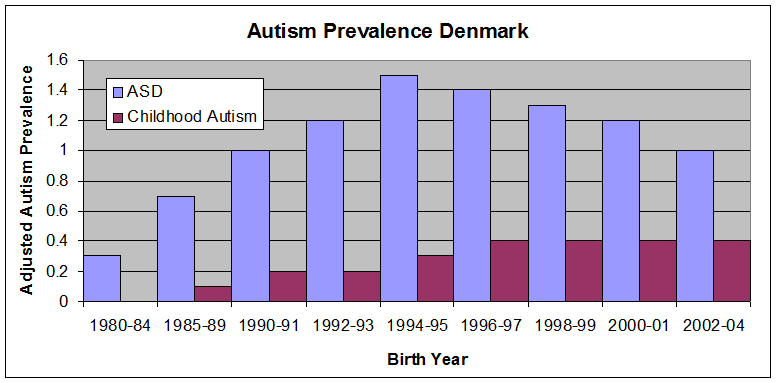
If you dive into more details, it gets even worse for the vaccines and/or thimerosal cause autism argument. Let’s look at the prevalence as a function of birth year for childhood autism and ASD from the recent study:

AutismPrevalenceDenmark

Consider this statement from a previous study:

This means that children who followed the full vaccination program during the period 1961–1970 had received a total of 400 g of thimerosal or 200 g of ethyl mercury by the age of 15 months and during the period 1970–1992 they had received a total of 250 g of thimerosal or 125 g of ethyl mercury at 10 months of age. In March 1992 the last batch of thimerosalcontaining vaccine was released and distributed from Statens Serum Institut in Denmark.

The thimerosal exposure was higher prior to 1992 than after. But the prevalence of both childhood autism and ASD is higher after the removal of thimerosal. This is the same result as shown in the 2003 study. The number of vaccines seems to be constant over this time period, so number of vaccines/aluminum/too-many-too-soon or other arguments don’t work either.

How about taking just a single year. The prevalence for ASD in 1996-97 was 1.4%. What is the autism prevalence in the U.S. for that year? To answer accurately, I’d contend we need a count today, not an old one. But people promoting the idea that vaccines cause autism take the CDC reports as absolute measures of autism, comparing each report and telling us all about the epidemic. So, let’s take the CDC number for kids born in 1994: 0.8%. That study was reported in 2009.

So, we have 1.4% in Denmark and 0.8%, nearly half the Danish prevalence, in the U.S.. Denmark had no thimerosal, no Hepatitis B shot (birth or otherwise), fewer vaccines and less aluminum exposure. And much higher reported autism prevalence.

Oddly enough, even though there have been many prevalence studies out of Denmark, Tomljenovic and Shaw didn’t include Denmark in their study “Do aluminum vaccine adjuvants contribute to the rising prevalence of autism?” My guess is that Denmark didn’t fit their conclusion then, and, like Iceland, would make their analysis fall apart now. It is even more odd that Tomljenovic and Shaw didn’t use Denmark as Denmark was used in a faux-study put out by Generation Rescue. In AUTISM AND VACCINES AROUND THE WORLD: Vaccine Schedules, Autism Rates, and Under 5 Mortality Someone at Generation Rescue made the first attempt at the sleight of hand of comparing the autism prevalence in various countries vs their vaccine schedules. At that time, 2009, Generation Rescue claimed that the autism prevalence in Denmark was 1 in 2,200, misrepresenting the 2003 study discussed here. The raw prevalence in this 2008 study was 0.65% or about 1 in 153. That value didn’t fit the thesis that the Generation Rescue author wanted to convey.

One argument found on the internet is that the 2003 Denmark paper fudged the results by clipping the last years off the data presented. An email involving people involved in the study is quoted as saying, “But the incidence and prevalence are still decreasing in 2001“. Oh, my, we are told, the autism prevalence and incidence actually went down after the removal of thimerosal!

But, it didn’t. The prevalence of childhood autism (basically what was studied in the 2003 paper) in Denmark is flat from birth cohorts 1996-2004. Flat. The prevalence of ASD’s do see a decline. That must be it! Evidence that thimerosal was causing autism in Denmark! But it isn’t. The prevalence of ASD in 2003-04 is the same as that in 1990-91, before thimerosal was removed. Why does the ASD prevalence go down? We can’t say for sure, but my strong suspicion is that it’s the same reason why the authors in 2003 were seeing a decrease: too few years of follow up. Autistic kids are typically diagnosed earlier than those with other ASD’s, but the average age was about 5 in Denmark in 2003 (as I recall). ASD kids can have an average age of diagnosis of 8. Recall that the recently released study followed kids up to the end of 2010. It’s no surprise to me that the estimated prevalence for ASD kids born in 2002 is lower than that for kids born in 2000 in this study. And this is consistent with the flat prevalence for kids with childhood autism diagnoses, as they are typically diagnosed earlier and 8-9 years would be enough to find the majority of the autistics in that population.

What about the idea that there’s a “changepoint” in the autism prevalence in Denmark and California pointing to some event in the late 1980s that’s contributing to autism prevalence? For one thing, the present study notes that the recurrence risk doesn’t change with time, so that’s good evidence against such an idea. There is no changepoint in the California data in the 1980’s, as it is exponential and fitting it to two straight lines is just a mistake. What about the prevalence data just released? The data are not finely spaced in birth years, in my opinion, to give a good idea of any “changepoints” in the 1980’s. But there is a changepoint of sorts in the childhood autism data in the 1990’s. The data plateaus at about 1996. But, as already noted, this doesn’t coincide with anything related to vaccines. The ASD prevalence appears to peak at about 1994, but, again, this doesn’t coincide with vaccine events and, I suspect, results largely from lack of follow up for the kids in the later birth years.

How about the MMR vaccine? MMR uptake for young children (MMR1) was basically flat from 1987-1997. Uptake rose somewhat after that. So, during the period that the estimated prevalence was increasing, MMR uptake was basically flat. During the time that the estimated prevalence was either flat (childhood autism) or decreasing (ASD’s), the MMR uptake was increasing. So if we were to play the “correlation equals causation” game, MMR prevents autism. (two notes, preventing rubella infections most likely does prevent some autism and the link above shows a nice example of rubella infections going down after MMR was introduced in 1987. The two points are not linked because most women in Denmark who were infected with rubella before 18 weeks gestation chose abortion, resulting in a low congenital rubella syndrome prevalence).

How about the “fetal cells in vaccines cause autism” argument? It’s one without biological plausibility, but then so was the thimerosal idea. I’d be interested in seeing how the vaccines were produced in Denmark in the 1990’s, but at present, the MMR vaccine there is developed using chicken eggs, not fetal cell lines. And they don’t routinely vaccinate against chickenpox, another vaccine in the U.S. using fetal cell lines. It looks like at least as far back as 1999 they were using egg-based vaccine production for MMR.

So, it appears we have a country with no vaccines grown in fetal cell lines with an autism prevalence as high or higher than that in the U.S.. In other words, the “vaccines from fetal cell lines caused the ‘autism epidemic’ theory” also appears to be debunked by the Denmark data.

In case you are looking for correlations with the vaccine program, here’s the history in Denmark.

So, how about the rise in estimated prevalence in the 1980’s. Is it “real”, as in does it represent an actual increase in the fraction of autistics in the population? It’s a good question and one which could be answered by performing a real study of autism prevalence in adults. The sort of study I and others have called for in the U.S., but that most autism-parent advocacy groups have refused to support. Such a study would not only answer the question of the prevalence, but it would give us valuable data on what has led to success and failure among the autistic adult population.

For those promoting the idea that environmental mercury emissions are a factor in the increase of autism rates, if you have data for Denmark, I’d love to see it. In the U.S., environmental mercury emissions dropped by over 50% in the 1990’s.

Lastly, let’s discuss a comment statement one will read or hear. It goes something like “the autism prevalence was 1 in 10,000 in 1980 and it’s 1 in 1,000 today”. This involves a number of sleights of hand. First, the autism prevalence wasn’t 1 in 10,000 in 1980. It was a few in 10,000 (Wing and Gould reported about 5/10,000). Doesn’t sound like a big deal, but when people start taking ratios (it went up a gazillion percent) a factor of 2 or 3 in the denominator makes a difference. Second, this was the estimated prevalence based on the number of autistics diagnosed at the time. As shown above, the childhood autism prevalence estimate for Denmark in the 1980’s increased by 240% in the past decade. This was not a real increase, but better identification. Third, the comparison is between autism (childhood autism, DSM-III autism or some other restrictive definition) vs. autism spectrum disorders. Also shown above was that the prevalence of ASD’s in the 1980’s increased by a factor of 10, increasing only in the past 10 years.

A factor of 10 in the numerator, a factor of 3 or 4 in the denominator and pretty soon you are talking about a big part of the increases observed.

In the end, none of the above arguments are that new. Or, to put it better, none of the vaccines-cause-autism arguments had much real support. The mercury idea has lost much of the support it had 10 years ago in the parent community, but it persists. The aluminum in vaccines idea has risen to try to take the place of the mercury hypothesis, but it is based on the exact same smoke and mirrors. The idea that the increase in autism is due to the MMR has been scientifically dead for years. And, yet, these ideas persist. And they cause harm, both to the community at large and to the autism community.


Matt Carey